
How to Find Medium Heat on a Griddle With the Water Test
This post contains affiliate links. As an Amazon Associate, we earn from qualifying purchases.
Medium heat on a griddle is a surface temperature between 325°F and 375°F (163°C–191°C), confirmed by the water test: droplets sizzle and evaporate quickly without hovering or puddling. This range is for thorough, golden-brown cooking of items like chicken breasts, pork chops, and vegetables over 6–8 minutes per side.
That temperature window isn’t a guess. It’s the operational sweet spot where proteins set without burning sugars, and fats render without smoking. Miss it, and your food steams in its own juices or chars before the center is done.
What follows: the exact water-test result from a manufacturer manual, the commercial kitchen standard for temperature stability, and the cooking times that turn a dial setting into predictable results. You’ll also learn why your location might change the rules.
Key Takeaways
- Use the water test: on medium heat, water droplets sizzle and vanish in 2–3 seconds. If they skate or pool, the temperature is wrong.
- Target 350°F as your default. This is the consensus midpoint for griddles, perfect for burgers, pancakes, and most proteins.
- Commercial manuals define stability as a temperature swing under 30°F over 15 minutes. Your home griddle should hold steady, not cycle wildly.
- Preheat for 15–20 minutes if you have a heavy commercial-style plate. A residential model might need only 5–10.
- Stainless steel griddles oxidize near salt water. In coastal areas, medium heat can feel different as the surface changes.
The Water Test: The Universal Griddle Thermometer
You don’t need an infrared thermometer. A flick of water from your fingertips tells you everything.
The test is simple, but the interpretation is specific. Toss a few droplets onto the preheated surface. Their behavior maps directly to temperature ranges. For medium heat, you’re looking for a rapid, aggressive sizzle with complete evaporation in a couple of seconds. The water shouldn’t ball up and skate across the surface (too hot), nor should it sit and slowly bubble away (too low).
According to the Napoleon Freestyle griddle manual, “Water sizzling and evaporating quickly indicates medium heat.” Low heat shows “puddling and slow evaporation,” while high heat creates “droplets hovering across the surface.”
This manufacturer definition gives you a reproducible standard. The manual for the Napoleon Freestyle F24DFT model uses this exact language. It turns a subjective “sizzle” into a diagnostic tool. If your water isn’t vanishing quickly, your griddle isn’t at medium.
Why does this work? Surface temperature dictates the Leidenfrost effect. Above roughly 380°F, water vaporizes so instantly underneath a droplet that it creates a insulating vapor layer, making the droplet hover. Below 300°F, there isn’t enough energy to flash-boil the water, so it pools and boils slowly. The sweet spot in between is where direct, violent contact happens.
Common mistake: Testing on an unoiled surface right after preheating a griddle. A perfectly dry plate can give a false hover. Always apply a thin coat of oil before the test, it improves thermal contact and mimics cooking conditions.
The Numbers Behind Medium Heat: 325°F to 375°F
While the water test is the field method, thermometers assign the numbers. Medium heat on a griddle lives between 325°F and 375°F.
350°F is the bullseye. This temperature appears consistently in commercial cooking charts. For example, the operational manual for MKG series commercial gas griddles lists 350°F for sausage, bacon, and hamburger patties. It’s high enough to trigger the Maillard reaction (browning) but low enough to cook something through without burning the exterior.
Commercial kitchens don’t rely on guesswork. Their equipment manuals define performance.
The MKG series manual specifies that a griddle’s temperature has stabilized when it “does not change by more than 30°F over a 15 minute time period.” That’s the engineering standard for steady heat.
Your home griddle won’t have that level of control, but the principle is the same. If your surface temperature is swinging 50 or 75 degrees, you’re not cooking on medium, you’re alternating between low and high. This is why preheating a griddle thoroughly matters. A 15–20 minute warm-up for a thick steel plate ensures the entire mass reaches equilibrium, not just the surface.
| Food Item | Target Griddle Temp | Approximate Time per Side (Medium Heat) |
|---|---|---|
| Hamburgers (1/2 lb patty) | 350°F | 6–8 minutes |
| Chicken Breast (6 oz) | 350°F–375°F | 6–7 minutes |
| Pork Chop (3/4″) | 350°F | 5–7 minutes |
| Pancakes | 375°F | 2–3 minutes |
| Salmon Fillet (skin-on) | 350°F | 4–6 minutes |
These times assume a stabilized surface. A cold spot or an under-preheated griddle adds minutes and leads to uneven cooking.
Setting Up Your Griddle Zone
Not every square inch needs to be the same temperature. In fact, zoning is how you cook efficiently.
If you’re only making one item, center it over the burner or heating element. For multiple foods with different needs, create zones. The classic setup is a high-heat sear zone (one burner on high) and a medium-heat cooking/finishing zone (another burner on medium). Some commercial manuals, like the one for Globe griddles, advise setting “adjoining areas… At progressively higher temperatures” to avoid a harsh thermal gradient that warps the plate.
Here is how to build a two-zone setup on a typical two-burner griddle:
- Left side (Primary Zone): Set to medium (350°F confirmed by water test). This is your main cooking area for the bulk of the work.
- Right side (Sear/Finish Zone): Set to medium-high (about 400°F). Use this for initial searing or finishing for crispness.
- Keep a cooler margin: The edges are always cooler. Use this space to hold cooked items or gently melt cheese.
This method prevents the “crowd and steam” problem. You always have a place to move food without dropping the core cooking temperature. It also directly addresses a common sticky griddle issue, overcrowding lowers the surface temp, causing food to release proteins that fuse to the metal.
What to Cook on Medium Griddle Heat
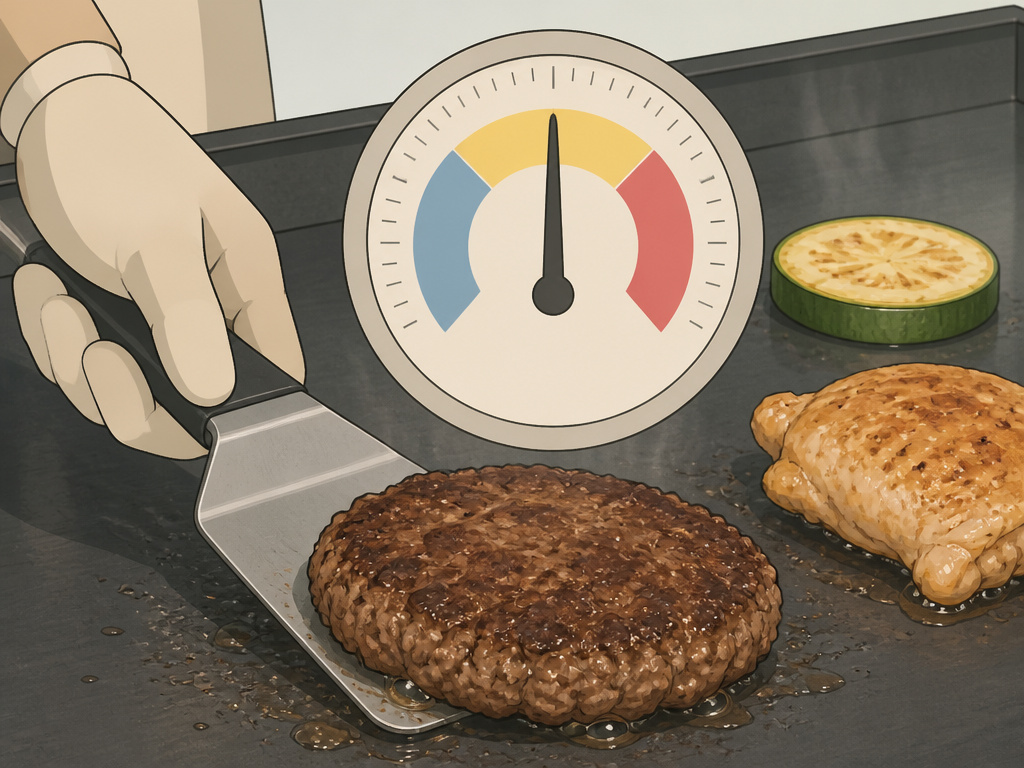
This temperature is your workhorse. It’s for anything that needs to be cooked through with a good crust, not just seared.
The list is long because the principle is universal: medium heat provides enough energy for browning while allowing time for heat to penetrate. It’s ideal for a variety of griddle recipes beyond breakfast. Think boneless chicken thighs, fish fillets, vegetable slices like zucchini and eggplant, smash burgers (after the initial smash on high), and quesadillas.
Where this goes sideways: Using medium heat for thin, quick-cooking items like shrimp or sliced onions. They’ll overcook and turn rubbery or mushy before they brown. Drop those to medium-low.
The Napoleon manual suggests a “Medium – 6 minutes” per side cook time. That’s a solid starting point for a 3/4-inch thick piece of protein. A thicker cut needs more time, but increasing the heat isn’t the answer, you’ll burn the outside. Keep the heat at medium and extend the time, or use a lid (if your griddle has one) to create a mini-oven effect.
If you’re exploring griddle recipes, start any unfamiliar protein or dense vegetable at medium. You can always move it to a hotter zone to finish, but you can’t un-burn it.
The Role of Oil and Surface Maintenance
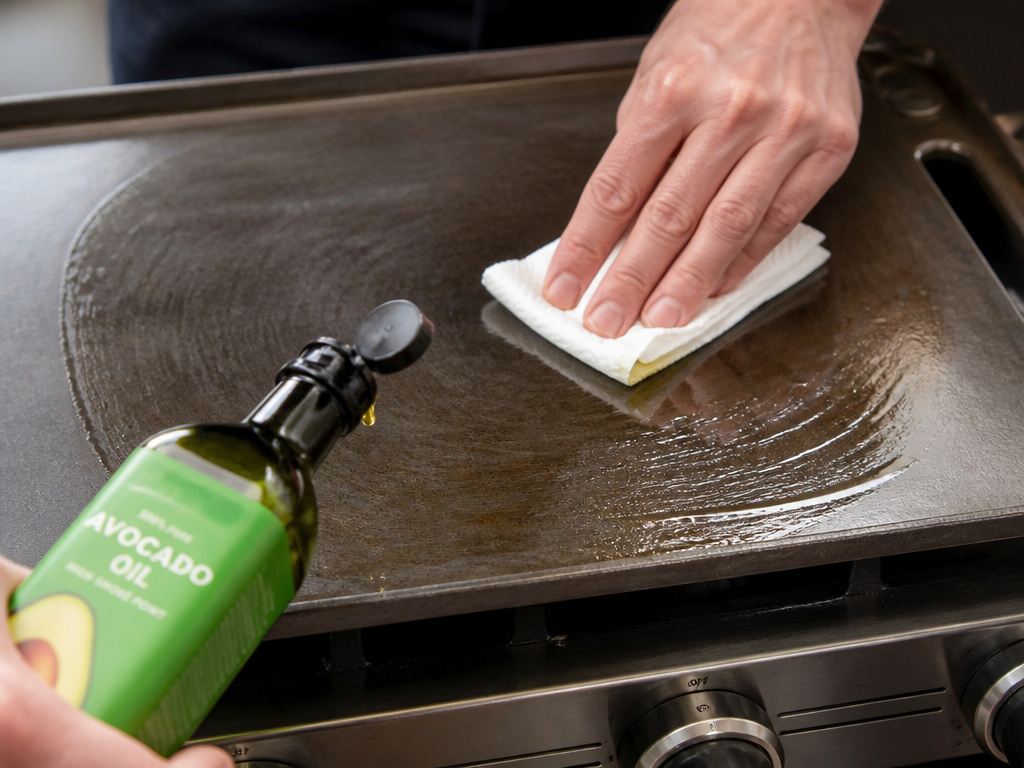
Temperature is only half the equation. The surface condition determines if your food releases or bonds.
On medium heat, you must apply oil before the food hits the plate. A thin, even coat is non-negotiable. It fills microscopic pores, creates a thermal bridge, and forms a barrier. The MKG manual states plainly: “If any product sticking occurs, apply a thin coat of cooking oil to the surface before loading product.”
The type of oil matters. Use a high-smoke point oil like canola, grapeseed, or avocado oil. Butter burns above 350°F, so it’s a finishing fat, not a cooking fat for griddling.
Your surface’s history matters more. A well-seasoned griddle has a polymerized layer that is naturally non-stick. This isn’t just for cast iron. Commercial manuals, like the one from Vollrath, recommend an initial “burn-in” at medium-high for 30 minutes, then seasoning a griddle with “cooking oil, shortening, beef suet, or the like” when warm. That layer protects the steel and makes medium heat cooking consistently reliable.
If you skip proper cleaning and carbon builds up, your temperature readings become meaningless. Carbon is an insulator. The burner might be putting out energy for 350°F, but the cooking surface under the crud could be 50 degrees cooler. Food will stick and cook unevenly. Cleaning a griddle after every use isn’t just about hygiene; it’s about thermal accuracy.
Edge Cases and Adjustments
Medium heat isn’t a fixed universal. Your environment and equipment tweak the rules.
If you own a stainless steel griddle like the Napoleon Freestyle, the manual has a specific warning: “Stainless steel oxidizes or stains in the presence of chlorides and sulfides, especially in coastal regions.” Salt air accelerates oxidation, creating a microscopic patina that changes how the surface conducts heat. Over time, medium heat on a coastal patio might behave like slightly lower heat. You’ll need to compensate by turning the dial a notch higher or seasoning a cast iron surface more frequently if you use that material.
Electric griddles are different. Their heating elements cycle on and off to maintain temperature, which can cause slight fluctuations. When using an electric griddle, wait for the indicator light to show it’s reached temperature, then give it another two minutes to let the plate itself even out. Don’t trust the thermostat light alone.
Altitude is another factor. Water boils at a lower temperature at high elevation, which slightly alters the water test. The sizzle-and-evaporate window will occur at a slightly lower actual surface temperature. The effect is minor for griddling, but it’s there.
Frequently Asked Questions
Is medium heat on a griddle the same as on a stove?
No. A stoveburner’s “medium” controls energy input to a small pot. A griddle’s “medium” refers to the achieved surface temperature of a large plate. A stovetop medium might get a skillet to 300°F; a griddle’s medium target is 350°F. Always use the surface temperature or water test, not the dial label.
Why does my food stick even on medium heat?
Sticking is usually a surface or oil issue, not a temperature issue. The griddle likely wasn’t properly preheated, wasn’t oiled, or has carbonized food residue acting as glue. Ensure you’re preventing sticking with oil on a clean, hot surface.
Can I use a non-stick pan on a griddle set to medium?
Technically yes, but it’s inefficient. Placing a pan on an electric griddle adds two layers of metal between the heat and your food, slowing everything down. It also risks scratching the griddle surface. The griddle plate itself is your pan.
How long does it take to preheat a griddle to medium?
For a residential griddle with a thinner plate, 5–10 minutes. For a heavy-duty commercial-style or griddle for gas stove with a thick steel top, budget 15–20 minutes. The plate must be hot to the touch everywhere, not just in the center.
What’s the best type of griddle for maintaining medium heat?
Heavy-duty griddle pans with thick carbon steel or cast iron plates hold heat best. They have high thermal mass, which minimizes temperature drops when you add food and ensures even, stable cooking. Thin aluminum or non-stick electric models cycle more dramatically.
The Bottom Line
Find medium heat with water, not a dial. Look for the quick, violent sizzle.
Anchor your cooking at 350°F for burgers, chops, and chicken. Give a thick plate 15 minutes to get there evenly. Keep the surface lightly oiled and properly seasoned, and clean it while it’s still warm.
That’s the whole game. Everything else, recommended griddle pans for gas stoves, fancy zoning, troubleshooting a sticky surface, starts from hitting that temperature target consistently. Get that right, and the griddle becomes the most predictable tool in your kitchen.
