
Can You Deep Fry in a Saucepan Safely? 4 Must-Follow Rules
This post contains affiliate links. As an Amazon Associate, we earn from qualifying purchases.
You can deep fry in a saucepan, but only if you match four things: a pan at least 4 inches deep, a heavy-gauge material like stainless steel, a high-smoke-point oil like peanut or canola, and a thermometer to hold the temperature between 350°F and 375°F. Skip any one, and the risk of a grease fire, severe burns, or ruined food jumps sharply.
That’s the direct answer. The next layer is why Tefal’s own safety guide tells you not to do this at all, while the USDA’s food safety page explains how to do it correctly. The gap between those two documents is where real kitchen safety lives — not in avoiding the task, but in executing it with the precision it demands.
What follows: the four non-negotiable rules, the one pan material the USDA says to avoid for this job, the step-by-step sequence that prevents steam explosions, and what to do when a dedicated fryer is the smarter choice.
Key Takeaways
- Depth is non-negotiable. Use a saucepan at least 4 inches deep. Filling a shallow pan more than halfway is an instant overflow hazard when you add food.
- Cast iron is the wrong tool for deep frying. Despite its heft, the USDA notes it breaks down oil faster than other metals, costing you money and flavor.
- Water causes instantaneous steam explosions. At 350°F, a drop of water vaporizes into steam 1,700 times its original volume. Pat food dry.
- Manufacturer warnings are real. Brands like Tefal explicitly advise against using their pans for deep frying due to the risk of oil self-ignition.
- Your best alternative isn’t a fryer. A Dutch oven or a wok provides more stable, safer capacity for home frying than a standard saucepan.
The 4 Non-Negotiables for Saucepan Deep Frying
This isn’t about being careful. It’s about following a protocol. The difference between a perfect batch of fries and a 911 call is about four specific specs.
First, pan depth. Your saucepan must be at least 4 inches deep. This allows for 2 to 3 inches of oil while leaving a 2-inch safety gap at the top. Hot oil bubbles and foams when food is added. A shallow pan guarantees a spill, and a spill onto a gas burner is a fire.
Second, oil type. You need an oil with a smoke point well above 375°F. Peanut, canola, grapeseed, and vegetable oil work. Olive oil does not. When oil smokes, it breaks down, tastes bitter, and its ignition point drops.
Third, temperature control. You cannot guess. A deep-fry or candy thermometer clipped to the pan is mandatory. The target window is 350°F to 375°F for most foods. Below 350°F, food absorbs oil and turns greasy. Above 375°F, it burns on the outside while staying raw inside.
Fourth, food preparation. Every piece must be thoroughly dried. The USDA deep fat frying guide explains the physics: water hitting 350°F oil vaporizes instantly, expanding violently and throwing scalding oil out of the pan.
Common mistake: Filling the pan more than halfway. Oil needs room to bubble up when food is added without breaching the rim. An overflow is not just a mess; it’s a direct path to a stovetop fire.
If your saucepan doesn’t meet the depth rule, stop. Look at your deep skillet or a Dutch oven for frying instead. They are designed for this volume.
Why Manufacturers Say No (And When to Listen)
Tefal’s safety instructions are unambiguous: “It is not recommended to use your pans for deep frying.” Their warning cites two specific risks: overfilling and using too high a heat, which can cause the oil to self-ignite.
They also warn against adding anything cold to a hot pan. “Do not add cold water, ice or fully frozen food items directly to a hot pan, as a steam eruption could occur.”
Where this goes sideways: Assuming a non-stick saucepan is safe for high-heat frying. The coatings on most non-stick pans begin to break down and release fumes well below deep-frying temperatures. That’s a different kind of hazard.
You should listen to this warning if your saucepan is thin, has a non-stick coating, or has plastic handles or lid knobs that aren’t oven-safe. The manufacturer is telling you their product’s limits.
But a heavy-duty, all-metal stainless steel saucepan is a different tool. The risk shifts from pan failure to operator error. This is why the USDA provides guidelines for doing it safely with the right equipment. The conversation moves from “can you” to “how must you.”
The Right Pan: Material and Shape Matter
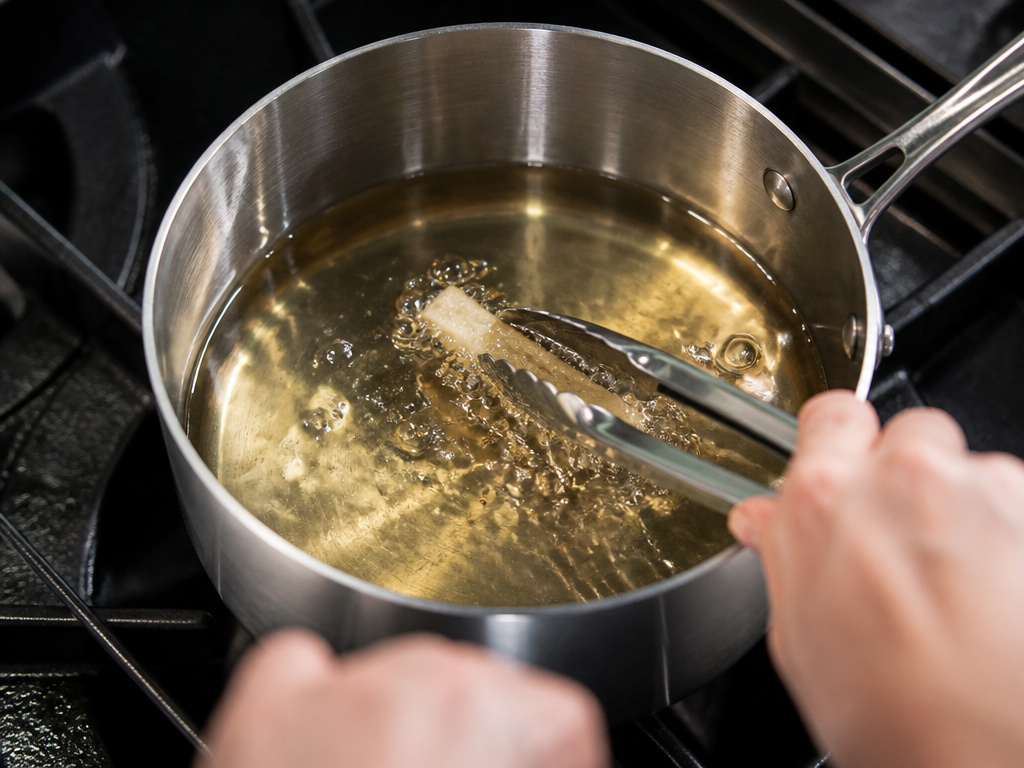
Not all saucepans are created equal. The ideal candidate is heavy-bottomed to distribute heat evenly and made from a non-reactive metal.
| Material | Good for Deep Frying? | Why It Works (Or Doesn’t) |
|---|---|---|
| Stainless Steel | Yes, best choice. | Even heating, non-reactive, handles high heat safely. Easy to clean. |
| Cast Iron | No, not recommended. | The USDA notes it breaks down oil faster. Also extremely heavy and hard to temperature-control. |
| Heavy-Duty Aluminum | Yes, with caution. | Heats quickly and evenly. Can react with acidic foods, but for plain frying, it’s fine. |
| Non-Stick Coated | No, avoid. | Coatings degrade at high temps. Risk of fumes and flaking into your oil. |
| Copper | No, impractical. | Reacts with oil, requires a lining, and is prohibitively expensive for this single task. |
A stainless steel saucepan with a clad bottom is the default. It’s the workhorse. For larger batches, dedicated cookware for deep frying like a deep fryer pot is designed for the job, but a sturdy saucepan works for a single serving.
Shape is just as critical. A pan with straight, tall sides contains splatters better than one with flared sides. This is where a deep sauté pan can be a better shape than a standard saucepan—it offers a larger surface area with still-high walls.
Step-by-Step: How to Deep Fry in a Saucepan Safely
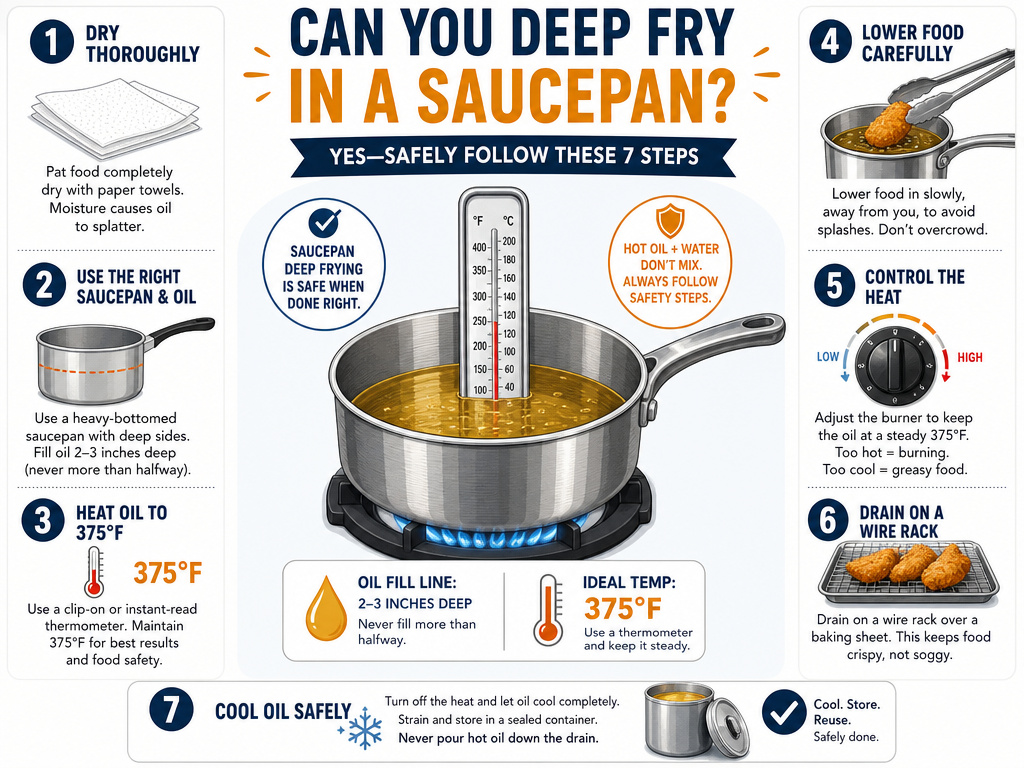
This sequence assumes you have the right pan, oil, and thermometer. Deviating from the order is how accidents happen.
- Dry the food completely. Use paper towels. Wet batter is fine; surface moisture on chicken or potatoes is not. This step prevents the steam explosions the Tefal manual warns about.
- Add oil to the cold pan. Pour in enough oil to reach a depth of 2-3 inches. Never fill past the halfway point. This leaves room for displacement.
- Heat the oil slowly to 375°F. Use medium heat. Clamp the thermometer to the side. Never leave the stove unattended.
- Add food in small batches. Lower each piece gently with tongs or a spider strainer, away from you. Crowding drops the oil temperature and causes greasy food.
- Maintain the temperature. Adjust the burner as needed to keep the oil between 350°F and 375°F. The temp will drop when you add food; let it recover before adding more.
- Remove and drain. When golden brown, remove food to a rack set over a sheet pan, not just paper towels. A rack keeps the bottom crisp.
- Let the oil cool completely. This takes at least two hours. Never pour hot oil down the drain or into a trash can.
Easy to miss: The first batch of food is a test. It tells you if your oil temperature is correct and if your drying was thorough. If it splatters violently, your food was wet. If it browns in 30 seconds, your oil is too hot.
What to Use Instead of a Saucepan
A saucepan is a compromise. For regular frying, these alternatives are safer and deliver better results.
A Dutch oven is the top choice for home cooks. Its cast iron construction (enameled or not) holds heat steadily, and its high, straight sides are perfect for containing oil. It’s essentially a stovetop deep fryer. This is why many guides on frying in a Dutch oven treat it as the standard.
A wok is another excellent option. Its rounded bottom naturally creates a deep pool of oil in the center while using less oil overall. The sloping sides make it easy to remove food. A traditional wok pan is designed for high-heat cooking.
For a more dedicated setup, a deep fryer with a built-in thermostat removes the guesswork. It also contains splatters and smells. If you’re comparing a saucepan to a dedicated appliance, our reviews of the best deep fryer pans and pots break down the models that are worth the investment.
Frequently Asked Questions
Can a non-stick saucepan be used for deep frying?
No. The non-stick coating is not designed for sustained temperatures above 400°F, which deep frying requires. It can degrade, releasing fumes and flaking into your food and oil. Stick to uncoated stainless steel or heavy-duty aluminum.
How do you dispose of used frying oil safely?
Let it cool completely in the pan. Then, strain it through a fine mesh sieve or cheesecloth into a sealable, non-reactive container like a glass jar. You can reuse it 2-3 times for similar foods. For disposal, seal the container and throw it in the trash, or find a local recycling center that accepts cooking oil. Never pour it down the drain.
What is the biggest safety risk when deep frying?
Unattended cooking. A pot of oil on the heat can go from perfect to smoking to flaming in under a minute. The second biggest risk is water contact. A single ice cube or a piece of wet frozen food can cause an explosive splatter of boiling oil.
Why does my oil smoke before it reaches 350°F?
You are either using an oil with too low a smoke point (like extra virgin olive oil) or your pan has a hot spot because it’s too thin. Thin pans heat unevenly, creating a super-hot zone that burns the oil. Upgrade to a heavier pan and use a neutral oil like canola or peanut.
Is a deep fryer actually safer than a saucepan?
Yes, by design. A quality electric deep fryer has a thermostat to control temperature, a contained vessel to prevent spills, and often a lid to smother potential flames. It removes several variables. For frequent frying, it’s a worthwhile safety upgrade over using pots for deep frying on an open burner.
Before You Go
You can deep fry in a saucepan. The real question is whether you should. If you have a deep, heavy stainless steel pan, a thermometer, and the discipline to dry your food and never walk away, you can do it safely for small batches.
If your kitchen lacks any of those, the risk isn’t worth the reward. Use a Dutch oven. Or get a dedicated fryer. The goal is crispy food, not a lesson in emergency response.
For one-time tasks, follow the four rules like a checklist. For anything more, invest in the right deep frying cookware from the start. Your stove, your ceiling, and your dinner will thank you.
