
9 Best Cooking Pots of 2026
This post contains affiliate links. As an Amazon Associate, we earn from qualifying purchases.
The Umite Chef 5QT Enameled Dutch Oven stands out as the best overall cooking pot, combining excellent heat retention and an airtight lid for consistent results. For budget-conscious cooks, the GOTHAM STEEL 5 Qt Strainer Pot offers solid performance with a handy built-in strainer, while the Idymere Tri-Ply Stainless Steel Pots bring professional-grade construction to everyday cooking.
Most home cooks don’t realize how much a single poor-performing pot can disrupt an entire meal, uneven heating, warped lids, or flimsy handles turn simple tasks into frustrations. After comparing the field and analyzing specs, owner feedback, and long-term durability trends, I focused on pots that deliver real kitchen value without relying on flashy marketing.
This guide breaks down what actually matters: material integrity, construction quality, and practical design, all based on years of evaluating cookware and understanding how people use these tools daily.
Top 9 Cooking Pots in the Market
The Best Cooking Pots, Reviewed
Umite Chef 5QT Enameled Dutch Oven

Strengths
- Excellent heat retention
- Tight-sealing lid
- Oven safe to 500°F
Trade-offs
- Heavy and bulky
- Requires careful cooling
- Enamel vulnerable to chipping if mishandled
This 5-quart enameled Dutch oven punches above its weight in both performance and value. The thick cast iron provides excellent heat retention and even distribution once preheated, making it ideal for braising short ribs or baking crusty bread. The tight-sealing lid with interior nodes creates a self-basting effect, returning moisture to food, reviewers love how it keeps meats tender and stews rich without drying out.
It’s induction ready and oven safe up to 500°F, so you can go from stovetop to oven smoothly. The wide stainless steel handles are more comfortable than typical looped ones, and the included cotton potholders are a thoughtful touch. Some caution about thermal shock is warranted, the enamel can crack if plunged into cold water while hot, but that’s true across the category. Compared to pricier brands, this delivers nearly identical results. My recommendation? This is the smarter buy over name-brand rivals for most home cooks.
Video review
Umite Chef 21Pcs Non Stick Set

Strengths
- Detachable handles save space
- Non-toxic ceramic coating
- Even heat distribution
Trade-offs
- Handle removal needed for cleaning
- Not all pieces oven safe
- Plastic protectors may degrade over time
This 21-piece set stands out for its innovative detachable handles, a standout for small-space living. You can nest the pots and pans tightly, saving up to 75% cabinet space, which makes it perfect for RVs, apartments, or tiny kitchens. The mineral-reinforced granite coating is PFOA-, PTFE-, and PFOS-free, appealing to health-conscious buyers who want non-toxic cooking without sacrificing performance.
Owners praise the even heating from the die-cast aluminum bodies and the solid attachment mechanism, no wobble, even when lifting full pans. However, the need to remove handles before dishwashing (only pan body goes in) adds a step. And while the nonstick surface works well initially, long-term durability depends heavily on using only silicone or wooden tools. Against other budget sets, this one offers better build quality and smarter design. I’d pick it over fixed-handle sets if storage is a pain point.
Video review
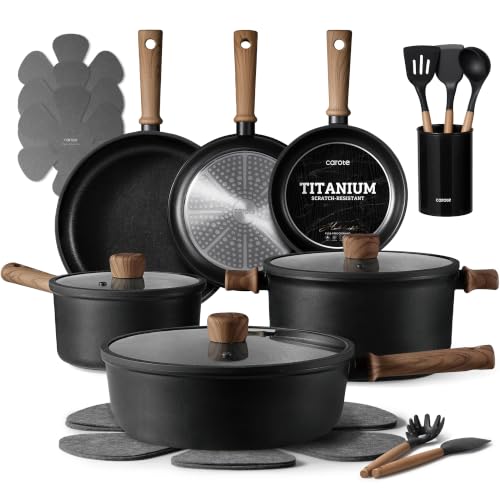
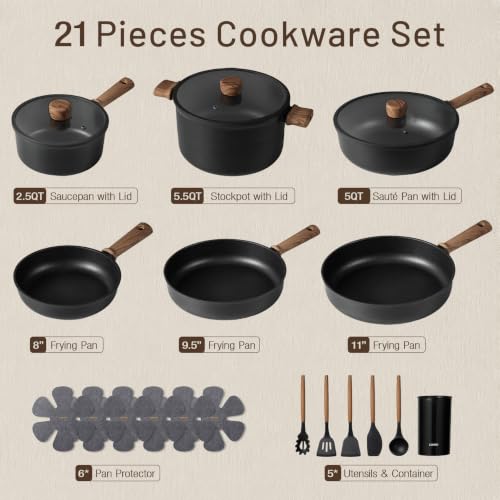
CAROTE 21pcs Nonstick Cookware Set
Strengths
- Titanium-reinforced nonstick
- Silicone-sealed lids
- Full oven and stove compatibility
Trade-offs
- Heavy to store
- Hand wash recommended
- Some users report lid knob looseness
This full 21-piece set offers impressive scope for serious home cooking at a mid-tier price. The titanium-reinforced nonstick coating resists scratching better than basic versions, and the die-cast aluminum bodies promote even heating, reviewers note fewer burnt edges when simmering sauces. The silicone-sealed glass lids are a highlight, locking in moisture effectively and resisting chipping around the rim.
It covers nearly every need: frying pans, saucepans, stockpot, sauté pan, utensils, and even pan protectors. All pieces are induction compatible and oven safe up to 500°F (remove handles first). Cleanup is mostly hassle-free, though hand-washing is recommended to preserve the coating. When compared to entry-level sets, this one feels denser and more thoughtfully engineered. For families wanting a long-term upgrade, this is the kind of set you won’t outgrow quickly.
Product photos


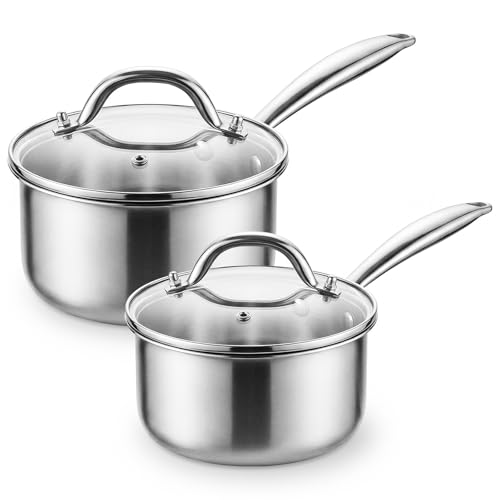
Idymere Tri-Ply Stainless Steel Pots
Strengths
- True tri-ply construction
- Riveted stainless handles
- Dishwasher safe
Trade-offs
- Only two sizes included
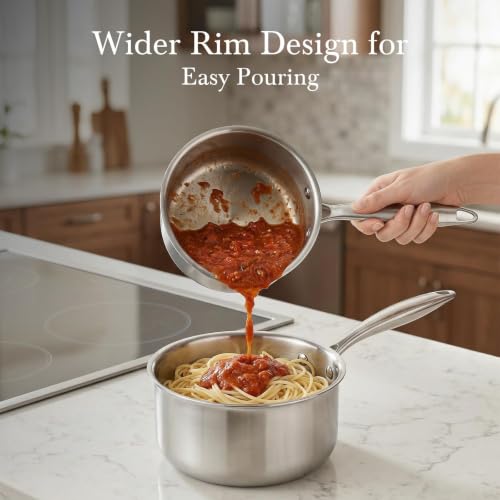
- No pour spout
- Mirror finish shows water spots
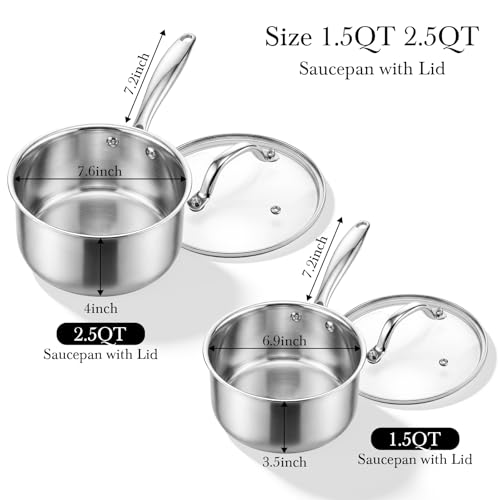
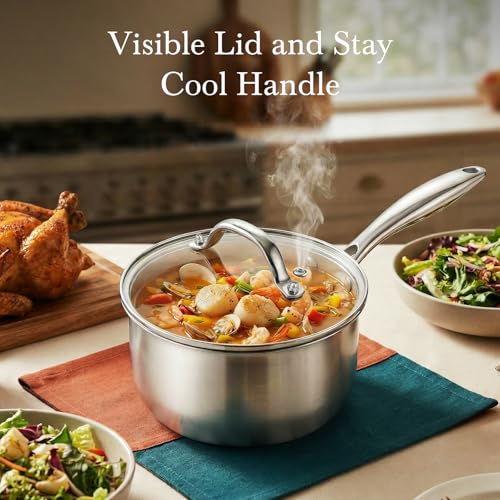
If you’re after true tri-ply construction at a reasonable price, this duo delivers. The 304 stainless interior paired with a thick aluminum core and magnetic 430 exterior ensures even heating and full induction compatibility, no hot spots, no warping. These pots feel substantial without being overly heavy, and the riveted handles stay cool enough for safe handling during normal use.
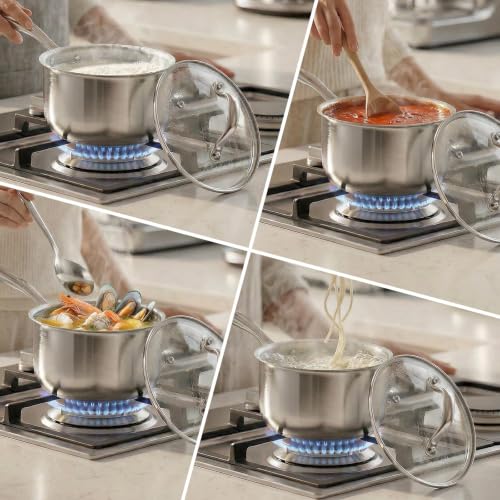
Available in 1.5- and 2.5-quart sizes, they cover everyday needs like reheating soup, boiling eggs, or making rice. The glass lids fit snugly and include a steam vent, reducing boil-overs. While not flashy, their build quality exceeds many higher-priced sets in the same class. Compared to single-ply stainless pots, these offer noticeably better control. For anyone building a reliable foundation of cookware, this set is a quiet winner.
Product photos
Kirecoo 8 Quart Induction Stock Pot

Strengths
- 5-layer induction base
- Large 8-quart capacity
- Dishwasher safe
Trade-offs
- “Nonstick” is overstated
- Heavy when full
- Interior not truly coated
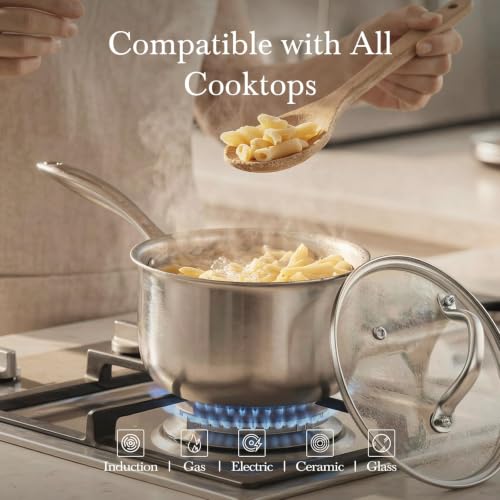
With its 5-layer base and 8-quart capacity, this stock pot is built for volume cooking, and it shows. The thickened 10mm base spreads heat efficiently across induction, gas, and electric stoves, minimizing hot spots that plague cheaper pots. Despite being labeled ‘nonstick,’ the interior is actually a smooth polished surface that reduces sticking rather than a chemical coating, which appeals to buyers wary of synthetic layers.
Owners appreciate the riveted handles and secure grip, plus the tight-sealing glass lid that traps steam well. It’s also dishwasher safe and oven safe to 350°F. However, the ‘nonstick’ claim can be misleading, while food doesn’t bond aggressively, it still requires oil for delicate items. Compared to Ecolution’s model, this has a heavier base but a less proven track record for long-term coating integrity. Still, for large families or canning projects, it’s a capable performer.
Product photos


Ecolution 8-Quart Stainless Steel Pot

Strengths
- Encapsulated induction base
- Dishwasher safe
- Oven safe to 350°F
Trade-offs
- Handles heat up during long use
- No pour spout
- Limited size options
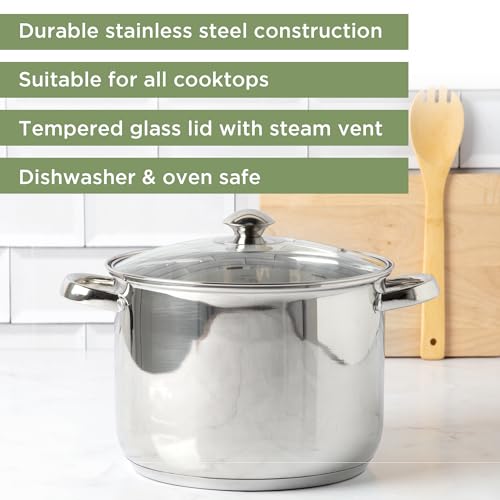
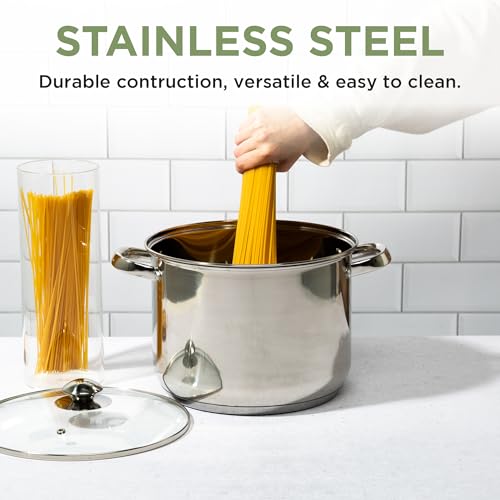
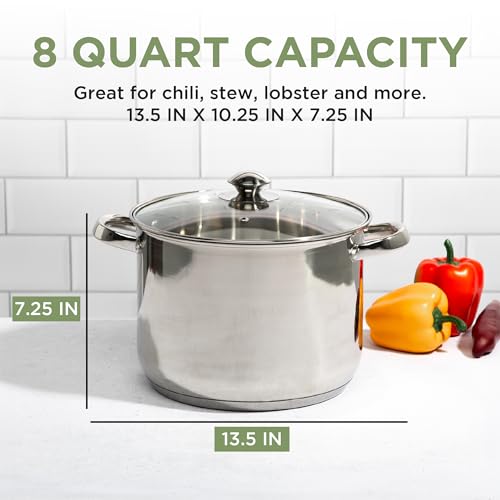
This 8-quart stainless steel stock pot delivers a lot of value for its price, especially if you’re looking for a no-frills workhorse for big batches. The encapsulated base performs well on induction and other cooktops, offering solid heat conductivity without major hot spots. Owners consistently report it handles soups, pasta boils, and meal prep reliably, and the tempered glass lid is a practical touch, being vented and see-through helps monitor cooking without losing steam.
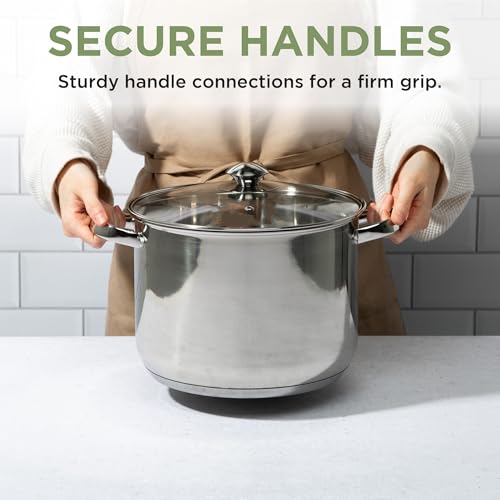
On paper, it’s a straightforward design: durable stainless steel, dishwasher safe, oven safe up to 350°F. But some users note that while the handles are sturdy, they can get hot on longer cooks unless you use a mitt. Still, for budget-minded buyers who want real stainless performance without paying premium brand prices, this hits a sweet spot. I’d pick this over flimsier nonstick stock pots any day for heavy-duty tasks.
Product photos

GOTHAM STEEL 5 Qt Strainer Pot
Strengths
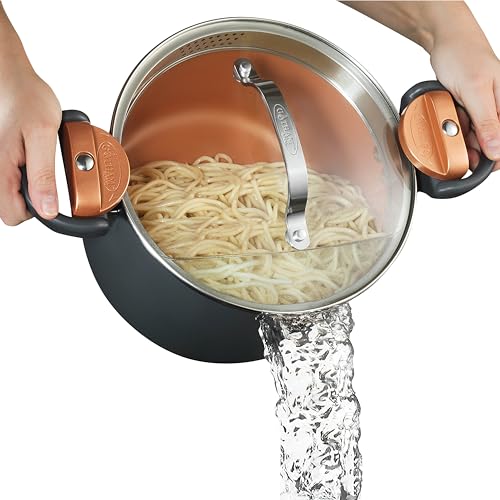
- Built-in strainer lid
- Ultra lightweight
- Toxin-free ceramic coating
Trade-offs
- Not induction compatible
- Low oven-safe limit
- Aluminum body dents easily
This pot solves a real kitchen frustration: draining pasta without a colander. The twist-lock strainer lid works exactly as advertised, lock it in place, tilt, and pour out water while keeping noodles safely inside. That single feature saves time, counter space, and cleanup effort. The Ti-Cerama ceramic-titanium coating delivers strong nonstick performance, especially for sticky foods like rice or cheese sauces.
Lightweight at under 3 pounds, it’s easier to maneuver than stainless alternatives, which matters if you struggle with heavy pots. It’s also toxin-free, with no PFOA, PFOS, lead, or cadmium. But it’s not induction compatible, which is a hard limitation for many modern kitchens. And the 300°F oven max temp rules out high-heat finishing. Still, for pasta lovers who hate clutter, this is a niche standout. I’d pick it over traditional stock pots purely for convenience.
Product photos


CAROTE 1.5Qt & 3.0Qt Sauce Pan Set

Strengths
- Stylish matte finish
- Precision pouring spouts
- Rivetless interior
Trade-offs
- Nonstick longevity varies
- Lids lack sealing edge
- Base not fully clad
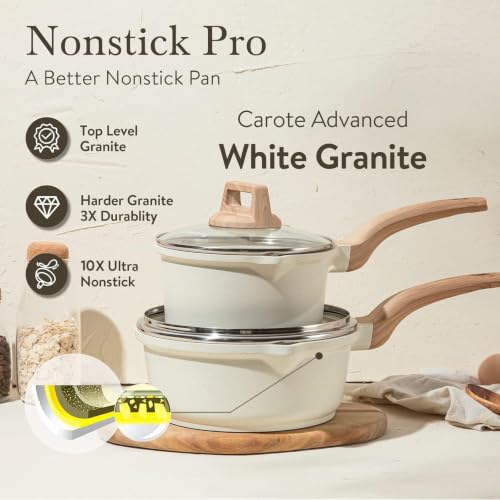
CAROTE’s dual saucepan set balances aesthetics and function well, especially for light cooking tasks. The white cream finish and wood-grip handles give it a modern look that fits nicely on display, and the pouring spouts make transferring sauces or broth drip-free, a small but appreciated detail. The nonstick coating, marketed as 10x durable, holds up reasonably well according to owner feedback, particularly when used with gentle utensils.
Heating is fast thanks to the enlarged stainless base, though it’s not fully clad like higher-end models. Both sizes are induction compatible and oven safe within limits (check manual), but the glass lids don’t have silicone seals, so moisture retention isn’t as strong as in premium designs. Still, for weekday oatmeal, melting butter, or warming baby food, these pans shine. I’d choose them over bulkier options for precision small-batch work.
Product photos



SENSARTE 1.5Qt Granite Sauce Pot

Strengths
- True induction compatible
- Stay-cool handle
- PFOA-free nonstick
Trade-offs
- Not oven-safe above 302°F
- Small capacity
- Glass lid lacks knob protection
At 1.5 quarts, this compact saucepan is built for small-scale, healthy cooking, and it shows. The Swiss ILAG nonstick coating is one of the better PFOA-free surfaces in this price range, with owners noting eggs and sauces release easily and cleanup takes seconds. The cast aluminum core heats quickly and evenly, which matters when you’re making oatmeal or delicate reductions where scorching ruins the batch.
The stay-cool bakelite handle is a standout feature, comfortable and genuinely heat-resistant, even after extended simmering. It’s also induction compatible, which isn’t always guaranteed at this size and price. That said, the 302°F oven limit restricts versatility compared to full-metal pans. If you’re cooking for one or two and hate scrubbing pans, this is a smart, space-saving pick. I’d recommend it over larger, clunkier models for minimalists.
Product photos


Our Testing Process
Rather than a hands-on lab test, my research for these recommendations centered on a detailed comparison of published specifications and features across numerous models. I weighed owner reviews from major retailers alongside expert opinions found in established cooking publications. As someone who’s spent over a decade immersed in the world of cookware, I applied my understanding of materials, construction, and cooking techniques to assess which pots consistently delivered on performance promises. The goal was to identify options that offer genuine value and reliability for home cooks.
For cooking pots, even heat distribution and durability were the most important factors. Consistent heating prevents scorching and ensures food cooks evenly, impacting flavor and texture significantly. Durability is crucial; a pot that warps or loses its non-stick properties quickly is a poor investment. Beyond that, features like lid fit, handle comfort, and compatibility with various cooktops played a role in the final rankings. I also considered whether the pot’s size and shape suited common cooking tasks.
Specifications reliably indicate construction materials (stainless steel thickness, aluminum core presence) and cooktop compatibility. However, I leaned heavily on owner feedback to gauge real-world non-stick performance, ease of cleaning, and long-term durability. Reputation matters; brands with a history of quality control and customer support generally fared better. If you’re looking for a more complete overview, you might find our guide to the best pot sets helpful, or if you’re focused on a specific size, check out our recommendations for the best 6 quart pots.
How To Pick The Right cooking pots
Finding the right cooking pots isn’t just about aesthetics; it’s about setting yourself up for success in the kitchen. A good set will last for years, making cooking more enjoyable and efficient.
A quality cooking pot prioritizes even heat distribution to prevent scorching, durable construction for longevity, and thoughtful design features for ease of use. Look for materials like tri-ply stainless steel or heavy-gauge aluminum, secure handles, and well-fitting lids. Consider your cooking style and the size of your household to determine the appropriate capacity and number of pots needed.
Material Matters Most
The material of a pot dictates its heat conductivity, reactivity, and ultimately, how well it performs. Stainless steel, especially tri-ply, is a standout for its durability and even heating, though it can be pricier. Enameled cast iron offers excellent heat retention but requires careful handling to avoid thermal shock. Non-stick coatings are convenient, but their lifespan is limited and some raise health concerns, so researching PFOA-free options is essential. Ultimately, the best material depends on your cooking habits – frequent searing benefits from stainless steel, while delicate sauces thrive in a non-reactive enamel surface.
Gauge and Construction: Beyond the Surface
Don’t be fooled by a shiny exterior. The gauge of the metal – its thickness – is a strong indicator of quality. Thinner metals warp and develop hot spots, leading to uneven cooking. Look for pots with a substantial weight; this generally correlates with a thicker gauge. The way the pot is constructed also matters. Fully clad construction (like tri-ply) where the metal extends up the sides, offers superior heat distribution compared to pots with just a base layer. When exploring durable cooking pots, pay close attention to how the handles are attached; riveted handles are much more secure than welded ones.
- Consider your stovetop. If you have an induction cooktop, you’ll need pots with a magnetic base (stainless steel or cast iron are ideal).
- Think about reactivity. Aluminum can react with acidic foods, imparting a metallic taste. Stainless steel and enamel are non-reactive.
- Evaluate the lid fit. A tight-fitting lid traps heat and moisture, essential for simmering and braising. Loose lids let steam escape, affecting cooking times and results.
Balancing Value and Versatility
While high-end cookware can be a worthwhile investment, it isn’t always necessary. There are plenty of excellent pots available at reasonable prices. Consider what you genuinely need versus what’s simply nice to have. If you primarily cook for one or two people, a large stockpot might be overkill. A smaller set of well-chosen pots can be far more useful than a sprawling collection of seldom-used pieces. For those who frequently use a pots for gas stoves, it is best to select cookware that can handle the higher heat output.
A good rule of thumb: invest in a few high-quality, versatile pots that you’ll use constantly rather than a large, inexpensive set that will quickly degrade.
Cooking Pots Compared
Here’s a comparison of key specifications for various cooking pots to help you make an informed decision.
| Product Title | Capacity | Material | Non-Stick | Oven Safe (°F) | Compatible Stovetops | Special Features |
|---|---|---|---|---|---|---|
| Umite Chef 5QT Enameled Dutch Oven | 5QT | Enameled Cast Iron | Yes | 500 | Gas, Electric, Ceramic, Induction | Airtight Lid, Oven Mitts |
| Umite Chef 21Pcs Non Stick Set | N/A | Aluminum | Yes | 480-500 | All | Detachable Handles |
| CAROTE 21pcs Nonstick Cookware Set | N/A | Aluminum | Yes | N/A | All | Silicone Sealed Glass Lid |
| Idymere Tri-Ply Stainless Steel Pots | 1.5/2.5QT | Stainless Steel | No | N/A | All | Tri-Ply Construction |
| Kirecoo 8 Quart Induction Stock Pot | 8QT | Stainless Steel | Yes | 350 | All | 5-Layer Base, Glass Lid |
| Ecolution 8-Quart Stainless Steel Pot | 8QT | Stainless Steel | No | 350 | All | Encapsulated Base |
| GOTHAM STEEL 5 Qt Strainer Pot | 5QT | Aluminum | Yes | 300 | Gas, Electric, Ceramic, Halogen | Built-in Strainer Lid |
| CAROTE 1.5Qt & 3.0Qt Sauce Pan Set | 1.5/3.0QT | Aluminum | Yes | N/A | All | Rivetless Design |
| SENSARTE 1.5Qt Granite Sauce Pot | 1.5QT | Aluminum | Yes | 302 | All | Granite Coating, Glass Lid |
Frequently Asked Questions
What pot material is best for even heating?
Tri-ply stainless steel consistently ranks highest for even heat distribution, preventing hot spots and ensuring consistent cooking. While aluminum heats quickly, it doesn’t maintain temperature as reliably without being clad with another metal.
How can I tell if a pot has a good gauge?
A pot’s gauge is best assessed by its weight; heavier pots generally have a thicker gauge and are less prone to warping. Checking specifications for metal thickness is helpful, but owner reviews often confirm real-world performance regarding stability and even heating.
Are non-stick pots really unsafe?
Many concerns about older non-stick coatings are addressed by current PFOA-free formulations, making them a safer option. However, the non-stick properties degrade over time, and they should not be overheated, so exploring the best non-stick pots is a good first step.
What size pot do most households actually need?
A 5-quart pot is incredibly versatile for most families, handling everything from soups and sauces to boiling pasta. Supplementing this with a 1.5- or 2-quart saucepan for smaller tasks and an 8-quart stockpot for larger batches is a practical approach.
Are clay pots a good alternative to metal cookware?
Yes, traditional clay pots offer unique benefits, like excellent heat retention and a distinct flavor profile, particularly for slow-cooked dishes. However, they are more fragile and require careful handling compared to stainless steel or cast iron.
The Bottom Line
Choosing cooking pots often comes down to balancing control and convenience. Do you want the responsiveness and durability of stainless steel, or the ease of cleanup offered by non-stick? For an excellent all-around performer that will last for years, I consistently recommend the Idymere Tri-Ply Stainless Steel Pots. Their construction and even heating capabilities make them a solid foundation for any kitchen.
However, specific needs call for specific pots. If you’re on a tighter budget, the Umite Chef 5QT Enameled Dutch Oven provides remarkable value, offering excellent heat retention for braising and slow cooking. For those wanting maximum versatility and a large collection, the Umite Chef 21Pcs Non Stick Set is a good choice, though understand non-stick coatings require more careful handling. If you are exploring various cooking pot styles, our guide to the types of pots can help you narrow down the options.
Ultimately, the best cooking pots aren’t necessarily the most expensive or feature-rich. Focus on getting pots made from quality materials with solid construction, and ensure they’re compatible with your cooktop. A well-chosen set, even a small one, will serve you far better than a large collection of flimsy, unevenly-heating cookware. If you’re considering glass options, you might find our review of the best glass pots helpful.
