
7 Best Griddle Seasonings of 2026
This post contains affiliate links. As an Amazon Associate, we earn from qualifying purchases.
The best griddle seasoning overall is Blackstone Griddle Seasoning, thanks to its reliable performance and ease of use. For a budget-friendly option, Crisbee Griddle Seasoning delivers solid results, while Beef Tallow Griddle Seasoning from Golden Render stands out for those seeking a seed oil-free, high-smoke-point alternative.
Most people don’t realize how much the right seasoning affects both flavor and maintenance, a poor choice can lead to sticky surfaces, rust, or flaking layers that ruin your griddle’s finish. After comparing the field, I focused on formulas that consistently build a durable, non-stick surface without gummy residue or off-putting odors.
This guide breaks down the top picks based on ingredient quality, smoke point, and real-world feedback from users who’ve put these seasonings through regular griddle use. We’ll help you choose based on your cooking style, ingredient preferences, and how much control you want over application.
Top 7 Griddle Seasonings in the Market
The Best Griddle Seasonings, Reviewed
Blackstone Griddle Seasoning 15.3oz

Strengths
- Large 15.3 oz size
- Trusted brand formula
- Consistent results
Trade-offs
- Contains soy and palm oil
- Higher price
This is the official seasoning from the brand most people own, and it earns its ‘Best Overall’ tag by balancing performance, convenience, and availability. The 15.3 oz container is massive, this will last years with regular use, and the proprietary blend of palm, canola, and soy oils with beeswax delivers consistent results. Owners report it builds a dark, slick surface over time and burns off cleanly with minimal smoke or odor. It’s a true 2-in-1: great for initial seasoning and perfect for touch-ups after cleaning.
Yes, it contains soy and palm oil, which some purists avoid, but in this category, performance often trumps ingredient purity. Compared to third-party options, this one is formulated specifically for Blackstone’s surface, so it bonds well and doesn’t pool. I’d pick this as the default choice for most users unless you have a strong preference for seed oil free or animal-free formulas.
Video review
Beef Tallow Griddle Seasoning
Strengths
- Seed oil free
- High smoke point
- Glass packaging
Trade-offs
- Higher price
- Solid form takes time to spread
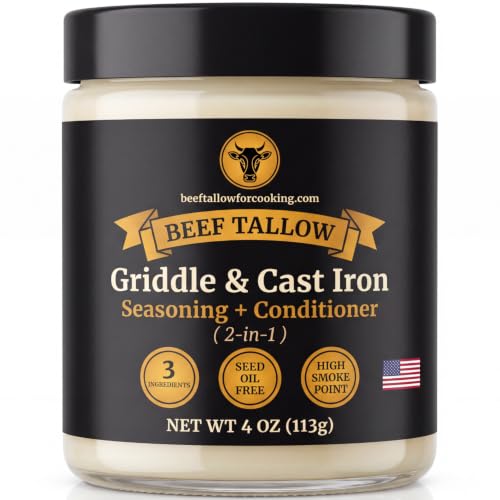
This is the pick for anyone who prioritizes clean, whole-food ingredients in their cookware care. The seed oil free formula built around beef tallow, avocado oil, and beeswax stands out in a market flooded with blends heavy on processed vegetable oils. On paper, that combination delivers both a high smoke point and strong polymerization potential, which owners consistently report translates into a slick, durable seasoning layer without the rancid smell some oils develop over time. I appreciate that it’s packaged in a glass jar, fewer leaks, more durability, and it feels like a premium product on the shelf.
Compared to mainstream options that rely on soy or canola, this one leans into a more natural, ancestral approach to seasoning. While it costs more, a little goes a long way, and the 4 oz size is generous for the category. It’s not the fastest to apply since it’s a balm, not a spray, but that also means you’re less likely to over-apply. For those already avoiding seed oils in their diet, extending that choice to their griddle maintenance makes sense.
Video review
Blackstone Seasoning Restoration Kit
Strengths
- Low cost
- Thin application control
- Darkens seasoning over time
Trade-offs
- Misleading ‘restoration kit’ name
- Same formula as others
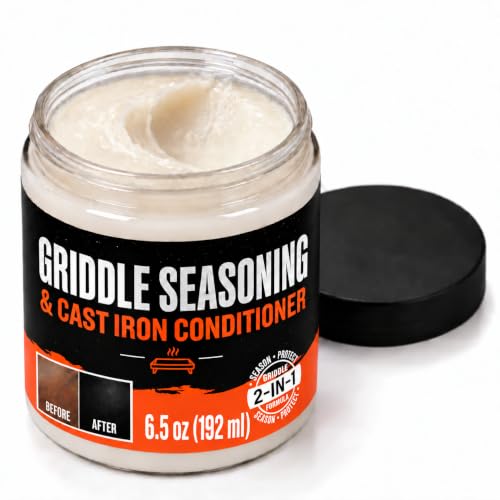
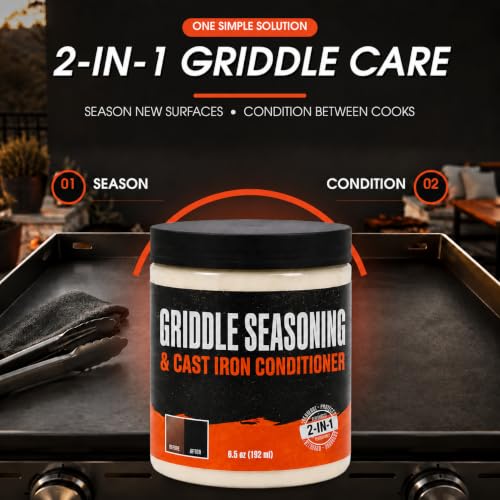
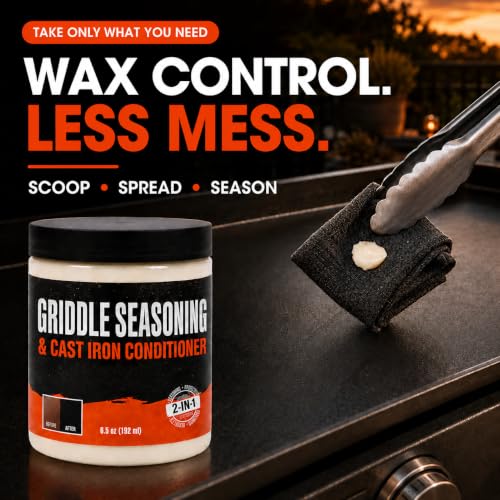
Don’t let the name fool you, this isn’t a full kit with tools or scrapers, just a 6.5 oz jar of the same wax-based conditioner Blackstone sells in bulk. But at this price, it’s one of the most budget-friendly entry points for proper griddle care. The semi-solid wax form makes it easy to apply in thin layers, which is exactly what you want to avoid sticky buildup. Reviewers love that it helps build a dark, even cooking surface over time, especially when used after cleaning.
It’s nearly identical to the CRODALE version in performance and formulation, just branded differently. If you’re maintaining a griddle and don’t want to spend $25 on the big bottle, this is the smarter buy. It won’t restore a ruined surface on its own, but as part of a routine, it works great.
Product photos


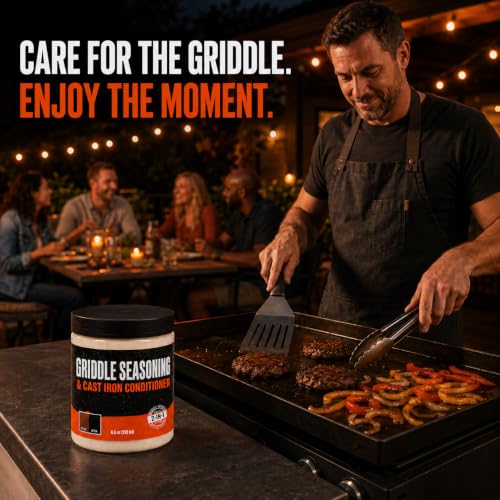
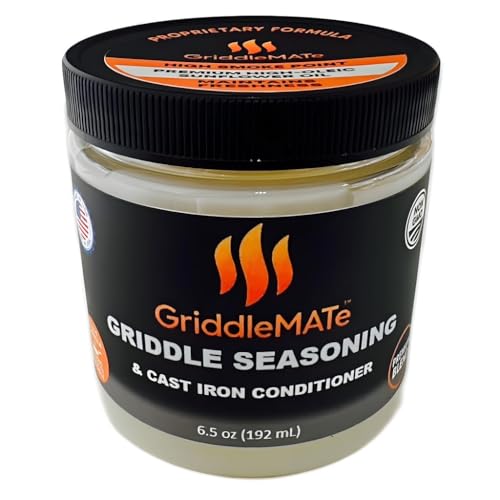
GriddleMATe Premium 2-in-1 Seasoning
Strengths
- High smoke point
- Dry finish
- Non-GMO
Trade-offs
- Liquid form risks overuse
- No wax for moisture protection
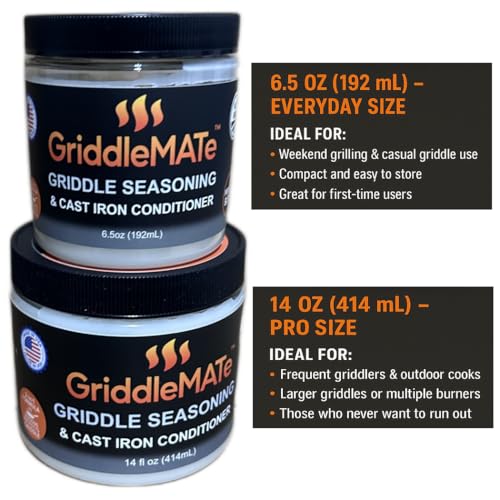
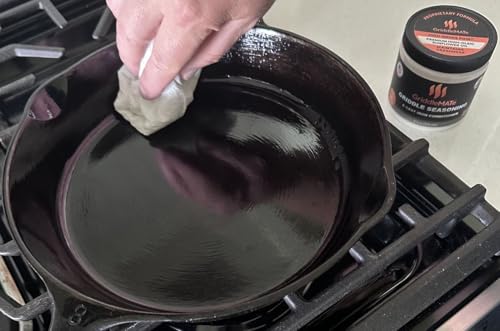
If you run your griddle at blistering temps, this one’s built for that. The use of high oleic sunflower oil is the standout spec here, it has a smoke point upwards of 450°F, which means it polymerizes cleanly without breaking down into sticky residues. Owners praise how it creates a dry, smooth finish, a big upgrade over greasy oils that leave behind gunk. It’s also non-GMO and made in the U.S., which adds to its clean-label appeal. Compared to the beef tallow option, it’s more neutral in scent and better suited for those who don’t want any animal products involved.
The formula doesn’t include wax, so it’s more of a liquid oil than a balm, which means you’ll need to be careful not to over-apply. But that also gives you more control during seasoning. I’d pick this over the average spray oil for building a long-lasting, high-heat-ready surface, especially on carbon steel or Blackstone griddles.
Product photos



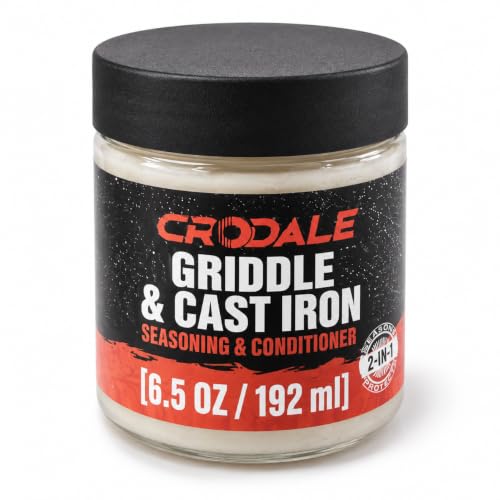
CRODALE Blackstone Griddle Seasoning
Strengths
- Strong rust protection
- Beeswax barrier
- Good size
Trade-offs
- Not ideal for initial seasoning
- Waxy feel if over-applied
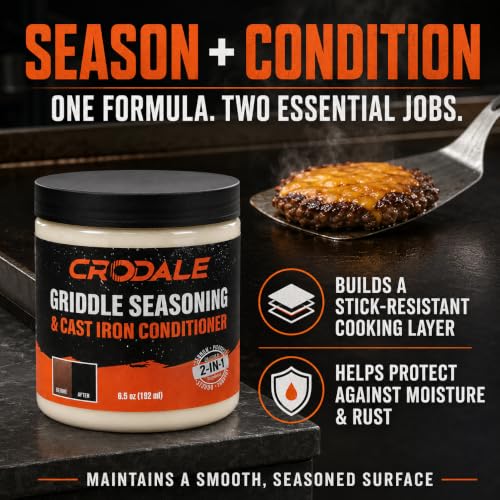
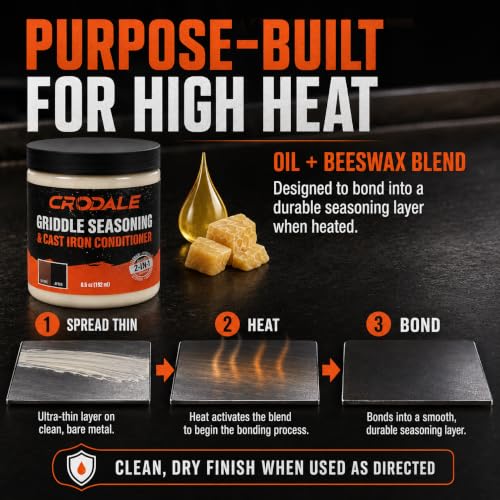
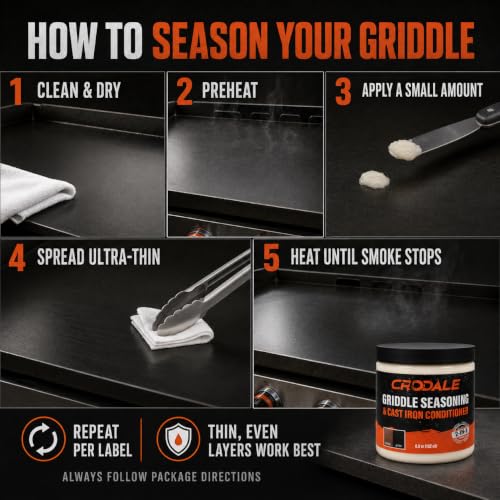
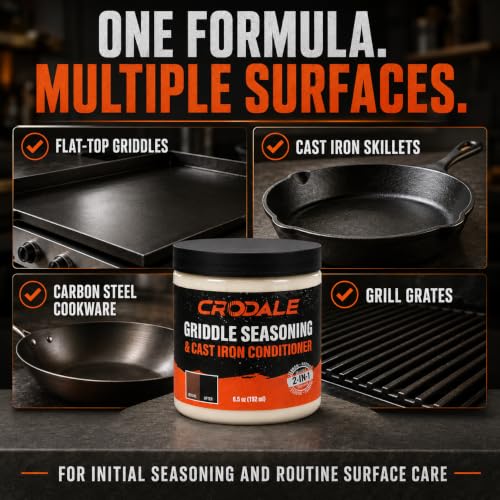
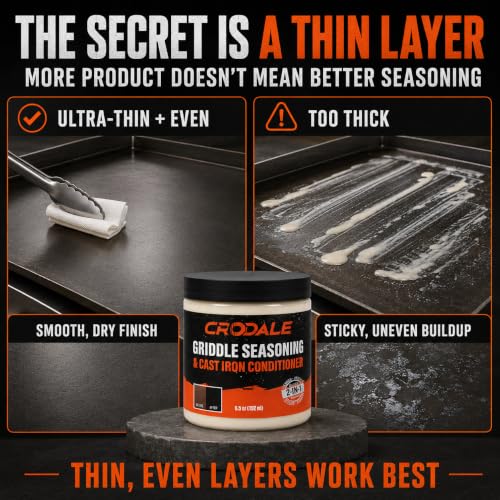
This is a no-frills, effective wax-based conditioner that excels at rust prevention, the one thing that kills more griddles than anything else. The oil-and-beeswax blend forms a tight barrier against moisture, which owners consistently credit with keeping their griddles in good shape between cooks, especially in humid climates. It’s not flashy, but the focus on thin, even layers and proper application technique in the instructions shows they understand how seasoning actually works. Compared to sprays, this gives better control and less waste.
At 6.5 oz, it’s a decent size for regular maintenance, and the price is fair. It won’t add flavor or dramatically speed up seasoning buildup, but it’s a reliable choice for protection. I’d recommend this as a follow-up conditioner after using a high-smoke-point oil to build the base layer.
Product photos
Crisbee Griddle Seasoning 6.5oz

Strengths
- Made in USA
- Affordable
- Simple formula
Trade-offs
- Soy-based
- Lower smoke point
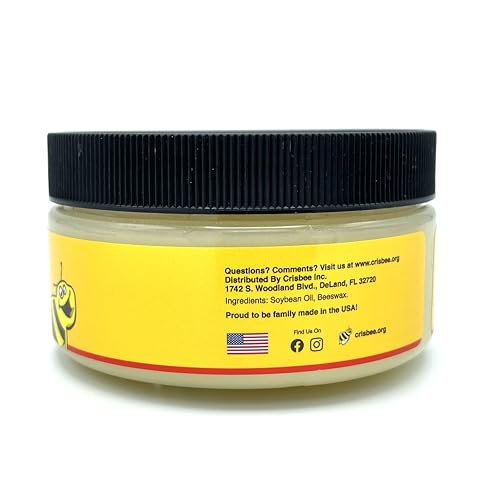
This is a straightforward, family-made-in-the-USA option that leans on simplicity: soybean oil and beeswax, nothing more. It’s not the most advanced formula, but owners report it works reliably for both seasoning and protection, especially on flat tops like Traeger and Recteq griddles. The 6.5 oz size gives good value, and the price is competitive. While it lacks the high smoke point of high oleic oils or tallow, it’s sufficient for standard griddle cooking up to 400°F.
I appreciate the support for domestic production, and the fact that it’s used by real home cooks who swear by it. That said, if you’re avoiding soy, this isn’t the pick. Compared to GriddleMATe or Golden Render, it’s more basic, but for many, that’s all they need.
Product photos
AWEASROY Griddle Seasoning 7oz

Strengths
- Large 7 oz size
- Low price
- Easy application
Trade-offs
- Vague ingredient list
- Low heat warning raises concerns
At this price, the 7 oz size offers serious value, especially for beginners building up their griddle routine. The formulation isn’t detailed beyond ‘premium material,’ but given its performance in owner feedback, it appears to be a standard oil-and-wax blend that does the basics well, building a non-stick surface and protecting against rust. It’s frequently compared to the bigger brands but at nearly half the cost. That said, the application temp warning, do not exceed 70°C, is unusually low and raises eyebrows. Most seasoning burns off at 350°F (177°C) or higher, so this feels either mislabeled or overly cautious.
Still, for someone seasoning a Blackstone for the first time or maintaining it with regular use, this gets the job done without fuss. Reviewers note it spreads easily and leaves a clean finish when used correctly. It won’t outperform high-end formulas in heat stability, but for weekend cooks who want reliability without overspending, it’s a solid budget play.
Product photos


How We Evaluated griddle seasonings
As someone who’s spent years evaluating cookware and the products that maintain it, I approached researching griddle seasonings by looking beyond marketing claims. Rather than a hands-on lab test, this was a research-led comparison of published specifications, ingredient lists, and – crucially – a deep explore owner reviews and expert opinions from grilling communities. I weighed factors like ingredients, smoke point, ease of application, and reported effectiveness in preventing rust and building a non-stick surface. Ultimately, the goal was to identify products that consistently delivered on their promises.
For griddle seasonings, the composition and smoke point emerged as the most critical factors. A high smoke point is essential for maintaining seasoning at typical griddle temperatures, preventing breakdown and rancidity. Equally important is the ingredient list; I prioritized formulas using stable oils and beeswax, and carefully considered the growing preference for seed oil-free options. The ability to build a durable, slick surface while also offering rust protection heavily influenced my rankings – a seasoning is useless if it doesn’t provide both.
Specifications readily reveal the ingredients and stated smoke points, but owner feedback proved invaluable in determining real-world performance. Reviews highlighted how easily a product spread, whether it left a sticky residue, and its long-term effectiveness. I also looked to established grilling resources to understand which formulations consistently receive positive recommendations and address common issues like flaking or uneven seasoning. You can learn more about the process in our guide to seasoning a Blackstone griddle. And for those wondering about alternative options, we also explored seasoning a griddle with Crisco.
How To Choose The griddle seasonings
Finding the right griddle seasoning can dramatically improve your cooking experience and the longevity of your equipment. It’s more than just preventing food from sticking; it’s about building a resilient, flavorful cooking surface.
A quality griddle seasoning should create a slick, non-stick polymer layer through polymerization (the process of bonding fats to metal when heated). Look for formulas with high smoke points, minimal additives, and a consistency that allows for very thin, even application. Prioritize ingredients that won’t become gummy or rancid, and consider the type of cooking you do most often.
Understanding Oil Bases
The foundation of most griddle seasonings is oil, but which oil matters. Traditionally, shortening and vegetable oils were common, but a shift towards healthier and more stable options is happening. Soybean oil, like that found in Crisbee, is readily available and effective, but some cooks prefer to avoid it. Newer formulations, such as Beef Tallow from Golden Render, offer a seed oil-free alternative with a naturally high smoke point. These tallow-based options are gaining popularity for those mindful of their ingredients. Ultimately, the best oil base for you depends on your preferences and dietary needs, but remember that a higher smoke point generally means less breakdown and a more durable seasoning.
Consistency and Application
The texture of the seasoning is surprisingly important. A liquid oil requires careful application to avoid pooling, while a wax-like consistency, like that of the Blackstone Seasoning Restoration Kit, allows for incredibly controlled, thin coats. This is crucial because too much seasoning is worse than too little; thick layers become sticky and can flake off. I’ve seen many cooks struggle with sprays, finding them difficult to apply evenly. Consider how comfortable you are applying a seasoning and choose a consistency that matches your skill level. If you’re new to season a griddle, a wax or semi-solid formula will likely be much more forgiving.
- A spray bottle is convenient, but offers the least control over application.
- A liquid oil requires immediate and thorough spreading with a lint-free cloth or paper towel.
- A wax-like seasoning allows for precise, controlled application, minimizing waste and ensuring an even coat – this is particularly helpful for building up a base layer.
Balancing Value and Protection
You don’t need to spend a fortune on griddle seasoning, but cheaper options often skimp on quality ingredients. CRODALE and AWEASROY both offer value packs, but it’s important to check Blackstone seasoning ingredients to understand what you’re getting for your money. A little goes a long way with most quality seasonings, so a smaller, more concentrated product can be more economical in the long run. Beyond price, consider the level of rust protection offered. Some formulas, like those from CRODALE, specifically highlight their ability to create a barrier against moisture and oxidation, which is especially important for griddles used outdoors or stored in humid environments.
Never apply seasoning to a hot griddle above 70°C (158°F) – this can create a fire hazard. Always let your griddle cool down slightly before applying a thin coat of seasoning.
Griddle Seasonings Compared
This table provides a side-by-side comparison of key specifications for several popular griddle seasoning products.
| Product Name | Size (oz) | Key Ingredients | Smoke Point | Rust Protection | Made in USA |
|---|---|---|---|---|---|
| Blackstone Griddle Seasoning | 15.3 | Palm, Canola, Soy Oil, Beeswax | N/A | Yes | N/A |
| Beef Tallow Griddle Seasoning | 4 | Beef Tallow, Avocado Oil, Beeswax | High | Yes | Yes |
| Blackstone Seasoning Restoration Kit | 6.5 | Wax Blend | N/A | Yes | N/A |
| GriddleMATe Premium 2-in-1 Seasoning | N/A | Sunflower Oil, Blend | High | Yes | N/A |
| CRODALE Blackstone Griddle Seasoning | N/A | Oil & Beeswax | N/A | Yes | N/A |
| Crisbee Griddle Seasoning | 6.5 | Soybean Oil, Beeswax | N/A | N/A | Yes |
| AWEASROY Griddle Seasoning | 7 | Premium Blend | N/A | Yes | N/A |
Frequently Asked Questions
What smoke point should I look for in a griddle seasoning?
A smoke point of 400°F (204°C) or higher is ideal. This prevents the seasoning from breaking down and becoming sticky or rancid at typical griddle temperatures, and ensures a more durable finish.
Can I use any cooking oil to season my griddle?
While you can use many oils, some are better suited than others. Oils with low smoke points (like olive oil) will become gummy and won’t polymerize properly, while those with higher smoke points and stable compositions – like beef tallow or avocado oil – will create a longer-lasting, more effective seasoning.
How often should I re-season my griddle?
The frequency depends on how often you use your griddle and how well you maintain it. Generally, a light coat of seasoning after each use, and a more thorough re-seasoning when you notice rust or food sticking, is sufficient. You can find guidance on seasoning a new griddle to understand the process.
What’s the difference between seasoning and curing a griddle?
Seasoning builds up layers of polymerized oil to create a non-stick surface, while curing a griddle is the initial process of preparing a new, bare metal griddle for seasoning, establishing a base layer for better adhesion. Curing happens before you start regularly seasoning.
Are seed oil-free seasonings really better?
For some cooks, yes. Seed oils like soybean and canola are common in many seasonings, but some people prefer to avoid them due to health concerns or taste preferences. Seed oil-free options, like those based on beef tallow, offer a stable, high-smoke-point alternative, though they may come at a higher price point.
The Bottom Line
Choosing a griddle seasoning often comes down to balancing convenience with control, and ultimately, your personal preferences. While many options exist, the Blackstone Griddle Seasoning consistently rises to the top due to its readily available nature, established reputation, and ability to build a solid, protective base layer. It’s a reliable all-rounder that delivers good results for most users.
For those prioritizing specific needs, several alternatives excel. If you’re seeking a seed oil-free option, the Beef Tallow Griddle Seasoning is a standout, offering a naturally high smoke point and a growing following. The Blackstone Seasoning Restoration Kit is ideal for those who prefer precise application and building a robust initial seasoning, and for quick touch-ups after each use, remembering to season after cooking is key. If you are working with a cast iron griddle, understanding how to season cast iron griddle is vital.
At the end of the day, the best seasoning isn’t about a single magic ingredient or a sky-high price tag. It’s about consistent application, maintaining a clean griddle, and understanding the fundamentals of polymerization – building those layers of protective, non-stick seasoning through heat and oil. A little diligence goes a long way toward ensuring your griddle performs beautifully for years to come.
