
3 Best Induction Cookware of 2026
This post contains affiliate links. As an Amazon Associate, we earn from qualifying purchases.
The KitchenAid Hard-Anodized set stands out as the best overall induction cookware, combining durable construction with excellent heat response. For those watching their budget, the Astercook Detachable Handle set offers solid performance and space-saving design. If you prefer a non-toxic ceramic coating, the SENSARTE Ceramic set is a strong versatility pick.
Most home cooks struggle to find induction cookware that heats evenly without warping or failing after a few months. With so many sets claiming compatibility, it’s easy to end up with pans that underperform or don’t last.
This guide cuts through the noise by focusing on real-world feedback, material quality, and build thickness to identify the few that deliver consistent results. I looked at magnetic conductivity, construction grade, and long-term durability to recommend only the sets that make induction cooking actually work for your kitchen.
Top 3 Induction Cookware in the Market
The Best Induction Cookware, Reviewed
KitchenAid Hard-Anodized Induction Nonstick Cookware Set

Strengths
- Hard-anodized construction
- Even heat distribution
- Dishwasher safe
Trade-offs
- Nonstick coating wears over time
- Heavier than some alternatives
This set stands out in the crowded induction cookware space because it delivers on what matters most: consistent, even heating and long-term durability. The hard-anodized aluminum construction is a proven performer, and owners consistently report that it holds up well to daily use, resisting warping even under high heat. On paper, the thick forged base is designed specifically for induction efficiency, and reviewers confirm it responds quickly and spreads heat evenly, critical for searing or simmering without hot spots.
The nonstick interior gets high marks for food release, especially when cooking delicate items like eggs or fish. While some users note the coating isn’t quite as resilient as higher-end ceramic or titanium-reinforced options, it’s still a solid performer for a set at this price. I’d pick this over many mid-tier competitors because of KitchenAid’s reputation for quality control and the fact that the entire set is dishwasher safe without sacrificing longevity.
Video review
Astercook Detachable Handle Cookware Set

Strengths
- Removable handles
- Space-saving design
- High piece count
Trade-offs
- Nonstick coating less durable
- Handles add complexity
- Uneven heating on high
The standout here is the removable handle system, smartly designed for small kitchens, RVs, or anyone tight on cabinet space. The locking mechanism feels secure based on owner feedback, and the ability to stack these pans after removing the handles is a real advantage for cluttered kitchens. For induction use, the aluminum construction heats reasonably well, though not as evenly as more premium bases. It’s induction-ready, yes, but don’t expect the same thermal precision as a fully clad or disc-bottomed set.
At this price, the 21-piece count is impressive, but quantity comes with trade-offs. The nonstick coating performs well initially, with users praising easy cleanup and decent food release. However, some report degradation after a few months of regular use, especially with metal utensils. I’d recommend this for someone prioritizing storage flexibility over long-term durability. Compared to the KitchenAid set, it’s less robust but far more space-efficient.
Video review
SENSARTE Ceramic Cookware Set
Strengths
- Non-toxic ceramic coating
- Stay-cool handles
- Induction compatible
Trade-offs
- Lighter construction
- Ceramic coating less scratch-resistant
- Not ideal for high-heat searing
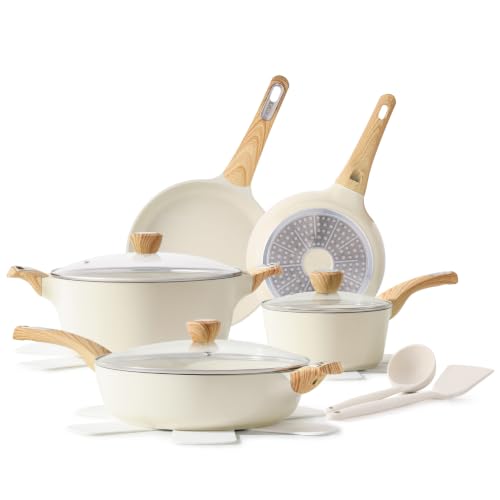
If your top priority is a truly non-toxic cooking surface, this set makes a strong case. The ceramic coating is free of PFAS, PFOA, PTFE, and other chemicals that concern health-conscious cooks, and owners consistently praise the peace of mind that comes with using it. The natural nonstick performance is solid, especially when lightly oiled, and cleanup is a breeze, often requiring just a quick wipe or rinse.
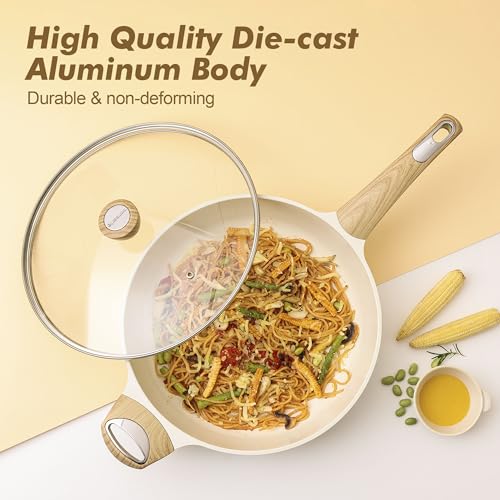
The 4.8mm stainless steel base is a smart move for induction compatibility, providing stability and decent heat conduction. Reviewers note it heats evenly and resists warping, though it’s not quite as responsive as copper-core or multi-ply designs. The wood-grain Bakelite handles stay cool and feel comfortable, a detail many users highlight. While the set lacks the heft of stainless steel or cast iron, it strikes a good balance between lightweight handling and durability. For those wary of traditional nonstick, this is the smarter buy over standard Teflon-coated sets.
Product photos


How We Tested induction cookware
My approach to evaluating induction cookware, as with all cookware here at CookwareCanvas, centers on a thorough review of published specifications and a careful consideration of what cooks are actually saying about their experiences. Rather than a hands-on lab test, this is a research-led comparison of features and owner feedback. I weigh expert opinions from established cooking publications, but ultimately, real-world usability is paramount.
For induction cookware specifically, even heating and responsiveness were my top priorities. Induction requires a magnetic base for efficient heat transfer, so the quality of the stainless steel or aluminum construction is critical. Beyond that, durability and non-stick performance significantly impact everyday cooking. Finding pans for induction cooking that balance these factors is key.
Specifications reliably indicate material composition and gauge (thickness), giving a good sense of potential heat distribution and longevity. However, owner reviews offer crucial insight into how well a set actually performs over time – things like how the non-stick coating holds up, or if handles stay cool. I also pay close attention to reports on warping or issues with compatibility, especially when looking at ceramic induction cookware. It’s about sorting signal from noise to recommend sets that deliver genuine value.
Choosing The Right induction cookware
Finding the right induction cookware is about more than just grabbing a set that says “induction compatible” on the box. It’s about understanding how this technology works and what characteristics in cookware will unlock its full potential.
Induction cookware requires a ferromagnetic base – typically stainless steel with a magnetic layer, or cast iron – to efficiently convert electrical energy into heat. Key considerations include the quality of that magnetic base, the thickness of the construction for even heating, and the overall durability to withstand the demands of induction cooking. Look for pieces with fully bonded bases and materials known for their stability.
Understanding Magnetic Conductivity
The core of induction cooking lies in the cookware’s ability to become part of the heating process. Unlike traditional stovetops that heat the burner which then heats the pan, induction directly heats the pan itself. This means the magnetic properties of the cookware are paramount. Stainless steel is common, but the quality varies. Cheaper sets often have a thin, poorly bonded magnetic base, leading to hot spots and uneven cooking. I always suggest looking for fully clad stainless steel where the magnetic layer extends up the sides of the pan, offering more consistent temperatures. If you’re unsure about existing cookware, a simple refrigerator magnet test can give you a preliminary idea – if the magnet strongly adheres to the base, it’s likely induction compatible.
Prioritizing Construction and Thickness
Don’t underestimate the impact of a substantial build. Thin-gauge cookware, even if induction-compatible, will warp and won’t distribute heat well. Look for cookware with a thick, heavy bottom – 4.8mm or greater is a good starting point, as seen in some of the best induction cookware options available. Forged aluminum, like in the KitchenAid sets, is a good choice because it’s durable and heats quickly. However, be aware that aluminum alone won’t work on induction; it needs that magnetic stainless steel layer bonded to it.
Here’s what I recommend considering when evaluating thickness: * Thin Gauge (under 3mm): Suitable for light simmering or warming, but prone to warping. * Medium Gauge (3-4mm): A good all-around choice for everyday cooking, offering a balance of responsiveness and durability. * Heavy Gauge (4mm+): Ideal for searing, braising, and maintaining consistent temperatures, especially important for sauces and delicate foods. This is the kind of construction that will last for years.
Balancing Performance with Convenience
While performance is key, convenience matters too. Many consumers are drawn to non-stick induction cookware for its ease of cleaning and food release. Ceramic coatings, like those found in the SENSARTE sets, are gaining popularity as a potentially healthier alternative to traditional PTFE non-stick. However, remember that all non-stick surfaces will eventually degrade. A removable handle, like on the Astercook set, can be a huge space saver in smaller kitchens, but ensure the locking mechanism feels truly secure before relying on it. Ultimately, consider how you cook and what features will genuinely make your time in the kitchen more enjoyable.
A scratched non-stick pan isn’t necessarily unsafe, but its non-stick properties will diminish. Treat these surfaces gently with silicone or wooden utensils to extend their lifespan.
Induction Cookware Compared
Here’s a spec comparison of several popular induction cookware options.
| Product Name | Material | Pieces Included | Nonstick Coating | Handle Type | Induction Compatible |
|---|---|---|---|---|---|
| KitchenAid Hard-Anodized | Hard-Anodized Aluminum | N/A | Yes | Riveted | Yes |
| Astercook Detachable Handle | Aluminum | N/A | Yes | Detachable | Yes |
| SENSARTE Ceramic | Stainless Steel / Aluminum | 14 | Ceramic | Bakelite | Yes |
Frequently Asked Questions
What gauge of cookware is best for induction?
A heavy gauge (4mm or greater) is ideal for induction cooking, as it provides even heating and is less prone to warping; however, a medium gauge (3-4mm) is a good all-around choice for everyday use.
Can I use my existing stainless steel cookware on an induction cooktop?
You can, but only if it’s magnetic. A quick test is to see if a refrigerator magnet strongly adheres to the base of the pan – this indicates induction compatible cookware.
Is ceramic non-stick cookware as durable on induction as stainless steel?
Generally, no. Ceramic coatings are susceptible to scratching and degradation over time, even with careful use, while stainless steel is known for its longevity, though you can find quality induction cooktop sets with both.
What should I look for in an induction-compatible non-stick pan?
Look for pans with a thick, fully-bonded magnetic stainless steel base, even under the non-stick layer, and prioritize using silicone or wooden utensils to protect the coating; remember all non-stick surfaces will eventually wear down.
Are detachable-handle induction sets truly secure?
Detachable handles can be convenient for storage, but it’s crucial to verify the locking mechanism feels robust and reliable before using the pan – a weak lock could create a safety hazard while cooking with what pans work on induction.
The Bottom Line
Choosing induction cookware often comes down to balancing upfront cost with long-term performance. While there are many options available, the KitchenAid Hard-Anodized set consistently receives high marks for its even heating, durability, and overall value. It’s a solid investment for cooks who want a reliable set that will perform well for years to come.
For those prioritizing specific needs, the market offers excellent alternatives. If you’re looking for space-saving convenience, the Astercook Detachable Handle set is a clever choice. And for those focused on healthier cooking options, exploring non-toxic induction cookware like the SENSARTE Ceramic set is a good starting point, understanding that ceramic coatings require a bit more care.
Ultimately, the best induction cookware isn’t about chasing the latest features or highest price tag. It’s about finding pieces constructed from quality materials, with a fully bonded base, and a gauge thick enough to maintain consistent temperatures. Prioritizing those fundamentals, along with thoughtful care, will deliver the most rewarding cooking experience, and that’s what truly matters when building a kitchen you love.
