
3 Best Induction Ready Cookware of 2026
This post contains affiliate links. As an Amazon Associate, we earn from qualifying purchases.
The KitchenAid Hard-Anodized Induction Cookware stands out as the best overall for its durable construction and reliable nonstick performance, while the Astercook 21 Pcs Ceramic Cookware offers a solid budget-friendly option with versatile detachable handles. For those seeking a balance of safety and performance, the SENSARTE 14-Piece Ceramic Cookware Set delivers a high-quality ceramic coating in a well-built package.
Choosing induction-ready cookware isn’t just about compatibility, it’s about finding pieces that heat evenly, hold up over time, and make cooking more efficient. Too many sets claim to be induction-ready but fall short in real kitchens, developing hot spots or warping under high heat.
This guide cuts through the noise by focusing on what actually matters: base construction, long-term durability, and real user experiences. I’ve compared specs and owner feedback across top models to highlight the ones that deliver consistent performance on induction stovetops.
Top 3 Induction Ready Cookware in the Market
The Best Induction Ready Cookware, Reviewed
KitchenAid Hard-Anodized Induction Cookware

Strengths
- Durable hard-anodized build
- Even heat distribution
- Dishwasher safe
- Full nonstick finish
- Induction ready
Trade-offs
- Higher price point
- Heavier than ceramic
- Nonstick still degrades over time
This is the set I’d recommend to someone who wants long-term reliability without stepping into professional-grade pricing. The hard-anodized aluminum construction is far more durable than standard aluminum or ceramic, resisting warping and standing up to daily use. The thick forged base delivers even heat across induction burners, critical for browning and simmering without hot spots. Owners consistently note how well it browns meats and handles temperature shifts.
The full nonstick interior includes the rivets, which is rare at any price and makes cleanup significantly easier. It’s dishwasher safe, a small luxury many ceramic sets don’t offer. Yes, it’s the most expensive of the three, but you’re paying for materials and engineering that last. Against the SENSARTE, it trades some chemical-free appeal for real-world resilience. For most home cooks, this balance makes it the smarter buy.
Video review
Astercook 21 Pcs Ceramic Cookware

Strengths
- High piece count
- Detachable handles
- Induction compatible
- Easy storage
- PFOA-free coating
Trade-offs
- Thin base
- Limited heat distribution
- Coating durability concerns
At this price, the Astercook set delivers an unusually high piece count with a standout feature: detachable handles. That design makes storage a breeze, especially for small kitchens or RVs, and the ability to stack these pans saves serious cabinet space. The ceramic nonstick coating checks the health-conscious boxes, PFOA-free and easy to wipe clean, though I’d temper expectations about long-term durability given the budget tier.
Owners consistently report it works well for light cooking tasks like eggs or sautéed veggies, but the aluminum construction isn’t as responsive or evenly heating as higher-end sets. It’s induction-ready, which is a plus, but the thin base can lead to hot spots on high power. Compared to the SENSARTE set, it’s more about quantity than quality. Still, for someone wanting a full kitchen setup without breaking the bank, this is a practical starting point.
Video review
SENSARTE 14-Piece Ceramic Cookware Set
Strengths
- Non-toxic ceramic coating
- PFAS/PTFE/PFOA free
- Stay-cool handles
- Oven safe
- Induction compatible
Trade-offs
- Ceramic coating less durable
- Heavier than average
- Not dishwasher recommended
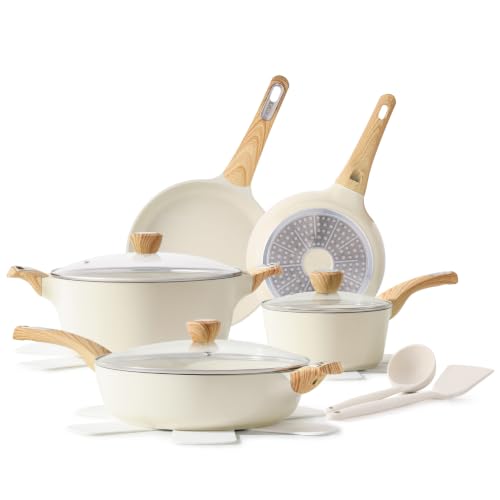
If your priority is a genuinely non-toxic cooking surface, this set stands out. It’s certified free of PFAS, PFOA, PTFE, and other harmful chemicals, a big win for health-focused households. The ceramic nonstick performs well early on, with owners praising how little oil is needed and how easily it wipes clean. The 4.8mm stainless steel base improves induction responsiveness over many ceramic sets, reducing warping risks and helping heat spread more evenly.
The wood-grain Bakelite handles stay cool and feel sturdy, and the glass lids offer good visibility. But ceramic coatings, even good ones, tend to degrade faster than hard-anodized alternatives. Compared to the KitchenAid set, it lacks the same longevity, but it wins on safety and ease of use. For families or anyone avoiding synthetic nonstick, this is a strong mid-tier pick.
Product photos


How We Picked These induction ready cookware
As someone who’s spent years evaluating cookware, I approached this guide by carefully comparing specifications and features across numerous brands. Rather than a hands-on test of each set, this is a research-led comparison, weighing owner reviews from multiple sources alongside professional assessments. I looked for patterns in reported performance, durability, and ease of use to arrive at these recommendations. My goal is to help you find cookware that truly delivers on its promises.
For induction cookware, even heating and durability are paramount. I prioritized sets with thick, multi-ply construction or robust, heavy-gauge aluminum, features that contribute to consistent temperatures and resistance to warping. Nonstick performance is also key, but I gave greater weight to the longevity of that nonstick coating and the materials used to create it, understanding that no nonstick lasts forever. You can explore more options in our guide to the best induction sets.
Specifications reliably indicate construction quality (gauge of metal, materials used), while owner feedback reveals how those specs translate to real-world cooking. I paid close attention to comments regarding hot spots, ease of cleaning, and how well the cookware held up over time. Reputation matters here, too; brands consistently praised for quality and customer service earned higher consideration. For those leaning toward a nonstick option, we also have a detailed look at ceramic induction cookware.
Choosing The Right induction ready cookware
Finding the right induction cookware can feel overwhelming, but focusing on a few key features will make the process much smoother. It’s more than just slapping a magnet on the bottom of a pan; truly good induction cookware delivers performance and durability.
Quality induction cookware features a ferromagnetic base, typically stainless steel, that efficiently transfers heat from the cooktop. Beyond that, look for even heating across the base, robust construction to resist warping, and a comfortable, secure handle. Consider the coating (if any) and its longevity, as well as how easy the cookware is to maintain.
Understanding Base Construction
The heart of any induction-ready pan is its base. It must contain a ferromagnetic metal to interact with the induction cooktop. Stainless steel is common, but the thickness and how it’s bonded to other layers (like aluminum or copper) significantly impact heat distribution. Thinner bases heat up faster, but can lead to hot spots. Look for cookware with a fully encapsulated base, meaning the ferromagnetic material extends up the sides of the pan, for more even heating. Don’t assume all stainless steel is created equal; 18/10 stainless steel (18% chromium, 10% nickel) offers superior corrosion resistance, extending the life of your induction-ready pots and pans.
Evaluating Non-Stick Coatings
While stainless steel is fantastic for searing and building fond, many cooks also want the convenience of non-stick. When it comes to induction non-stick pans, ceramic coatings are increasingly popular as a PFOA-free alternative to traditional Teflon. However, ceramic coatings generally don’t last as long.
Here’s what to consider:
- Coating Type: Ceramic is a good starting point, but proprietary formulations from brands like Thermolon are often more durable.
- Layer Count: More layers can mean better non-stick and longevity, but it’s not always the case. Focus on reviews.
- Maintenance: All non-stick surfaces require gentle handling (no metal utensils!) and careful cleaning. Avoid abrasive cleaners, and some manufacturers recommend against dishwashers even if the packaging says otherwise.
A good rule of thumb: if a non-stick pan’s surface looks scratched or discolored, it’s time to replace it, even if it still seems to work.
Balancing Value and Features
You don’t have to spend a fortune to get good induction cookware. Sets like the Astercook offer detachable handles, a useful feature for storage and cleaning, but prioritize construction quality over fancy extras. Consider how often you’ll actually use each piece in a set. A smaller, well-made set is often a better investment than a large, cheap one. Don’t overlook the importance of handles; they should be comfortable, stay cool during cooking, and be securely attached. A wobbly handle is a safety hazard, and a poorly designed one can ruin your cooking experience. For those prioritizing a truly toxin-free cooking experience, exploring options with advanced ceramic coatings, like the SENSARTE set, can be a worthwhile investment.
Induction Ready Cookware Compared
Here’s a specification comparison of several induction-ready cookware options to help you choose the best set for your needs.
| Product Title | Material | Pieces | Nonstick Coating | Detachable Handle | Dishwasher Safe |
|---|---|---|---|---|---|
| KitchenAid Hard-Anodized Induction Cookware | Hard-Anodized Aluminum | N/A | Yes | No | Yes |
| Astercook 21 Pcs Ceramic Cookware | Aluminum | 21 | Ceramic | Yes | N/A |
| SENSARTE 14-Piece Ceramic Cookware Set | Aluminum & Stainless Steel | 14 | Ceramic | No | No |
Frequently Asked Questions
What gauge of stainless steel is best for induction cookware?
A thicker gauge, generally 18/10 stainless steel, is preferable as it provides better heat distribution and is more resistant to warping over time, you’ll find this discussed in detail when looking at cookware sets for induction.
How can I tell if my existing cookware will work on an induction cooktop?
The simplest test is with a magnet; if it strongly adheres to the bottom of the pan, it’s likely induction compatible cookware. However, this isn’t foolproof, and the material composition is more important than magnetism alone.
Are ceramic non-stick coatings truly as durable as traditional Teflon?
Generally, no. While ceramic coatings offer a PFOA-free alternative, they typically don’t last as long as well-maintained Teflon coatings, and require even more careful handling to prevent damage.
What’s the advantage of cookware with a fully encapsulated base?
A fully encapsulated base, where the ferromagnetic layer extends up the sides, promotes more even heating across the entire cooking surface, eliminating hot spots that can affect your results.
Beyond the initial cost, what should I factor into the long-term expense of induction cookware?
Consider the potential replacement cost of non-stick coatings, as they will degrade over time, and factor in the need for specific cleaning products or utensils to maintain their performance – a quality induction-ready cookware set will often save money in the long run.
The Bottom Line
Choosing induction cookware often comes down to balancing initial cost with long-term performance. While many options exist, the KitchenAid Hard-Anodized Induction Cookware set consistently receives high marks for its durability and even heating – it’s a solid choice for cooks who want a reliable set that will last. It strikes a good balance between price and quality, making it an excellent all-around performer.
For those on a tighter budget, or those wanting the convenience of removable handles, the Astercook 21 Pcs Ceramic Cookware set is a very appealing option. If you’re specifically looking for a set with a focus on a toxin-free cooking experience, the SENSARTE 14-Piece Ceramic Cookware Set stands out, offering a unique ceramic formula praised for its safety features. Understanding induction-ready cookware is the first step toward finding the right fit for your kitchen.
Ultimately, the best induction cookware isn’t about chasing the highest price tag or the most features. It’s about finding pieces with a solid ferromagnetic base, thoughtful construction, and materials that will stand up to regular use. Don’t get too hung up on specific coatings or fancy designs – focus on the fundamentals of heat control and durability, and you’ll be well-equipped to create delicious meals for years to come with your new cookware for induction stoves.
