
7 Best Induction Saucepan Sets of 2026
This post contains affiliate links. As an Amazon Associate, we earn from qualifying purchases.
The Michelangelo Triply Stainless Steel set is the best overall induction saucepan set for its even heating and durable construction, with the EWFEN 3 Ply Stainless Steel as a solid budget-friendly alternative that still delivers reliable performance on induction cooktops.
Most home cooks want saucepans that heat evenly, won’t warp, and last for years, especially when cooking on induction. Too many sets promise compatibility but fall short on build quality or practical sizing. This guide cuts through the noise, focusing on sets that deliver real performance based on construction, owner feedback, and everyday usability. I looked at material, size range, handle comfort, and how well each set works on induction hobs, so you can find one that fits your kitchen rhythm.
Top 7 Induction Saucepan Sets in the Market
The Best Induction Saucepan Sets, Reviewed
Michelangelo Triply Stainless Steel Saucepan Set
Strengths
- Fully clad construction
- Oven safe to 600°F
- Glass lids
Trade-offs
- Higher price
- Heavier than nonstick
- No strainer lid
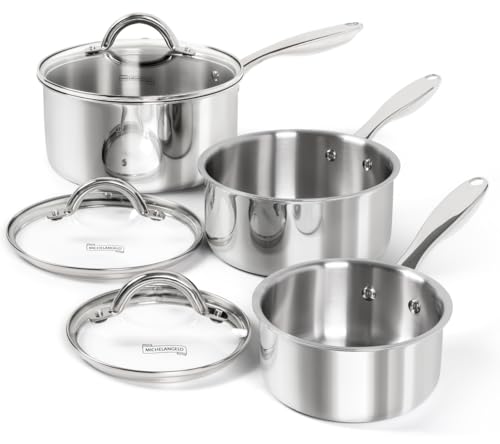
This is the set I’d recommend to most home cooks who want long-term value. The triply construction wraps fully around the pot body, not just the base, which means heat spreads evenly from bottom to rim, ideal for simmering sauces without hot spots. The 304 stainless steel is non-reactive and dishwasher safe, and owners report it resists warping even after repeated induction use. The glass lids are a big upgrade, allowing easy monitoring without lifting and losing steam.
Compared to the other Michelangelo stainless set on this list, this one is more complete with full cladding and higher oven safety (600°F). It’s also pricier, but the build justifies it. The hollow stainless handles stay relatively cool and feel secure thanks to double rivets. If you’re building a core set that will last decades, this is the smarter buy over nonstick or partial-clad alternatives.
Video review
EWFEN 3 Ply Stainless Steel Sauce Pan
Strengths
- Budget friendly
- Stay-cool handles
- Even heating
Trade-offs
- Lid assembly risk
- Not fully clad
- Lid not oven safe
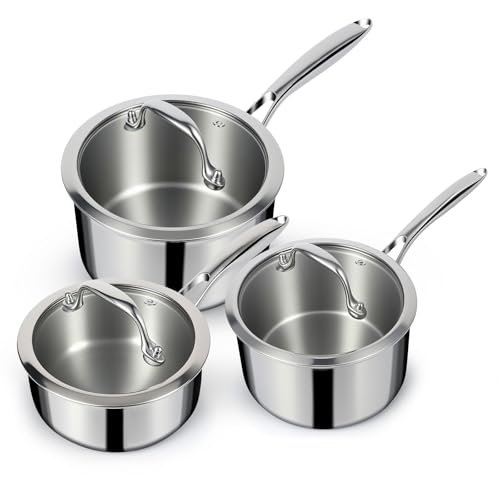
At this price, the EWFEN set is a steal. It delivers tri-ply construction with a 304 stainless interior and aluminum core, which on paper means even heating and flavor-safe cooking. Owners consistently report it performs well on induction, heats quickly, and stays cool at the handle, thanks to the double-riveted stainless grips. The mirror finish holds up in dishwashers, and the glass lids seal well for moisture retention.
But there’s a caution: the lid assembly warning suggests a potential weak point. If not installed correctly, the glass could crack under thermal stress. That’s a rare red flag in an otherwise solid budget set. Still, for solo cooks or small families needing basic, reliable pots without overspending, this is the go-to. It doesn’t have the full cladding of the premium Michelangelo set, but for everyday tasks, it gets the job done.
Video review
Michelangelo 1Qt & 2Qt Stainless Sauce Pans

Strengths
- Compact sizes
- Oven safe
- Mirror finish
Trade-offs
- Limited capacity
- Only two pieces
- No 3-quart option
This compact 2-piece set is ideal for minimalists or small kitchens. The 1Qt and 2Qt sizes handle most solo or couple-sized tasks, boiling eggs, heating soup, making rice, without taking up excess cabinet space. The 18/10 stainless steel with tri-ply base delivers solid induction performance, and the mirror finish resists discoloration, which owners appreciate for long-term looks.
It’s oven safe to 600°F and broiler safe, which is impressive at this price. But the lack of a 3-quart option limits its use for family meals. Compared to the 6-piece KOCH SYSTEME set, it’s less thorough but more focused. If you already have larger pots and just need small, precise tools, this is the smarter buy.
Product photos


Michelangelo Hard Anodized Nonstick Sauce Pans

Strengths
- Strainer lid
- Oven safe
- Non-toxic coating
Trade-offs
- Not metal utensil safe
- Coating longevity varies
- Heavier than ceramic
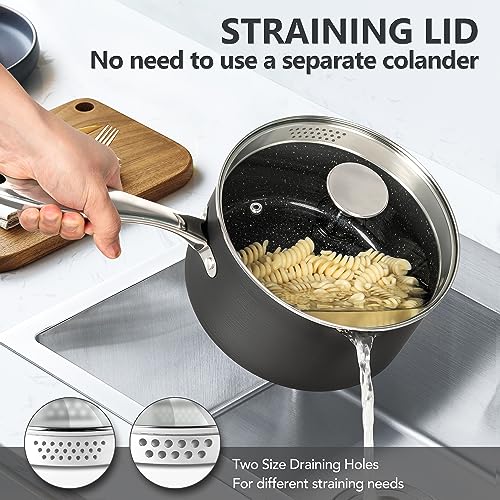
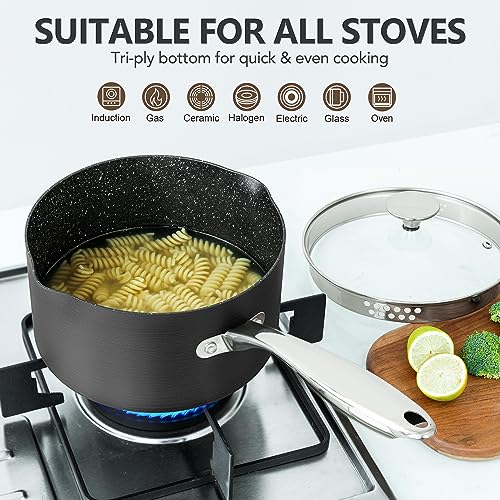
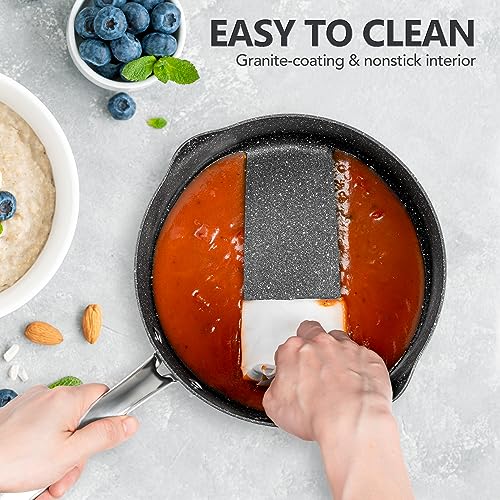
This hard-anodized set leans into performance with a granite-derived nonstick coating that owners say holds up well under regular use. The triply construction and thick base deliver fast, even heating, critical for delicate sauces or reheating without scorching. The standout is the strainer lid, which many reviewers use daily for draining pasta or rinsing grains, eliminating the need for extra tools. It’s a small detail that adds real kitchen efficiency.
Oven-safe up to 450°F and compatible with all stovetops, it’s versatile for weeknight meals. But hard-anodized pans still can’t match the longevity of stainless steel under high heat or metal utensil use. If you’re cooking at high temps or with metal spoons, this won’t last as long as a clad set. Still, for low-to-medium heat cooking and easy cleanup, it’s one of the more practical nonstick options here.
Product photos

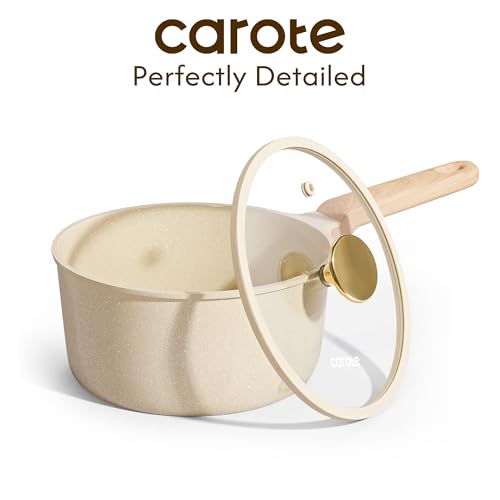
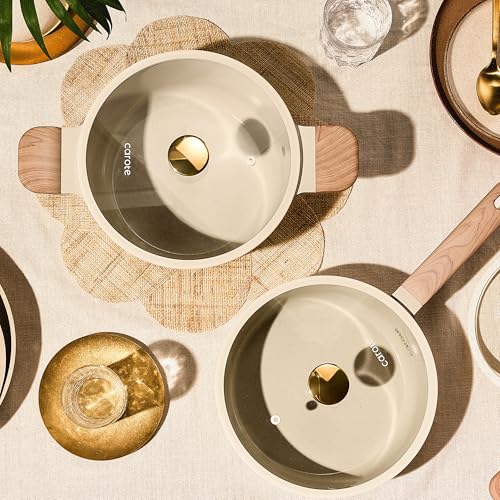
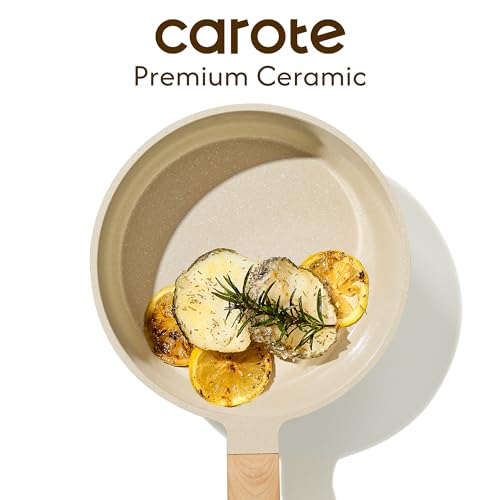
CAROTE Ceramic Nonstick 1.5Qt & 2.5Qt
Strengths
- Ceramic nonstick
- Non-toxic
- Lightweight
Trade-offs
- Coating wears faster
- Not for high heat
- Limited sizes
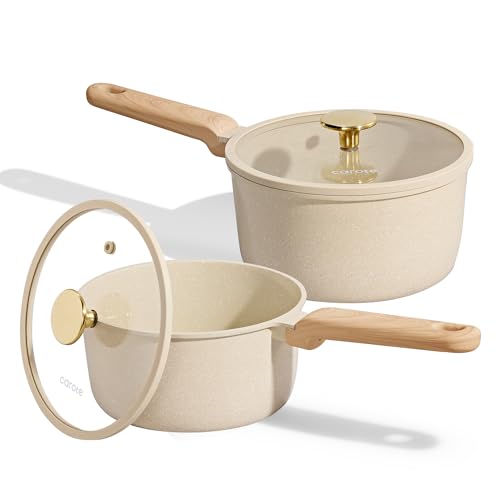
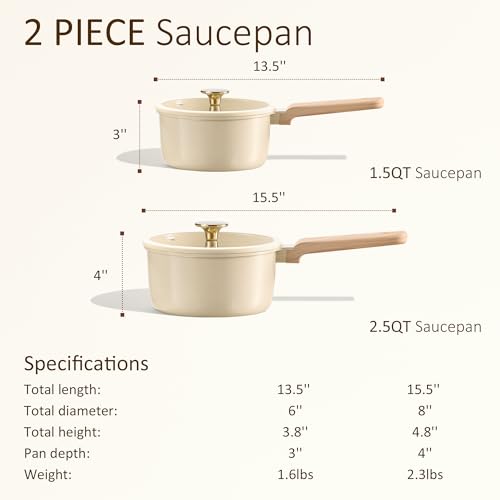
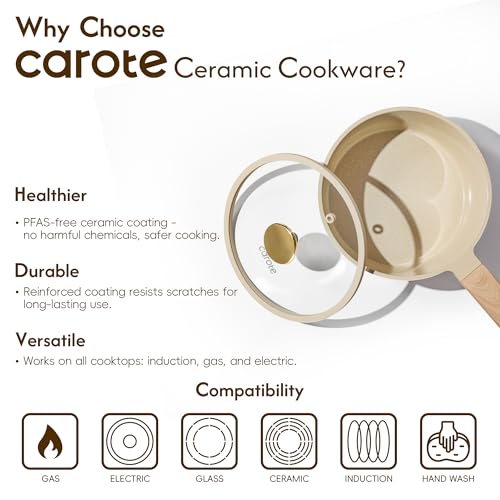
Ceramic nonstick is a niche choice, but it shines here for health-focused users. The coating is free of PFOA, PTFE, and heavy metals, which aligns with clean cooking trends. Owners report it works well for low-heat tasks like warming milk or making oatmeal, and cleanup is effortless with just a rinse. The enlarged stainless base ensures decent induction compatibility and heat spread, though not as even as tri-ply metal.
Where it falls short is longevity. Ceramic coatings typically degrade faster than hard-anodized or stainless, especially with metal utensils or high heat. This set is best treated as a short-to-mid-term solution. But at this price, it’s a low-risk way to go non-toxic. For families avoiding synthetic coatings, it’s a sensible compromise.
Product photos
SENSARTE 2.0 & 3.0 Quart Sauce Pans
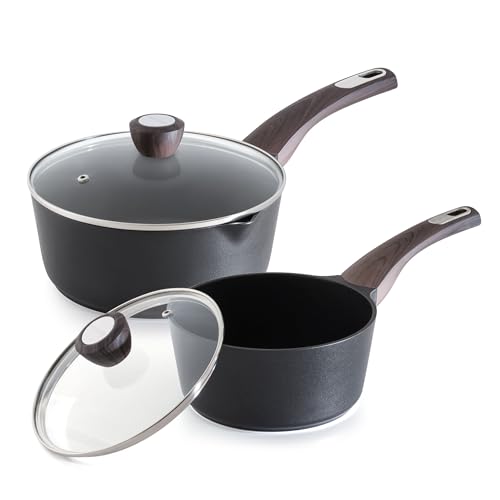
Strengths
- Double pour spout
- Non-toxic coating
- Induction ready
Trade-offs
- Plastic handle durability
- No small saucepan
- Not oven safe
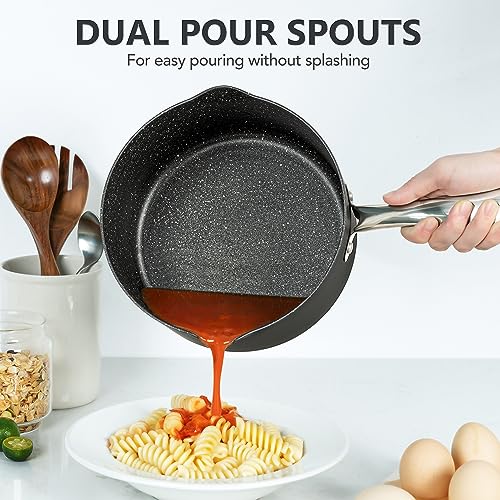
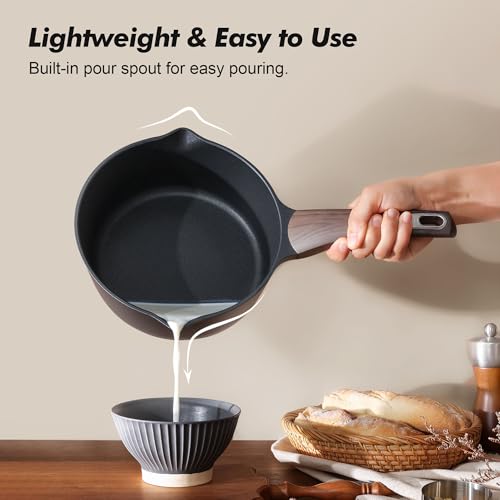
The double pour spout is a standout for left-handed users or ambidextrous kitchens, something rarely seen in standard sets. It allows smooth pouring from either side without drips, and owners who’ve struggled with right-hand-only spouts say this small detail makes a big difference. The Swiss ILAG nonstick coating is also a strong point, delivering reliable food release with minimal oil, and it’s free of PFOA and other toxins.
The die-cast aluminum body heats evenly and responds well on induction. But the wood-grain Bakelite handle, while cool to the touch, feels less durable than stainless and may degrade over time with high heat exposure. Still, for light cooking, sauces, soups, reheating, it’s a solid pick. The 2.0 and 3.0 quart combo is also more practical than smaller sets for most households.
Product photos



KOCH SYSTEME CS Stainless Steel Saucepans

Strengths
- Tri-ply base
- Cool-touch handle
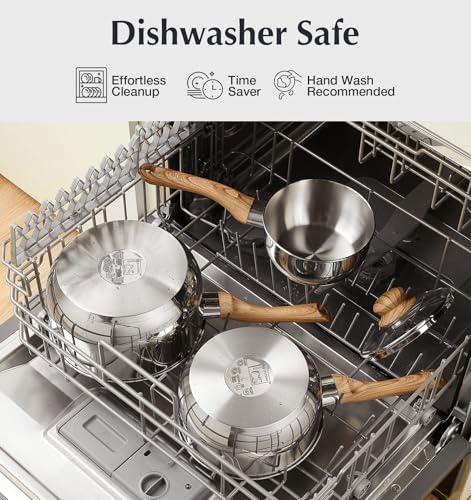
- Dishwasher safe
Trade-offs
- No glass lids
- Plastic handle feel
- Not fully clad
This 6-piece stainless steel set stands out for its tri-ply base and cool-touch Bakelite handles, which owners consistently praise for staying comfortable during long stovetop use. The 18/10 stainless steel construction is a solid choice for flavor neutrality and durability, and the even heating on induction is backed by both specs and user reports. It’s a rare find at this price point to get a full 6-piece set with lids and a fully clad base design, though the handle material may not appeal to those who prefer metal.
Still, the real win here is the handle safety. For households with kids or less experienced cooks, the heat-resistant Bakelite offers peace of mind. Compared to other stainless sets in this list, it doesn’t have glass lids or full-clad sidewalls, which limits visibility and edge-to-edge heating. But if your priority is safety and simplicity, this set delivers reliably.
Product photos


Our Testing Process
Rather than a hands-on lab test, my research for these recommendations focused on a detailed comparison of published specifications and features across numerous sets. I weighed owner reviews from multiple retailers alongside expert opinions found in established cooking publications. As someone who’s spent years understanding what makes cookware perform, I applied that knowledge to rank sets against criteria important to home cooks.
For induction saucepan sets, even heating and durability are paramount. A fully clad or tri-ply construction is key to eliminating hotspots and providing consistent results, so those were heavily weighted factors. Equally important is a secure, comfortable handle, as daily use demands a good feel and reliable grip. Finally, nonstick performance (when applicable) factored in, though stainless steel’s longevity often outweighs a coating’s initial convenience.
Specifications reliably indicate construction materials and stovetop compatibility. However, I heavily relied on owner feedback to assess real-world durability, ease of cleaning, and how well a set holds up to consistent use. Understanding induction cooktop compatibility guide is also crucial, and owner experiences shed light on whether a set truly performs as advertised on various induction surfaces. Many shoppers also seek out complete sets, so I also looked at comparable pricing for individual pieces versus complete induction hob pan sets.
Choosing The Right induction saucepan sets
Finding the right saucepan set can transform how you approach cooking. It’s about more than just having pots; it’s about having tools that respond to your needs and deliver consistent results.
A truly versatile saucepan set will feature fully-clad construction for even heating, a range of useful sizes, and durable materials like tri-ply stainless steel or quality hard-anodized aluminum. Prioritize sets compatible with your cooktop (especially if you’re investing in induction-ready cookware) and consider how easily they clean and store.
Material Matters: Stainless Steel vs. Nonstick
The first decision is material. Stainless steel is incredibly durable and reactive, meaning it won’t impart flavors to your food. However, it requires a bit more skill to prevent sticking. Look for tri-ply or fully-clad construction, like in the Michelangelo Triply set, where a layer of aluminum is sandwiched between stainless steel for even heat distribution. This eliminates those frustrating hot spots. Nonstick, like in the Michelangelo Hard Anodized set, simplifies cooking delicate foods like eggs and sauces. But be aware that nonstick coatings degrade over time, even with careful use, and may not be ideal for high-heat searing.
Size and Versatility: Building a Useful Collection
Don’t get caught up in enormous sets you’ll rarely use. A core set of three saucepans – 1-quart, 2-quart, and 3-quart – covers most everyday cooking tasks. Think about how you cook.
- If you frequently make small batches of sauces or melt butter, a dedicated 1-quart is essential.
- The 2-quart is a workhorse for simmering soups, heating vegetables, and making rice.
- A 3-quart saucepan is perfect for larger batches of sauces, boiling pasta for a small family, or preparing side dishes.
Consider sets like the EWFEN 3 Ply Stainless Steel or Michelangelo 1Qt & 2Qt Stainless Sauce Pans if you’re starting small, or if you’re looking to supplement an existing collection.
A good rule of thumb: prioritize a smaller number of high-quality, well-sized saucepans over a large set filled with redundant pieces you won’t use.
Ergonomics and Special Features
Beyond the basics, think about usability. Handles should be comfortable and stay cool enough to grip without pot holders (the KOCH SYSTEME CS set is praised for its cool-touch handles). Lids are often overlooked, but a tight-fitting, transparent lid lets you monitor cooking without releasing heat. Some sets, like the SENSARTE 2.0 & 3.0 Quart Sauce Pans, feature unique elements like dual pour spouts, which are fantastic for left-handed cooks. If you’re looking for top induction pan sets, confirm the base is compatible with your cooktop before committing. Ultimately, the best set is one that feels comfortable and intuitive to you.
Induction Saucepan Sets Compared
Here’s a comparison of key specifications for various induction saucepan sets to help you make an informed decision.
| Product Title | Capacity (Qt) | Material (Interior) | Material (Exterior) | Lid Material | Nonstick Coating | Oven Safe (°F) |
|---|---|---|---|---|---|---|
| Michelangelo Triply Stainless Steel | 1, 2, 3 | 304 Stainless Steel | 304 Stainless Steel | Tempered Glass | No | 600 (350 lid) |
| EWFEN 3 Ply Stainless Steel | 1, 2, 3 | 304 Stainless Steel | 430 Stainless Steel | Glass | No | 500 |
| Michelangelo 1Qt & 2Qt Stainless | 1, 2 | 18/10 Stainless Steel | N/A | Tempered Glass | No | 600 |
| Michelangelo Hard Anodized Nonstick | N/A | Hard-Anodized | N/A | Glass | Yes | 450 |
| CAROTE Ceramic Nonstick | 1.5, 2.5 | Ceramic | Aluminum | N/A | Yes | N/A |
| SENSARTE 2.0 & 3.0 Quart | 2.0, 3.0 | ILAG Nonstick | Stainless Steel | Glass | Yes | N/A |
| KOCH SYSTEME CS Stainless Steel | N/A | 18/10 Stainless Steel | Stainless Steel | N/A | No | N/A |
Frequently Asked Questions
What size saucepan set should I realistically buy?
A three-piece set with 1-quart, 2-quart, and 3-quart saucepans is generally sufficient for most home cooks. You can always expand later if you find yourself needing more specialized sizes, but starting with a versatile core set prevents clutter and wasted expense.
Are stainless steel saucepans really that much better than nonstick?
Stainless steel offers superior durability and won’t leach chemicals into your food, though it requires more attention to prevent sticking. While nonstick is convenient, even the best coatings degrade over time, making stainless steel a better long-term investment if you’re looking for quality saucepan sets.
How can I tell if a saucepan is truly induction compatible?
A magnet should strongly adhere to the base of the saucepan. However, owner reviews are the best indicator, as some manufacturers’ claims don’t always reflect real-world performance on different induction cooktops.
What does “tri-ply” or “fully clad” construction actually mean for cooking?
These terms indicate that a layer of aluminum (or sometimes copper) is sandwiched between layers of stainless steel. This construction provides even heat distribution, eliminating hotspots and improving cooking consistency, unlike saucepans with just a base layer. You can learn more about what is a heavy-bottomed saucepan and its benefits.
Are expensive saucepan sets always better?
Not necessarily. While higher price points often correlate with better materials and construction, a well-made, mid-range set can outperform a poorly constructed expensive one. Focus on features like fully clad construction and comfortable handles instead of solely chasing a brand name or high price.
The Bottom Line
Choosing a saucepan set always comes down to balancing what you’re willing to spend with how much fuss you want in the kitchen. If you prioritize long-term durability and even heating above all else, I recommend the Michelangelo Triply Stainless Steel set. It represents an excellent investment in quality that will pay off with consistent cooking results for years to come.
For those with specific needs, several sets stand out. If you’re building a collection from scratch or supplementing what you have, the EWFEN 3 Ply Stainless Steel set is a fantastic starting point. Shoppers seeking nonstick convenience should consider the Michelangelo Hard Anodized Nonstick, though you should remember nonstick coatings do require more mindful care. And if you’re unsure about cookware that works on induction, carefully verify compatibility before purchasing any set.
Ultimately, the most expensive set isn’t necessarily the best. Focus on construction quality – fully clad or tri-ply stainless steel is crucial – comfortable handles, and a size range that matches your cooking style. A well-chosen set of saucepans will become the foundation of countless delicious meals, and that’s what truly matters.
