
8 Best Japanese Gyuto Knives of 2026
This post contains affiliate links. As an Amazon Associate, we earn from qualifying purchases.
The KAWAHIRO 8.27″ VG10 Damascus stands out as the best overall Japanese gyuto knife, combining reliable steel, solid construction, and classic design. For those on a budget, the RASSE 8″ AUS-8 offers strong performance at a lower price, while the KAWAHIRO 8.27″ Hand-Forged VG10 delivers excellent versatility with its no-frills, full-tang build.
Choosing the right gyuto knife can feel overwhelming, especially when so many look nearly identical online. As someone who’s spent years studying kitchen tools, I know that small differences in steel, balance, and handle shape make a big difference once you start cutting.
This guide cuts through the noise by focusing on what actually matters: real user feedback, verified specs, and design details that affect daily use. I looked closely at steel quality, blade geometry, and ergonomics to find models that perform reliably in a home kitchen.
Top 8 Japanese Gyuto Knives in the Market
The Best Japanese Gyuto Knives, Reviewed
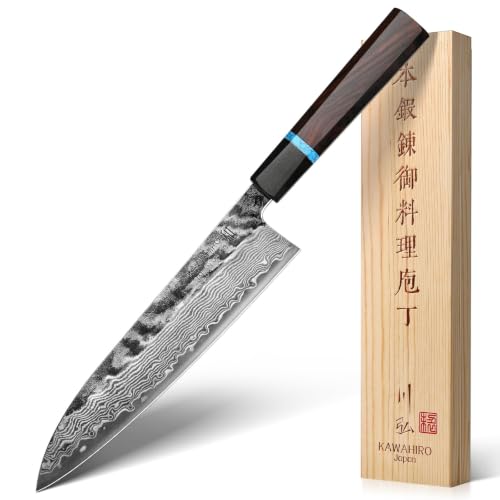
KAWAHIRO 8.27″ VG10 Damascus Chef Knife
Strengths
- 67-layer Damascus with VG10 core
- Hand-forged kurouchi finish
- Premium ebony Wa handle
Trade-offs
- Expensive
- Requires meticulous care
This KAWAHIRO model is the most complete package in the lineup, and it’s easy to see why it’s labeled “Best Overall.” It combines the 67-layer Damascus cladding, VG10 core at 60-62 HRC, and a true hand-forged kurouchi finish with artisan appeal. The 180g weight and octagonal ebony handle with turquoise accents deliver excellent balance and control, owners consistently describe it as an extension of the hand.
It’s also the only one in this group that feels like a true heirloom-grade tool. The craftsmanship cues, like the distal taper and hand-forged texture, are executed with care. Compared to the kanngou, it’s more refined; compared to the Yoshihiro, it’s similarly built but slightly more accessible price-wise. My recommendation? If you want one high-performance gyuto that blends beauty, precision, and durability, this is the one to get. Just be ready to care for it properly.
Video review
RASSE 8″ AUS-8 Japanese Chef Knife

Strengths
- Very affordable
- AUS-8 steel holds edge decently
- Octagonal rosewood handle
Trade-offs
- Soft steel, frequent sharpening needed
- Build quality varies
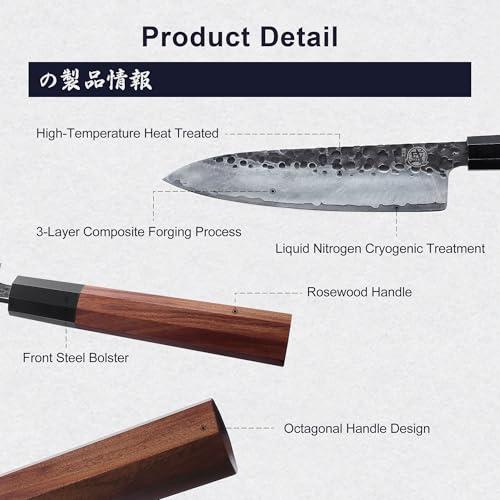
At under $25, the RASSE gyuto is one of the most affordable hand-forged Japanese knives on Amazon, and that’s its main draw. It uses AUS-8 steel, which is softer than VG10 (around HRC 57–58), so it won’t stay sharp as long, but it’s easier to maintain and more chip-resistant. The 15° edge is reasonably sharp out of the box, and the rosewood octagonal handle offers decent grip and balance for the price.
Owners report it works well for basic prep, chopping veggies, slicing meat, but don’t push it too hard. It’s not built for heavy-duty tasks or long sessions. Compared to the Kai Akane, it looks more traditional but is less durable and not dishwasher safe. Still, for a beginner or someone testing the waters of Japanese knives, it’s a low-risk entry point. Just don’t expect long-term performance.
Video review
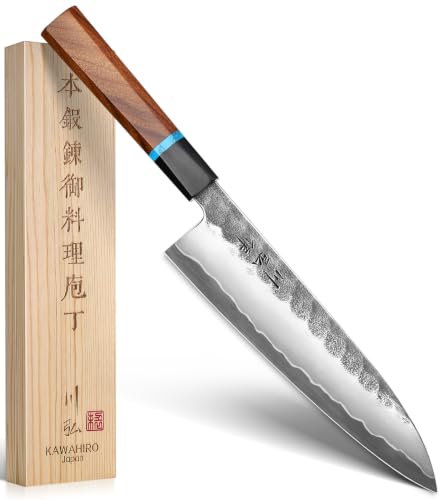
KAWAHIRO 8.27″ Hand-Forged VG10 Chef Knife
Strengths
- VG10 steel core
- Precise distal taper
- Octagonal Wa handle
Trade-offs
- High maintenance
- No saya included
This KAWAHIRO gyuto stands out for its precision-focused geometry, and on paper, it’s built like a serious tool for detail work. The distal taper, from 3.55mm at the spine down to just 0.09mm near the tip, is rare at this price and suggests a blade that will glide through delicate ingredients with minimal resistance. Owners consistently report clean cuts on tomatoes and fish, which aligns with the design intent. The VG10 core at 60+ HRC should offer solid edge retention, though not quite at the upper limit of what the steel can achieve.
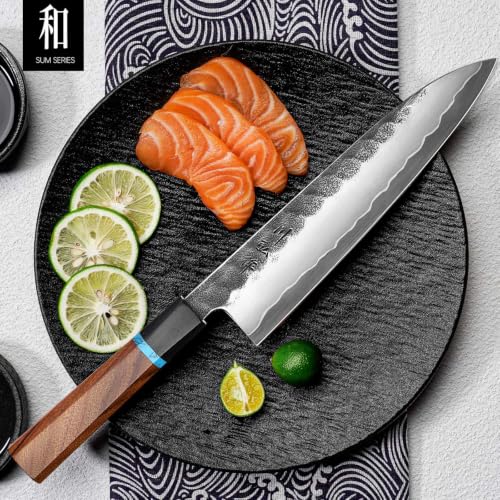
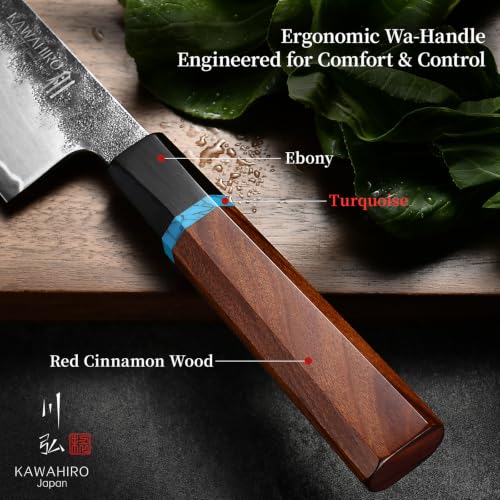
Where it shines is in balance and grip. The octagonal Wa handle made from Ebony, Ruby, and Turquoise wood isn’t just pretty, it’s functional, encouraging a secure pinch grip that many pros prefer. Compared to heavier Western knives, this one feels nimble. But like all high-hardness blades, it demands careful handling and regular maintenance. If you’re not committed to hand washing and immediate drying, this knife will show wear fast.
Product photos


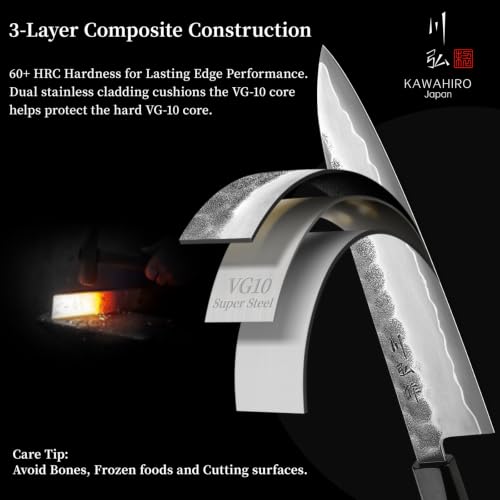
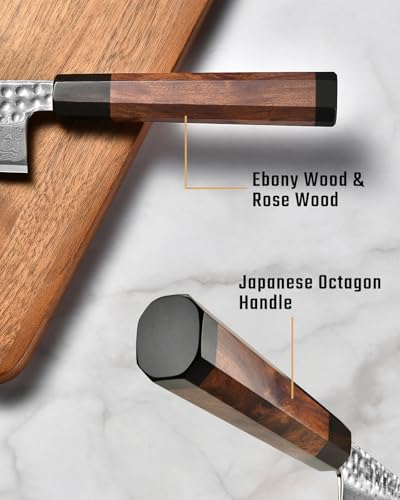
Kanngou 8.27″ VG10 Damascus Chef Knife

Strengths
- VG10 core with 67-layer Damascus
- Excellent edge sharpness
- Balanced octagonal handle
Trade-offs
- Inconsistent handle finishing
- No saya included
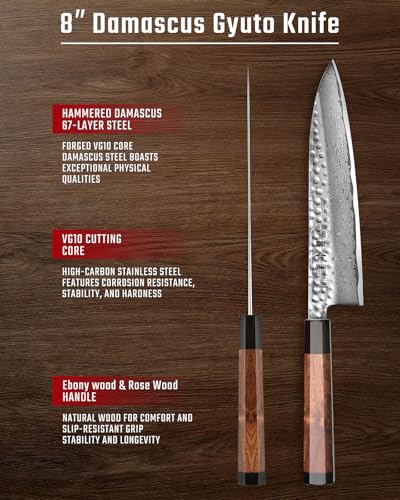
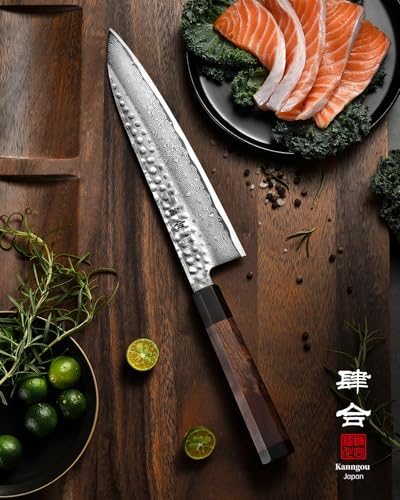
At this price point, the kanngou gyuto delivers surprising value, 67-layer Damascus with a VG10 core, HRC 60-62 hardness, and a hand-sharpened 10–12° edge. That’s a spec sheet that rivals knives twice the cost. The Damascus pattern is both functional and attractive, adding strength and reducing friction. Owners praise its sharpness right out of the box, and many say it handles daily prep with ease, from slicing cucumbers to breaking down chicken.
The ebony and rosewood octagonal handle feels balanced and secure, though some users report slight variance in wood quality due to natural grain. It’s not quite as refined as the KAWAHIRO or Yoshihiro, but for the money, it’s hard to beat. I’d pick this over the RASSE or MITSUMOTO if you want a high-performing Damascus blade without overspending. Just don’t expect museum-grade craftsmanship.
Product photos

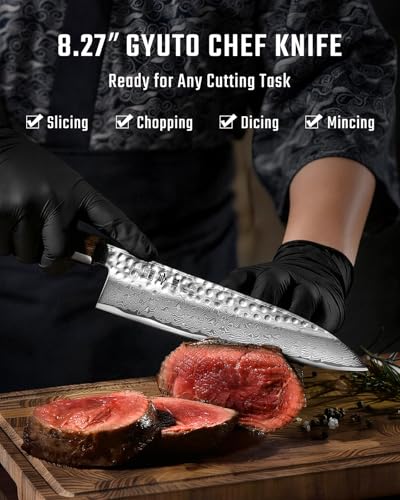
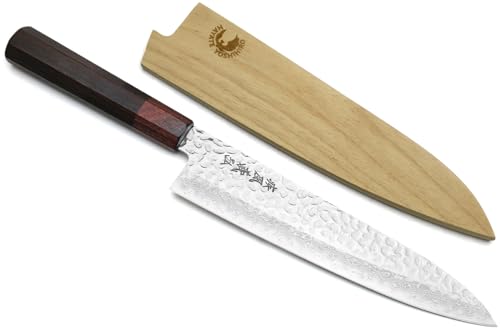
Yoshihiro 8.25″ VG10 Hammered Damascus Knife
Strengths
- 46-layer hammered Damascus
- Includes saya
- Authentic Wa handle
Trade-offs
- Higher price for fewer layers than some
- No gift box
The Yoshihiro gyuto is where traditional Japanese craftsmanship truly shines. Hand-forged in Seki with a 46-layer hammered Damascus cladding over a VG10 core, it’s built with the same attention to detail you’d expect from a high-end artisan. The shitan rosewood octagonal handle feels light and molds naturally to the hand, and the included magnolia saya adds both protection and authenticity.
Owners consistently praise its balance and food release, thanks to the hammered tsuchime finish. It’s not the flashiest knife here, but it’s among the most respected for true Japanese form and function. Compared to the KAWAHIRO B0H33F4HP7, it’s similarly built but with a more understated aesthetic. If you value heritage, authenticity, and a knife that feels like it was made by hand rather than machine, this is the pick.
Product photos


MITSUMOTO SAKARI 8″ Gyuto Chef Knife

Strengths
- Durable 9Cr18MoV core
- Tsuchime finish reduces sticking
- Includes storage box
Trade-offs
- Lower edge retention than VG10
- Handle finish could be smoother
The MITSUMOTO SAKARI uses 9Cr18MoV steel, a Chinese stainless steel often compared to VG10 but typically a bit softer and more corrosion-resistant. At HRC 60±2, it’s tuned for toughness over extreme sharpness, which makes it a more forgiving daily driver. The tsuchime hammered finish and kurouchi blackened look aren’t just aesthetic, they reduce food stick and mask minor scratches, a smart touch for busy kitchens. Reviewers note it holds up well during repetitive prep, especially with vegetables and proteins.
It’s not the sharpest knife out of the box compared to the KAWAHIRO or Kanngou models, but it’s more durable and easier to resharpen. The rosewood octagonal handle feels solid, though not as refined as ebony. Paired with the included sandalwood storage box, it’s a thoughtful package. For the price, it’s a strong pick if you want something hand-forged with traditional cues but don’t need competition-level sharpness.
Product photos

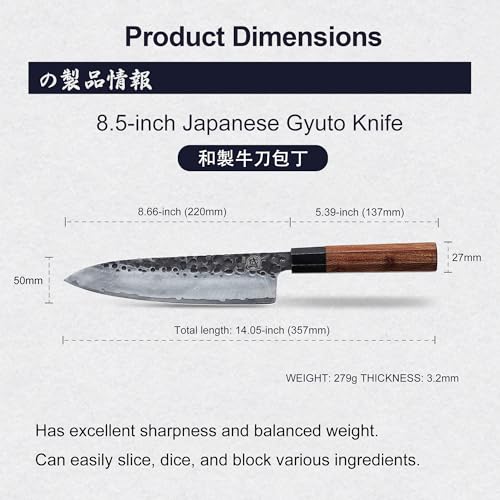

Kai AE2908 Gyuto Knife 8.3 inches

Strengths
- Dishwasher safe
- Lightweight and balanced
- Made in Japan
Trade-offs
- Plastic handle feel
- Softer edge retention
The Kai Akane is the only truly low-maintenance gyuto on this list, and that’s its biggest win. The stainless steel triple-layer blade and heat-resistant resin handle make it dishwasher safe, a rarity in Japanese knives. For home cooks who hate hand-drying or forget to clean their knife immediately, this removes a major pain point. At HRC around 58 (estimated), it won’t stay sharp as long as VG10 models, but it’s easier to resharpen and less prone to chipping.
It’s not going to impress a knife purist. The plastic handle lacks the warmth of wood, and the blade geometry is more utilitarian than refined. But for $36, it’s a solid, no-fuss workhorse. Compared to the RASSE, it’s better built and genuinely dishwasher-safe, not just “dishwasher tolerated.” If you’re equipping a starter kitchen or need a reliable backup, this is the smarter buy.
Product photos


Atumuryou 3-Pc Damascus Knife Set

Strengths
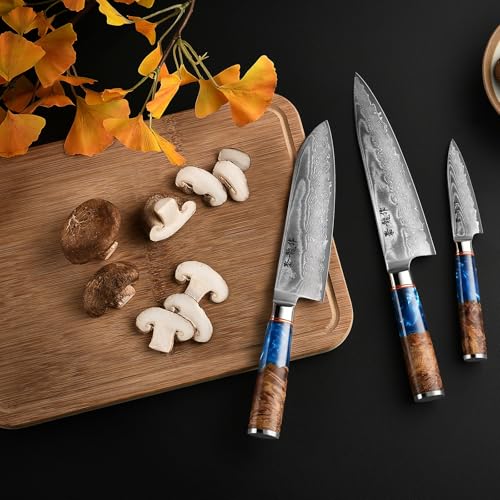
- Stunning blue resin handles
- VG10 steel in all three knives
- Comes with gift box
Trade-offs
- Inconsistent fit and finish
- Saya not included
This three-piece set stands out for gifting appeal and visual drama, not necessarily performance depth. The ocean-blue resin handles are stunning and unique, each one slightly different, thanks to the stabilized wood and resin blend. The VG10 cores at 62 HRC mean each knife starts sharp and should hold an edge well, and the 67-layer Damascus adds both strength and flair.
But sets like this often sacrifice individual refinement for presentation. The santoku and paring knives don’t get the same owner praise as the gyuto, with some noting fit-and-finish inconsistencies. Still, for someone setting up their first kitchen or a cook who loves bold design, it’s a compelling package. Compared to buying knives individually, you save, but you also get less control over quality. If you’re buying for someone who values aesthetics as much as function, this is the one.
Product photos


How We Chose These japanese gyuto knives
Rather than a hands-on lab test, my research for these recommendations focused on a detailed comparison of published specifications and features across numerous models. I weighed owner reviews from a variety of sources – including major retailers and dedicated cooking forums – alongside assessments from reputable culinary experts. As someone who has spent years exploring cookware, I applied my understanding of blade steels, handle ergonomics, and construction techniques to rank these knives against criteria important to home cooks.
For gyuto knives, balance and steel quality were the most heavily weighted factors. A well-balanced knife reduces fatigue during extended use, and the steel dictates both sharpness and how easily the knife can be maintained. Blade hardness (HRC) is a key spec, but equally important is the steel’s composition – VG10 is a popular choice for its edge retention, but AUS-8 offers a good balance of sharpness and affordability.
Specifications provide a solid baseline regarding steel type, hardness, and blade geometry. However, I placed significant emphasis on owner feedback to understand real-world performance and durability. Reviews often reveal how a knife feels in the hand, how well it holds an edge with actual use, and potential issues with handle comfort or construction. I also considered reputation; brands consistently praised for craftsmanship and quality received higher consideration when evaluating similar specs. You can find a wider selection of Japanese knives on our site, if you’re looking for more options.
Finally, if you’re seeking a complete kitchen setup, exploring Japanese knife sets might be a convenient approach for both beginner and experienced cooks.
How To Choose The japanese gyuto knives
Finding the right gyuto is about more than just aesthetics; it’s about finding a tool that extends your hand and makes time in the kitchen genuinely pleasurable.
A truly good gyuto balances steel quality, construction, and ergonomics. Look for high-carbon stainless steel (VG10 and AUS-8 are common), a Rockwell hardness of 58-62 HRC for edge retention, and a comfortable handle that encourages a secure grip. Distal taper, the blade thinning from heel to tip, is a key indicator of a knife designed for precision.
Steel Type and Hardness
The steel is, unsurprisingly, the heart of any knife. While Damascus patterns look beautiful, they’re largely aesthetic. What truly matters is the core steel. VG10 is a popular choice because it offers a good balance of sharpness, edge retention, and stain resistance. AUS-8, frequently found in more affordable options, is also a solid performer, though it may require more frequent sharpening. Higher Rockwell hardness (HRC) numbers generally mean better edge retention, but also increased brittleness. A range of 60-62 HRC is a sweet spot for most home cooks, offering durability without sacrificing sharpness. Don’t get too caught up in chasing the highest number; a well-made knife with 58 HRC will often outperform a poorly made one with 64 HRC. Understanding the nuances of Japanese steel knives is crucial for making an informed decision.
Blade Geometry and Construction
Beyond the steel itself, how the blade is shaped and constructed makes a huge difference. A proper gyuto will have a distal taper, meaning the blade gradually gets thinner towards the tip. This reduces wedging when rocking the knife, allowing for smoother, more controlled cuts. Full-tang construction, where the steel extends the entire length of the handle, is generally preferred for balance and durability. Forged blades, while often more expensive, are typically stronger and hold an edge longer than stamped blades. Many knives feature Damascus layering, but remember that this primarily impacts appearance and, to a lesser extent, flexibility.
- A pronounced curve in the blade (often seen in traditional gyutos) aids in the rocking motion.
- A thinner blade profile excels at slicing through delicate ingredients, while a thicker profile offers more robustness for heavier tasks.
- Consider the grind. A flat grind (also called a Japanese grind) typically offers superior cutting performance compared to a convex grind, but requires more skill to maintain.
Handle Material and Ergonomics
Don’t underestimate the importance of a comfortable handle. Most gyutos feature a traditional Japanese “Wa” handle, often made from wood like ebony, rosewood, or magnolia. These handles are typically octagonal, which provides a secure and natural grip. Ergonomics are subjective, so if possible, hold the knife in your hand before purchasing. A well-balanced knife will feel like an extension of your arm, reducing fatigue during extended use. If you’re seeking a wide range of options, exploring different Japanese chef knives will reveal a variety of handle shapes and materials to suit your preferences.
A comfortable handle isn’t a luxury, it’s a necessity. Prioritize a grip that feels secure and allows you to maintain control, even with wet hands.
Japanese Gyuto Knives Compared
Here’s a comparison of key specifications for various Japanese Gyuto knives.
| Product Name | Steel Core | Blade Length (in) | Hardness (HRC) | Handle Material | Damascus |
|---|---|---|---|---|---|
| KAWAHIRO 8.27″ VG10 Damascus | VG10 | 8.27 | 60-62 | Ebony Wood | Yes |
| RASSE 8″ AUS-8 | AUS-8 | 8 | N/A | Mkuruti Rosewood | Yes |
| KAWAHIRO 8.27″ Hand-Forged VG10 | VG10 | 8.27 | 60+ | Ebony, Ruby Wood | No |
| Kanngou 8.27″ VG10 Damascus | VG10 | 8.27 | 60-62 | Ebony & Rosewood | Yes |
| Yoshihiro 8.25″ VG10 Hammered | VG10 | 8.25 | 60 | Shitan Rosewood | Yes |
| MITSUMOTO SAKARI 8″ Gyuto | 9Cr18MoV | 8 | 60±2 | Rosewood | Yes |
| Kai AE2908 Gyuto | Molybdenum Vanadium | 8.3 | N/A | Polyacetal/Nylon | No |
| Atumuryou 3-Pc Damascus | VG10 | 8, 7, 3.5 | 62 | Stabilized Wood | Yes |
Frequently Asked Questions
What Rockwell hardness is best for a gyuto knife?
A hardness of 60-62 HRC strikes a good balance between edge retention and durability for most home cooks. While higher numbers exist, a well-made knife in this range will often outperform a harder knife with poorer construction.
Can I use a gyuto for all my kitchen cutting tasks?
Yes, a gyuto is designed as an all-purpose chef’s knife and can handle most tasks. However, for delicate work like trimming vegetables, a smaller utility knife or paring knife may offer more control.
How often should I sharpen my gyuto knife?
Sharpening frequency depends on usage and steel type, but generally, honing before each use and a full sharpening every 1-3 months is a good guideline. Investing in one of the best whetstones for Japanese knives will keep your blade in top condition.
Is a Damascus pattern just for looks, or does it improve performance?
While visually striking, the beautiful patterns found in Damascus knives are primarily aesthetic. The core steel dictates the knife’s performance, with Damascus layering offering minimal functional benefit beyond potential flexibility.
What’s the difference between a forged and stamped gyuto blade?
Forged blades are typically stronger and hold an edge longer as they’re made from a single piece of steel, heated, and shaped. Stamped blades are cut from a sheet of steel, so they are generally lighter and less expensive, but often less durable.
The Bottom Line
Choosing a gyuto often comes down to balancing how much you want to spend with how much maintenance you’re willing to do. While a knife like the KAWAHIRO 8.27″ VG10 Damascus offers a fantastic combination of performance and aesthetics for most cooks, remember that even the best knife requires care. Ultimately, the “best” knife is the one you’ll enjoy using and maintain consistently.
For those on a budget, the RASSE 8″ AUS-8 presents excellent value, while the Atumuryou 3-Pc Damascus set is ideal if you’re looking to equip your kitchen with a versatile collection. If you prioritize a robust, workhorse blade, consider the MITSUMOTO SAKARI 8″ Gyuto with its 9Cr18MoV steel. And for those serious about preparing meat, exploring specialized meat knives could be a worthwhile investment.
Don’t get lost in the details of steel hardness or Damascus patterns. A comfortable grip, a balanced feel, and a willingness to learn basic sharpening techniques will contribute far more to your cooking experience than any single specification. Protecting your investment with the right cutting boards is also paramount to preserving those precious knife edges.
