
7 Best Japanese Whetstones of 2026
This post contains affiliate links. As an Amazon Associate, we earn from qualifying purchases.
The Yoshihiro Toishi 1000/3000/6000 set stands out as the best overall choice for most home cooks, offering a well-rounded progression and solid build. For those on a tighter budget, the KING 1000/6000 Grit Starter Set delivers reliable performance without breaking the bank, while the Wucgea 400-8000 Grit Kit gives unmatched versatility for serious sharpening enthusiasts.
If you’ve ever struggled with a dull knife or wasted money on gadgets that don’t deliver, you know how critical a good sharpening stone really is. A poor-quality whetstone can leave your edge uneven, wear down too fast, or make the process more frustrating than it needs to be.
I looked at dozens of Japanese whetstones, comparing grit ranges, materials, and real-world feedback from users who sharpen regularly. These picks balance performance, value, and ease of use, based on what actually works in a home kitchen, not just lab specs or flashy claims.
Top 7 Japanese Whetstones in the Market
The Best Japanese Whetstones, Reviewed
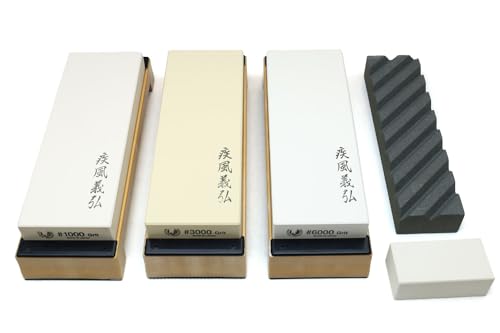
Yoshihiro Toishi Set 1000/3000/6000 Grit
Strengths
- Complete grit progression
- Includes Nagura stone
- Full-size traditional stones
Trade-offs
- High upfront cost
- Requires regular maintenance
- No angle guide
This full set, 1000, 3000, and 6000 grit stones, plus a stone fixer and Nagura, is what I’d recommend if you want a complete, high-end Japanese sharpening system in one purchase. The stones are full-size, made in Japan, and behave like traditional water stones: they soak, form slurry, and cut with the smooth progression you’d expect from pro-grade tools. Owners consistently report these last longer than budget alternatives and deliver restaurant-level results.
The real value here is in the completeness and quality control. You’re not piecing together mismatched brands or grits, everything works in harmony. Compared to the SHAPTON ceramic set, this requires more maintenance (soaking, flattening, storage), but it offers a more authentic experience and better feedback during sharpening. It’s also significantly more expensive, but if you’re serious about knife care, it’s a one-time investment that pays off.
Video review
Wucgea 400-8000 Grit Kit with Tools

Strengths
- Full grit range
- Includes flattening stone
- Leather strop included
Trade-offs
- 400-grit wears quickly
- Angle guide feels cheap
- Stones less durable
If you’re looking for the most complete sharpening ecosystem under $25, this kit is tough to ignore. The quad-sided stone covers all bases, coarse reshaping, refining, and polishing, and the inclusion of a flattening stone is rare at this price. Most budget kits skip it, then users end up with uneven surfaces that ruin edge geometry. Here, you can actually maintain the stone’s flatness long term.
The angle guide isn’t as precise as higher-end models, but it’s functional, and the bamboo base with rubber grips keeps everything stable. Some owners report the 400-grit side wears fast, which is typical for low-end stones, but having it there means you can fix chips or rebuild a bevel. When you add in the leather strop, this kit bridges the gap between basic sharpening and real blade care.
Video review
KING 1000/6000 Grit Starter Set

Strengths
- Angle guide included
- Durable plastic base
- Genuine Japanese origin
Trade-offs
- No coarse grit (400/1000)
- Guide feels plasticky
- Cloth not essential
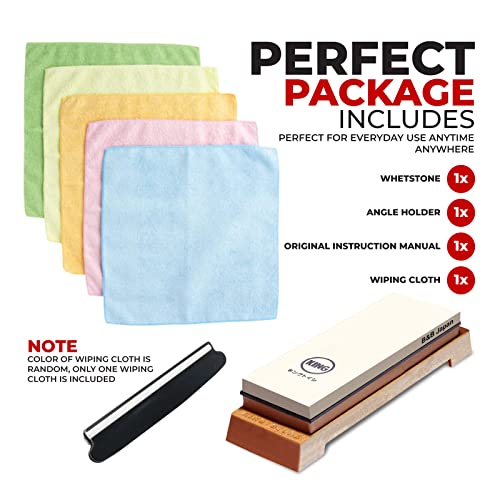
This set hits the sweet spot for newcomers who want real Japanese-style sharpening without the steep learning curve. The 1000/6000 combo stone performs like a proper synthetic water stone, soaking required, slurry builds well, and the inclusion of an angle guide is a standout for consistency. Owners note the guide isn’t perfect, but it’s far better than freehand attempts for beginners.
What pushes this set over the edge is the full package: cloth, base, and guide all included. The stone wears reasonably slowly, and while it’s not as fast-cutting as some premium brands, it’s predictable and forgiving. Compared to the Wucgea kit, it lacks a coarse side, so it’s not ideal for reviving battered blades, but for routine maintenance and moderate dulling, it’s more than capable.
Product photos


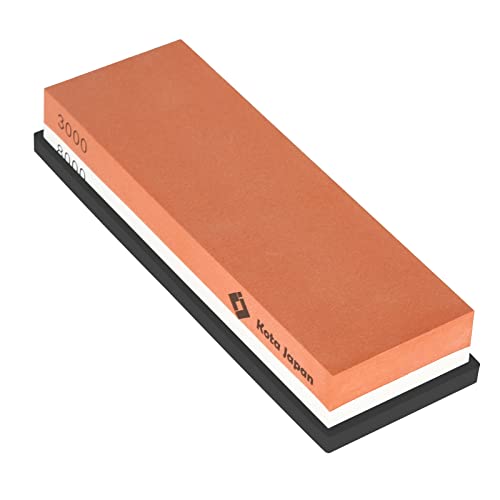
Kota 3000/8000 Grit Fine Stone
Strengths
- Dual grit efficiency
- Stable silicone base
- Consistent abrasive
Trade-offs
- Smaller footprint
- No Nagura stone
- Not for coarse work
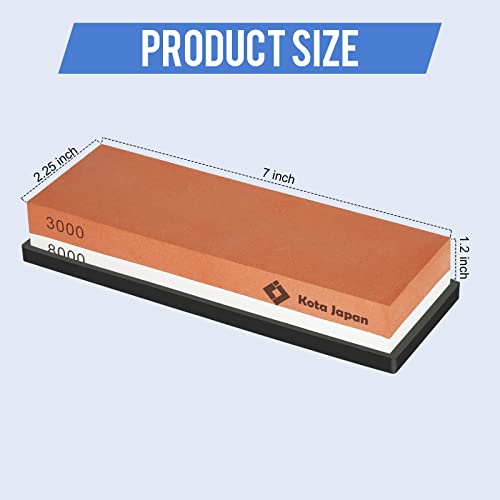
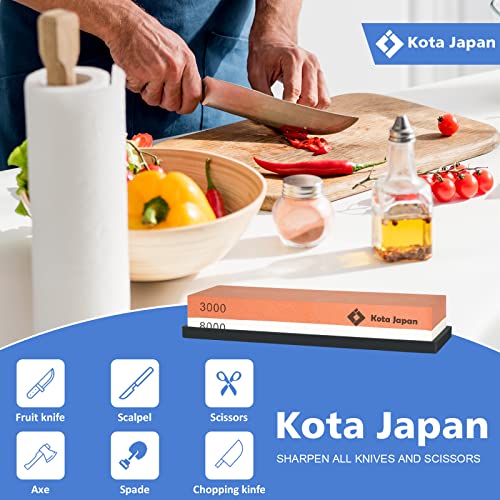
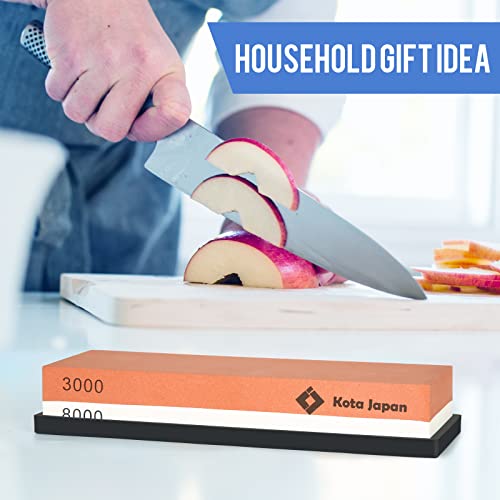
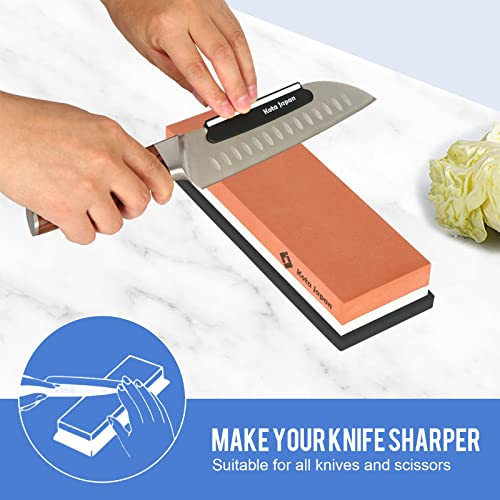
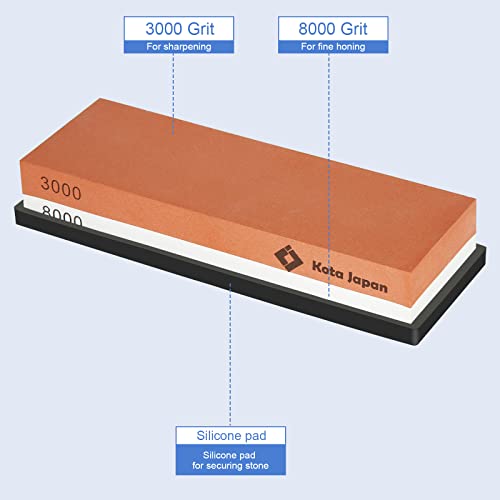
For the price, this dual-sided Kota stone punches above its weight. The 3000 to 8000 grit jump is ideal for moving from refinement to a polished edge, and reviewers frequently praise how well it works on both kitchen knives and straight razors. The aluminum oxide construction holds up well over time, and the lack of chipping or cracking is a recurring theme in owner feedback, a real win at this price point.
The included silicone base adds stability without feeling flimsy, which is more than you can say for some budget holders. That said, the stone itself is smaller than full-size Japanese standards, so if you’re used to longer strokes, you might find it a bit cramped. Still, for someone building a compact kit or needing a solid high-grit duo without breaking the bank, this is a smart buy.
Product photos
Sharp Pebble 1000/6000 Grit with Guide
Strengths
- Adjustable angle guide
- Non-slip base
- Even cutting surface
Trade-offs
- No coarse grit
- No flattening tool
- Limited for advanced users
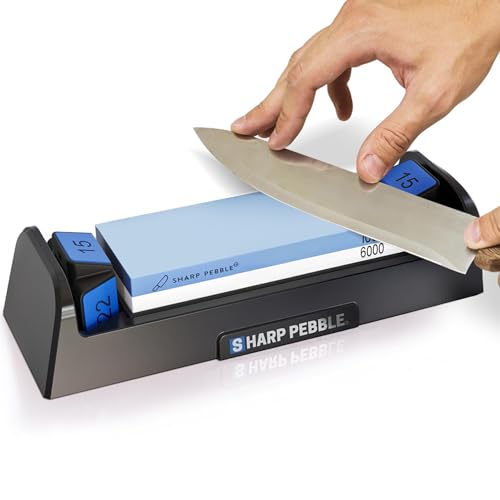
Sharp Pebble built this kit with beginners in mind, and it shows. The adjustable angle guide is the standout feature, offering preset angles that take the guesswork out of sharpening. That alone makes it more accessible than freehand stones like the KING or SHAPTON sets. The 1000/6000 stone is dense and cuts evenly, with fewer reports of crumbling than cheaper alternatives.
Owners appreciate how stable the base is and how little setup is needed, just soak and go. It’s not the fastest stone, but it’s consistent, and the design prioritizes safety and control over speed. When compared to the Wucgea kit, it lacks coarse grit and a flattening stone, so it’s not for damaged blades. But for maintaining factory edges on everyday knives, it’s one of the most user-friendly options available.
Product photos


Shapton Ha No Kuromaku 1000+5000

Strengths
- No soaking required
- Stays flat longer
- Durable storage cases
Trade-offs
- Smaller working surface
- Higher learning curve
- No angle guide
Shapton’s ceramic stones are in a different league when it comes to consistency and longevity. These are not traditional water stones, they’re splash-and-go, don’t require soaking, and the included storage boxes double as guided holders. That’s a big plus for people who hate waiting or dealing with stone trays. The #1000 grit cuts with surprising aggression for ceramic, and the #5000 delivers a refined edge that many say rivals higher-grit natural stones.
Owners love how flat these stay over time, which means less need for lapping. The downside? The surface area is slightly smaller than full-size stones, and the ceramic can feel a bit slick under certain angles. But if you value low maintenance and repeatability, and don’t mind paying for it, this set is hard to beat. Compared to the KING starter set, it’s faster, flatter, and more durable, though less beginner-friendly due to the lack of an angle guide.
Product photos


Yoshihiro #10000 Grit Finishing Stone

Strengths
- Ultra-fine polish
- Includes Nagura stone
- Large surface area
Trade-offs
- Too fine for dull blades
- Not a standalone solution
- High price for single grit
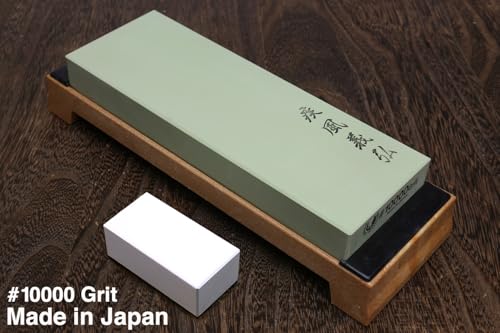
This 10000-grit Toishi stone is built for one thing: delivering a glassy, mirror-like edge that only ultra-fine polishing can achieve. On paper, it’s a specialist, not a workhorse, and owners consistently report it shines brightest when used as a final step after coarser stones. The included Nagura stone helps generate a proper slurry, which is critical at this grit level to maintain cutting efficiency and surface consistency.
At this fineness, progress is subtle, and expectations should match that. I wouldn’t recommend this as a standalone stone for dull knives, it’s simply not meant for reprofiling or heavy material removal. But for sushi chefs or precision knife enthusiasts who value edge refinement over speed, this delivers a finish that feels almost surgical. The full-size 8×2.9-inch footprint also means you’re not fighting for space during delicate strokes.
Product photos


How We Chose These japanese whetstones
Rather than a hands-on lab test, my research into Japanese whetstones involved a detailed comparison of published specifications and features across numerous models. I weighed owner reviews from multiple sources – paying close attention to patterns in reported ease of use, durability, and sharpening results – alongside expert evaluations from culinary websites and knife-focused publications. This process allowed me to build a ranking based on real-world performance expectations and value.
For Japanese whetstones, grit range and material quality were the most heavily weighted factors. A versatile set including at least 1000 and 3000 grits, and ideally extending to 6000 or 8000, provides the range needed for both repairing damage and achieving a refined edge. The material – whether white or blue corundum, or ceramic – impacts sharpening speed, feedback, and how consistently the stone wears. Properly maintaining your knives also requires attention to the surface you cut on; exploring cutting boards for Japanese knives is a good next step.
Specifications clearly indicate grit levels and stone dimensions, which are useful for understanding potential sharpening area and the stone’s longevity. However, owner feedback proved crucial for assessing how quickly a stone wears, how much “mud” it produces during use, and its overall stability. Reputation and consistent positive reviews were prioritized over marketing claims, and I also looked for insights on the quality of included accessories like bases and angle guides – things specs rarely detail. If you’re looking for additional guidance, my guide to Japanese knife sharpeners offers further insight.
How To Pick The Right japanese whetstones
Finding the right whetstone can feel daunting, but it doesn’t have to be. A good stone isn’t just about grit number; it’s about the material, its consistency, and how well it suits your sharpening style and knives.
A quality whetstone should be consistently abrasive across its surface, hold its shape during use (minimizing dishwashing), and provide sufficient feedback to allow for accurate angle control. Consider the stone’s composition – natural, synthetic, or ceramic – as this impacts its sharpening speed, fineness, and overall lifespan. Proper soaking and flattening are also critical for optimal performance.
Grit Progression & Your Needs
Many beginners assume a single grit stone will suffice, but a progression is key to a truly refined edge. Starting with a coarser grit (like 400 or 1000) removes material quickly to repair damage or establish a new bevel. Moving to medium grits (3000-5000) refines the edge, and finer grits (6000+) polish it to a razor sharpness. Don’t feel you need a massive set to begin. The KING 1000/6000 Grit Starter Set is popular for a reason; it’s a solid starting point for general kitchen knives. However, if you are working with Japanese steel knives, particularly those with very hard steels, you may find a wider grit range more beneficial.
Stone Material: Synthetic vs. Ceramic vs. Natural
Synthetic stones, like those from Wucgea and Shapton, are the most common and affordable. They generally cut faster than natural stones and are available in a wider range of grits. Ceramic stones, exemplified by Shapton’s Ha No Kuromaku series, are known for their consistent performance and ability to create a very fine polish. Natural stones, while prized by some, can be inconsistent in abrasive quality and require more skill to use effectively.
Here’s a quick breakdown:
- Synthetic: Versatile, affordable, fast cutting.
- Ceramic: Consistent, fine polish, can be more brittle.
- Natural: Traditional, requires expertise, variable quality.
Choosing the right material depends on your budget, experience level, and the type of knives you’re sharpening.
Size, Base & Accessories
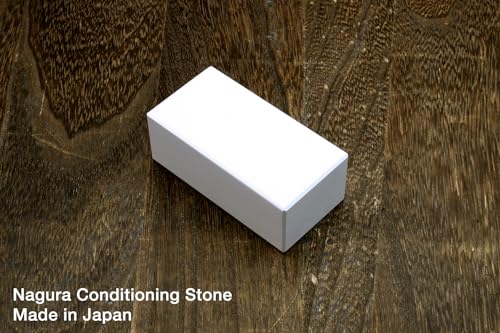
Don’t underestimate the importance of a stable base. A non-slip surface is crucial for maintaining a consistent angle, and many kits, like the Sharp Pebble, include one. A larger stone (8” x 3” is a common size) provides more surface area and makes it easier to maintain a consistent stroke. You’ll also need a nagura stone (or similar conditioning stone) to create a slurry, which helps the whetstone cut more effectively. Consider too, that a good sharpening routine isn’t just about the stone itself, but also about maintaining your tools, and finding the best whetstones for Japanese knives can be a great start to upgrading your sharpening setup.
A stable base is paramount. If your stone slides around, precise angle control becomes nearly impossible, negating the benefits of even the highest-quality abrasive.
Japanese Whetstones Compared
This table provides a reference of specifications for various Japanese whetstones to aid in comparison.
| Product Name | Grit 1 | Grit 2 | Material | Includes | Dimensions (in) |
|---|---|---|---|---|---|
| Yoshihiro Toishi Set 1000/3000/6000 | 1000, 3000, 6000 | N/A | N/A | Fixer, Nagura | 8×2.9x.9 |
| Wucgea 400-8000 Grit Kit | 400, 1000, 3000, 8000 | N/A | White Corundum | Base, Guide, Strop | N/A |
| KING 1000/6000 Grit Starter Set | 1000, 6000 | N/A | N/A | Angle Holder, Cloth | N/A |
| Kota 3000/8000 Grit Fine Stone | 3000, 8000 | N/A | Aluminum Oxide | Silicone Holder | N/A |
| Sharp Pebble 1000/6000 Grit | 1000, 6000 | N/A | N/A | Guide, Base | N/A |
| Shapton Ha No Kuromaku 1000+5000 | 1000, 5000 | N/A | Ceramic | Box | 8.25×2.75×0.5 |
| Yoshihiro #10000 Grit Finishing Stone | 10000 | N/A | N/A | Nagura | 8×2.9x.9 |
Frequently Asked Questions
What grit whetstone should I start with if I’m a beginner?
A 1000-grit stone is the best starting point for most beginners, as it’s versatile enough to handle moderately dull knives and establish a new edge without being overly aggressive. It offers a good balance between material removal and refining the blade.
How often do I need to flatten my whetstone?
You should flatten your whetstone after every 3-5 uses, or more frequently if you notice the surface becoming uneven. Consistent flattening maintains a consistent sharpening surface and prevents rounded edges on your knives.
Can I sharpen my Japanese chef’s knives with a ceramic whetstone?
Yes, ceramic whetstones are excellent for sharpening Japanese chef’s knives, as they produce a very fine polish ideal for the hard steel often used in these blades. They can be more brittle than synthetic stones, so care is needed.
What’s the purpose of the “slurry” formed when sharpening?
The slurry created during sharpening acts as an abrasive compound, improving the stone’s cutting action. It consists of dislodged metal particles and stone material, helping to polish the blade more effectively.
Are more expensive whetstones always better?
Not necessarily; price doesn’t always equate to performance. While higher-priced stones often use premium materials or have more precise manufacturing, a well-maintained, moderately priced synthetic stone can deliver excellent results, particularly if you’re also investing in complete Japanese knife sets to hone your skills.
The Bottom Line
Choosing a whetstone often comes down to balancing control and convenience. While a full progression of stones offers the ultimate in sharpening precision, the Wucgea 400-8000 Grit Kit delivers excellent versatility for most home cooks without demanding an overwhelming investment in time or money. It provides a solid range of grits and helpful accessories to get you started.
For those just beginning, or looking for a simple, effective solution, the KING 1000/6000 Grit Starter Set remains an excellent choice. If you’re specifically working with high-quality Japanese knives, or prefer the refinement of ceramic, the Shapton Ha No Kuromaku 1000+5000 is worth considering, though it’s a step up in price and requires a bit more technique.
Ultimately, the “best” whetstone isn’t about a single number or material. It’s about understanding your knives, developing a consistent technique, and prioritizing a stable base and consistent angle – those fundamentals will yield sharper, longer-lasting edges than any premium stone ever could.
