
9 Best Vegetable Steamer Pots for 2026
This post contains affiliate links. As an Amazon Associate, we earn from qualifying purchases.
The SUNHOUSE 4.6 QT Stainless Steel Steamer Pot stands out as the best overall choice, combining solid tri-ply construction, reliable even heating, and a practical size for most households. For those on a tighter budget, the ROCKURWOK 2 qt Ceramic Nonstick Sauce Pan with Steamer offers a compact, affordable option that still handles basic steaming well. And if you want maximum flexibility, the Oster 3-Quart Dutch Oven with Steamer Basket doubles as a Dutch oven, making it a smart pick for versatile cooking.
Steaming vegetables should be simple, but the wrong pot can turn it into a frustrating mess, uneven cooking, warped bases, or flimsy baskets that collapse under weight. After years of evaluating cookware, I know that performance comes down to smart design, not flashy claims.
This guide cuts through the noise, focusing on real-world usability, durability, and value. We looked at specs, owner feedback, and build quality to find steamer pots that actually work, not just ones that look good on the shelf.
Top 9 Vegetable Steamer Pots in the Market
The Best Vegetable Steamer Pots, Reviewed
SUNHOUSE 4.6 QT Stainless Steel Steamer Pot

Strengths
- Toxin-free construction
- Even heat distribution
- Dishwasher safe
Trade-offs
- No straining lid
- Slightly smaller than 5-quart models
- Mirror finish shows marks
This one checks nearly every box: tri-ply base, 4.6-quart capacity, toxin-free stainless steel, and a clear glass lid with a tight seal. It’s not the largest, but it’s the most balanced, a true ‘best overall’ contender. The steamer basket lifts out easily, and the base works well on its own for soups and sauces. Owners appreciate the even heating and the fact that it’s completely free of PFOA, lead, and cadmium, which matters for health-conscious households.
Compared to the LOLYKITCH, it’s slightly smaller but more refined in design, with a smoother interior and better lid fit. The tri-ply base performs well on induction, and the handles stay cool enough for safe handling. While it doesn’t have straining spouts on the lid, the overall build quality and versatility make it the smartest all-around pick. For most home cooks, this is the one to get.
Video review
ROCKURWOK Ceramic Nonstick Sauce Pan with Steamer

Strengths
- Nonstick ceramic coating
- Easy cleanup
- Wooden handle
Trade-offs
- Coating wears over time
- Not as durable
- Not oven safe
This is the only nonstick option in the lineup, which makes it a niche pick. The ceramic coating is PFOA-free and does make cleanup easier, owners confirm food slides right off. The wooden handle adds a nice aesthetic touch and stays cool, though it requires assembly.
But here’s the catch: nonstick and steaming don’t always go hand in hand. Steaming is typically a gentle method that doesn’t require nonstick surfaces, and ceramic coatings degrade over time, especially with metal utensils or high heat. While it works for light steaming and boiling, it’s less durable than stainless steel models. Compared to the Oster or SUNHOUSE pots, it’s less versatile and not built to last. I’d only recommend it if easy cleanup is your top priority and you’re okay with replacing it in a few years.
Video review
Chefbee 3.2QT Stainless Steel Steamer Pot

Strengths
- Affordable price
- Solid tri-ply base
- Multi-functional basket
Trade-offs
- Handles can heat up
- Not oven safe
- Basic finish
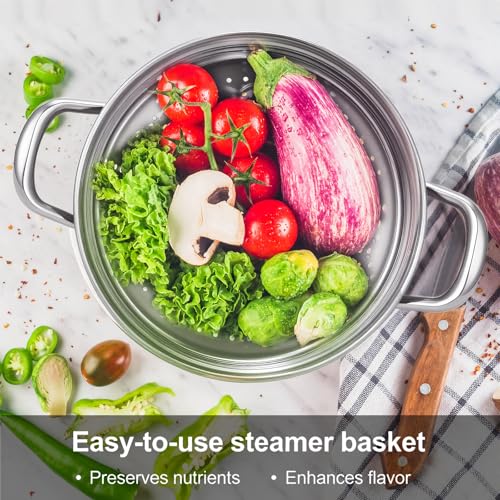
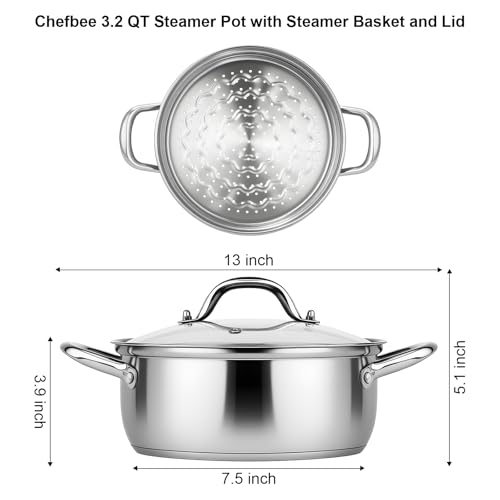
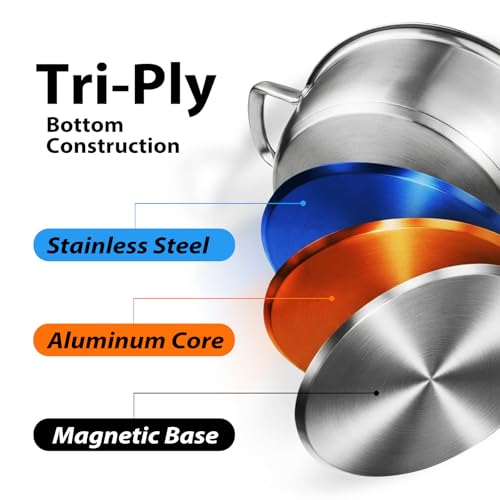
At under $25, this Chefbee steamer delivers a lot of function for the money. The 3.2-quart size fits 2 to 4 servings comfortably, and the tri-ply bottom ensures decent heat distribution, not quite full-clad, but better than single-layer pots. Owners praise its sturdiness and the included glass lid with steam vent, which lets you monitor cooking without lifting and losing heat.
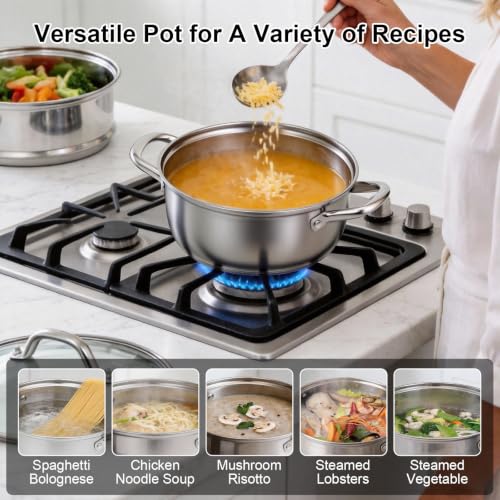
It’s a no-frills workhorse, but that’s the point. Compared to the Kirecoo model, it’s nearly identical in specs and performance, though some feedback suggests the handles feel slightly less insulated. Where it wins is in versatility, it’s frequently used for everything from steaming dumplings to boiling pasta to camping trips. The steamer basket doubles as a colander, which many find convenient. For budget-conscious buyers, this hits the sweet spot.
Product photos
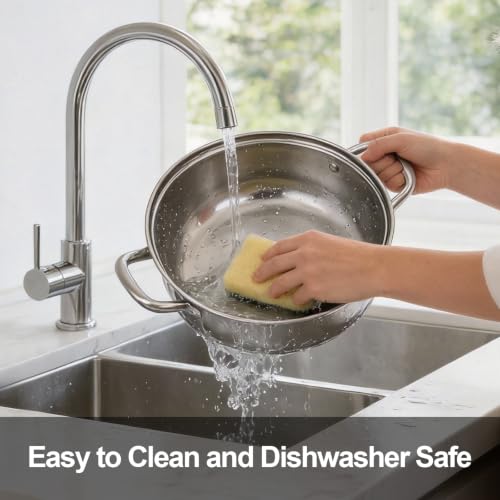
SLOTTET Tri-Ply Whole-Clad Stainless Steel Saucepan

Strengths
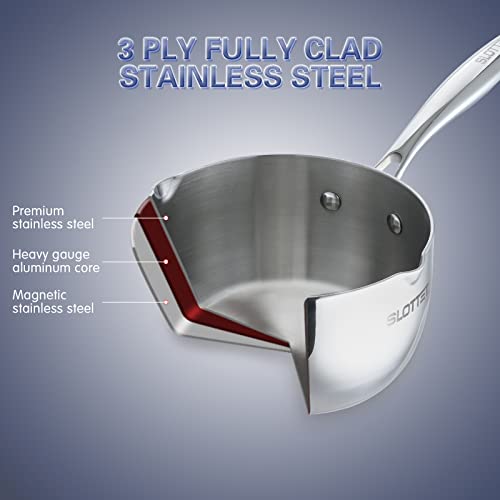
- Full tri-ply construction
- Even heat distribution
- Straining lid
Trade-offs
- No multi-tier option
- Higher price
- Limited capacity
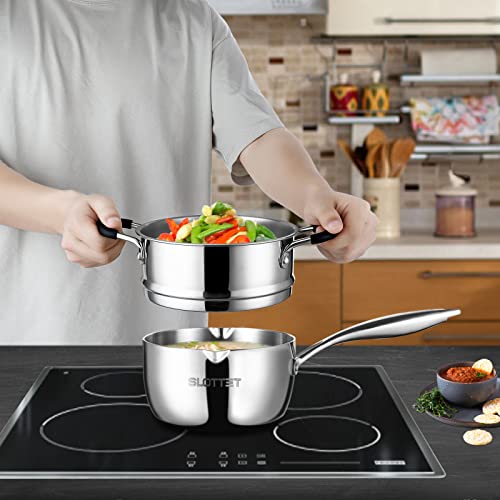
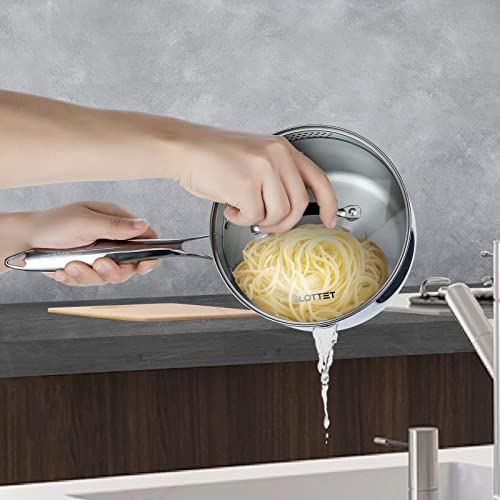
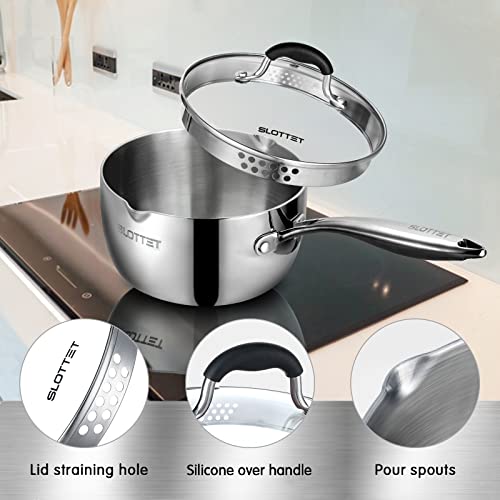
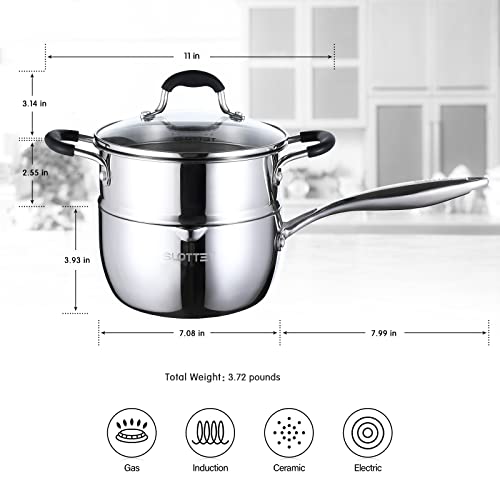
If even heating is your priority, this tri-ply saucepan is a standout. The full-clad construction means heat moves through the entire pot, not just the base, which is rare at this price. On paper, that translates to fewer hot spots and more consistent steaming, and owners confirm it, especially when using induction. The glass lid with straining spouts is a thoughtful touch, eliminating the need for a separate colander.
It’s not the largest steamer here, but its 2.5-quart capacity strikes a balance between portability and usability. Compared to the Oster model, it heats more evenly and works better across all stovetops, especially induction. The only downside is the lack of a second tier, you can’t steam and simmer two dishes at once unless you use the basket over liquid in the same pot. Still, for precision cooking, this is one of the most technically sound options.
Product photos
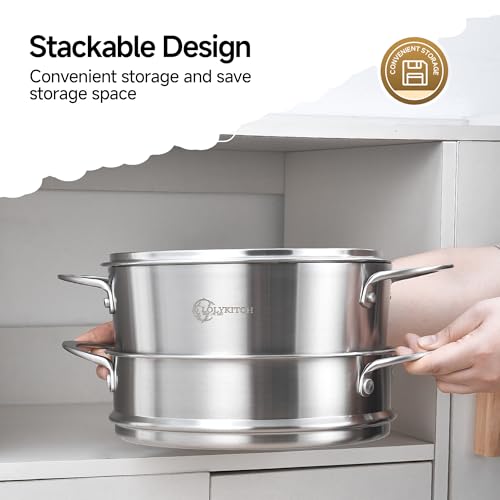
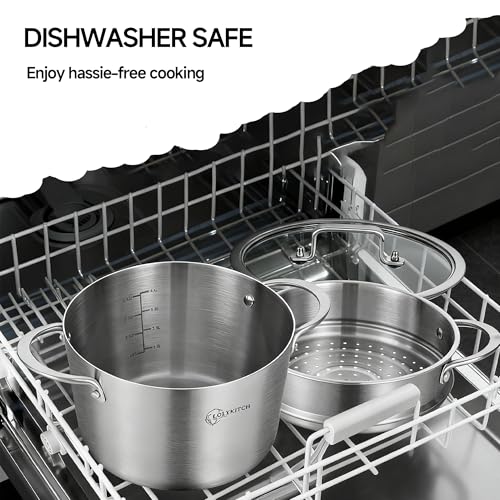
LOLYKITCH 5-Quart Tri-Ply Stainless Steel Steamer

Strengths
- Large 5-quart capacity
- Brushed finish hides wear
- Sturdy tri-ply build
Trade-offs
- Heavy when full
- No straining lid
- Takes up storage space
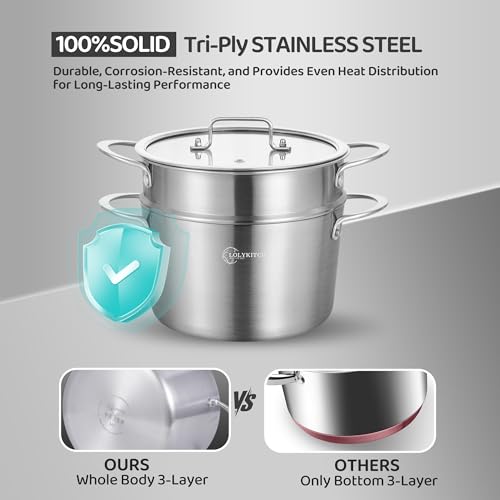
This is the go-to if you regularly cook for three or more. The 5-quart capacity is generous, and the tri-ply construction adds real durability, reviewers note it feels heavy and stable, especially on induction. The brushed finish is a smart touch, hiding fingerprints and scratches better than mirror-polished models.
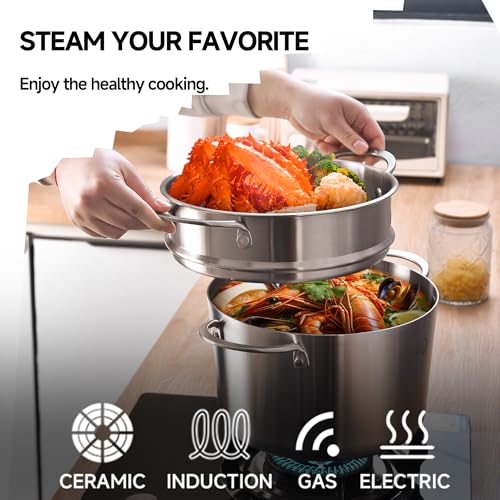
It’s marketed as a 3-piece set, but the key feature is the two-tier design: simmer soup below, steam corn or tamales above. Owners love using it for seafood boils and holiday prep. Compared to the SUNHOUSE model, it has a slightly larger capacity and a more professional build, though the lid doesn’t have straining holes. Cleanup is straightforward, and the riveted handles inspire confidence when moving a full pot. For large households, this is the most practical long-term investment.
Product photos

Kirecoo 3.2QT Stainless Steel Steamer Pot

Strengths
- Excellent price
- Silicone-wrapped handles
- Dishwasher safe
Trade-offs
- Not oven safe
- Basic heat distribution
- Finish shows water spots
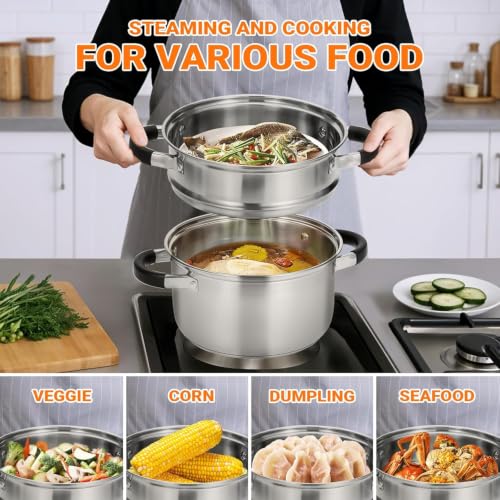
This is the best value pick, it costs less than $25 and delivers performance close to pricier models. The tri-ply base heats quickly and evenly, and the included glass lid with steam vent works well for monitoring without losing heat. Owners consistently report using it for everything from steaming broccoli to boiling pasta to making soups.
The silicone-wrapped handles are a standout, staying cool even after prolonged boiling. Compared to the Chefbee model, it’s nearly identical in size and features, but some feedback suggests the rivets are slightly more secure. It’s not full-clad, so heat doesn’t travel up the sides, but for stovetop steaming, it performs reliably. For the price, it’s hard to beat.
Product photos


ZENFUN 1.8 Quart Mini Steamer Pot

Strengths
- Compact two-tier design
- Cool-touch handles
- Mirror-polished finish
Trade-offs
- Shallow steamer basket
- Not oven safe
- Limited capacity
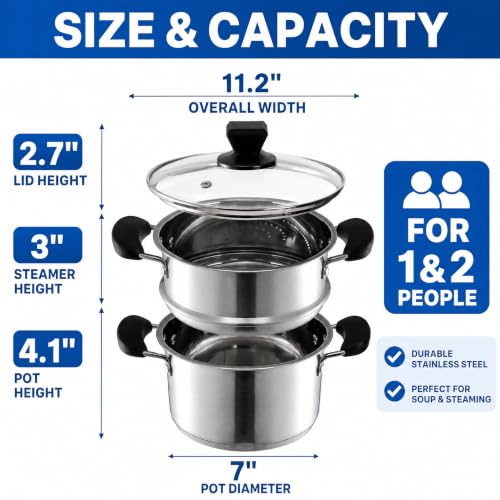
Slightly larger than the Ohtomber, this 1.8-quart steamer is still firmly in the ‘small batch’ category. The two-tier design works well for one to two people, steam veggies above, simmer broth below. The bakelite handles stay cool, and the glass lid offers a clear view, which many owners find helpful for monitoring delicate foods.
It’s made from 304 stainless steel, which is a plus for corrosion resistance, and the mirror finish cleans up easily. However, it’s not oven-safe, which limits its versatility compared to full-clad models. The steamer basket is functional but shallow, so it’s not ideal for large portions. Compared to the Ohtomber, it offers a bit more capacity and a more modern look, but the build feels a little lighter.
Product photos

Oster 3-Quart Dutch Oven with Steamer Basket

Strengths
- Compact size
- Oven safe
- Dishwasher safe
Trade-offs
- Small capacity
- Basic basket design
- Shows water spots
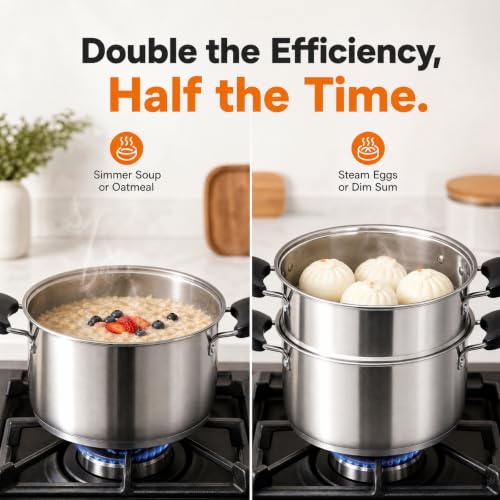
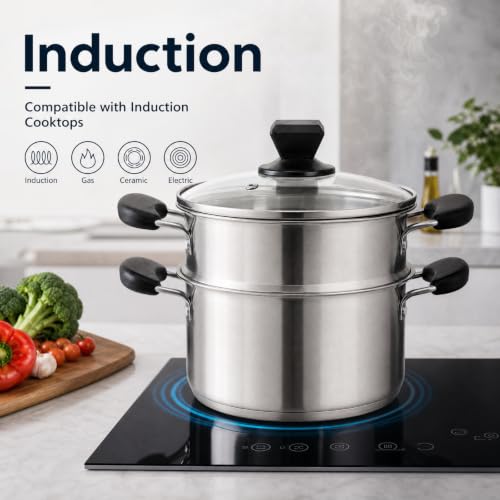
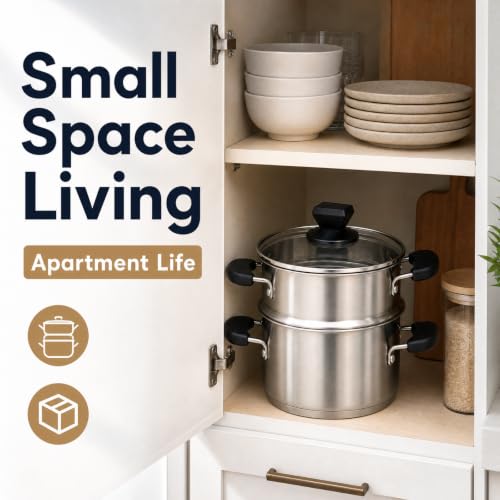
This is a smart buy if you want a compact, all-in-one solution for steaming and braising but don’t need a large capacity. The 3-quart size is ideal for one to two people, and the fact that it’s oven-safe to 400°F gives it real versatility most basic steamers lack. Owners consistently report using it for everything from steaming broccoli while simmering risotto to finishing short ribs in the oven. The stainless steel build holds up well over time, though some note the finish shows water spots easily.
Where it stands out is in its simplicity, no extra layers, no complicated stacking. It’s a Dutch oven first, steamer second, which means it’s not the fastest steamer on the market, but it’s more flexible than dedicated multi-tier pots. Compared to larger models like the LOLYKITCH 5-quart, this one wins on storage efficiency and stovetop-to-oven use, but loses on batch cooking.
Product photos


Ohtomber 1.5 Qt Tri-Ply Saucepan with Steamer

Strengths
- Compact and lightweight
- Stay-cool handles
- Easy to store
Trade-offs
- Very small capacity
- Not for family meals
- No oven use
This tiny pot is perfect if you live alone or cook for two. The 1.5-quart size is compact, and the tri-ply bottom delivers surprisingly good heat response for such a small unit. It’s frequently used for quick steamed veggies, single-serve oatmeal, or reheating baby food, tasks where larger pots are overkill.
Owners like the stay-cool handles and the clear glass lid with a steam vent, which lets you watch food without lifting. It’s also easy to store and dishwasher safe, making cleanup simple. Compared to the ZENFUN model, it’s slightly smaller but better built, with more secure rivets and a tighter-fitting basket. It won’t replace a full-sized steamer, but for minimalists or apartment dwellers, it’s a smart space-saving tool.
Product photos
How We Chose These vegetable steamer pots
As someone who’s spent over a decade immersed in the world of cookware, I approached researching vegetable steamer pots by first looking at the core construction and features across a wide range of models. Rather than a hands-on lab test, this is a research-led comparison of published specifications – capacity, materials, cooktop compatibility – and weighing owner and expert reviews. I then applied my experience to assess how those features translate into real-world performance and value.
For vegetable steamer pots, the most important factors are even heating and build quality. Consistent heat distribution is vital for properly steamed vegetables, preventing hot spots that can lead to uneven cooking. Durable construction, particularly a tri-ply base in stainless steel models, ensures longevity and prevents warping. Capacity also plays a role; smaller pots are ideal for individuals or couples, while larger families will benefit from a larger volume. I focused on these elements when evaluating the available options.
Specifications reliably indicate a pot’s size and materials, but owner feedback and reputation are crucial for assessing durability and real-world performance. I paid close attention to reports of warping, handle comfort, and ease of cleaning. I also considered how well different models performed across various cooktops, as indicated in both manufacturer claims and user experiences. You can find more information about dedicated steamer pots if you want to explore a wider range of choices. Knowing what you’ll be making is also helpful, and there are many delicious steamer recipes to explore.
How To Pick The Right vegetable steamer pots
Choosing the right vegetable steamer pot can truly elevate your cooking, offering a healthier way to prepare meals while preserving vital nutrients.
A quality steamer pot prioritizes even heat distribution for consistent cooking, durable construction to withstand regular use, and a design that accommodates various stovetops. Consider the capacity needed for your household size, the material’s safety (avoiding harmful chemicals), and the convenience of cleaning and storage. A well-made pot will simplify meal prep and deliver reliably delicious results.
Capacity and Household Size
The size of the steamer pot is paramount. Don’t fall into the trap of assuming bigger is always better. If you’re primarily cooking for one or two people, a larger pot will be inefficient and require more energy to heat. Conversely, a pot that’s too small will leave you constantly refilling it. I often recommend starting with a 3- to 5-quart capacity for a typical family of four, but adjust based on your usual cooking habits. If you frequently entertain, or prepare large batches of food, you’ll want to lean towards the larger end of that spectrum.
Material and Construction
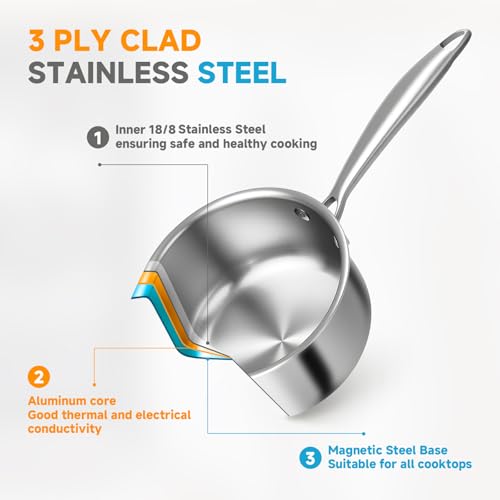
Stainless steel is generally the best choice for durability and safety, but the construction matters immensely. Tri-ply stainless steel – featuring a core of aluminum sandwiched between layers of stainless steel – offers superior heat distribution, preventing hot spots and ensuring food cooks evenly. Avoid pots with thin, single-layer bottoms, as these are prone to warping and uneven heating. Look for pots that clearly state they are free of PFOA, lead, and cadmium, especially if you’re concerned about chemical leaching. If you’re looking for other options, consider reading our guide to the best steamer pots.
- A basic stainless steel pot will last for years, but may require more attention to prevent sticking.
- Nonstick ceramic coatings offer easy cleanup, but they tend to degrade over time and may not be as durable as stainless steel.
- A tri-ply construction is a worthwhile investment, as it delivers consistent results and prevents hot spots, even on induction cooktops.
Versatility and Features
Beyond simply steaming, consider what else you want your pot to do. A steamer pot that can also function as a stockpot or saucepan offers greater value. Features like a tight-fitting lid with a steam vent, cool-touch handles, and a removable steamer basket add to the convenience. The ability to transition from stovetop to oven (up to a certain temperature) is also a plus. Don’t underestimate the importance of a well-designed steamer basket; it should fit securely within the pot and allow for efficient steaming. Knowing what to steam is just as important as knowing how to steam!
Never preheat an empty stainless steel steamer pot on high heat for an extended period. This can cause warping or damage to the base. Start with a lower heat setting and gradually increase as needed.
Vegetable Steamer Pots Compared
Here’s a comparison of key specifications for various vegetable steamer pots to help you make an informed decision.
| Product Title | Capacity | Material | Compatible Stovetops | Features | Steamer Basket Included? |
|---|---|---|---|---|---|
| SUNHOUSE 4.6 QT Stainless Steel Steamer Pot | 4.6 qt | Stainless Steel | All | Tri-Ply Bottom, Dishwasher Safe | Yes |
| ROCKURWOK Ceramic Nonstick Sauce Pan with Steamer | 2 qt | Ceramic Non-Stick | All | Non-Stick, PFAS-Free | Yes |
| Chefbee 3.2QT Stainless Steel Steamer Pot | 3.2 qt | Stainless Steel | All | Tri-Ply Bottom, Glass Lid | Yes |
| SLOTTET Tri-Ply Whole-Clad Stainless Steel Saucepan | N/A | Stainless Steel | All | Tri-Ply, Strainer Lid | Yes |
| LOLYKITCH 5-Quart Tri-Ply Stainless Steel Steamer | 5 qt | Stainless Steel | All | Tri-Ply, Brushed Finish | Yes |
| Kirecoo 3.2QT Stainless Steel Steamer Pot | 3.2 qt | Stainless Steel | All | Tri-Ply Bottom, Silicone Handle | Yes |
| ZENFUN 1.8 Quart Mini Steamer Pot | 1.8 qt | Stainless Steel | All | 2-Tier, Glass Lid | Yes |
| Oster 3-Quart Dutch Oven with Steamer Basket | 3 qt | Stainless Steel | All, Oven-Safe to 400°F | Dutch Oven + Steamer | Yes |
| Ohtomber 1.5 Qt Tri-Ply Saucepan with Steamer | 1.5 qt | Stainless Steel | All | Tri-Ply, Visible Lid | Yes |
Frequently Asked Questions
What size steamer pot do I really need for a family of six?
A 6- to 8-quart capacity steamer pot is generally best for a family of six, allowing enough space to cook a substantial amount of vegetables at once. Smaller sizes will require multiple batches, extending cooking time.
Are ceramic non-stick steamer pots as durable as stainless steel?
Generally, no. While ceramic non-stick offers easy cleanup, the coating tends to degrade faster than stainless steel, typically lasting 2-5 years with proper care, whereas a quality stainless steel pot can last a lifetime.
Can I use a steamer pot on an induction cooktop?
Most of the models I recommend are compatible with induction cooktops, but always confirm the manufacturer’s specifications. Stainless steel pots with a magnetic base (check product details) will work on induction, while aluminum alone will not.
What’s the difference between a dedicated steamer and a pot with a steamer basket?
A dedicated steamer often has a more efficient steaming design, but a pot with a removable steamer basket offers greater versatility. You can use the pot for other cooking tasks beyond steaming, making it a more practical choice for many kitchens, especially if you want to understand more about steamer pot uses.
How important is the lid when choosing a steamer pot?
The lid is very important. A tight-fitting lid is essential for trapping steam and cooking vegetables efficiently. Look for a lid with a steam vent to prevent pressure buildup and a glass knob to monitor cooking progress without lifting the lid and releasing heat – a key component of how steamers work.
The Bottom Line
Ultimately, choosing a vegetable steamer pot comes down to balancing convenience with control. While a nonstick option like the ROCKURWOK Ceramic Nonstick Sauce Pan with Steamer might seem appealing for easy cleanup, I consistently find that the durability and even heating of stainless steel provide the best long-term results. For overall performance and versatility, the SUNHOUSE 4.6 QT Stainless Steel Steamer Pot stands out as a fantastic choice – the tri-ply construction ensures consistent cooking, and its 4.6-quart capacity suits most households.
If you’re primarily cooking for one or two people, the ZENFUN 1.8 Quart Mini Steamer Pot is an excellent, space-saving option. For those needing a multi-purpose pot, the Oster 3-Quart Dutch Oven with Steamer Basket offers the flexibility of a Dutch oven alongside steaming capabilities. And don’t overlook the importance of investing in quality vegetable steamer baskets to complement your pot and maximize its functionality.
More than any specific feature or price point, remember that consistent heat and a well-constructed pot are the foundations of perfectly steamed vegetables. Understanding the steamer basket function and choosing a material that distributes heat evenly will always yield better results than chasing the latest trends or focusing solely on a low price tag. Prioritize quality construction and thoughtful design, and you’ll be enjoying flavorful, nutritious meals for years to come.
