
9 Best Wireless Cooking Thermometers of 2026
This post contains affiliate links. As an Amazon Associate, we earn from qualifying purchases.
The ThermoMaven 3000FT Wireless Thermometer stands out as the best overall pick for its exceptional range and reliable RF connectivity, while the HOPEPOP Wireless Bluetooth Thermometer offers strong accuracy and dual probes at a more accessible price point. For those prioritizing smart features and WiFi convenience, the ThermoMaven WiFi Wireless Meat Thermometer is a solid versatility choice.
Choosing the right wireless cooking thermometer shouldn’t mean guessing whether your steak is done or fighting with a finicky app. Too many models promise precision but fail when you need them most, dropping connection during a long smoke or giving inconsistent readings.
This guide cuts through the noise, focusing on what actually matters: proven accuracy, stable connectivity, and real-world usability. I researched each model based on specs, owner feedback, and expert insights to highlight thermometers that deliver consistent performance without unnecessary gimmicks.
Top 9 Wireless Cooking Thermometers in the Market
The Best Wireless Cooking Thermometers, Reviewed
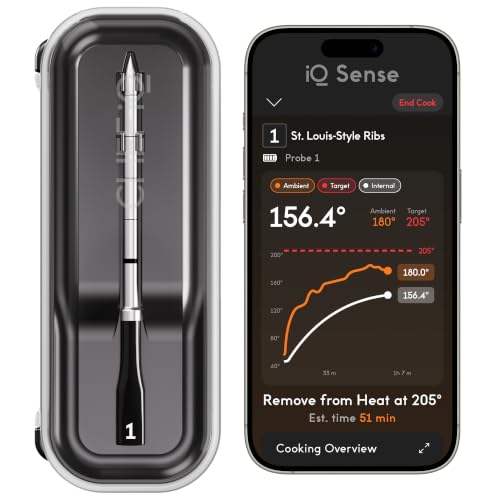
CHEF iQ Sense Smart Wireless Thermometer
Strengths
- WiFi unlimited range
- Five-sensor accuracy
- Ultra-thin probe
- Long battery life
- Dishwasher-safe probes
Trade-offs
- No color-coded probes
- Only two probes included
- App required for full features
The CHEF iQ Sense Gen3 stands out in a crowded field by combining WiFi unlimited range with solid build quality and a genuinely useful app ecosystem. For someone like me who values both kitchen performance and smart integration, this one hits the sweet spot between professional accuracy and home cook convenience. The five sensors, four internal, one ambient, deliver consistent readings that owners say match up well with manual checks, and the ultra-thin probe design is a real win for preserving meat integrity.
What really sets it apart is the unlimited WiFi range, which lets you monitor from anywhere, not just within Bluetooth limits. That’s a big deal if you’re hosting and want to step away from the grill or smoker without losing connection. The app offers guided cooking and USDA presets, which newer cooks will appreciate. Compared to Bluetooth-only models, this is the smarter pick if you want true remote monitoring without tethering your phone to a single spot.
Video review
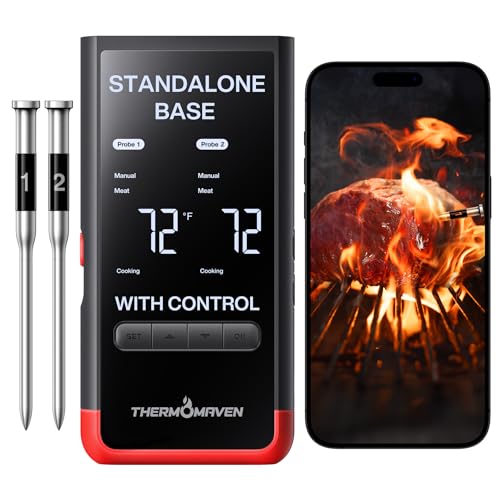
ThermoMaven WiFi Wireless Meat Thermometer
Strengths
- Unlimited WiFi range
- 752°F heat resistance
- NIST & HACCP compliant
- IPX8 waterproof probes
- 6-sensor precision
Trade-offs
- Highest price point
- Only two probes
- Requires 2.4GHz WiFi
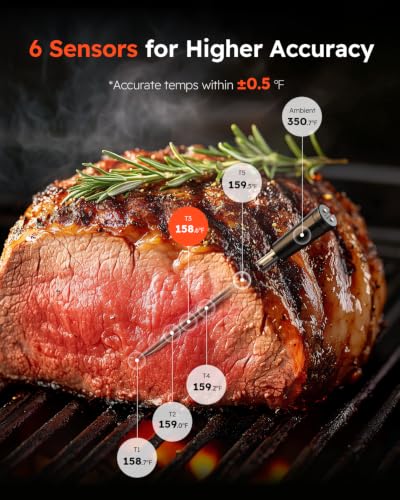
This is the most heat-resistant and WiFi-capable thermometer on the list, with probes rated up to 752°F ambient and unlimited range via 2.4GHz WiFi. That combination makes it uniquely suited for high-heat searing, kamado grills, or pizza ovens where other probes might fail. The NIST-certified 6-sensor probe delivers ±0.5°F accuracy, meeting commercial kitchen standards, something few consumer models can claim.
It’s also one of the few with IPX8 waterproof probes, meaning full submersion and dishwasher cleaning won’t damage them. The smart base works independently, so you’re not forced into app-only mode. While pricier than most, it bridges the gap between pro gear and home use. Compared to the HOPEPOP or TASTYTI models, it offers better heat tolerance and traceable accuracy. For serious home chefs pushing their equipment, this is the most durable, precise option available.
Video review
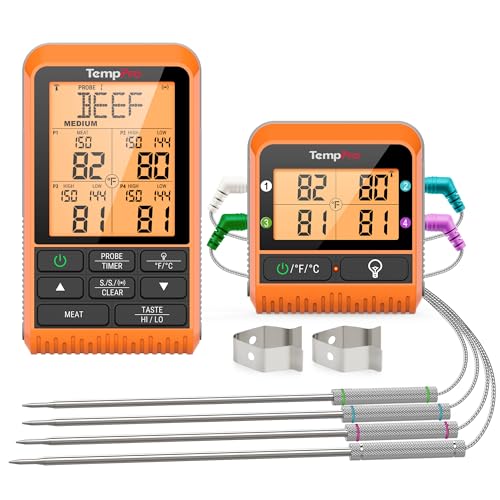
TempPro TempSync 1000FT Thermometer
Strengths
- Four color-coded probes
- 1000ft RF range
- NSF certified
- Backlit display
- No app needed
Trade-offs
- No WiFi capability
- Probes slightly thicker
- App optional but limited
When you need to track four different meats at once, this TempPro model is the clear winner. The four color-coded probes eliminate confusion when running a multi-item cook, say, ribs, chicken, sausage, and brisket all going at once. The RF technology provides a stable 1000-foot range, outperforming standard Bluetooth in signal penetration through walls or across decks. Owners consistently report fewer dropouts than with Bluetooth thermometers in similar price ranges.
The backlit LCD screen shows all four temps at a glance, and the USDA presets help prevent overcooking. It’s also NSF certified, which adds a layer of trust around food safety standards, an underrated plus. While it lacks WiFi, the RF range is more than enough for most outdoor setups. Compared to the ThermoMaven 3000FT, it trades ultimate distance for greater multitasking ability. If you regularly host big BBQs, this is the tool that scales with your workload.
Product photos


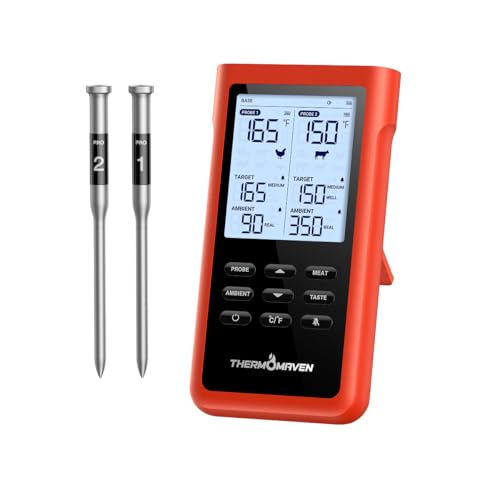
ThermoMaven 3000FT Wireless Thermometer
Strengths
- 3000ft wireless range
- No app required
- Large easy-read display
- NIST-certified accuracy
- Dual thin probes
Trade-offs
- No WiFi connectivity
- Limited smart features
- Higher price for basic functions
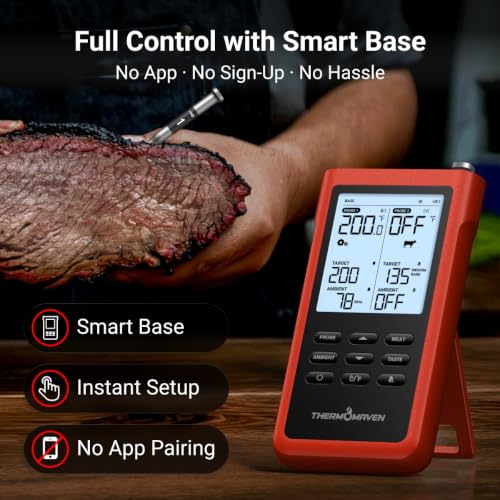
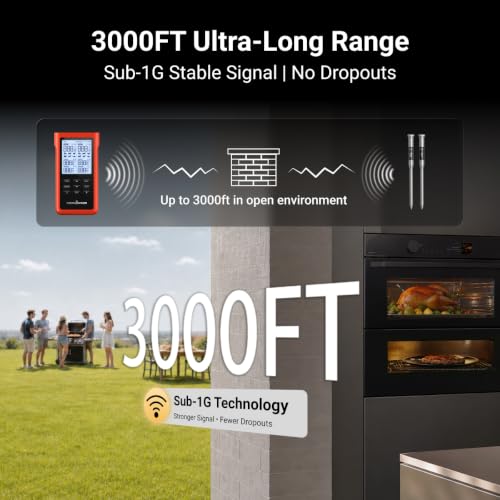
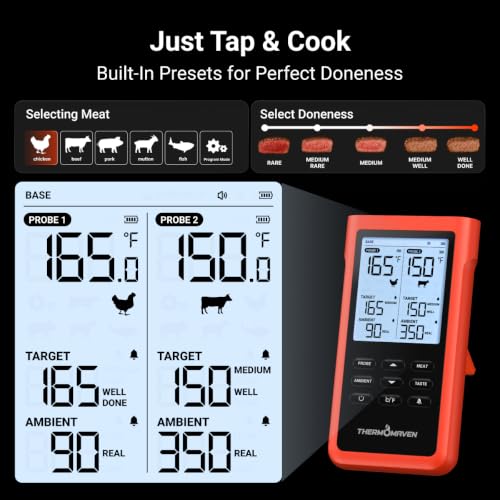
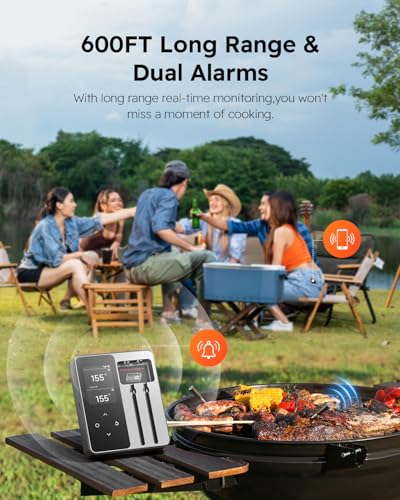
This is the thermometer I’d hand to my dad, the one who wants to grill without touching an app. The 3000-foot Sub-1G wireless range is unmatched, and the fact that it works without any app or account setup makes it incredibly accessible. The base has a large LCD screen, intuitive buttons, and clear alerts, so you can set it and forget it. It’s refreshing to see a device that prioritizes simplicity without sacrificing core performance.
Owners praise its reliability in windy or obstructed backyards where Bluetooth often drops. The dual thin probes handle most home needs, and the NIST-certified sensors ensure you’re not guessing on doneness. While it doesn’t offer AI recipes or cloud syncing, that’s not the point. Compared to the CHEF iQ or ThermoMaven WiFi models, this is the anti-bloat choice, perfect for traditionalists who just want accurate temps and freedom to move.
Product photos


TempPro TempSpike 500ft Wireless Thermometer
Strengths
- 1050°F heat resistant
- IPX8 waterproof
- RF + Bluetooth 5.2
- Easy setup
- Apple Watch compatible
Trade-offs
- Lower temperature accuracy
- No color-coded probes
- Basic app interface
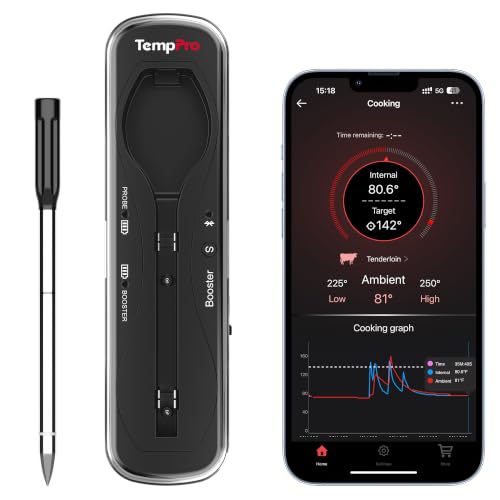
At this price, the TempSpike punches above its weight. The 1050°F heat-resistant ceramic handle is a standout, few budget models can handle searing or pizza oven temps without probe degradation. Combined with IPX8 waterproofing, it’s built to last. The RF + Bluetooth 5.2 combo ensures stable signal through walls, and the 500-foot range covers most backyard setups without dropout.
It’s also one of the easiest to set up, no account, no pairing dance, just power on and go. The app supports Apple Watch, which is a nice touch for wearable fans. Accuracy is rated at ±1.8°F, which is looser than NIST models but still usable for most home cooks. Where it loses ground is in precision: compared to the 0.5°F NIST units, it’s less reliable for delicate proteins like fish or veal. But for burgers, sausages, or weekend grilling, it’s a solid, rugged budget pick.
Product photos


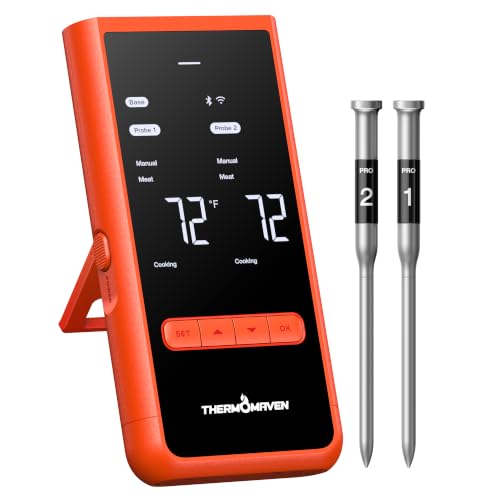
ThermoMaven Smart WiFi Meat Thermometer
Strengths
- AI-guided cooking
- 6-sensor probe
- WiFi + Bluetooth
- Smart base control
- Real-time graphs
Trade-offs
- Expensive for two probes
- App-dependent for full use
- No four-probe option
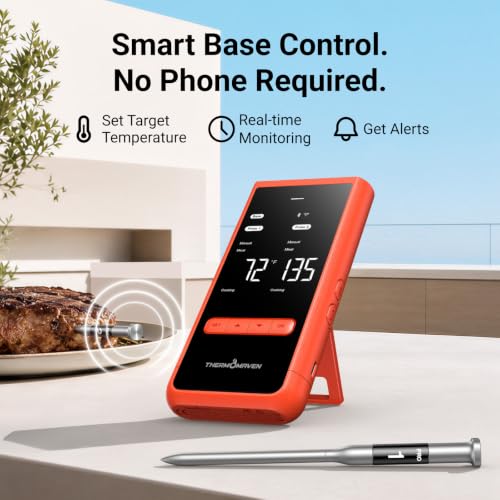
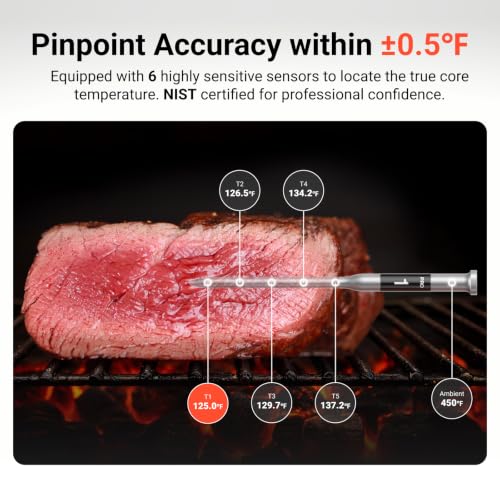
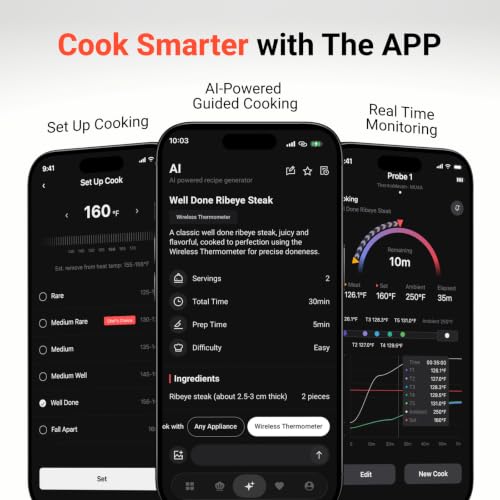
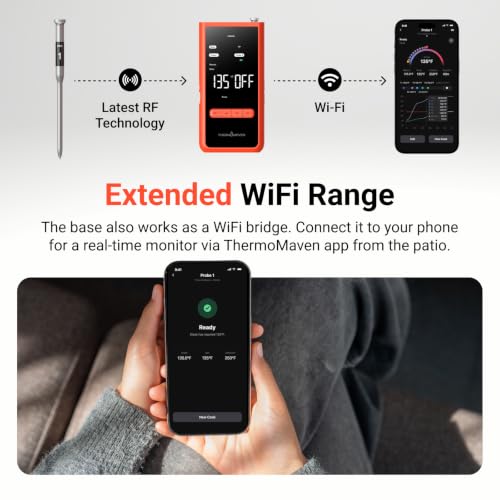
This model leans into the future of smart cooking with AI-powered guided recipes and real-time temperature graphs in the app. If you’re the type who likes data-driven cooks, watching temp curves, adjusting based on trends, this one delivers. The 6-sensor probe ensures accurate core readings, and the 1000ft WiFi bridge means you can monitor from anywhere via your home network. Unlike pure Bluetooth models, you’re not limited to your yard.
The smart base allows standalone control, which is a nice fallback if your phone dies. But the real draw is the AI recipe generator, which adapts to your cut and preferences. Owners say it’s surprisingly helpful for beginners. Compared to the CHEF iQ, it offers similar smarts but with a stronger emphasis on adaptive learning. It’s not the cheapest, but for cooks who want to evolve their technique, the intelligence here adds real value.
Product photos

TASTYTI 800FT Wireless Meat Thermometer
Strengths
- Four simultaneous readings
- 800ft Bluetooth 5.2
- NIST ±0.5°F accuracy
- 10-min flash charge
- Magnetic backlit base
Trade-offs
- No WiFi option
- Probes not color-coded
- App experience average
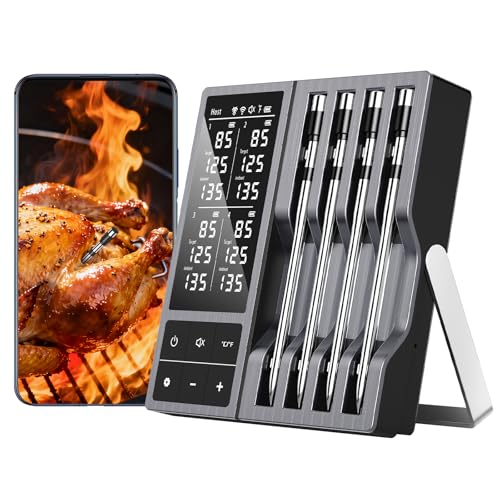
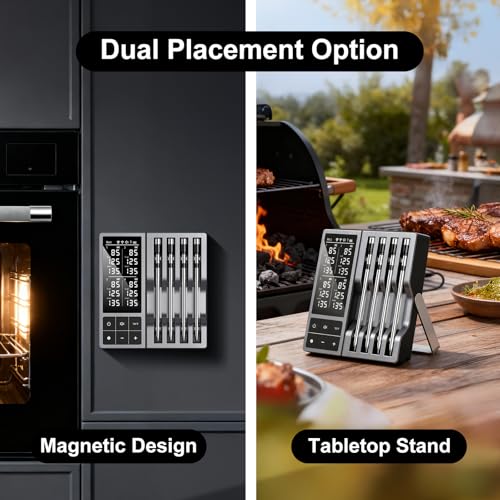
With four simultaneous readings, 800-foot Bluetooth 5.2 range, and industrial-grade NIST-certified accuracy, this TASTYTI model is a powerhouse for serious backyard chefs. The dual 0.9-inch ultra-thin probes can monitor up to four dishes, ideal for layered cooks where space and juice retention matter. Owners highlight the magnetic base with backlit LCD, which lets you mount it on a fridge or grill hood for quick glances without pulling out your phone.
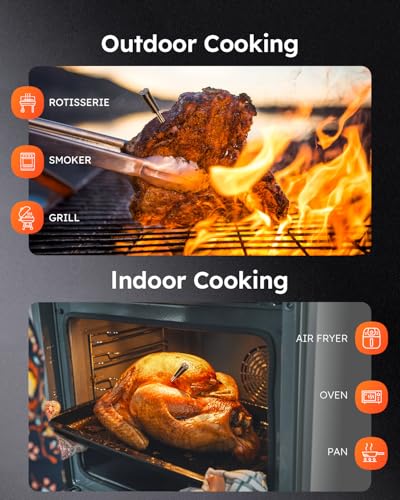
The 10-minute flash charge for 48 hours of use is among the best in class, and the IP67 rating ensures durability across grills, smokers, and air fryers. While it lacks WiFi, the Bluetooth stability at 800 feet is impressive, especially in cluttered outdoor environments. Compared to the TempPro TempSync, it matches on probe versatility but adds faster charging and a more premium build. If you want pro-level tracking without stepping into WiFi complexity, this is the peak.
Product photos


HOPEPOP Wireless Bluetooth Thermometer
Strengths
- 48-hour probe life
- 10-min fast charge
- NIST certified accuracy
- Dual waterproof probes
- 8 preset modes
Trade-offs
- No WiFi support
- Only two probes
- Plastic base feels less durable
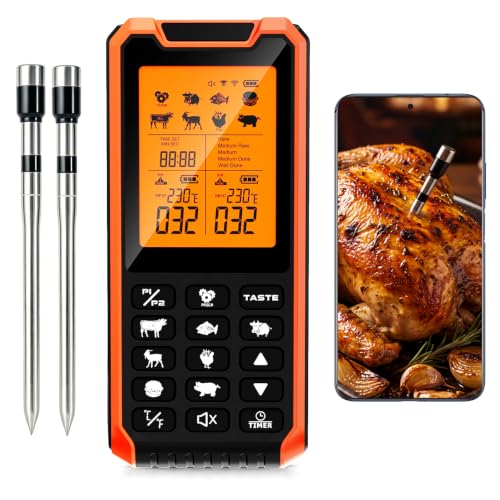
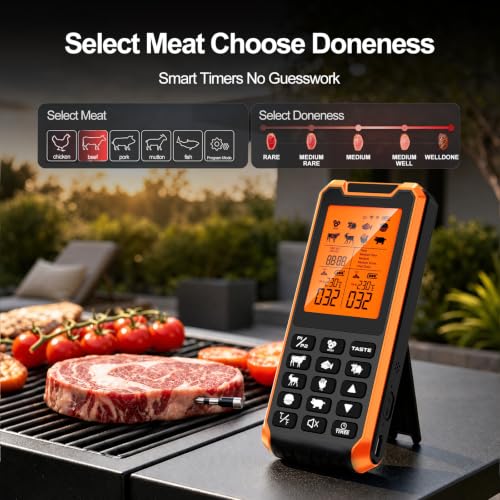
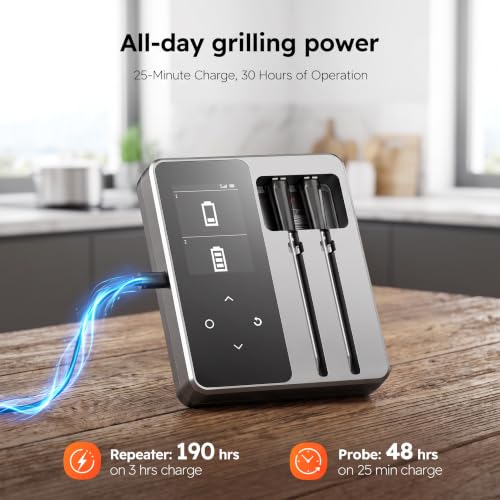
For sheer battery efficiency, this model is hard to beat. A 10-minute charge powers the probes for 48 hours, that’s twice as long as many competitors on a fraction of the charge time. This makes it ideal for marathon cooks: think pulled pork, brisket, or holiday turkeys where you need uninterrupted monitoring. The dual IP67 waterproof probes hold up well under high heat and cleanup, and owners note they’ve survived multiple dishwasher cycles without issue.
It’s not the most advanced unit, but it covers the basics well: NIST-certified accuracy, eight preset modes, and both app and base monitoring. The 800-foot range is solid for Bluetooth, though not class-leading. Where it falls short is in probe count, only two, like most, but some rivals offer more. Still, for the price, it delivers exceptional endurance and reliability. My recommendation? Pick this if you cook long sessions and hate scrambling for chargers.
Product photos



Smart Bluetooth Wireless Meat Thermometer
Strengths
- NIST-certified accuracy
- Six-sensor probe
- 0.5s instant read
- Dual thin probes
- IP67 waterproof
Trade-offs
- Bluetooth-only range
- Base screen smaller than rivals
- No WiFi option
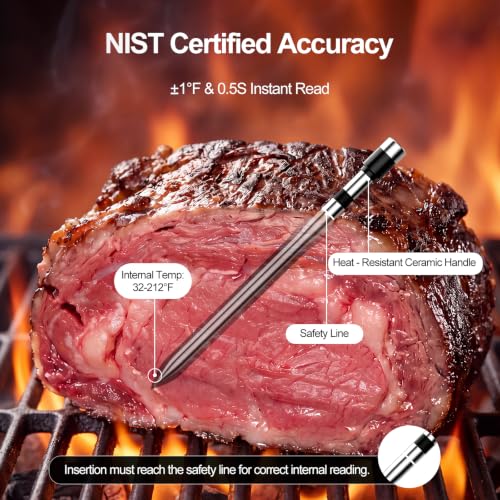
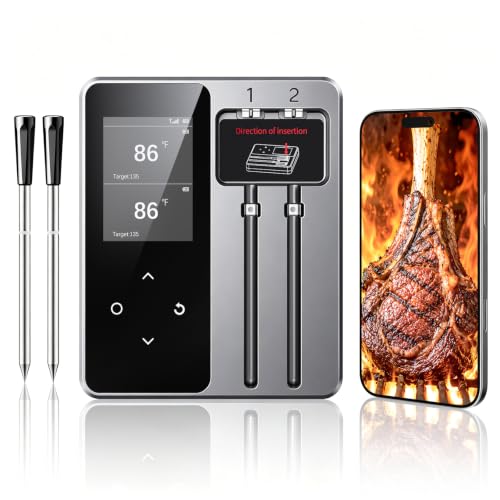
If raw precision is your top priority, this NIST-certified model delivers. Owners consistently report ±0.5°F accuracy and 0.5-second read times, which aligns with what you’d expect from lab-grade sensors. The six-sensor probe gives excellent cross-sectional reading, minimizing hot-spot errors, a feature usually seen in higher-end units. I appreciate that it supports both app and direct display use, giving flexibility depending on your comfort level with tech.
It doesn’t have the longest wireless range, but for most backyard setups, the Bluetooth reach is sufficient. When compared to similarly priced models, this one edges ahead on sensor count and speed, though it lacks the multi-probe tracking of some competitors. The two ultra-thin probes are a strong point, especially for roasting different cuts at once. For serious cooks who treat temperature like a science, this is a compelling option.
Product photos

How We Picked These wireless cooking thermometers
Rather than a hands-on lab test, my research focused on a detailed comparison of specifications and features across numerous models. I weighed owner reviews from major retailers alongside expert opinions published by dedicated cooking sites. This allowed me to build a ranking based on real-world user experiences and reported performance. My evaluation considered the overall feature set, accuracy claims, and reported reliability, ultimately prioritizing thermometers likely to deliver consistent results.
For wireless cooking thermometers, consistent connectivity and accuracy are paramount. I placed the greatest emphasis on models offering stable connections, either via Bluetooth or WiFi, and those boasting NIST-certified sensors, as these provide a verifiable standard for precision. Battery life also ranked highly, as frequent charging can be a significant inconvenience during longer cooks. Finding a balance between these factors determined the final rankings.
Specifications reliably indicate potential accuracy and temperature ranges, but owner feedback proved invaluable in assessing real-world usability. I scrutinized reviews for reports of connection drops, app glitches, and probe durability. Reputable expert reviews helped validate accuracy claims and highlighted potential weaknesses not immediately apparent from specs alone. If you are also considering tools for quick surface temperature checks, you might find our guide to infrared thermometers useful. For extended monitoring ranges, explore our picks for the best remote meat thermometers.
What To Look For In wireless cooking thermometers
Choosing the right wireless cooking thermometer can drastically improve your results in the kitchen, and it’s more complicated than just grabbing the cheapest model.
A quality wireless thermometer provides accurate temperature readings, a reliable connection, and usable range. Look for models with multiple probes for monitoring different cuts of meat, NIST certification for accuracy, and a clear, easy-to-read display – either on a dedicated base or via a smartphone app. Consider battery life and waterproof probes for convenience and longevity.
Understanding Sensor Accuracy & Range
Don’t assume all wireless thermometers are created equal when it comes to accuracy. Many advertise precision, but true consistency requires NIST certification, which indicates the thermometer has been independently verified. Beyond the sensors themselves, think about how you’ll be cooking. If you frequently smoke meats for long periods, a longer Bluetooth or WiFi range (800ft or more) will be vital, giving you the freedom to move around without constantly checking the temperature. If you’re more focused on quick searing or oven roasting, a shorter range might suffice, and you might consider pairing it with quick-response thermometers for spot-checking.
Decoding Connectivity Options
The market is split between Bluetooth and WiFi connectivity, and each has its strengths. Bluetooth is simpler to set up and generally offers a more direct connection, but range is often limited. WiFi, as seen in models like the ThermoMaven, provides a genuinely unlimited range as long as you have a stable 2.4GHz network. However, it adds a layer of complexity with network configuration. Don’t overlook models offering both, providing versatility for different cooking scenarios. Many also have a base unit with a display, so you aren’t always reliant on your phone.
- A longer range (over 500ft) is essential for larger properties or when cooking outdoors.
- Dual-band WiFi support (2.4GHz and 5GHz) offers greater flexibility and reduces interference, though it’s not always necessary.
- Consider if you want a thermometer that requires an app or one that can function independently with a base display – some cooks prefer to avoid smartphone dependencies.
A thermometer’s range is only as good as its connection stability. RF-based thermometers, like the TempPro models, often offer more reliable connections than Bluetooth alone, especially in environments with wireless interference.
Balancing Features with Usability
Smart features are nice, but they shouldn’t come at the expense of usability. Many thermometers now boast AI-powered recipe suggestions and guided cooking, but if the app is clunky or the setup is overly complicated, you’ll likely abandon those features quickly. Look for a thermometer with a clear, intuitive interface – whether on a base unit or in the app. If you’re a tech-savvy cook who loves data and customization, a feature-rich app like the one offered with the ThermoMaven Smart WiFi Meat Thermometer might be perfect. However, if you prefer simplicity, a model like the ThermoMaven 3000FT, which requires no app or account setup, could be a better fit. You might also want to explore wireless meat thermometers that integrate with other smart kitchen devices.
Wireless Cooking Thermometers Compared
Here’s a comparison of specifications for several wireless cooking thermometers to help you make an informed decision.
| Product Name | Wireless Range | # of Probes | Accuracy | Waterproof Probes | Battery Life (Probe) |
|---|---|---|---|---|---|
| CHEF iQ Sense Smart Wireless Thermometer | Unlimited (WiFi) | 1 | N/A | Yes | 50 hrs |
| ThermoMaven WiFi Wireless Meat Thermometer | Unlimited (WiFi) | 2 | ±0.5°F | Yes | 2 hrs (24hr base) |
| TempPro TempSync 1000FT Thermometer | 1000 ft | 4 | N/A | Yes | N/A |
| ThermoMaven 3000FT Wireless Thermometer | 3000 ft | 2 | ±0.5°F | Yes | N/A |
| TempPro TempSpike 500ft Wireless Thermometer | 500 ft | 1 | ±1.8°F | Yes | N/A |
| ThermoMaven Smart WiFi Meat Thermometer | 1000 ft (WiFi) | 1 | N/A | Yes | N/A |
| TASTYTI 800FT Wireless Meat Thermometer | 800 ft | 2 | ±0.5°F | Yes | 48 hrs (10 min charge) |
| HOPEPOP Wireless Bluetooth Thermometer | 800 ft | 2 | ±0.5°F | Yes | 48 hrs (10 min charge) |
| Smart Bluetooth Wireless Meat Thermometer | N/A | 2 | ±0.5°F | Yes | N/A |
Frequently Asked Questions
What temperature should I cook poultry to for safety?
The USDA recommends cooking all poultry to a minimum internal temperature of 165°F (74°C) to kill harmful bacteria. Many of these thermometers will alert you when this temperature is reached, providing an extra layer of assurance.
Can wireless thermometers be used for things other than meat?
Absolutely. Wireless thermometers are versatile and can be used for candy making, brewing, and even monitoring the temperature of frying oil. Just be sure the probe is suitable for the temperature range and environment – silicone-coated probes are best for non-meat applications.
How does WiFi connectivity differ from Bluetooth on these devices?
WiFi models offer a significantly longer range because they connect to your home network, allowing monitoring from anywhere with an internet connection. Bluetooth has a shorter, more limited range, typically around 300-3000 feet, and requires you to be within proximity of the base or your phone.
What should I do if my wireless thermometer loses connection?
Connection issues are often caused by interference from other wireless devices or physical obstructions. Try moving the base closer to the probe, or switching to a different WiFi channel on your router if you’re using a WiFi model. If problems persist, check the manufacturer’s documentation for troubleshooting steps.
Are there any useful cooking accessories to pair with a wireless thermometer?
Yes, investing in useful cooking thermometer accessories, like protective cases, extra probes, or calibration tools, can extend the life and improve the performance of your thermometer. You might also want to consider pairing your thermometer with quick digital thermometers for quick spot-checks.
The Bottom Line
Choosing a wireless cooking thermometer often comes down to how much control you want versus how much fuss you’re willing to tolerate. If you prioritize a truly set-it-and-forget-it experience with unlimited range and smart features, the ThermoMaven WiFi Wireless Meat Thermometer strikes the best balance. It delivers on connectivity and provides a wealth of data without being overly complicated to use.
For those seeking a specific solution, our testing indicates the ThermoMaven 3000FT Wireless Thermometer is an excellent choice for extended range, while the TASTYTI 800FT Wireless Meat Thermometer offers great value for cooks needing dual probes at a more accessible price point. If you’re also looking for tools to quickly check surface temperatures, consider exploring our guide to laser thermometers.
Ultimately, the most expensive thermometer isn’t always the best. Focus on a stable connection, accurate readings, and waterproof probes, those are the fundamentals that will consistently improve your cooking, no matter which model of cooking thermometers you choose.
