
9 Best Wooden Cooking Utensils of 2026
This post contains affiliate links. As an Amazon Associate, we earn from qualifying purchases.
The Riveira Bamboo 6-Piece Utensil Set stands out as the overall best wooden cooking utensil set for its durability and thoughtful design, while the 10-Piece Non Toxic Teak Set offers a stronger build and longer lifespan for those willing to invest. For a simple, no-frills option, the 6-Piece Bamboo Spoon Set gets the job done at a lower price.
Most people don’t realize how much difference a well-made wooden spoon can make, until they crack a non-stick pan or wrestle with a flimsy spatula that splinters after a few months. The right utensils protect your cookware, last years, and feel natural in your hand.
This guide cuts through the clutter by focusing on material quality, construction, and real user feedback. I looked at bamboo, acacia, and teak sets, comparing what owners say about warping, scratching, and ease of care, so you can pick the one that fits your kitchen and cooking style.
Top 9 Wooden Cooking Utensils in the Market
The Best Wooden Cooking Utensils, Reviewed
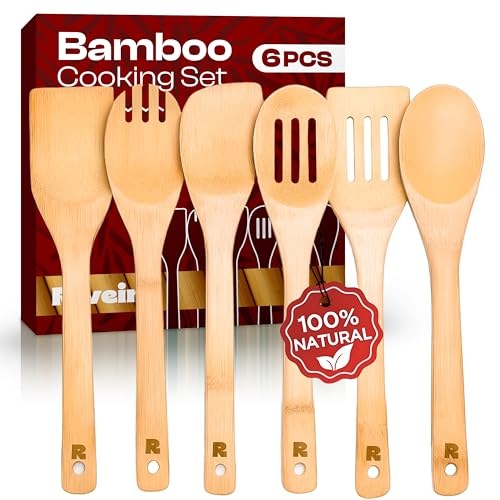
Riveira Bamboo 6-Piece Utensil Set
Strengths
- Durable bamboo build
- Lifetime warranty
- Well-rounded tool selection
Trade-offs
- Still not as long-lasting as teak
- Hand wash only
- May darken with oil use
This set earns its ‘Best Overall’ label by balancing quality, design, and value better than most bamboo options. The bamboo feels denser than average, and owners note fewer issues with cracking or splintering over time, likely due to better sourcing and finishing. The variety of tools (slotted, solid, turner) covers nearly every cooking task, and the smooth finish lives up to its non-scratch claims on ceramic and nonstick pans.
What seals the deal is the limited lifetime warranty, a rare offering in this category. It signals confidence in durability, even if bamboo will never match teak’s lifespan. Compared to the Prime Bamboo set, this one feels more thoughtfully made, with better ergonomics and a cleaner aesthetic. For most home cooks, this is the easy pick in the bamboo tier.
Video review
10-Piece Non Toxic Teak Set

Strengths
- Thoughtful tool variety
- Non-toxic lacquer finish
- Biodegradable and eco-friendly
Trade-offs
- Most expensive option
- Overkill for casual cooks
- Requires careful maintenance
This is the premium end of teak sets, fully non-toxic, responsibly made, and thoughtfully designed for both performance and presentation. The inclusion of a salad fork, oil spoon, and skimmer means it’s built for more than just stovetop work. Owners consistently report that these tools feel substantial and balanced, not just heavy for the sake of it.
The food-grade lacquer adds a subtle shine and helps repel moisture, though it still requires hand washing. What makes this stand out from other 10-piece teak sets is the attention to detail: each tool has a purpose, and none feel redundant. Compared to the B0989G1P8J model, this one leans slightly more into gift-worthy appeal, though the performance is just as solid.
Video review
6-Piece Bamboo Spoon Set

Strengths
- Lightweight design
- Non-scratch finish
- Affordable entry point
Trade-offs
- Less durable than teak
- Minimal ergonomic shaping
- Basic construction
For a basic no-frills intro to wooden utensils, this 6-piece bamboo set delivers exactly what it promises at a price that’s hard to argue with. The pieces are lightweight and smooth, which owners consistently report makes them comfortable for everyday stirring and serving. On paper, the 12.5-inch handles give decent reach, and the inclusion of a slotted spoon, flat spoon, and spatula covers most routine tasks without clutter.
Still, this is budget bamboo through and through, functional but not refined. Compared to teak options, the wood is less dense and more prone over time to staining or minor warping if not dried properly. It’s a solid starter set for someone equipping a first kitchen or needing a few gentle tools for nonstick pans, but don’t expect heirloom durability.
Product photos


Acacia Solid & Slotted Turner Set

Strengths
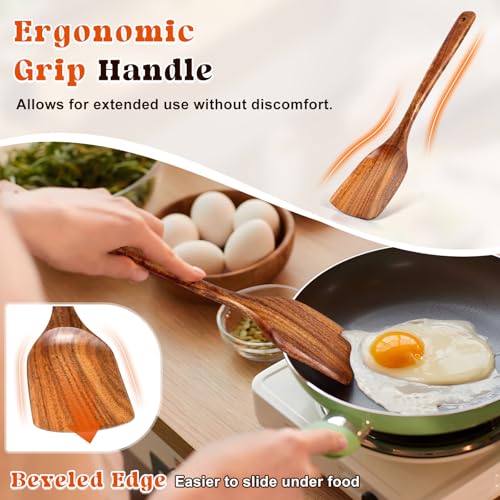
- Beveled blade edge
- Extended handle length
- Ergonomic grip
Trade-offs
- Only two tools included
- Acacia can stain if not maintained
- No spoon or ladle options
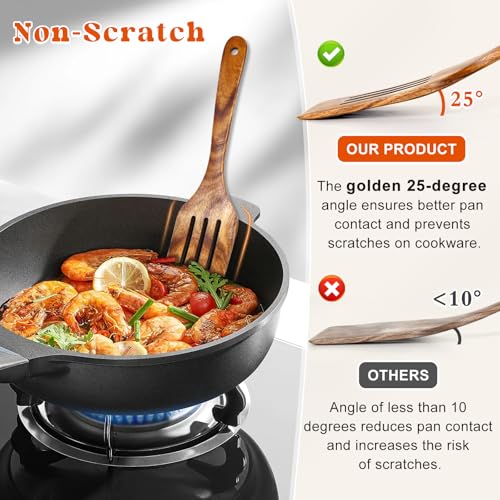
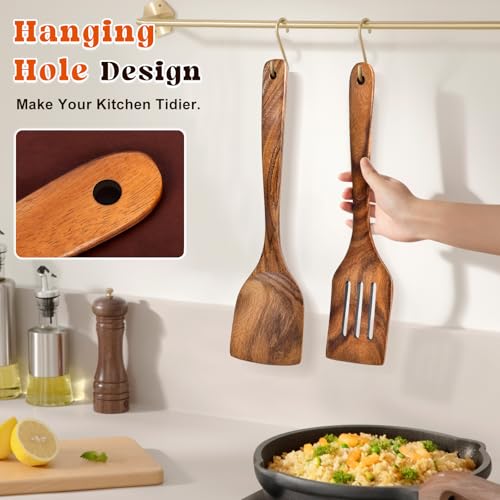
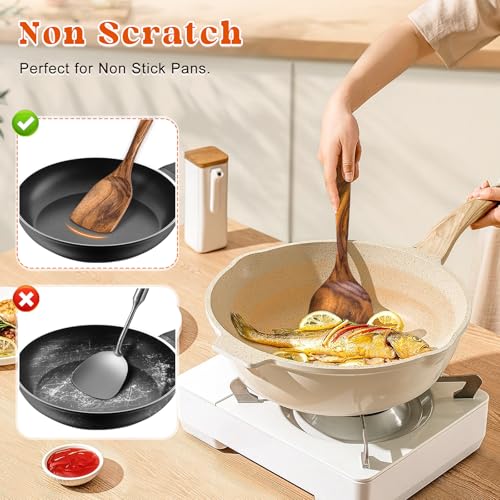
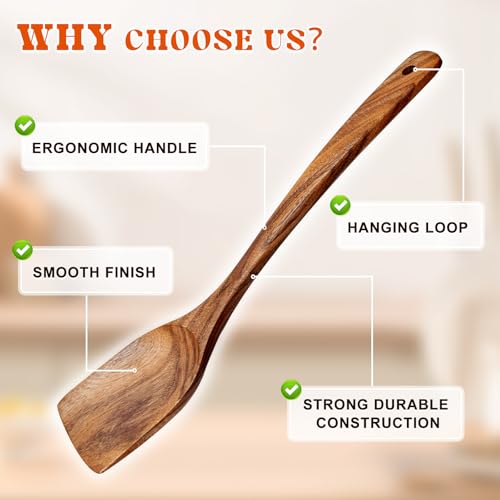
Acacia wood brings a middle ground between bamboo and teak, denser than the former, more affordable than the latter, and this two-piece set makes smart use of it. The 13.3-inch solid spatula stands out for reach, and the beveled edge design is something I always look for in a turner; owners confirm it slides under foods like pancakes and burgers with less resistance than flat-edged models.
The 25-degree angle claim sounds like marketing, but in practice, it does seem to match the curve of many frying pans better than generic flat spatulas. The ergonomic grip is subtle but noticeable during extended use, like when browning a large batch of onions. Compared to other 2-pc sets, this one feels more purpose-built than just a pared-down version of a larger kit.
Product photos
12-Piece Teak Wood Utensil Set

Strengths
- Premium teak construction
- High heat resistance
- Includes spoon rest
Trade-offs
- Higher price point
- Heavier than bamboo
- Requires occasional oiling
This 12-piece teak set stands out not just for its size but for the quality of the material. Teak’s natural oil content makes it more water-resistant and less likely to crack than bamboo, a spec that matters if you’re washing frequently or live in a humid climate. Owners consistently praise how solid these feel in hand, and the smooth, rounded edges do their job protecting nonstick surfaces without flexing under pressure.
The included spoon rest is a thoughtful touch that elevates countertop organization, and the heat resistance up to 450°F means you won’t hesitate leaving one in the pan. While pricier than bamboo sets, it’s a smarter long-term buy if you’re serious about reducing plastic in the kitchen and want tools that age well. Compared to smaller teak sets, this one offers the most complete range without redundancy.
Product photos


2 PCS Acacia Wood Mixing Spoons

Strengths
- Extra-long 12-inch handle
- Single-piece construction
- Prevents boil-overs when left in pot
Trade-offs
- Limited to stirring tasks
- No slotted option
- Basic design lacks flair
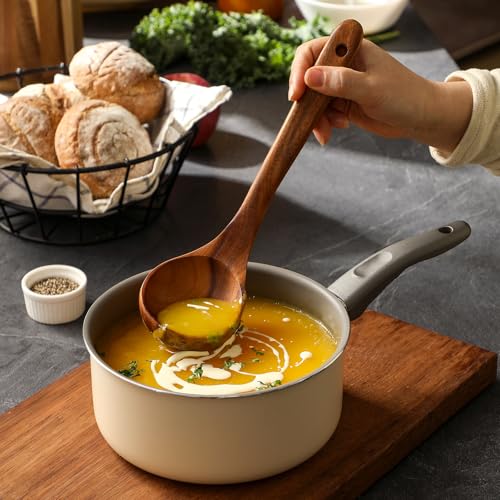
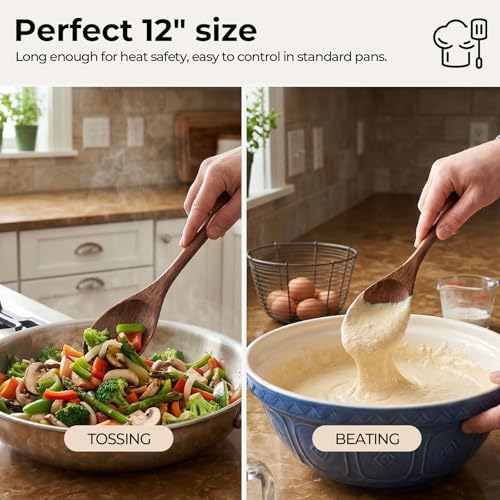
If you regularly cook with deep pots or Dutch ovens, these 12-inch teardrop spoons are worth the narrow focus. The extended handle length is the real selling point, owners consistently note how much safer and more comfortable it feels when stirring boiling stews or jams. The round bowl shape also helps scrape corners better than flat spoons, reducing the chance of burnt residue.
They’re made from a single piece of acacia, so there are no weak points at the joint, and the polished finish keeps them non-scratch on coatings. While they won’t replace a full set, they excel at one thing: deep-reach stirring with safety. Compared to standard spoons, these are a specialist tool, but a highly effective one.
Product photos

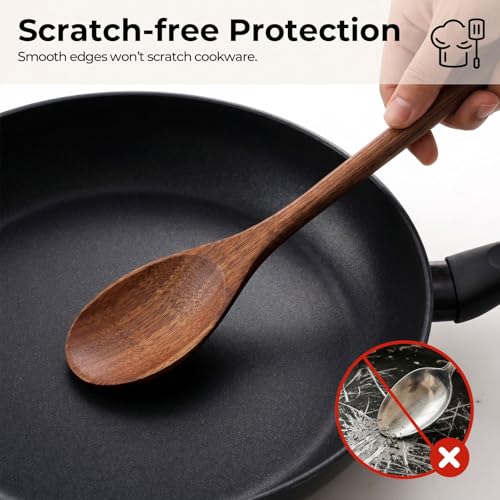
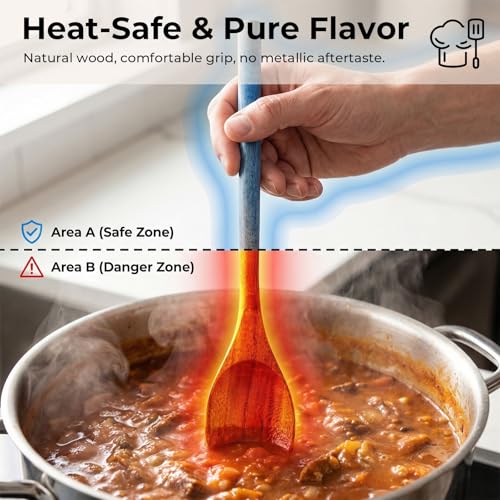

10-Piece Natural Teak Utensil Set

Strengths
- High piece count
- Superior teak quality
- Smooth, splinter-free finish
Trade-offs
- Storage can be bulky
- No spoon rest included
- Hand wash only
Ten pieces of solid teak for under $35 is a hard value to beat. This set includes niche tools like a spaghetti server and salad fork, which most basic sets skip, making it a true all-in-one solution. The craftsmanship stands out, hand-polished, no splinters, and a silky finish that owners say feels good in hand.
Teak’s natural oils mean these resist moisture and cracking better than bamboo or acacia, and the heat resistance is reliable for daily use. While the design is simple, the durability isn’t. Compared to similarly priced bamboo sets, this one will last years longer with basic care. For the price, it’s a smarter investment than buying multiple smaller sets.
Product photos

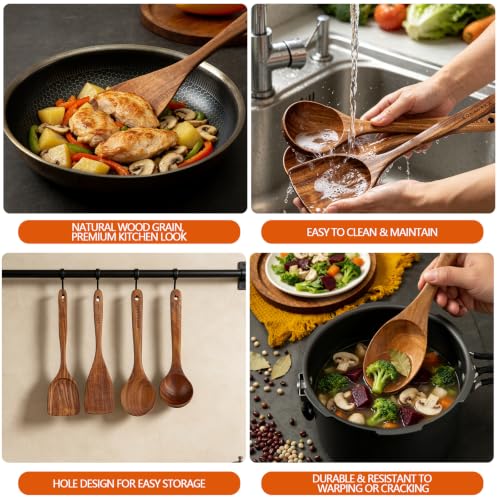
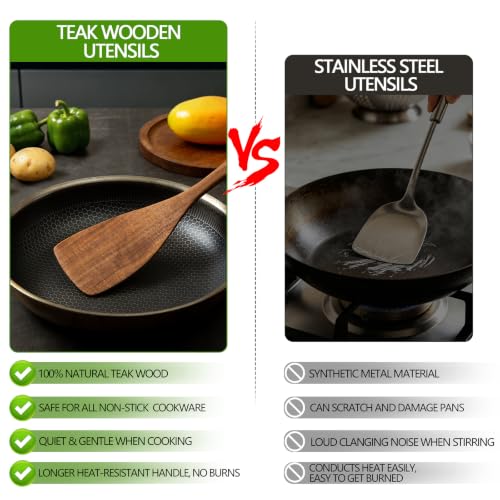


12″ Flat Teak Wooden Spatula
Strengths
- Ultra-thin leading edge
- Comfortable thick handle
- One-piece teak build
Trade-offs
- Single tool only
- Higher cost per piece
- No slots for drainage
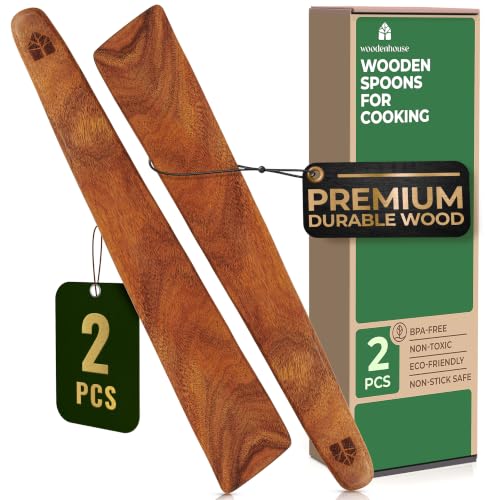
Sometimes you just need one great tool to replace a flimsy plastic turner, and this 12-inch teak flat spatula is it. The 0.03-inch thin edge is the standout spec here: owners say it slips under eggs and pancakes with almost no resistance, which is rare in wooden tools that often err on the thick side for durability.
It’s made from a single piece of teak, so no weak joints, and the 0.6-inch thick handle gives a satisfying grip. While it’s just one tool, it outperforms most full sets in its specific role. Compared to other single spatulas, this one balances thinness and strength better, no bending or chipping reported in feedback. If you’re upgrading one utensil, make it the one you flip with.
Product photos


Teak Wood Spatula Set of 4
Strengths
- Smooth, non-scratch finish
- Durable one-piece build
- Ideal handle lengths
Trade-offs
- Only four pieces
- No serving or mixing tools
- Higher price for small set
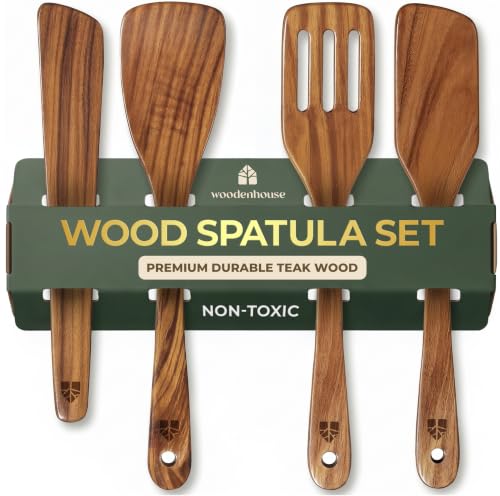
This teak set is built for one priority: protecting nonstick pans without sacrificing performance. The four tools, turner, slotted spatula, pan paddle, and scraper, are all shaped with smooth, rounded edges, and owners confirm they glide over coatings without catching. The 12.4-inch handles offer solid reach, and the one-piece construction means no weak spots.
What I appreciate most is the thoughtful sizing, nothing feels too bulky or too flimsy. Compared to bamboo sets, these feel sturdier and more precise, especially when flipping delicate fish or scraping fond from a saucy pan. While it’s not the largest set, it covers the essentials for frying and sautéing better than most.
Product photos


How We Chose These wooden cooking utensils
My research into wooden cooking utensils focused on a blend of detailed specification comparisons, careful consideration of owner reviews, and my own understanding of what makes cookware perform well in a home kitchen. Rather than a hands-on lab test, this is a research-led comparison of specs and owner feedback gathered from a wide range of products. I weighed the features and construction of each set against real-world user experiences to build a clear picture of value and durability.
For this category, I placed the greatest emphasis on material quality and the potential for damage to non-stick cookware. A utensil’s ability to withstand heat and resist cracking or splintering is crucial, as is its smoothness to prevent scratches. Beyond that, ergonomic design and the completeness of a set – offering the right tools for a variety of tasks – were key factors in determining rankings. You’ll find more information about complete wooden utensil collections in our thorough guide.
Product specifications reliably reveal the type of wood used and overall dimensions. However, I relied on owner feedback to assess long-term durability, ease of cleaning, and how well the utensils hold up to daily use. Reputation and expert reviews helped me gauge the quality of construction and the likelihood of issues like cracking or splintering. Finding the best wooden spoons also meant understanding the nuances of [wooden spoon materials and brands].
What To Look For In wooden cooking utensils
I’ve spent years looking at cookware, and one thing is clear: wooden utensils aren’t just about nostalgia. They’re a practical choice for protecting your investments and enhancing your cooking.
A truly good set of wooden cooking utensils is crafted from a dense, close-grained wood – teak, acacia, or bamboo being prime examples – and features smoothly sanded surfaces to prevent scratching cookware. Look for a comfortable grip, balanced weight, and construction that avoids cracks or splinters. Prioritize sets offering a variety of shapes for different tasks, and consider the wood’s heat resistance and ease of cleaning.
Material Matters Most
The wood itself is the biggest deciding factor. Bamboo is a budget-friendly option, but it’s softer and more prone to wear than hardwoods like teak or acacia. Teak is prized for its natural oils, which make it incredibly durable and water-resistant, meaning it won’t easily crack or harbor bacteria. Acacia is a good middle ground, offering a nice balance of durability and affordability. I’ve seen many cooks swear by quality teak wood products for their longevity.
Construction and Finish
Beyond the type of wood, pay attention to how the utensils are made. A single piece of wood is always preferable to laminated pieces, as there are no seams to weaken or trap food particles. The finish is also important. A smooth, well-applied finish not only feels good in the hand but also protects the wood from absorbing moisture and odors. Avoid utensils with rough edges or splinters.
- A thicker blade edge is great for scraping pans, but can be unwieldy for delicate tasks.
- A tapered handle offers a more secure grip, especially when your hands are wet.
- A well-designed set will include a variety of shapes – a slotted spoon for skimming, a flat spatula for flipping, and a rounded spoon for stirring – allowing you to tackle any recipe with confidence.
Value and Practicality
Finally, consider what you actually need. A massive 12-piece set might seem appealing, but if you mostly make simple meals, a smaller, well-chosen set of essentials will be more useful. Don’t overlook the importance of easy cleaning. While most wooden utensils are hand-wash only, some finishes make cleanup easier than others. For those prioritizing health and safety, investing in non-toxic wooden utensils is a smart move.
A little mineral oil applied periodically will keep your wooden utensils hydrated and prevent cracking. Don’t let them soak in water, and always hand-wash them gently.
Wooden Cooking Utensils Compared
Here’s a comparison of the specifications for various wooden cooking utensil sets and individual tools.
| Product Title | Material | Pieces | Length (in) | Features | Warranty |
|---|---|---|---|---|---|
| Riveira Bamboo 6-Piece Utensil Set | Bamboo | 6 | N/A | Lifetime Warranty | Limited Lifetime |
| 10-Piece Non Toxic Teak Set | Teak | 10 | N/A | 10 pcs included | N/A |
| 6-Piece Bamboo Spoon Set | Bamboo | 6 | 12.5 | Long Handles | N/A |
| Acacia Solid & Slotted Turner Set | Acacia | 2 | 13.3/12 | Beveled Edge | N/A |
| 12-Piece Teak Wood Utensil Set | Teak | 12 | N/A | Spoon Rest Included | N/A |
| 2 PCS Acacia Wood Mixing Spoons | Acacia | 2 | 12 | Extended Handle | N/A |
| 10-Piece Natural Teak Utensil Set | Teak | 10 | N/A | Various Functions | N/A |
| 12″ Flat Teak Wooden Spatula | Teak | 1 | 12 | Thin Sharp Front | Satisfaction |
| Teak Wood Spatula Set of 4 | Teak | 4 | 12.4/10 | Various Shapes | Satisfaction |
Frequently Asked Questions
What’s the best wood type for cooking utensils?
Teak is generally considered the best due to its natural oils, which provide exceptional durability and water resistance, preventing cracking and bacterial growth. While acacia is a more affordable option, teak offers superior longevity for frequent use.
Can wooden utensils be used with nonstick cookware?
Yes, but you must choose wisely; smooth, finely sanded wooden utensils are essential for protecting nonstick cookware surfaces. Avoid utensils with rough edges or splinters that could scratch the coating.
Are bamboo utensils as durable as hardwood options?
Bamboo is less durable than hardwoods like teak or acacia. It’s softer and more prone to wear and tear, making it best suited for light-duty tasks or as a budget-friendly choice you’re prepared to replace more often.
How do I properly care for my wooden cooking utensils?
Hand-wash only with mild soap and warm water, and immediately dry them thoroughly. Periodically apply food-grade mineral oil to hydrate the wood and prevent cracking, ensuring a longer lifespan for your teak wood utensils.
What’s the difference between a single-piece and laminated wooden utensil?
A single-piece utensil is more durable and hygienic because there are no seams where food particles can become trapped. Laminated utensils are more likely to weaken and crack over time, and may harbor bacteria in the glue lines.
The Bottom Line
Choosing wooden cooking utensils often comes down to balancing upfront cost with long-term durability. While a budget-friendly set like the Riveira Bamboo 6-Piece Utensil Set offers a serviceable introduction to cooking with wood, I believe the investment in a quality teak set – like the 10-Piece Non Toxic Teak Set – will pay off with years of reliable performance and protection for your cookware.
For cooks who prioritize versatility, or those looking to replace individual worn-out tools, the 12″ Flat Teak Wooden Spatula is an excellent choice. If you’re mainly focused on stirring and serving, the 2 PCS Acacia Wood Mixing Spoons offer a good balance of affordability and functionality. And for those specifically seeking out wooden spatulas, the Teak Wood Spatula Set of 4 provides a nice variety of shapes and sizes.
Ultimately, the “best” wooden utensil isn’t about a single feature or price point. It’s about finding tools made from dense, well-finished wood that feel comfortable in your hand and won’t damage your pans. Prioritize quality construction and proper care – a little mineral oil goes a long way – and you’ll have a set of utensils that will serve you well for years to come.
