
Slow Cooker Safety: Can I Cook a Frozen Roast? USDA Advice
This post contains affiliate links. As an Amazon Associate, we earn from qualifying purchases.
You should not put a frozen roast in a slow cooker. Federal food safety authorities like the USDA and academic extensions like Michigan State University explicitly state to always thaw meat first. A frozen roast can linger in the bacterial “danger zone” (40°F to 140°F) for hours as it slowly thaws, allowing pathogens like Salmonella or E. Coli to multiply to dangerous levels before the interior reaches a safe temperature.
That gap between official advice and manufacturer suggestions is where confusion, and risk, lives. Crock-Pot’s own FAQ says you can, with extra liquid and time. The USDA’s published guide says you must not. One is a convenience feature; the other is a public health line.
What follows breaks down that contradiction, explains the mechanical failure behind the warning, and walks through the only safe method if you’re starting from frozen. You’ll also get the manufacturer-specific caveats that protect your appliance from cracking.
Key Takeaways
- The USDA and Michigan State University Extension mandate thawing meat before slow cooking to avoid the bacterial “danger zone.”
- A four-pound frozen roast can spend over 4 hours in the danger zone in a slow cooker, ample time for bacterial replication.
- Crock-Pot’s guidelines for frozen meat contradict federal advice and introduce a thermal shock risk to the ceramic pot.
- The only reliably safe method is to thaw the roast in the refrigerator for 24-48 hours before cooking.
- Always verify doneness with a meat thermometer reading of at least 165°F at the roast’s thickest part.
The Official Food Safety Stance
The answer from public health bodies is uniform and unequivocal. The USDA slow cooker safety guide opens its “Reminders” section with a bolded line: “Always thaw meat or poultry before putting it into a slow cooker.This is the baseline rule from the Food Safety and Inspection Service, the federal agency tasked with preventing foodborne illness.
USDA Food Safety and Inspection Service (FSIS) Guideline: “Always thaw meat or poultry before putting it into a slow cooker.” This is because “Frozen meat or poultry may not thaw quickly enough to prevent the growth of pathogens.”
That same directive is echoed in the MSU Extension safe cooking PDF, a university publication that reiterates the danger zone definition and the thaw-first rule. These sources are stating a control point for preventing illness.
The reasoning is mechanical, not culinary. A slow cooker works by applying low, steady heat, typically between 170°F and 280°F, over many hours. This is perfect for tenderizing tough cuts, but it’s a dangerously slow way to bring a solid block of frozen meat up through the critical temperature range where bacteria thrive.
Why a Frozen Roast Is a Unique Risk
Not all frozen foods pose the same threat in a slow cooker. Frozen vegetables or small, pre-cubed meat pieces thaw relatively quickly. A dense, four-pound chuck or pork roast is a different beast. Its thermal mass is enormous.
Think of the roast as an ice cube the size of a brick. The outside layers warm first and may even begin to cook while the core remains frozen. The region between the cooked exterior and the frozen center can sit in the 40°F to 140°F sweet spot for bacterial growth for an extended period. This is the predictable physics of heat transfer through a poor conductor.
| Roast Characteristic | Why It Increases Risk | Typical Timeline in Danger Zone |
|---|---|---|
| Large size (3-4 lbs) | High thermal mass slows overall heat penetration | 4+ hours |
| Dense, solid cut (e.g., chuck) | Less surface area for heat exchange vs. Ground meat | Longer than a cut of same weight |
| Starting from fully frozen | Must absorb latent heat of fusion (thaw) before it can even start to warm | Adds 2-3 hours before cooking temp rise begins |
This timeline is the core of the hazard. Bacteria like Salmonella can double in number every 20 minutes under ideal conditions. A four-hour stroll through the danger zone is an incubation period.
The Manufacturer Contradiction: Crock-Pot vs. The USDA
Here is where the clear water of official advice gets muddy. If you search “can I cook frozen meat in my Crock-Pot,” the brand’s official FAQ says yes. Their guidance is specific: add at least one cup of warm liquid to the stoneware, do not preheat the cooker, and extend cooking times by 4-6 hours on low or 2 hours on high.
Where this goes sideways: Following Crock-Pot’s frozen-meat guidelines directly violates the USDA’s primary rule. You are choosing manufacturer convenience over federal food safety protocol.
This puts the home cook in a difficult spot. Who do you trust, the brand that made your appliance, or the government agency that tracks foodborne illness outbreaks? The conflict is real, and most slow cooker recipes blogs don’t mention it. They just parrot one side or the other.
Other manufacturers are not on Crock-Pot’s page. The Russell Hobbs RHSC600 manual states plainly: “Thaw frozen food completely before adding to the ceramic bowl.” Gourmia’s manual for the GSC517 warns against thermal shock, advising that cold food shouldn’t be added to a hot pot, a risk inherent in the “add warm liquid” method.
The Mechanical Dangers Beyond Bacteria
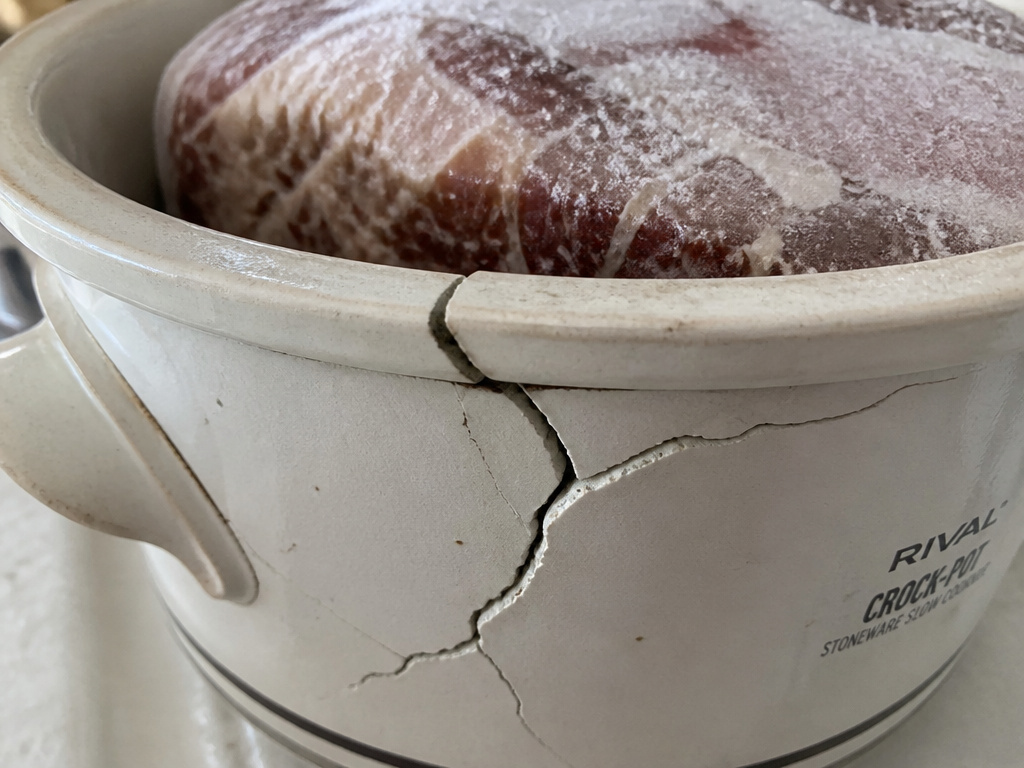
Even if you dismiss the food safety risk, cooking a frozen roast threatens your appliance. The ceramic stoneware insert in most slow cookers is brittle. It handles gradual, even heating beautifully. It does not handle thermal shock.
The Gourmia manual states it bluntly: “The ceramic pot CANNOT withstand the shock of sudden temperature changes.” Placing a frozen roast directly into a preheated pot, or even adding warm liquid to a stoneware bowl holding a frozen mass, creates drastic temperature differentials. The material expands at different rates, creating stress microfractures.
You might not see the crack immediately. It often appears as a hairline fracture after a few cycles, leading to slow leaks or, eventually, a pot that splits in half during a cook. Replacing a cracked stoneware insert often costs more than half the price of a new slow cooker.
The Only Safe Path: Thawing First
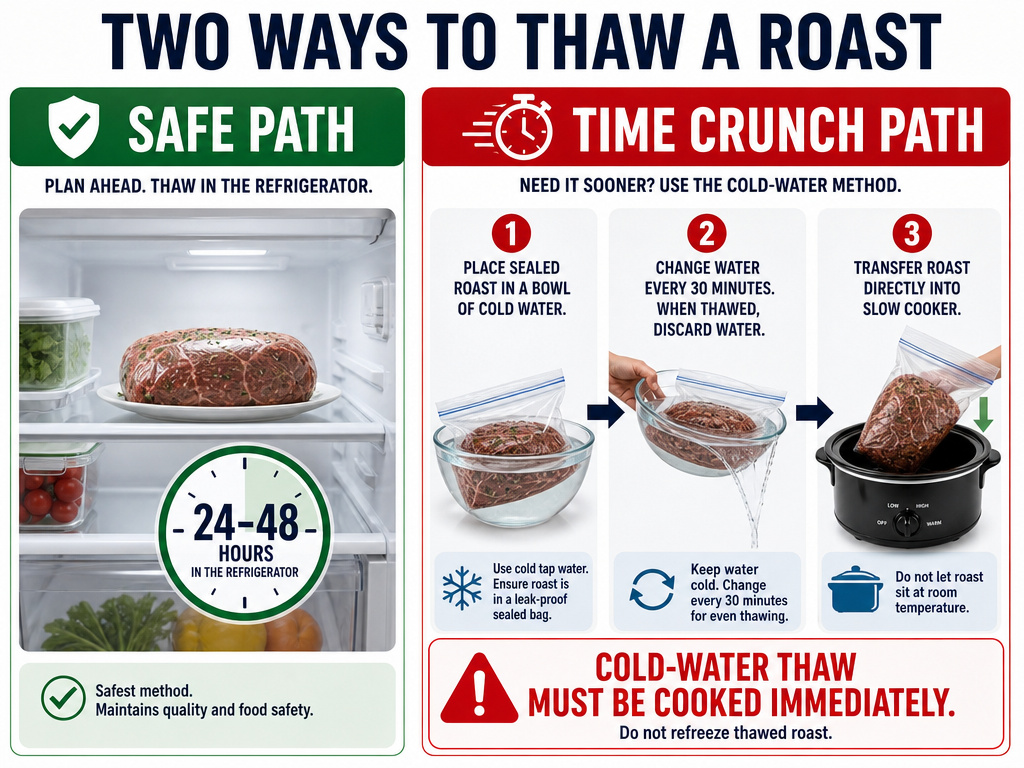
The safe method requires planning, not shortcuts. Thaw your roast in the refrigerator. This keeps the meat at a safe, cold temperature (below 40°F) throughout the process, preventing any bacterial growth.
For a standard 3-4 pound roast, budget 24 to 48 hours in the fridge. Place it on a plate or tray to catch any drips. Once fully thawed, you can proceed with any standard slow cooker recipes.
If you’re in a genuine time crunch, you have one alternative: use the cold-water thaw method. 1. Keep the roast in its leak-proof packaging. 2. Submerge it in a bowl of cold tap water. 3. Change the water every 30 minutes to keep it cold. 4. A 3-pound roast may thaw in about 3 hours this way.
Critical rule: Meat thawed by cold water must be cooked immediately. Do not refreeze it, and do not let it sit on the counter. Transfer it directly to your prepped slow cooker.
How to Cook Your Thawed Roast Safely
With a thawed roast, you can cook with confidence. The process is straightforward and leverages what a slow cooker does best.
- Prep the pot. There’s debate on adding liquid to a slow cooker. For a roast, you need some moisture, about ½ to 1 cup of broth, wine, or water, to create steam and prevent drying, especially on the high setting.
- Layer wisely. Place dense root vegetables (carrots, potatoes) at the bottom, near the heat source. Then add your thawed roast.
- Set the temperature. The “Low” setting (around 200°F) is ideal for tenderness over 8-10 hours. “High” (around 280°F) will cook it in 4-6 hours but can be less forgiving.
- Leave it alone. Resist lifting the lid. Each peek releases steam and drops the internal temperature, adding 15-20 minutes to your cook time.
- Verify doneness. Time is a guide, not a guarantee. Insert a meat thermometer into the thickest part of the roast, avoiding bone. It must read at least 165°F. For fall-apart tenderness, aim for 195°F-205°F.
Common mistake: Assuming a cooked-looking roast is safe. Color and texture are unreliable. Only a thermometer reading tells the truth.
After cooking, you can’t just leave it on “Keep Warm” indefinitely. For safe slow cooker storage, transfer leftovers to shallow containers and refrigerate within two hours.
The Special Case of Commercially Frozen Meals
The USDA’s own guide makes a single exception to the thaw-first rule: “If using a commercially frozen slow cooker meal, prepare according to manufacturer’s instructions.” These are pre-assembled, flash-frozen meals designed for the specific thermal profile of a slow cooker.
They use precise portioning, ingredient sizing, and sometimes pre-cooked components to ensure the entire meal passes through the danger zone quickly and uniformly. This exception does not extend to your homemade frozen roast or stew. It applies only to products engineered for that purpose and labeled as such.
FAQ: Your Frozen Roast Questions, Answered
Can I put a frozen roast in the slow cooker on high?
While the “High” setting heats faster, it does not eliminate the risk. A frozen roast’s core will still lag behind, spending significant time in the danger zone. Both the USDA slow cooker safety guide and the MSU Extension safe cooking PDF advise against it regardless of setting.
What happens if I cook a frozen roast?
You risk two failures. First, the meat may harbor dangerous levels of bacteria by the time it’s done. Second, the extreme temperature difference between the frozen roast and the hot ceramic pot can cause thermal shock, cracking your slow cooker insert.
How long does a frozen roast take in a slow cooker?
Crock-Pot suggests adding 4-6 hours on Low or 2 hours on High to a normal recipe time. However, this extended duration is part of the problem, it’s extra time for the outer layers to incubate bacteria while the core thaws.
Can I thaw a roast in the slow cooker itself?
No. Thawing requires keeping meat below 40°F (in the fridge) or under constant cold water. A slow cooker’s “Warm” setting is still well above 40°F, placing the meat directly into the danger zone for the entire thawing period. This is arguably riskier than cooking it frozen.
Are slow cooker liners safe to use with frozen meat?
Slow cooker liners don’t change the food safety equation. They protect the pot from staining and make cleaning the slow cooker pot easier, but they provide no insulation against thermal shock or bacterial growth. The same rules apply.
The Bottom Line
The convenience of tossing a frozen roast into a slow cooker is a mirage. It’s overshadowed by a real, documented risk of foodborne illness and potential damage to your appliance. The official guidance from the USDA and academic extensions is clear and non-negotiable: thaw first.
Plan for a 24-hour refrigerator thaw. Use a meat thermometer to verify every roast hits 165°F. That’s the difference between a hearty meal and a hazardous one. Your slow cooker is a tool for building flavor safely, not for cutting corners on food safety fundamentals.
