
Pressure Cooking Frozen Chicken: Is It Safe & How-To Guide
This post contains affiliate links. As an Amazon Associate, we earn from qualifying purchases.
Yes, you can put frozen chicken in a pressure cooker, but manufacturer manuals label it “for emergencies only” and restrict it to small, individual cuts like breasts or chops. For safety and even cooking, you must add at least 50% more time to the standard cooking duration and ensure the cooker is never more than two-thirds full.
That “emergencies only” clause from the Presto manual isn’t a suggestion. It’s a liability shield for a real physical problem: a solid block of frozen meat lowers the temperature inside the pot so dramatically that the time to reach pressure can stretch to 40 minutes. During that extended pre-heat, the chicken surface sits in warm, not hot, liquid, a prime zone for bacterial growth if the total cook time isn’t adjusted upward significantly.
What follows: the exact rules pulled from six different cooker manuals, the mechanical reason frozen food risks uneven results, and a step-by-step method that adds the necessary time while keeping the chicken safe and edible. We’ll also cover what you should never try with frozen poultry.
Key Takeaways
- Manufacturer instructions from Presto, Instant Pot, and others explicitly state cooking frozen meat should be reserved for “emergencies only” and for smaller cuts.
- When you must cook from frozen, add 50% more time to the standard cooking time for thawed chicken to account for the extended come-to-pressure phase.
- Frozen food can double or triple the pressurization time; an Instant Pot Max manual notes pre-heat may take up to 40 minutes.
- Only cook individual frozen cuts up to 1 inch thick without thawing; whole chickens or large roasts are not recommended and may not cook through safely.
- The silicone sealing ring in your cooker’s lid will retain strong odors from cooking frozen chicken, and those smells may linger through several subsequent uses.
The Official Manufacturer Rules on Frozen Chicken
Don’t guess. The manuals have already decided. I pulled the guides for half a dozen popular models, and the consensus is cautious, specific, and framed around risk mitigation.
For stovetop models like the Presto 01241, 01264, and 01282, the manual states: “Cooking meat from a frozen state should be reserved only for emergencies. To cook frozen meats, thaw one half hour or more so that the surface of the meat will sear… Frozen beef, veal, and lamb should be cooked 25 minutes per pound. Frozen pork should be cooked 30 minutes per pound.”
That’s a direct, third-person technical snippet. Notice the wording: “reserved only for emergencies.” It’s not “a handy shortcut.” For their electric models, Presto repeats the emergency line but adds a crucial qualifier: it should be “considered only for smaller cuts of meat, such as chops, ribs, and steak.” The MegaChef 12 Qt. Electric cooker manual is even more precise, advising that only individual cuts up to 1 inch thick should be cooked from frozen without a time adjustment.
| Pressure Cooker Model | Stance on Frozen Meat | Key Restriction / Note |
|---|---|---|
| Presto (Stovetop) | Emergencies only | Provides per-pound times for beef/pork (25-30 min/lb) |
| Presto (Electric) | Emergencies only | Smaller cuts only (chops, ribs, steak) |
| Instant Pot Max | Allowed | “Will take a longer amount of time to pressurize.” |
| MegaChef 12 Qt. | Allowed with limits | Individual cuts up to 1 inch thick only; no whole birds or roasts |
| Emeril Lagasse PAF 360 | Allowed | “Add an average of 10 extra mins.” |
The table shows the split between stovetop tradition and electric convenience. Modern multi-cookers like the Instant Pot Max and the Emeril Lagasse Power AirFryer 360 Plus permit it but warn about extended times. The older, mechanical stovetop advice is stricter. This isn’t marketing. It’s engineering. The basic mechanics of a pressure cooker rely on a rapid temperature rise; a frozen mass works directly against that.
Where this goes sideways: Assuming “allowed” means “recommended.” Every manual that allows it couples that permission with a warning about increased pressurization time or a restriction on cut size. Ignoring those caveats is how you end up with chicken that’s steaming hot on the outside but still frozen at the bone.
The core function of any pressure cooker is to trap steam, raising the internal pressure and therefore the boiling point of water. This is the science behind its faster cooking speed. A frozen chicken breast acts like a large ice cube, absorbing massive amounts of thermal energy just to reach 0°C (32°F) before it can even start to cook. That energy drain is why the “come-to-pressure” time balloons.
Why Frozen Chicken Is a Problem for Pressure Cooking
It’s a heat sink. A one-pound frozen chicken breast can require as much energy to thaw as it does to fully cook. Your cooker’s heating element or burner is working overtime just to melt the ice, delaying the moment when the pot’s interior reaches the 115–120°C (239–248°F) needed for pressure cooking. During this extended warm-up period, the outer layers of the chicken linger in the “danger zone” between 4°C and 60°C (40°F and 140°F) for far longer than food safety guidelines prefer.
The second issue is liquid displacement and fill level. A pressure cooker water requirement isn’t optional; you need a minimum amount of liquid to generate steam. Frozen chicken often releases a significant amount of water as it thaws. If you started with the correct amount of liquid, you might end up with a watery, diluted sauce or soup. More critically, you must respect the fill line.
MEAT, DO NOT FILL PRESSURE COOKER OVER ⅔ FULL! NO PORTION OF THE MEAT SHOULD EXTEND ABOVE THE ⅔ FULL MARK.
That all-caps warning from the Presto manual is non-negotiable. Food expands during cooking, and overfilling can block the vent pipe, a primary safety concern for any pressure cooker. A bulky frozen item is easier to overestimate. You must account for the space it will occupy once thawed and cooked, not just its frozen dimensions.
Finally, there’s the texture and safety trade-off. To ensure the center reaches a safe 74°C (165°F), the outer layers will inevitably overcook. For a forgiving cut like a chicken thigh, this might be acceptable. For a lean breast, it often results in a dry, stringy exterior by the time the interior is done.
The 3-Step Process for Frozen Chicken Breasts
If you’ve weighed the warnings and need to proceed, this method minimizes risk. It applies specifically to individual, frozen chicken breasts or chops.
Before you start: Unplug or remove the cooker from the heat source before opening. The steam inside is at extreme pressure and can cause severe burns. Always use long utensils, keep your face and hands away from the vent, and confirm the float valve has dropped before twisting the lid.
Step 1: Assess and Prepare
Check the size of your frozen chicken. If any piece is thicker than 1 inch, or if you have a solid block of multiple pieces frozen together, stop. Thaw it in the refrigerator instead. The manual rules are clear for a reason. For pieces under 1 inch thick, proceed. Gather your liquid. You’ll need at least 1 cup (240 ml) of broth, water, or sauce. This meets the minimum liquid for pressure cooking for most electric models. Do not add butter or oil here, they don’t generate steam.
Step 2: Calculate Time and Cook
This is the critical math. Find a reliable recipe for thawed chicken breasts and its recommended high-pressure time. For example, many recipes call for 6–8 minutes for thawed, boneless breasts. Add 50% to that time. If the recipe says 8 minutes, you’ll cook for 12 minutes. This compensates for the extended come-to-pressure phase where the chicken is thawing but not fully cooking. Place the trivet in the pot, add your liquid, and set the frozen chicken on the trivet. This keeps it mostly out of the liquid, promoting more even steaming. Secure the lid, set the valve to sealing, and start the high-pressure cooking program.
Step 3: Release and Verify
Once the cook time ends, you must use a natural release. Do not quick-release. Let the pressure drop on its own for at least 10 minutes. A quick release while the chicken is still releasing internal moisture can make it tough. After releasing remaining pressure, open the lid away from you. Immediately check the internal temperature of the thickest part of each piece with a meat thermometer. It must read 74°C (165°F). If it doesn’t, you can return it to pressure for 2–3 minute increments, but be aware this will further dry out the meat.
What You Should Never Do with Frozen Poultry
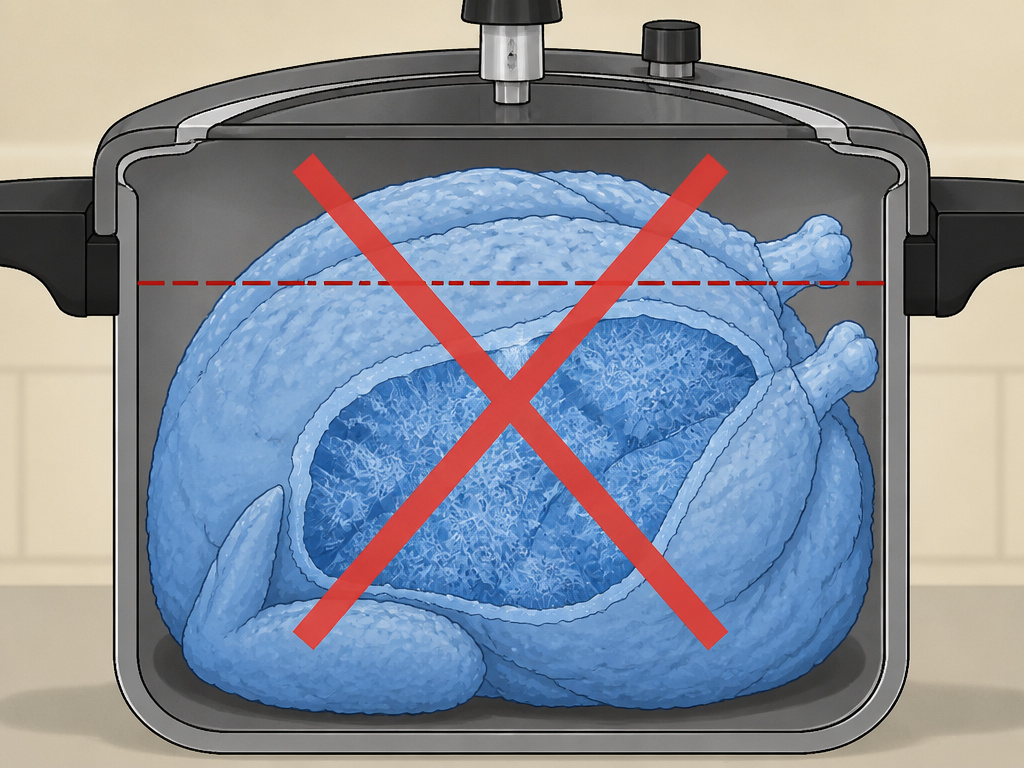
Some mistakes turn a convenience into a hazard or guarantee a failed meal.
- Never cook a whole frozen chicken. The thermal mass is too great. The outside will be mush while the cavity remains frozen, creating a massive food safety risk. This is explicitly warned against in manuals like the MegaChef’s.
- Never skip the extra liquid. The frozen chicken won’t release its own liquid in time to create the initial steam. Without sufficient liquid, the cooker can boil dry, damaging the pot and creating a burn notice on electric models.
- Never pack the pot. The 2/3 fill line is an absolute limit for meat. A frozen roast or multiple breasts can easily exceed this once they expand. Blocked vents are how explosion risks become real, though modern safety features make catastrophic failures rare.
- Never rely on guesswork for doneness. Color is meaningless under pressure. You need a thermometer. Undercooked poultry is a serious health hazard.
The sealing ring in your lid is made of silicone. Silicone retains odors. Cooking strong-smelling frozen chicken will impregnate that ring with the scent, which may transfer to the next few dishes you make, like a delicate rice pudding or steamed vegetables. It fades after several uses, but it’s a tangible side effect.
Frozen vs. Thawed: Is the Time Saved Real?
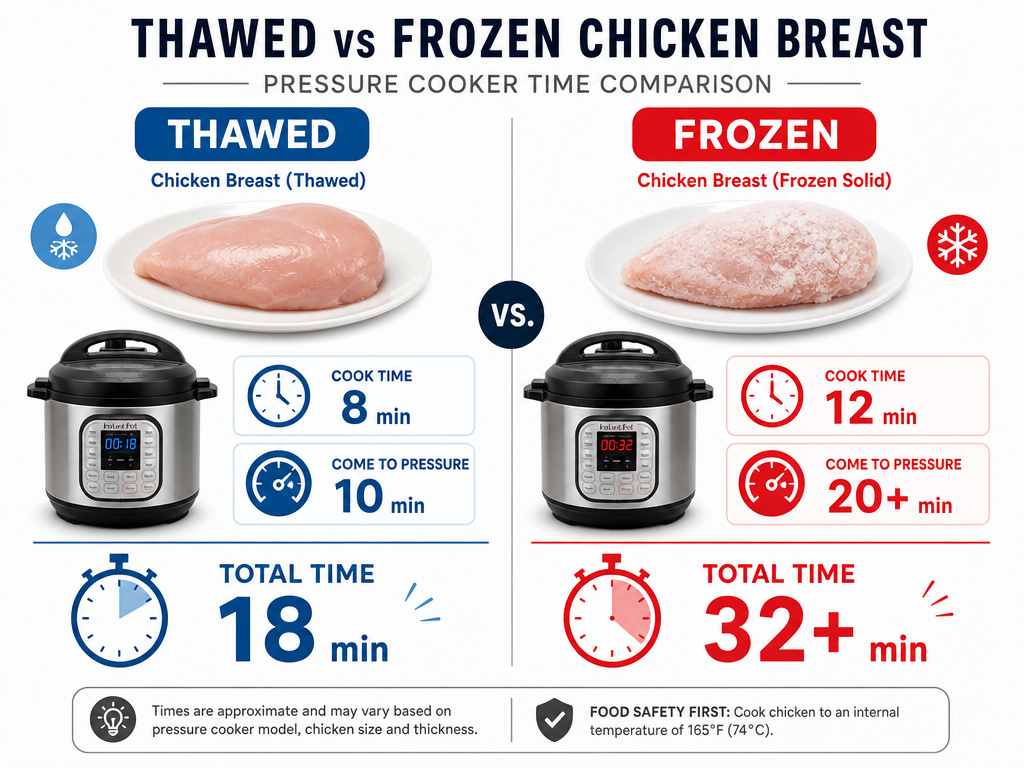
Let’s run the numbers. A typical thawed chicken breast cooks in 8 minutes at high pressure. The come-to-pressure time might be 10 minutes. Total hands-off time: roughly 18 minutes.
That same breast, frozen, needs 12 minutes of cook time (50% more). The come-to-pressure time could easily double to 20 minutes or more as the frozen mass slowly heats. Total hands-off time: 32+ minutes.
You “saved” the 12-24 hours of refrigerator thawing. But you added at least 14 minutes of active cooker time and guaranteed a drier texture. For a true emergency, you forgot to thaw dinner, it’s a viable salvage operation. As a regular practice, it degrades quality and contradicts the manufacturer’s own guidance designed to ensure consistent results and safety.
For a truly hands-off approach to cooking frozen food, a slow cooker is the designed tool, though it has its own safety rules. The functional distinctions between an Instant Pot vs slow cooker are stark: one is built for speed under pressure, the other for slow, low-temperature thawing and cooking.
Frequently Asked Questions
Can I put frozen chicken in an Instant Pot?
Yes, an Instant Pot or other electric pressure cooker will cook frozen chicken. The Instant Pot Max manual specifically notes that “frozen food will take a longer amount of time to pressurize.” You must follow the same rules: use smaller cuts, add at least 50% more cook time, and ensure sufficient liquid. The “Pot Roast” or “Poultry” button is just a pre-set timer; you will need to manually adjust it upward.
How much longer does frozen chicken take?
Add a minimum of 50% more time to the standard cooking time for thawed chicken. If a recipe calls for 10 minutes at high pressure for thawed breasts, cook frozen ones for 15 minutes. The total process will be longer because the “coming to pressure” phase before the countdown starts can take twice as long, up to 40 minutes for a full pot, per some manuals.
Is it safe to pressure cook frozen chicken?
It is conditionally safe if you follow strict guidelines: use individual cuts no thicker than 1 inch, add significant extra cook time (50%+), and always verify the internal temperature with a meat thermometer reaches 74°C (165°F). The major safety risk is not from pressure failure but from undercooking if time adjustments are insufficient. The manuals’ “emergency only” phrasing reflects this conditional safety.
Can I cook frozen chicken breasts without thawing?
You can, but you shouldn’t make a habit of it. For best results, juicy, evenly cooked meat, thawing first is superior. If you must cook from frozen, use the 50% time increase, a natural pressure release, and a thermometer. The texture will be drier and more stringy than chicken cooked from thawed, but it will be safe to eat if the temperature is correct.
Before You Go
You can pressure cook frozen chicken. The manuals from Presto, Instant Pot, and MegaChef give you a cautious, procedural green light. The real answer isn’t about permission; it’s about cost. The cost is extra time waiting for pressure to build, a guaranteed sacrifice in texture, and operating outside the ideal parameters your cooker was designed for.
For a genuine time-crunch emergency, use the 50% rule, stick to thin cuts, and trust your thermometer. For every other night, take the five minutes to move chicken from the freezer to the fridge in the morning. Your pressure cooker recipes for tough cuts of meat and a whole variety of pressure cooker meals will turn out better, and you’ll sidestep the manufacturer’s sternest warnings entirely.
