
No Dutch Oven? How to Make Sourdough with a Skillet or Pyrex
This post contains affiliate links. As an Amazon Associate, we earn from qualifying purchases.
Yes, you can make sourdough without a Dutch oven. The goal is to replicate its three core functions: trapping initial steam, providing steady bottom heat, and then allowing venting for browning. This is done with a covered, heatproof vessel like a Pyrex casserole, an inverted stock pot over a baking stone, or a cast iron skillet capped with a roasting tin.
A Dutch oven isn’t magic. It’s just a heavy pot with a lid. The real work is done by the steam it traps from the dough itself during the first 20-25 minutes of the bake. If you can recreate that sealed, humid micro-climate with something else that can handle 450–500°F, you’re in business.
What follows is a breakdown of what you’re actually replacing, a direct comparison of the most effective alternative setups from your kitchen, and the specific, non-negotiable rules for preheating and steam that make them work. We’ll cover the Pyrex warning, the skillet-and-lid trick, and why a fan setting can ruin everything.
Key Takeaways
- The critical phase is the first 20–25 minutes under cover. Steam keeps the crust soft so the loaf can expand fully.
- Check your Pyrex. UK-made borosilicate handles 300°C; US-made soda-lime is rated for only ~220°C (425°F). Using the wrong one at sourdough temperatures risks shattering.
- A cast iron skillet preheated for a full hour, capped with a deep roasting tin, is the closest functional substitute to a Dutch oven.
- Never pour water directly onto a cold oven door or glass to create steam, thermal shock will crack it. Use a preheated tray.
- If your oven has a fan (convection) setting, turn it off for the initial steam phase. Moving air dries the crust too fast.
The Three Things a Dutch Oven Actually Does
Forget the brand name. A Dutch oven solves a specific physical problem in home baking. Your oven is designed to be dry, but sourdough needs a burst of humidity at the start. Understanding the mechanics shows you what to replace.
A Dutch oven traps ambient moisture released from the dough during the first 20–25 minutes of baking at 230–260°C (450–500°F). This steam delays crust formation, allowing for maximum oven spring before the lid is removed to vent humidity and brown the crust.
The heavy cast iron provides thermal mass, which means it holds heat steadily and prevents the temperature from crashing when you load the cold dough. The tight-fitting lid is the key to the steam trap. Any alternative needs to provide both a hot base and a sealed, or mostly sealed, cover for that initial phase. This is the core principle behind every Dutch oven substitute.
Why Steam Isn’t Optional
Without that initial steam, the dough’s surface dries and sets within minutes. The crust becomes a rigid cap, physically preventing the loaf from expanding. You get a dense, pale loaf with a thick, tough crust. Steam keeps the surface elastic. The starches gelatinize in a humid environment, which later dries into a shiny, crisp shell instead of a hard, matte barrier.
Your Kitchen’s Best Dutch Oven Substitutes, Ranked
Not all alternatives are equal. Some require buying a single piece of cheap kit; others use what you already own. This table compares the effectiveness, cost, and ease of the top methods.
| Method | Best For | Heat Source | Steam Trap | Key Watch-Out |
|---|---|---|---|---|
| Cast Iron Skillet + Roasting Tin Lid | Closest results to a Dutch oven | Preheated skillet | Inverted roasting tin | Needs a full 60-min preheat |
| Inverted Stock Pot over Baking Stone | High oven spring, strong bottom heat | Baking stone/pizza steel | Large stock pot | Pot must be oven-safe to 500°F |
| Pyrex Casserole with Glass Lid | Using existing bakeware | The Pyrex dish itself | Its own glass lid | Must verify glass type (UK vs US) |
| Two Loaf Pans (Sandwich Style) | Baking sandwich loaves | One loaf pan | Second inverted loaf pan | Less steam retention; seal isn’t tight |
| Baking Stone + Separate Steam Tray | Open baking, multiple loaves | Baking stone | Tray of boiling water/ice below | Most finicky; oven loses heat faster |
Method 1: The Pyrex Casserole Warning
If you have a glass casserole dish with a lid, you’re holding a potential Dutch oven substitute. But this method comes with a major, non-negotiable caveat that depends entirely on where your dish was made.
UK Pyrex (often marked “International Cookware, France”) is borosilicate glass, rated to 300°C. It can handle typical sourdough temperatures. US Pyrex (Corelle Brands, marked “Made in USA”) is soda-lime tempered glass, rated to about 220°C (425°F). Putting US Pyrex into a 500°F oven is asking for thermal shock and failure.
Where this goes sideways: Assuming all Pyrex is the same. Using US soda-lime Pyrex at 260°C (500°F) risks catastrophic shattering when the dough’s moisture hits the overheated glass. Check the bottom stamp before you preheat.
The process is simple: preheat the empty dish and lid in the oven for 45-60 minutes. Load the dough onto the hot dish, cover with the hot lid, and bake. The glass lid traps steam effectively. Just know its limits.
Method 2: The Cast Iron Skillet & Roasting Tin Lid
This is the professional baker’s hack. It separates the two jobs of a Dutch oven, thermal mass and a lid, into two affordable pieces.
You need a heavy cast iron skillet (a 28cm/11-inch Lodge works perfectly) and a deep, oven-safe roasting tin that fits over it like a cloche. The skillet is your heat battery. The roasting tin is your steam dome.
- Place the skillet on the middle rack and the roasting tin on a separate rack. Preheat everything to 250°C (480°F) for a full 60 minutes. Twenty minutes isn’t enough.
- Carefully load your dough onto the screaming-hot skillet (parchment paper is your friend).
- Using oven gloves, immediately place the hot roasting tin over the skillet to create a sealed chamber.
- Bake covered for 25 minutes. Remove the roasting tin lid, reduce the heat to 220°C (425°F), and bake uncovered for 15-20 minutes to brown.
The results are nearly identical to a cast iron Dutch oven for sourdough, but loading the dough onto a shallow skillet is far safer than lowering it into a deep pot.
Method 3: The Inverted Stock Pot over a Baking Stone
This method is excellent if you already own a baking stone or pizza steel. The stone provides incredible bottom heat, and the pot acts as a dedicated steam chamber.
Use a large, all-metal stock pot (no plastic handles) or a stainless steel mixing bowl. An 8-quart pot fits a standard boule. Preheat the baking stone and the inverted pot on a separate rack for an hour. Slide your dough onto the stone, then quickly cover it with the hot pot. The seal won’t be perfect, but it’s enough. This setup is a fantastic alternative to a Dutch oven for bakers who already own a stone.
The Non-Negotiable Rules for Steam & Heat
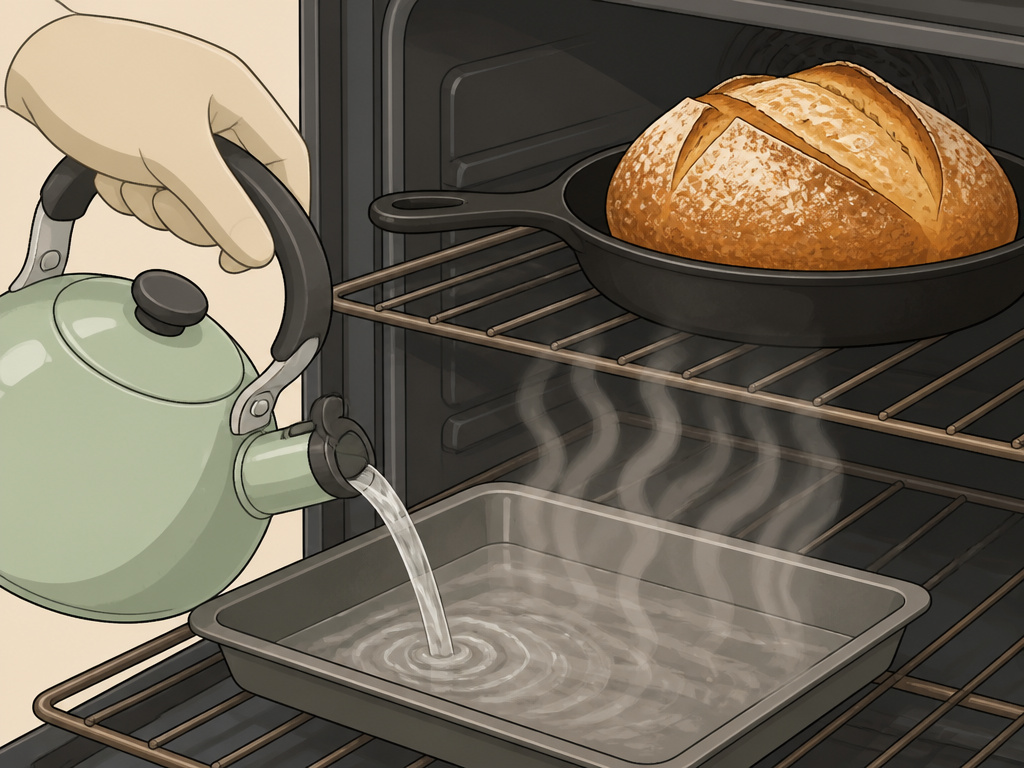
You can have the perfect setup and still fail by missing one of these procedural details. They’re what turn a good alternative into a great one.
Rule 1: Preheat Thermal Mass for a Full Hour
A common mistake is preheating your skillet, stone, or Pyrex for only 20 minutes. The surface is hot, but the core hasn’t reached temperature. When you load the cold dough, the core temperature plummets, resulting in a pale, soggy bottom.
Easy to miss: The one-hour preheat. Your skillet might feel hot after 20 minutes, but its thermal mass needs 45-60 minutes at 250°C to fully charge. That steady, deep heat is what drives strong oven spring.
Rule 2: Manage Steam Correctly (No Door Pouring)
If you’re using a steam tray instead of a cover, you must add water safely. Never pour water directly onto the oven door or a cold glass panel. The thermal shock can crack it instantly.
Instead, place a metal tray (like a rimmed baking sheet) on the bottom rack during preheat. When you load the bread, carefully pour about a cup of boiling water into the hot tray. It will flash to steam. For a slower, longer steam release, some bakers soak rolled-up kitchen towels in a pan of water during the preheat.
Rule 3: Turn Off the Fan (Convection)
If your oven has a convection setting, turn the fan off for the first 20-25 minutes. A fan circulates dry air, which actively wicks moisture away from the dough’s surface. This defeats the entire purpose of creating a humid micro-climate. If you can’t turn the fan off, this method becomes much harder. The moving air will dry the crust prematurely, limiting oven spring.
Frequently Asked Questions
What’s the cheapest Dutch oven alternative for sourdough?
Stainless steel mixing bowl inverted over a preheated baking sheet or pizza stone. It costs almost nothing if you own a bowl, and it replicates the steam-trapping function well. For a more permanent, superior solution, a Lodge cast iron skillet paired with a cheap roasting tin lid is a powerhouse combination that outperforms many dedicated Dutch ovens for sourdough bread.
Can I use a regular pot instead of a Dutch oven?
Yes, if it’s all-metal (no plastic or wood handles) and has a tight-fitting, oven-safe lid. An enameled cast iron pot, a heavy stainless steel stock pot, or even a deep casserole dish can work. The key is verifying the lid’s temperature rating and ensuring it seals reasonably well.
Why did my bread turn out dense without a Dutch oven?
The most likely cause is insufficient steam in the first 20 minutes. Without a tight seal, humidity escapes, and the crust sets too early. Check your cover for gaps, ensure you preheated your base vessel long enough, and verify you’re not using a fan setting. A dense loaf is almost always a steam problem, not a flour problem.
Is a baking stone enough by itself?
No. A baking stone only provides bottom heat, it doesn’t trap steam. You must pair it with a covering method (like an inverted pot) or a separate, active steam source (like a tray of boiling water). Using a stone alone will give you a well-baked bottom but a pale, thick crust and poor rise because the steam escapes immediately.
How do I know if my Pyrex is safe for high-temperature baking?
Look at the stamp on the bottom. If it says “PYREX” in all caps (often on older pieces) or “International Cookware, France,” it’s likely borosilicate and safer for high heat. If it says “pyrex” in lowercase or “Made in USA,” it’s soda-lime glass. Do not exceed 220°C (425°F) with soda-lime glass. When in doubt, use it as a cover over a different heat source, not as the preheated base vessel.
The Bottom Line
You absolutely can bake excellent sourdough without a dedicated Dutch oven. The secret isn’t in buying a specific pot; it’s in rigidly applying the physics of steam and thermal mass. Pick a cover that seals, pick a base that holds heat, and preheat both longer than you think you need.
For most bakers, the cast iron skillet and roasting tin lid is the winning combo, it’s affordable, safe, and delivers results that truly challenge the need for a premier Dutch oven for sourdough bread. Start with the kit you have, master the steam, and upgrade your hardware only if the baking bug truly takes hold. Your perfect loaf is already in your oven. You just need to cover it.
