
Can You Preheat a Ceramic Dutch Oven for Bread? Here’s How
This post contains affiliate links. As an Amazon Associate, we earn from qualifying purchases.
You can preheat a ceramic Dutch oven for bread if, and only if, the manufacturer explicitly states it is safe. The answer hinges on your specific pot’s maximum rated temperature and its resistance to thermal shock. Brands like Emile Henry and Breadtopia design certain models for preheating up to 500°F, while generic ceramics often cannot handle the stress.
That “if” is the whole game. Ceramic doesn’t fail quietly. It cracks. The difference between a perfect loaf and a shattered pot comes down to three verifiable specs: the manufacturer’s preheat rating, the exact temperature ceiling, and your commitment to a gradual heat-up. Ignore any one, and the thermal stress finds the weak point.
What follows: the brand-by-brand temperature limits pulled from OEM manuals, the physical reason ceramic cracks when cast iron doesn’t, and the step-by-step method that actually works. You’ll also get the cold-start workaround for pots that can’t be preheated, and why that method changes your crust.
Key Takeaways
- **Check the manual first.Your pot’s preheat safety is a printed specification, not a universal rule. Emile Henry and Breadtopia publish exact limits (500°F and 475°F, respectively). Thermal shock is immediate. Placing a cold ceramic pot into a hot oven, or a hot pot on a cold counter, can cause a crack within minutes.Always heat and cool gradually.
- Use room-temperature dough. Cold dough hitting a preheated ceramic base is a classic thermal shock trigger. Let your shaped loaf sit out for 30 minutes first.
- Preheating improves oven spring. A hot pot gives a stronger initial rise and a crisper crust. If your model is rated for it, preheating is the better method.
- Parchment paper is non-negotiable for cold starts. Without preheating, dough sticks fiercely. A parchment sling is the only reliable release.
Why Preheat at All? The Steam and Spring Principle
A Dutch oven bakes bread by mimicking a professional steam-injected oven. The heavy, preheated walls radiate intense heat to the dough the moment it goes in. This “oven spring”, the rapid final rise, happens best when the environment is already hot. The sealed lid traps the moisture evaporating from the dough itself, creating a humid microclimate that keeps the crust supple long enough to expand fully before setting.
Technical Snippet: In bread baking, oven spring refers to the rapid expansion of dough during the first 10-15 minutes in the oven, driven by steam and heat. A preheated Dutch oven provides immediate, consistent radiant heat from all sides, maximizing this expansion and yielding a taller, more open crumb structure.
The alternative is a cold start. You place the dough in a room-temperature pot and put both in a cold oven. The heat rises slowly, so the spring is less vigorous. The crust can be slightly paler and less crisp. For pots not rated for preheating, it’s the only safe path. But if your ceramic cookware is rated for it, preheating delivers a textbook result.
Ceramic vs. Cast Iron: Why the Material Changes Everything
This is not a minor detail. Cast iron is thermally resilient. It can handle rapid temperature swings, throwing a cold Dutch oven into a hot oven is standard practice. Ceramic and porcelain enamel are vitrified glass. Glass expands and contracts at a different rate than the metal underneath, and it’s brittle.
The risk is thermal shock. A sudden, uneven temperature change causes different parts of the material to expand at different speeds. This creates internal stress. If the stress exceeds the material’s strength, it cracks. This isn’t a “maybe.” It’s a predictable physical failure.
| Factor | Ceramic / Porcelain Enamel | Cast Iron |
|---|---|---|
| Thermal Shock Risk | High | Very Low |
| Preheat Safety | Brand and model specific | Universally safe |
| Failure Mode | Cracking, crazing (hairline cracks in glaze) | Warping (rare) |
| Typical Max Preheat | 450°F – 500°F (check manual) | 500°F+ |
| Heating Rule | Always heat and cool gradually with the oven | Can be placed in a preheated oven |
That’s why the question “can you preheat a ceramic Dutch oven” has no general answer. It’s a question about your specific pot’s construction materials and factory testing. A Le Creuset enameled cast iron pot is fundamentally different from an Emile Henry all-ceramic cocotte, even though both are used for bread.
The 475°F vs. 500°F Ceiling That Decides
Manufacturer limits are your only reliable guide. These numbers are the result of stress testing.
- Breadtopia Cloche: Their care sheet states do not exceed 475°F. The preheat method recommends 450-475°F. This is a primary source fact.
- Breadtopia Ceramic Baker: This model has a higher limit, 500°F. The same company, two different products, two different specs.
- Emile Henry: States their ceramic bread cloches and Dutch ovens for bread can be preheated up to 500°F.
- Le Creuset (Ceramic): Their ceramic (not enameled cast iron) models are typically rated up to 450°F.
- Generic / Unknown Brands: Assume it is not preheat-safe unless you have a printed manual that says otherwise.
Where this goes sideways: Assuming “oven-safe” means “preheat-safe.” Many ceramic pots are oven-safe for cooking, which means you can bake a casserole in them. Preheating empty is a more severe thermal stress test. The manual must explicitly approve it.
These limits matter because exceeding them doesn’t always cause an instant explosion. It can cause crazing, a network of hairline cracks in the glaze. This weakens the pot and makes it stain-prone. The failure happens silently, and you only notice it months later.
The Safe Preheating Method for Ceramic (Step-by-Step)
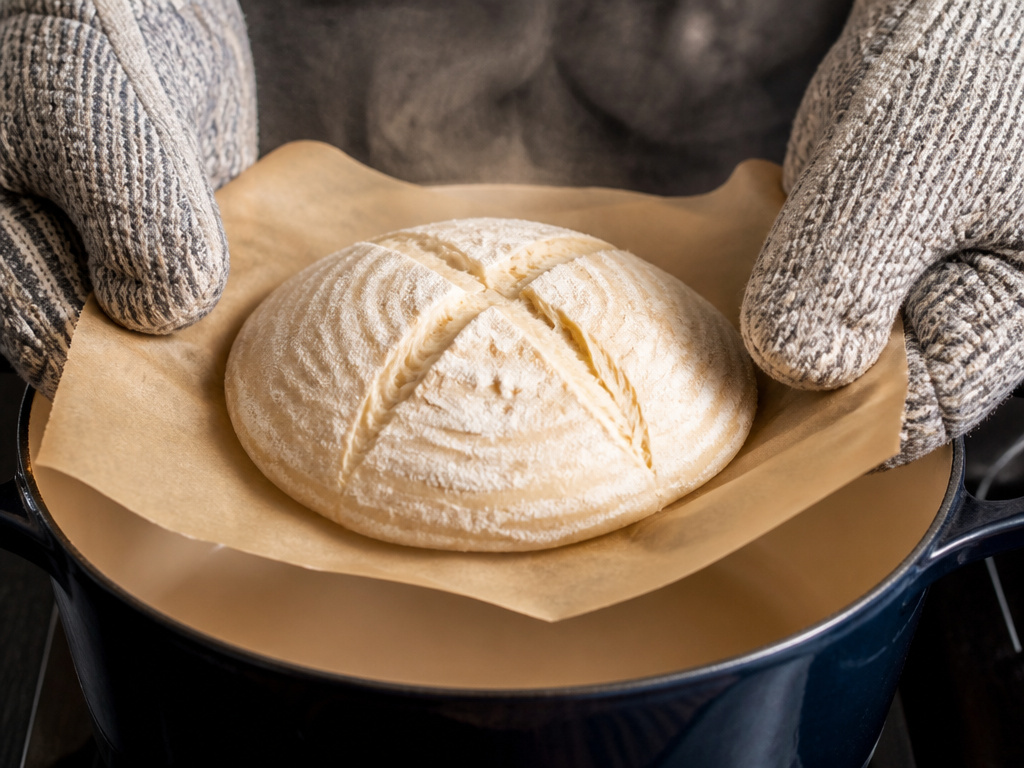
If your manual gives the green light, this sequence minimizes thermal stress. Deviating from it is how you test your warranty.
- Verify the rating. Double-check the manual for the maximum preheat temperature. Write it down. This is your hard ceiling.
- Start with a cold oven. Place your empty, room-temperature Dutch oven (with lid) inside. Do not place it into an already-hot oven. This gradual heating is the single most important step.
- Set the temperature. Turn the oven to your target baking temp, ensuring it does not exceed the pot’s maximum rating (e.g., 475°F for a Breadtopia Cloche).
- Preheat for 30-45 minutes. Let the oven and pot come to temperature fully. The pot needs this time to heat evenly throughout its mass.
- Prepare room-temperature dough. Your shaped loaf should not be cold from the fridge. Let it sit covered on the counter for 20-30 minutes to take the chill off.
- Work quickly and safely. Use thick oven mitts. Pull the hot pot out, place it on a heat-safe surface. Lower your dough in using a parchment paper sling, this protects the pot’s base and makes removal easier.
- Bake as directed. Score the dough, cover with the hot lid, and return to the oven.
Common mistake: Using a cold dough sling. If your parchment and dough are fridge-cold, you’re placing a thermal shock bomb into your preheated pot. The bottom can crack. Always use room-temp components.
Skipping the parchment paper is tempting for a cleaner look. Don’t. The preheated pot will likely release the bread, but the parchment guarantees it. A stuck loaf in a 475°F pot is a burn hazard and a mess.
When You Shouldn’t Preheat: The Cold-Start Alternative
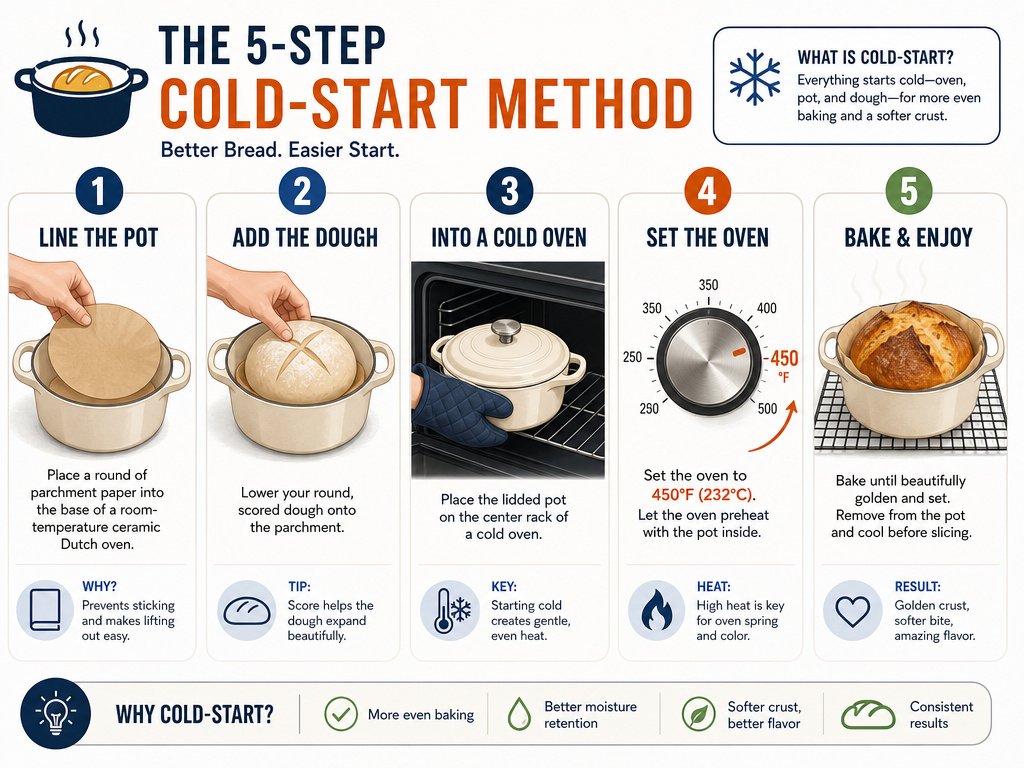
What if your pot is ceramic but the manual is silent on preheating, or it explicitly warns against it? You use the cold-start method. This is the standard for many basic ceramic Dutch ovens.
The Cold-Start Process:
- Line the base of your room-temperature pot with parchment paper. This is mandatory; the dough will fuse to an unheated ceramic surface.
- Place your shaped dough inside.
- Put the lidded pot into a cold oven.
- Set the oven to your desired baking temperature (usually 450°F).
- Bake as usual, removing the lid for the final browning.
The bread will still bake. The oven spring will be less dramatic, and the crust may be a bit softer and paler. It’s a trade-off for safety. This method completely avoids the thermal shock risk of a hot pot, making it the default for unrated or sensitive oven-safe ceramic.
Real-World Contradictions and User Experiences
The theory is clean. The practice is messy. Community forums reveal where real use clashes with official advice.
On The Fresh Loaf, a user reported preheating an empty Le Creuset enameled Dutch oven at 500°F for an hour, weekly, for years. The handle, which Le Creuset says cannot handle that temperature, remained in “perfect condition.” Another user directly contacted Emile Henry after their included instructions seemed to warn against preheating. The company replied that preheating empty was “perfectly okay.”
What does this tell you? Manufacturer limits are conservative. They build in a safety margin for worst-case scenarios, a cold pot in a dirty, unevenly heating oven. A careful home baker following a gradual heat-up in a clean oven is operating under ideal conditions. However, the conservative limit is what they will honor for a warranty claim. Your personal risk tolerance decides whether you follow the letter of the manual or the anecdote from a forum.
Critical Post-Bake Handling: Avoiding the Final Crack
Your pot is most vulnerable right after baking. It’s at 450°F+ and full of residual heat.
Never place a hot ceramic Dutch oven on a cold, hard surface like a granite countertop or a metal sink. The temperature differential can shock the base and cause a crack.
The Breadtopia care guides are explicit: place the hot cloche or baker on a stove top, a cooling rack, or a folded towel. Let it cool slowly to room temperature before you even think about washing it. This cool-down period is part of the baking process. Rushing it voids the care you took during preheating.
Frequently Asked Questions
Can I preheat my ceramic Dutch oven if it doesn’t have a manual?
No. Without explicit manufacturer confirmation, you must assume it is not preheat-safe. Use the cold-start method. The risk of cracking a pot is not worth the marginal crust improvement. Invest in a Dutch oven that is documented for the job, or use the one you have safely.
My bread sticks to my ceramic Dutch oven. What did I do wrong?
For preheated pots, you likely needed a parchment sling or a light oiling of the base before heating. For cold-start pots, sticking means you skipped the parchment paper. Ceramic is porous when not preheated; dough bonds to it. Always use a parchment sling for cold starts.
Is a ceramic or cast iron Dutch oven better for bread?
For pure performance and durability for preheating, cast iron wins. It’s indestructible in this context. Ceramic offers excellent heat distribution and often comes in lighter weights and brighter colors. The “better” choice is the one you will use correctly: a preheat-safe ceramic if you follow its limits, or a cast iron if you want zero worry.
Can thermal shock damage happen later, not right away?
Yes. Crazing, a network of fine cracks in the glaze, can develop over time after repeated thermal stress. It weakens the surface and makes it prone to staining. A pot can look fine after one misuse but fail silently over several bakes.
How do I choose the right size Dutch oven for bread?
4 to 5-quart capacity is ideal for a standard 500g loaf. It gives the dough enough space to expand without touching the sides too early. Our guide on Dutch oven sizes for bread breaks down the capacity-to-loaf weight ratios in detail.
The Bottom Line
Preheating a ceramic Dutch oven for bread is a conditional yes. The condition is printed in your manual. Find the maximum temperature rating, 475°F for a Breadtopia Cloche, 500°F for an Emile Henry, and treat it as law. Heat it from a cold oven, use room-temperature dough on parchment, and let it cool on a towel. If your pot isn’t rated, the cold-start method still makes great bread. The goal is to get a fantastic loaf, bake after bake, without a trip to the recycling bin.
