
Does a Roaster Oven Need Water? The Essential Guide & Specs
This post contains affiliate links. As an Amazon Associate, we earn from qualifying purchases.
Yes, a roaster oven needs water in its removable cooking pan for preheating and buffet serving, but you must never add water directly into the roaster oven body. For a standard 18-quart model like the DASH RO180, that means 5 to 6 quarts of water heated to 350°F for 30 minutes before use. This creates the steam that prevents food from drying out and ensures even, moist heat.
That “in the pan, not the body” distinction is where the whole system lives or dies. The heating element is wrapped around the lower third of the outer shell. Pour water into the body, and it hits that live element directly. The result is a short circuit, a tripped breaker, and a repair bill that costs more than a new unit.
What follows is a breakdown of the three situations where water is mandatory, the exact quantities from the manufacturer manuals most articles skip, and the one Hamilton Beach trick that changes the rule entirely.
Key Takeaways
- Water goes only in the removable roasting pan, never directly into the roaster oven body. Violating this can short the heating element.
- For preheating and buffet serving, fill the pan 1/2 to 3/4 full (5-8 quarts for most 18-quart models) and heat at 350°F for 30 minutes.
- The Hamilton Beach method uses two small water containers in the pan corners to keep bread warm, avoiding a full pan of water.
- Water is not required for standard roasting, baking, or slow cooking if the recipe doesn’t call for added liquid.
- Always check your specific model’s manual. A DASH RO230 needs 8 quarts; an 18-quart DASH with a buffet server needs 5-6.
The Short, Specific Answer
For preheating a roaster oven before buffet service, fill the removable cooking pan 1/2 to 3/4 full with water—typically 5 to 8 quarts for an 18-quart model—and heat at 350°F for 30 minutes. This step is non-negotiable for creating a moist, steaming environment that keeps food hot without drying it out.
The need for water hinges entirely on what you’re using the appliance for. If you’re running a buffet line or keeping a large batch of mashed potatoes warm for hours, water is essential. If you’re roasting a turkey or baking potatoes, it’s usually not needed unless the recipe includes a braising liquid.
The core mistake is assuming all moisture comes from the food. A roaster oven is not a sealed pressure cooker; it’s a well-insulated box with a heating element. Without a water bath, the hot, dry air circulating inside will wick moisture from the surface of your food. That’s how a beautifully cooked ham turns into a leathery brick after 90 minutes on the buffet.
Where this goes sideways: Adding water directly into the roaster oven body, bypassing the pan. The DASH RO230-B-1 manual states this caution in bold: “Never add water directly inside the ROASTER OVEN BODY.” The heating element isn’t designed to be submerged. Do it once, and you might just get a scary spark and a dead appliance. Do it with the unit plugged in, and you risk a serious electrical fault.
The 350°F Preheating Rule (And Why 30 Minutes Matters)
Every manual from DASH, Aroma, and GE agrees on the preheating specs: 350°F for 30 minutes. This isn’t a suggestion. It’s the time required to bring several quarts of water from room temperature to a steady, rolling steam.
The physics are simple. A roaster oven’s thermostat cycles the heating element on and off to maintain temperature. Dumping cold food into a pan of lukewarm water forces the element to run constantly, struggling to climb back to 250°F. The food sits in the “danger zone” (40°F–140°F) for too long. Preheating the water to a boil ensures the environment is already at a food-safe temperature the moment you add the serving trays.
Here are the model-specific quantities that generic guides miss:
| Roaster Oven Model | Water for Preheating | Preheat Temp & Time | Primary Source |
|---|---|---|---|
| DASH RO160/170/180/230 Series | 8 quarts (1/2 – 3/4 full pan) | 350°F for 30 min | DASH RO230-B-1 manual |
| DASH 18 QT with Buffet Server | 5 to 6 quarts (1/2 – 3/4 full pan) | 350°F for 30 min | DASH RO180BR-C manual |
| Aroma ART-818 | Fill pan, level below serving trays | 350°F for 30-35 min (until boiling) | Aroma ART-818 manual |
| GE 169059 | 8 quarts (1/2 – 3/4 full pan) | 350°F for 30 min | GE User Manual |
Notice the consistency? The 30-minute preheat is universal because it works. Skip it, and you’re gambling with food safety and quality for no gain.
When You Don’t Need Water in the Pan
For standard roasting and baking, water in the pan is often unnecessary and can be detrimental. If you’re following a recipe for a roast chicken or a tray of vegetables, you’re using the roasting pan as a dry-heat cooking vessel, much like your regular oven.
- Roasting Meat & Poultry: The goal is a browned, crisp exterior. Adding water creates steam, which prevents browning. The Aroma manual notes that for tender cuts like ribs, dry roasting is recommended. Only add a cup or two of water to the pan if you’re cooking a high-fat bird to prevent smoking from drippings.
- Baking: Cakes, breads, and casseroles need dry, circulating heat to rise and set properly. A water bath would make the environment humid and soggy.
- Slow Cooking Soups & Stews: The food itself provides the liquid. The versatile roaster oven appliance acts as a giant slow cooker here, with the lid kept on to retain moisture.
The rule shifts when you move from cooking to holding. Cooking is usually dry; holding hot food for extended periods requires a moisture source. This is the key decision point most home cooks miss.
The Hamilton Beach Hack: Two Cans of Water

One manufacturer provides a clever exception that redefines the “full pan of water” rule. The Hamilton Beach manual details a method for keeping rolls, biscuits, or pancakes warm for up to an hour.
The part nobody mentions: Preheat the roaster to 250°F. Take two empty, washed food cans. Fill each two-thirds with hot water and place them in opposite corners of the insert pan. Stack your bread items in the center, making sure they don’t touch the pan’s sides. Cover and keep warm.
This method works because the small, concentrated water sources create just enough localized steam to prevent drying without making the entire enclosure soggy. It’s a brilliant solution for short-term holding and proves that the question of whether a roaster needs water has nuanced answers. It’s not a simple yes or no; it’s “yes, but here’s how much and where.”
Buffet Serving: Where Water Is Non-Negotiable
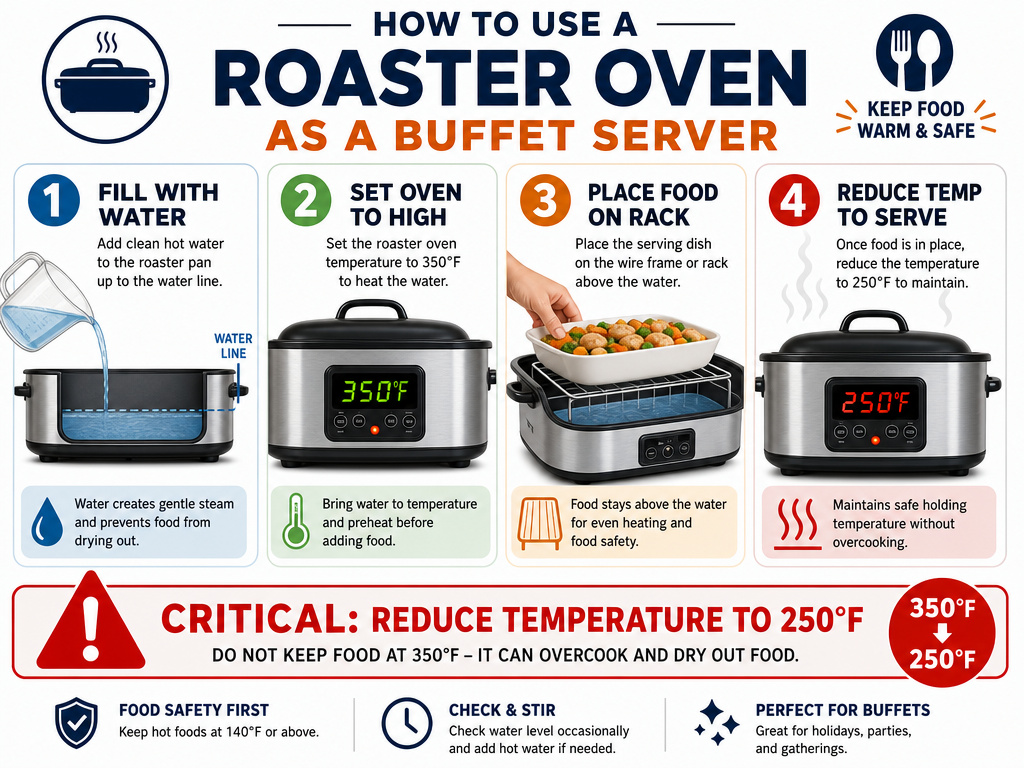
This is the primary use case that makes water mandatory. When using the buffet server attachment, you are creating a steam table. The pan of hot water sits below the frame holding the serving dishes, gently steaming and keeping everything at a safe temperature above 150°F.
The procedure is precise for a reason: 1. Fill the pan to the specified level (ensuring water won’t touch the bottom of the serving trays). 2. Preheat at 350°F for 30 minutes. 3. Place the frame and filled serving trays. 4. Reduce the temperature to 250°F for holding.
Reducing the temperature is critical. Holding at 350°F will rapidly boil the water away and overcook the food. The 250°F setting maintains a gentle steam. You must check the water level periodically and add more hot water as needed. Letting it run dry turns the roaster oven into a dry-heat box, and your food will suffer.
What Happens If You Add Water to the Body?
This is the failure mode with a direct, physical consequence. The exterior body of the roaster oven contains the insulated heating element. It is not a watertight vessel.
- Immediate Risk: Electrical short circuit, tripped breaker, potential for shock.
- Long-Term Damage: Water corrosion on the heating element or wiring. This damage may not be immediate but will cause the element to fail prematurely.
- Voided Warranty: Every manual lists this as a misuse that voids the warranty.
The caution is so universal it appears verbatim in the Aroma ART-718 manual: “Caution: Never add water directly into the roaster oven’s body without cooking pan in place.” This isn’t scare talk. It’s the predictable outcome of mixing 120-volt electricity with a liquid it wasn’t designed to contact.
If you accidentally spill water into the body, unplug the unit immediately. Let it dry completely for at least 48 hours in a warm, dry place before plugging it in again. Do not use a hair dryer or heat gun, as this could melt internal components.
Cleaning Up: Dealing with the Water Afterward
Once the party is over and the roaster oven has cooled completely, you’ll need to empty and clean the pan. This is where many people encounter a burnt-on mess from minerals in the water or spills from the serving dishes.
Common mistake: Trying to scrub a cooled, greasy pan with water still in it. Empty the water first, then let the pan soak with hot, soapy water to loosen residue.
For stubborn stains or burnt-on gunk, a paste of baking soda and water works well. For a full guide on tackling a tough mess, see our steps on how to clean a burnt roasting pan. Remember, never immerse the roaster oven base itself in water. Wipe it out with a damp cloth only.
Frequently Asked Questions
Can I use my roaster oven without the removable pan?
No. The manuals are explicit: “Always use the REMOVABLE ROASTING PAN in the roaster oven when cooking.” The pan is a necessary heat diffuser and protects the body from food and liquids. Using the oven without it risks damaging the heating element and creates a major cleaning headache.
Does a Nesco roaster need water?
Yes, a Nesco roaster follows the same principles. While specific manuals vary, the brand’s design for buffet serving and moist-heat cooking requires water in the pan for preheating. Always consult your Nesco model’s manual for the exact quantity.
My roaster oven smells like plastic when I preheat it with water. Is that normal?
Slight odor during the very first use can be normal as manufacturing oils burn off. However, a persistent plastic smell could mean water has leaked into the body and is contacting the heating element or insulation. Unplug the unit, let it cool, and inspect for any signs of water inside the body where it shouldn’t be.
Can I put the electric roaster pan in my regular oven?
It depends. Some removable pans are made of oven-safe materials like stainless steel, but others have plastic handles or non-stick coatings with temperature limits. You must check your specific roaster pan’s manufacturer instructions. Never assume it’s safe.
Is this similar to the water needed in a pressure cooker?
Not really. A pressure cooker needs water to create the steam that builds pressure for cooking. A roaster oven uses water to create a humid environment for holding food warm. The mechanisms and required amounts are completely different.
Before You Go
The answer isn’t a blanket yes. You need water in the removable pan for preheating and buffet serving—typically 5-8 quarts at 350°F for 30 minutes. You do not need water for most roasting or baking. And you must never, under any circumstances, add water directly into the roaster oven body.
The best move is to find your model’s manual online. Look for the preheating section and note the exact volume. That number, more than any generic advice, is what keeps your ham moist, your guests happy, and your appliance running for years. Now you know what to do with that water in the bottom.
