
How Do You Season a Blackstone Griddle | The 10-Minute Heat Rule
This post contains affiliate links. As an Amazon Associate, we earn from qualifying purchases.
To season a Blackstone griddle, you polymerize a thin layer of oil onto the hot steel surface. The process creates a non-stick, rust-resistant coating. For most Blackstone models, you heat the clean, dry griddle on high for 10 minutes, apply 2-3 tablespoons of a high-smoke-point oil, spread it impossibly thin, then heat until the oil stops smoking, which takes 15-25 minutes on the 28-inch Model 1517. You repeat this 3-4 times.
That 10-minute pre-heat is the step most people skip. They oil a cold surface, and the oil pools instead of bonding. The result is a sticky, patchy coat that flakes off within a month. The timing is the difference between a coating that lasts for years and one that fails after a dozen burgers.
What follows: the exact steps pulled from five different Blackstone manuals, the oil that works (and the one that doesn’t), how to spot and fix the two most common seasoning mistakes, and the simple maintenance that keeps the surface black and slick for a decade.
Key Takeaways
- Heat the griddle for 10 minutes before the first oil coat. An empty, hot surface ensures the oil spreads thin and polymerizes evenly, preventing sticky puddles.
- Use 2-3 tablespoons of oil for the entire surface per coat. That’s less than you think. Wipe it as if you’re trying to remove it all, any thick spots will turn gummy.
- Stop when the smoke stops. For the 28″ Model 1517, this takes 15-25 minutes per coat. Smaller models may smoke for less time, but the rule is the same.
- Humid or coastal climates demand heavier oils and more frequent touch-ups. Canola or flax oil beats olive oil here; the polymerized layer is more durable against moisture.
- A brownish, sticky residue means you used too much oil or cut the heat too soon. The fix is to re-heat the griddle for 10-15 minutes on high, scrape the gunk off, and start the seasoning process over with a thinner layer.
What Seasoning Actually Does to Your Griddle
You aren’t just coating the steel. You’re changing its chemistry. When a thin layer of oil is heated past its smoke point, its organic compounds break down and cross-link into a hard, plastic-like layer bonded directly to the metal. This is polymerization.
Seasoning creates a polymerized layer, a natural, stick-resistant coating formed when oil is heated beyond its smoke point and its molecules bond to the steel surface. Unlike a synthetic non-stick coating, this layer can be repaired and rebuilt indefinitely.
That bonded layer does two jobs. It fills the microscopic pores in the steel, creating a smooth barrier that water and oxygen can’t penetrate, this stops rust. It also provides a slick, hard surface that food releases from easily. Every time you cook with a little fat, you’re adding to this layer. A well-seasoned Blackstone is a living surface that improves with use.
The importance of seasoning is why the factory coating is just a rust preventative for shipping. You must wash it off and start fresh. This first seasoning process for a Blackstone sets the foundation for everything you cook later.
The 7-Step Initial Seasoning Process (and the One Step Nobody Skips)
This is the core process for curing a griddle surface. The steps are simple, but the precision in timing and quantity is what separates a pro result from a frustrating one.
Before you start: You’re working with high heat, hot oil, and metal. Use heat-resistant gloves or tongs to handle paper towels. Work in a well-ventilated area, there will be smoke. Have a metal scraper and dry paper towels ready.
- Wash the factory coating off. This is the only time you use soap. Scrub the cold griddle top with hot, soapy water to remove the shipping oil. Rinse thoroughly and dry completely with paper towels. Any water left will cause the oil to bead up.
- Heat the dry, empty griddle on high for 10 minutes. This is the skipped step. Heating the bare metal opens its pores and ensures an even surface temperature. You’ll see the steel change color slightly.
- Turn the heat down to medium-high. Apply 2-3 tablespoons of your seasoning oil to the center of the griddle. Use a folded paper towel gripped with tongs to spread the oil over the entire surface, including the edges and corners.
- Wipe as if you made a mistake. Go back over the entire surface with a clean, dry paper towel. Your goal is to remove any visible oil, leaving only a microscopic, even film. Thick spots will polymerize into sticky patches.
- Let it smoke until it stops. This is the polymerization phase. For the Blackstone 28″ Model 1517, the manual specifies 15-25 minutes. For other models, watch for the smoke to visibly diminish and the surface to turn a darker brown or black. Do not turn off the heat early.
- Let the griddle cool completely. Turn off the burners and walk away. The polymer layer sets as it cools. Rushing this with another coat of oil on a warm surface leads to the same puddling problem as a cold start.
- Repeat steps 2 through 6 three to four times. Three rounds is the minimum for basic protection. Four rounds builds a more robust, darker layer that’s noticeably more non-stick from the first cook.
Choosing Your Seasoning Oil: Flax, Canola, or the Proprietary Blend?
The best oil has a high smoke point, is low in impurities, and polymerizes into a hard finish. Your climate and goals decide the winner.
| Oil Type | Best For | Trade-Off | Smoke Point |
|---|---|---|---|
| Blackstone Griddle Seasoning & Cast Iron Conditioner | First-time seasoning & long-term storage | A dedicated product, not a kitchen staple | ~500°F (260°C) |
| Flaxseed Oil | Building a hard, durable coating quickly | Expensive, can go rancid if not fully polymerized | 225°F (107°C) |
| Canola or Vegetable Oil | Most users, especially in humid climates | Accessible and reliable; the default choice | 400°F (204°C) |
| Olive Oil | Maintenance coats after cooking | Smokes at low temp; not ideal for initial seasoning | 375°F (191°C) |
The proprietary seasoning from Blackstone is formulated for this job. It’s a blend of oils designed to polymerize effectively and protect against oxidation. For a first-time seasoning a brand-new griddle, it’s a foolproof pick. For a cheaper, equally effective home option, canola oil is the workhorse.
Where this goes sideways: Using extra virgin olive oil for the initial seasoning. Its low smoke point and impurities cause it to burn before it fully polymerizes, leaving a weak, splotchy layer that attracts food.
The short version: For your initial coats, use Blackstone’s blend, flax, or canola. Save the olive oil for a quick wipe after cleaning.
The Brownish Residue Problem (Too Much Oil, Too Little Heat)

You followed the steps, but your seasoned surface is sticky and brown, not black and slick. This is the most common seasoning failure, and the Blackstone 2165 and 2177 manuals diagnose it directly.
Common mistake: A thick coat of oil or turning off the heat before the smoking stops. The oil thickens instead of polymerizing, creating a gummy residue that food will stick to.
The fix is straightforward but requires patience: 1. Heat the griddle on high for 10-15 minutes. This will re-liquefy the thickened oil. 2. Use your metal scraper to aggressively scrape the entire surface. You’re removing the gunk, not the metal. 3. Let it cool slightly, then wipe it clean with dry paper towels. 4. Start the seasoning process over from the beginning, this time with half the oil you used the first time.
This is a standard part of the griddle curing learning curve.The visual target is a consistent, dark color. If you see shiny, sticky patches, you’re looking at uncooked oil.
Rust, Humidity, and Long-Term Care
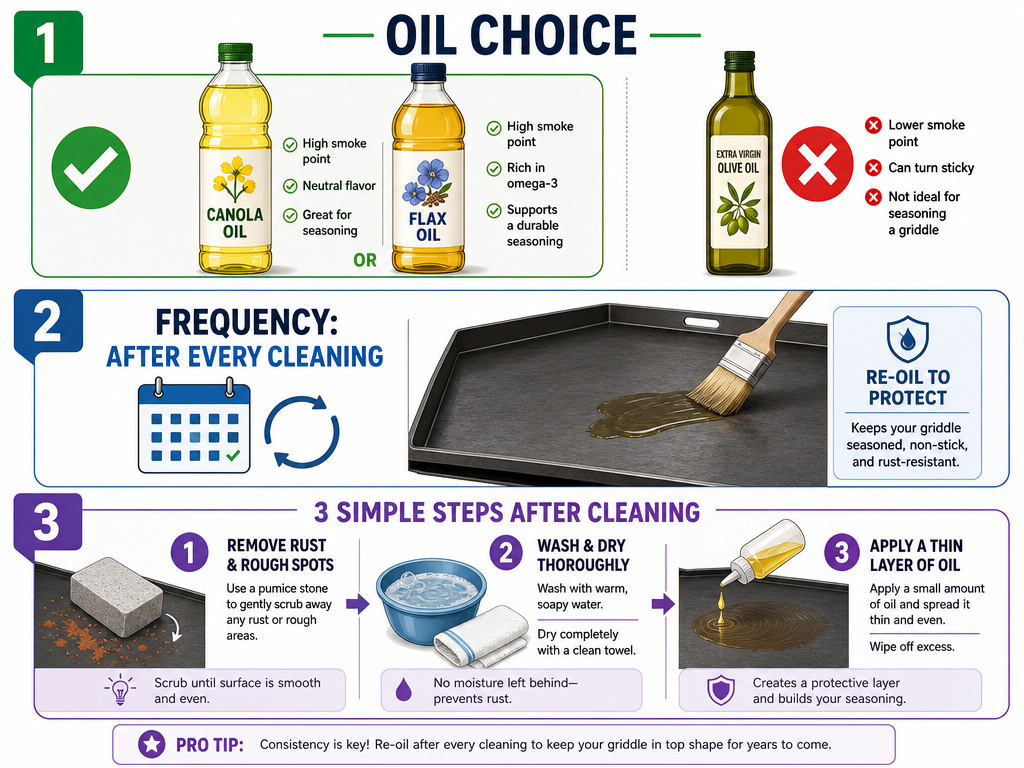
Steel wants to rust. Your seasoning is the only thing stopping it. In humid, coastal, or rainy climates, that job is harder.
The Blackstone 1517 manual has a specific warning: “CUSTOMERS IN HUMID OR COASTAL CLIMATES MAY REQUIRE MORE FREQUENT SEASONINGS AND THE USE OF HEAVIER COOKING OILS TO AVOID RUSTING AND CORROSION.”
This means two things for your routine: * Oil Choice: Use canola or flax oil, not olive oil. They form a more moisture-resistant polymer. * Frequency: Apply a maintenance coat after every cleaning, not just when the surface looks dry. A quick, thin coat of oil after the griddle cools is your best defense.
If you see the orange speckles of surface rust, don’t panic. The warranty excludes surface rust, but you can fix it. 1. Scrub the rust off with a Blackstone Pumice Stone or fine steel wool (0000 grade). 2. Wash the area with a tiny bit of soapy water to remove any grit, rinse, and dry thoroughly. 3. Re-season that spot with 2-3 coats, feathering the oil into the surrounding well-seasoned area.
The consequences of not seasoning are exactly this: a constant battle with rust and food that welds itself to the metal. A covered, seasoned griddle can live outside. A bare one cannot.
Seasoning as Maintenance: The After-Cook Ritual
Initial seasoning builds the base. Maintenance seasoning keeps it intact. This is the simple habit that makes your griddle better every time you use it.
After cooking: 1. While the griddle is still warm (not scorching hot), scrape off any food debris. 2. Pour a small amount of water on tough spots and let it steam, then scrape again. 3. Wipe the entire surface clean with paper towels until no residue comes off. 4. While the surface is still slightly warm from cleaning, apply a very thin coat of your seasoning oil. A single tablespoon is enough for a 36″ griddle. Spread it and wipe it thin. 5. Let the residual heat of the metal set this micro-layer. This is your post-cooking care.
This is a protective top-up that prevents moisture from contacting the steel overnight. It takes one minute and is the single most effective thing you can do for your griddle’s longevity.
Frequently Asked Questions
What’s the fastest way to season a Blackstone griddle?
There isn’t one. Rushing by applying thick oil or skipping cooling steps creates a weak, sticky coating that you’ll have to strip and redo. The 10-minute pre-heat and the 15-25 minute smoke time per coat are non-negotiable for a durable layer. The “fast” method is the correct method done once.
Can I use bacon grease to season my griddle?
You can, but you shouldn’t for the initial seasoning. Bacon grease contains salt, sugar, and solids that burn and carbonize, creating a uneven, flaky layer. It’s fine for a maintenance coat after cooking if you strain it clean, but for building your base coat, use a pure, high-smoke-point oil.
How do I know when my griddle is fully seasoned?
properly seasoned griddle has a uniform, dark black or very dark brown surface that is dry to the touch, not glossy or sticky. When you cook, food releases easily without leaving behind a shredded mess. If water beads and dances on the surface, that’s a good sign of a solid polymerized layer.
Why does my seasoning keep flaking off?
Flaking is almost always caused by a too-thick initial layer of oil that didn’t fully bond to the metal. The thick oil forms a brittle shell on top of the steel instead of bonding with it. The solution is to strip the flaky layer with a pumice stone or scraper and re-season with the correct, whisper-thin coats of oil.
Is the Blackstone seasoning wax worth it?
The Blackstone Griddle Seasoning & Cast Iron Conditioner is a reliable product designed for the job. It’s not wax; it’s a blended oil. Its advantage is consistency, you know exactly what you’re getting. For many, it’s worth it for the initial seasoning your griddle. For maintenance, any high-quality oil from the table above works.
Before You Go
Seasoning a Blackstone is a mechanical process: heat, a thin oil film, time, and repetition. The 10-minute pre-heat and the “wipe it like you hate it” oil application are the two levers that control everything.Get those right, and you’ll build a finished seasoning look that makes cooking effortless.
When you’re comparing the best seasonings, remember the goal is polymerization, not flavor. Choose an oil for its smoke point and purity, not its taste. And if you hit a snag, sticky residue, rust, flaking, the answer is always the same: strip it back to bare metal and apply a thinner coat. Your griddle can take it. That’s the point of steel.
