
How Your Slow Cooker Works: A Guide to Low & Slow Physics
This post contains affiliate links. As an Amazon Associate, we earn from qualifying purchases.
A slow cooker works by using a low-wattage heating element in its base to gently warm a heavy stoneware cooking vessel. This creates a sealed, moist environment where temperatures stay between 170°F and 280°F, perfect for breaking down connective tissue in meat over many hours without supervision. The tight-fitting lid traps steam, which both raises the internal temperature and prevents food from drying out.
That sealed, steamy environment is the whole game. It’s what turns a chuck roast into pulled beef and a pork shoulder into something that falls apart with a fork. Without the lid, you’re just warming a pot very slowly.
What follows is a breakdown of the three parts that make it happen, the exact temperatures you’re dealing with, and the handful of safety rules that turn a convenient appliance into a reliable one. By the end, you’ll know why your grandmother’s pot roast recipe works, how to test if your old unit is still safe, and what the “Auto” button on a fancy model actually does.
Key Takeaways
- The tight-fitting lid is non-negotiable; it traps steam to raise the cooking temperature and create a self-basting environment.
- Never reheat leftovers directly in a slow cooker. The unit takes too long to pass through the bacterial danger zone (40°F–140°F).
- Most units have a standard two-year warranty. If an older cooker fails the simple water temperature test, retire it.
- The “Auto” setting on models like the Russell Hobbs RHSC600 switches from High to Low but does not turn the unit off automatically.
- For efficient heat transfer, fill the stoneware vessel between half and two-thirds full.
The Three Core Components
Every slow cooker, from a basic Crock-Pot to a programmable model, is built from three pieces. Understanding what each one does explains why the method works.
The base contains the heating element, usually a coiled wire or heater band wrapped around a metal liner. This element runs at a lower wattage than a stovetop burner, often between 200 and 320 watts for a 6-quart model. It heats up gradually, transferring warmth directly to the bottom of the stoneware vessel sitting inside it.
The heating element warms the base’s metal liner, which then conducts heat to the heavy stoneware cooking vessel. This indirect transfer prevents scorching and creates an even, radiant heat that climbs slowly up the sides of the pot, much like a Dutch oven on the lowest stovetop setting.
The stoneware vessel is the workhorse. Its heavy ceramic or stoneware construction absorbs heat steadily and releases it evenly, preventing hot spots that could burn food at the bottom. This material also retains heat exceptionally well, so the temperature stays stable even when you lift the lid briefly. For the most consistent results, you should fill this vessel between half and two-thirds full.
The lid seems simple, but it’s the most critical part. A tight seal traps the moisture evaporating from your food. That moisture turns to steam, raising the internal pressure and temperature slightly, and then condenses on the cool lid to drip back down, continuously basting the food. Lifting the lid lets that heat and moisture escape, which can add 20 minutes or more to your cooking time. Some manuals advise against removing it at all for the first two hours.
What Temperature Does a Slow Cooker Reach?
You won’t find a precise thermostat setting. “Low” and “High” refer to how much power the heating element delivers, not a specific degree. The consensus range is between 170°F and 280°F on the High setting.
The “Low” setting delivers less power, so it takes longer for the contents to reach the target temperature band. Once there, it maintains a similar, steady heat. This is why a recipe might call for 8 hours on Low or 4 hours on High, it’s about the rate of heat input, not a different final temperature.
| Setting | Typical Power (6-Qt Model) | Time to Reach Simmer | Best For |
|---|---|---|---|
| Low | ~200 Watts | 3-4 hours | All-day cooking, tough cuts, unattended use |
| High | ~300 Watts | 1-2 hours | Faster cooking, soups, reheating pre-cooked food |
The bacterial danger zone is 40°F to 140°F. A slow cooker’s greatest safety strength, its low heat, is also its vulnerability during the initial warm-up phase. It can take several hours for a full pot of cold food to climb above 140°F. This is why you should start with thawed ingredients and, if possible, use the High setting for the first hour to shorten that journey. It’s also the definitive reason you should never use it to reheat leftovers.
The Physics of “Low and Slow” Cooking
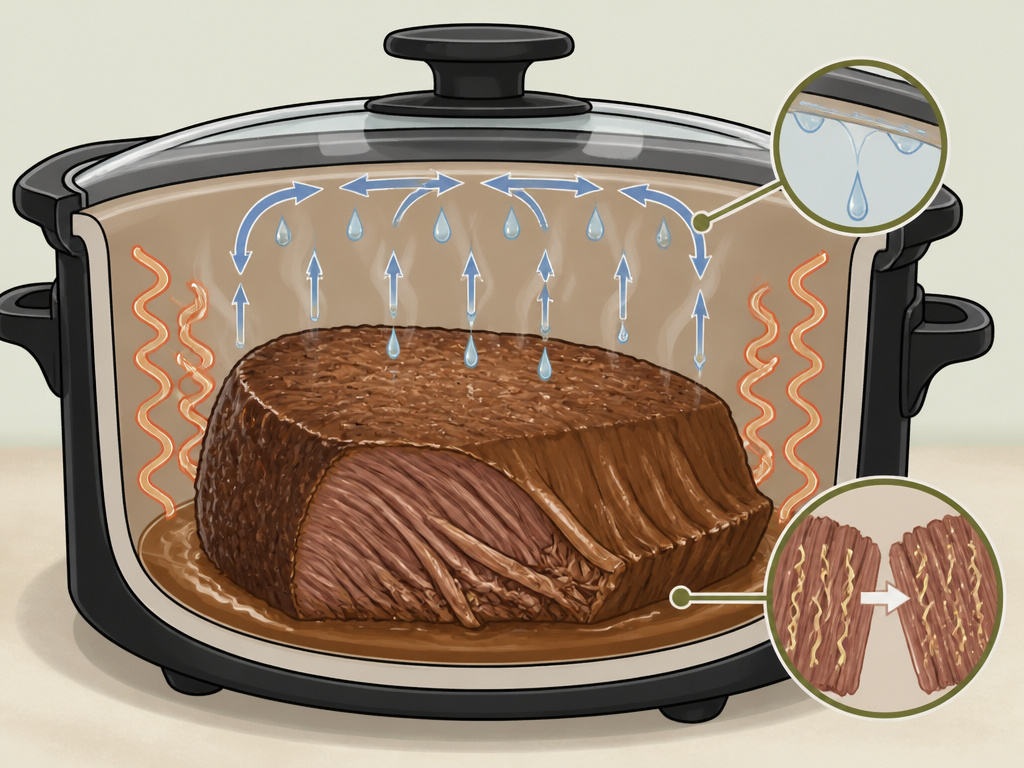 The magic isn’t in complexity; it’s in patience and consistent moisture. The combination of low, even heat and a humid environment targets the collagen in tough cuts of meat.
Collagen is the connective tissue that makes a chuck roast chewy. When heated slowly in a moist environment, that collagen dissolves into gelatin. This process starts around 160°F and works best when held steadily for hours. The resulting gelatin is what gives slow-cooked meat its signature juicy, tender mouthfeel. High, dry heat would squeeze out the meat’s moisture long before the collagen had time to break down.
The steam trapped by the lid serves a dual purpose. First, water transfers heat more efficiently than air, so the steam helps cook food evenly from all sides. Second, it creates a closed-loop system. Evaporation → steam → condensation on the lid → basting drips. This constant self-basting is why you rarely need to add much liquid.
Common mistake: Adding too much liquid at the start. A slow cooker recipe might only call for a half-cup of broth because the ingredients will release their own juices, and almost no moisture escapes. Doubling the liquid dilutes flavor and can prevent the temperature from rising efficiently.
Safety, Testing, and Maintenance
 A slow cooker is a safe appliance for unattended cooking, but only if it’s functioning correctly and used with basic food safety in mind. The rules aren’t complicated, but they’re absolute.
Before you start: Always begin with thawed meat and refrigerated pre-chopped veggies. Never place a frozen stoneware vessel into a hot base or rinse a hot vessel with cold water, thermal shock can crack the ceramic. Ensure the cord and base are dry.
The most important safety rule is about leftovers. Do not reheat them in the slow cooker. Leftovers must be reheated quickly to 165°F to kill bacteria, which a microwave or stovetop does in minutes. A slow cooker lingers in the danger zone for too long. Reheat on the stove first, then transfer to a preheated slow cooker to keep warm.
How to Test Your Slow Cooker’s Health
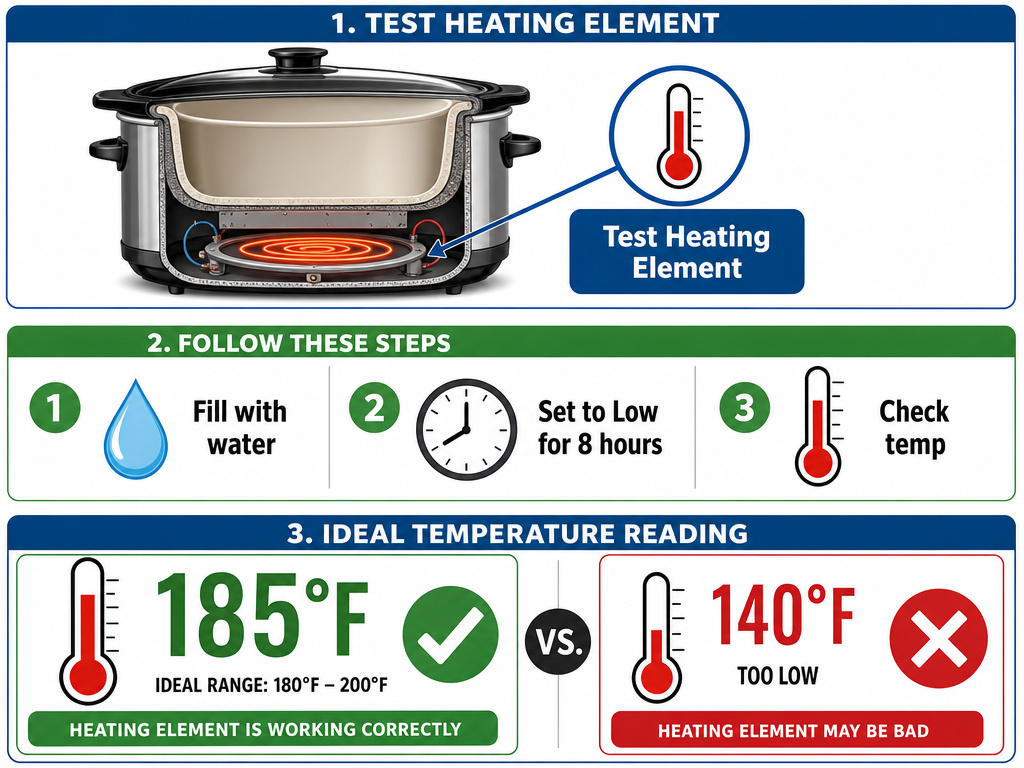
Appliances wear out. A slow cooker that can’t reach a safe temperature is a food safety hazard. Here is a simple test from university food safety guidelines.
- Fill the stoneware vessel halfway to two-thirds with room-temperature water.
- Set the cooker to Low, cover with the lid, and let it run for 8 hours.
- Use a food thermometer to check the water temperature immediately after the 8 hours.
If the water temperature is at least 185°F, your cooker is working safely. If it’s below 185°F, the heating element is failing. If the unit is still under its typical two-year warranty, contact the manufacturer. If it’s older, the only safe move is to replace it. A faulty slow cooker isn’t worth the risk.
| Symptom | Likely Cause | Action |
|---|---|---|
| Food takes much longer | Weak heating element | Perform the water test. |
| Cooker feels very hot outside | Damaged insulation in base | Discontinue use immediately; replace unit. |
| Ceramic vessel has a crack | Thermal shock or impact | Stop using; replace vessel or entire cooker. |
| Lid doesn’t fit snugly | Warped plastic or lost seal | Purchase a replacement lid from the manufacturer. |
Decoding Slow Cooker Features and Settings
Modern models add buttons, but the core principles remain. Knowing what these features actually do prevents confusion.
The “Auto” or “Programmable” setting is often misunderstood. On many models, like the Russell Hobbs RHSC600, “Auto” means the cooker will start on the High setting for a set period (e.g., one hour) to bring food up to temperature faster, then automatically switch to Low for the remainder of the cooking time. It does not mean the cooker switches itself off. You must still turn the dial to “Off.”
“Warm” holds food at a serving temperature, ideally around 140°F or above, after cooking is complete. Don’t use it as a cooking setting. Food held on “Warm” for more than four hours can still dry out and lose quality.
When choosing a good slow cooker, look for a heavy, well-fitting lid and a stoneware vessel that feels substantial. A removable stoneware insert is easier to clean and serve from. The convenience of a programmable timer is nice, but the basic manual low/high switch on a Crock-Pot is utterly reliable.
Frequently Asked Questions
Is a slow cooker the same as a Crock-Pot?
Crock-Pot is a brand of slow cooker. “Crock-Pot” became so synonymous with the appliance that many people use the terms interchangeably. All Crock-Pots are slow cookers, but not all slow cookers are Crock-Pots. The difference between slow cooker and Crock-Pot is just branding.
Can a slow cooker boil water?
Technically, yes, but not vigorously. On the High setting, a slow cooker can reach a simmer (around 200°F–210°F), where small bubbles break the surface. It cannot achieve a rolling boil (212°F) because its wattage and design are meant for gentle cooking. Don’t use it to boil water for pasta.
Is it safe to leave a slow cooker on overnight?
Yes, that’s one of its primary uses. As long as the unit is in good working order (passes the water test), placed on a heat-resistant surface away from walls and curtains, and used with the proper amount of food, overnight cooking is safe. Follow the slow cooker safety guidelines for unattended use.
How much electricity does a slow cooker use?
Very little compared to an oven. A typical 6-quart slow cooker uses about 200-300 watts, similar to a bright light bulb. Running it on Low for 8 hours consumes roughly 1.6 to 2.4 kilowatt-hours. Its energy efficiency is a major benefit.
Can I use an Instant Pot as a slow cooker?
Many Instant Pots have a “Slow Cook” function, but they often perform differently than a dedicated appliance. Instant Pots typically heat from the bottom only, while a traditional slow cooker heats up the sides as well. Results can be less even. For dedicated slow cooking, a traditional unit is usually better. Understand the slow cooker vs. Instant Pot differences before you rely on it.
Before You Go
A slow cooker’s job is simple: apply gentle, steady heat and keep moisture locked in. That’s it. The real skill is in the preparation, browning your meat, layering flavors, and knowing when to leave the lid alone. Trust the process. If your unit is modern or passes the water test, it will hold a safe temperature for as long as you need.
For your next step, browse some proven slow cooker recipes or check our roundup of best slow cookers if yours is due for an upgrade. Now go turn a cheap cut of meat into a weekend feast.
