
Instant Pot vs. Pressure Cooker: What’s the Real Difference?
This post contains affiliate links. As an Amazon Associate, we earn from qualifying purchases.
Yes, an Instant Pot is a pressure cooker. It’s a specific brand of electric multi-cooker whose defining and most powerful function is pressure cooking. An Instant Pot uses pressurised steam, typically reaching a working pressure around 80 kPa, to cook food faster than conventional methods. However, calling it just a pressure cooker misses the point, it also slow cooks, sautés, steams, makes yogurt, and more.
That pressure cooking function is the engine of the appliance. It’s what turns a pot of beans from an overnight soak project into a 45-minute weeknight side. But the moment you treat it like a single-use tool, you’re paying for features you’ll never touch.
The rest walks the line between the sealed physics of pressure cooking and the open-pot versatility of a multi-cooker. You’ll see the exact programs that use pressure, the ones that don’t, and where an Instant Pot fits in a kitchen that might already have a slow cooker or a stovetop pressure cooker.
Key Takeaways
- An Instant Pot’s core identity is as an electric pressure cooker, but it is marketed and designed as a multi-cooker with 7+ additional functions.
- Only specific “Smart Programs” use pressure: Pressure Cook, Rice, Steam (on some models), and Egg. Programs like Sauté, Slow Cook, and Yogurt do not pressurize the pot.
- The inner pot is food grade 304 (18/8) stainless steel, FDA-compliant, and designed to withstand pressure cooking cycles.
- You must allow the appliance to depressurize completely before opening the lid. Forcing it open while pressurized risks severe steam burns.
- For most home cooks replacing several appliances, an Instant Pot multi-cooker is the logical choice. For those who only want pressure cooking, a basic electric pressure cooker often costs less.
The Technical Core: Pressure Cooking in an Instant Pot
Look at any Instant Pot manual. The section titled “PRESSURE COOK” isn’t a suggestion; it’s the first program listed for a reason. The manuals state these appliances use “pressurised steam to quickly and evenly cook foods.” This isn’t a slow simmer, it’s a sealed environment where steam pressure raises the boiling point of water, allowing food to cook at temperatures around 115-121°C (239-250°F) instead of 100°C (212°F).
Pressure cooking uses pressurised steam to quickly and evenly cook foods. You can adjust the settings based on your recipe. – Instant Pot Pro WiFi Manual
This mechanism is identical to how a stovetop pressure cooker works. The difference is automation. An Instant Pot uses a built-in heating element and microprocessor to regulate the pressure, eliminating the need to monitor a stovetop flame or a jiggling regulator.
The pressure isn’t always on “high.” Most models offer level options: * Low Pressure (~35-55 kPa / 5-8 psi): Used for delicate foods like fish, some grains, and steamed desserts. * High Pressure (~65-85 kPa / 9-12 psi): The default for most pressure cooking, used for meats, beans, soups, and rice. * Max Pressure (on Pro models): An even higher setting for faster cooking of tough cuts.
The machine achieves this by sealing the lid with a silicone sealing ring. When the ring is intact and the lid is locked, steam builds until the target pressure is reached, then the heating element cycles to maintain it for the set cooking time.
What Makes an Instant Pot a “Multi-Cooker”?
If the pressure cooker is the engine, the multi-cooker is the whole car. This is the critical distinction. A standalone pressure cooker does one thing. An Instant Pot does that, plus it replaces a half-dozen other countertop appliances.
The control panel tells the story. Next to the “Pressure Cook” button, you’ll find: * Sauté: This function does not pressurize the pot. It heats the inner pot directly to temperatures from 95°C to 190°C (203°F to 374°F), letting you brown meat, soften onions, or reduce a sauce before you lock the lid for pressure cooking. You cannot do this in a standard pressure cooker. * Slow Cook: This also operates without pressure. It mimics a traditional Crock-Pot, heating food slowly over many hours. The manual for the Duo model explicitly states it “works just like a traditional slow cooker.” * Yogurt: This program maintains a precise, low temperature (41°C for fermentation) to culture yogurt. No pressure involved. * Steam (Non-Pressure): On some models, the Steam program is a non-pressure function that simply boils water to produce steam, like a stovetop steamer basket.
This collection of functions is why the term “multi-cooker” is the accurate category. It pressures, but it also slow cooks, sautés, and cultures. Buying one for pressure cooking alone is fine, but you’re bringing home a Swiss Army knife when you might only need a single blade.
| Function | Uses Pressure? | Primary Use | Key Limitation |
|---|---|---|---|
| Pressure Cook | Yes | Fast cooking of tough ingredients (beans, roasts) | Requires liquid to create steam; cannot brown food. |
| Sauté | No | Browning, searing, reducing sauces. | Lid must be off; no pressure buildup. |
| Slow Cook | No | Long, slow simmering like a Crock-Pot. | Takes hours; not for quick meals. |
| Yogurt | No | Fermenting dairy or non-dairy yogurt. | Requires precise temperature control. |
| Steam | Varies | Quick steaming of vegetables. | On some models, this is a pressure function. |
Pressure Cooker vs. Multi-Cooker: Where the Instant Pot Fits
This is the heart of the confusion. People use “Instant Pot” to mean any electric pressure cooker, the way they use “Kleenex” for tissues. But it’s a brand name for a specific type of appliance: the electric multi-cooker.
A standard pressure cooker (electric or stovetop) has one job: cook under pressure. It’s a specialist. An Instant Pot is a generalist. Its pressure cooking is often its best feature, but it’s packaged with other tools.
Before you start: The sealing ring and steam release valve are critical for safe pressure operation. A damaged or missing sealing ring means no seal, the pot will never pressurize. Never force the lid open if the float valve is still up; hot steam can cause instant, severe burns.
So, is an Instant Pot a pressure cooker? Technically, yes. Practically, it’s more. If your question is, “Can I use it to pressure cook dried beans?” the answer is absolutely. If your question is, “Should I get rid of my slow cooker and rice cooker because I bought this?” the answer is probably yes.
Here’s the simple breakdown: * If you want a dedicated, often less expensive appliance solely for pressure cooking: Look at a basic electric pressure cooker. * If you want to pressure cook but also value having a slow cooker, yogurt maker, and sauté pan in one footprint: An Instant Pot multi-cooker is your default.
The functional distinctions between Instant Pot and slow cooker are a perfect example. One appliance can mimic the other’s primary function, but they aren’t built the same way.
The Non-Pressure Functions Explained

To truly understand what you own, you need to know what doesn’t use pressure. These functions change how you plan meals.
The Slow Cook function is the most common point of reference. It’s designed to replicate a traditional slow cooker. However, most Instant Pot models heat from the bottom only, unlike an oval Crock-Pot that may have wraparound heat. This can lead to hotter spots on the bottom. For best results, use the provided cooking pot and don’t expect it to behave identically to a dedicated appliance you’ve used for years. The difference between a pressure cooker and a Crock-Pot is fundamental, one uses pressure for speed, the other uses low, steady heat for tenderness.
The Sauté function is what makes an Instant Pot a true one-pot meal machine. In a standard pressure cooker, you’d need to brown meat in a separate skillet. Here, you can sear your roast directly in the inner pot, deglaze with wine or broth, then add the remaining ingredients and switch to Pressure Cook. It’s a seamless workflow that saves on cleanup.
The Yogurt function highlights the appliance’s precision. It runs a two-step process: pasteurization (heating milk to at least 72°C) and fermentation (holding at 41°C for 8-12 hours). This temperature control is a far cry from the high heat of pressure cooking and showcases the multi-cooker’s range.
Safety, Parts, and the Reality of Maintenance
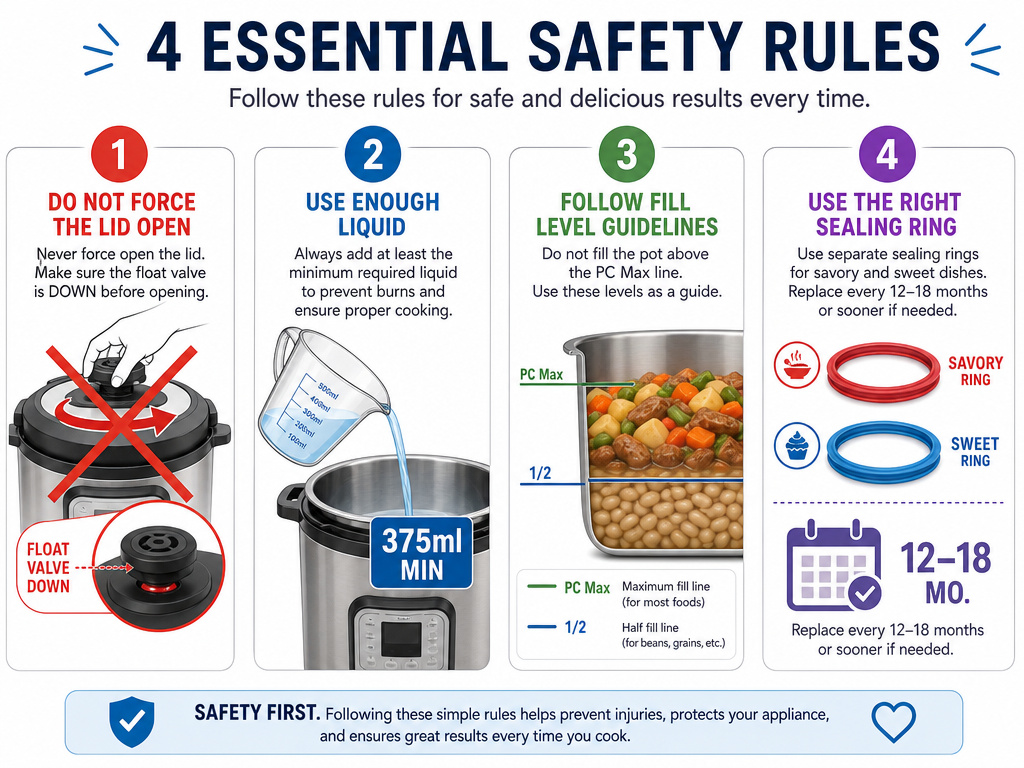
Pressure cooking demands respect. Every Instant Pot manual has a safety section in all caps for a reason. The rules aren’t complicated, but they are absolute.
- Never force the lid open. The lid will not turn if the pot is pressurized. The float valve (a small metal pin next to the lid) must be fully down. If you muscle it, you risk a blast of superheated steam.
- Use enough liquid. Pressure cooking requires water-based liquid to create steam. For a 5.7L model, the minimum is typically 375ml. Without it, the pot can overheat and burn food onto the bottom.
- Don’t overfill. For most foods, don’t go past the “PC Max” line. For foods that expand (rice, beans, pasta) or foam (oatmeal, applesauce), the max is the “1/2” line. An overfull pot can clog the steam release valve.
- Handle the sealing ring. This silicone ring absorbs odors. It’s why many owners keep two: one for savory dishes, one for sweets. The manuals advise replacing it every 12-18 months, as it can stretch and lose its seal over time. A failed seal means no pressure.
The basic mechanics of pressure cooking rely on this sealed system. If any component, the ring, the valve, the lid lock, is compromised, the mechanics fail.
Choosing What’s Right for Your Kitchen
You have three real paths, and the best one depends on what you already own and how you cook.
Path 1: The Multi-Cooker Route (Instant Pot)
Choose this if your countertop is crowded, you make yogurt, you like the idea of searing and cooking in one pot, and you’ll actually use the slow cook function. You’re buying a platform. Popular models like the Instant Pot Duo Plus or Instant Pot Pro offer this full suite. You can explore specific Instant Pot models to see which feature set matches your needs.
Path 2: The Dedicated Electric Pressure Cooker Route
Choose this if speed is your only goal. You want to cook beans from dry, make quick stock, and soften tough cuts fast. You don’t care about slow cooking or yogurt. You’ll often find these simpler appliances at a lower price point than a full multi-cooker. Our guide to the best electric pressure cookers covers these focused tools.
Path 3: The Stovetop Pressure Cooker Route
Choose this if you’re a purist, you want the highest possible pressure (for even faster cooking), and you’re comfortable managing heat on a stovetop. Brands like Fissler and Kuhn Rikon excel here. These are the definitive pressure cookers for performance, but they lack any of the “multi” functions.
Your kitchen real estate and cooking style decide. For most people starting out or consolidating, the multi-cooker’s versatility justifies its presence.
Frequently Asked Questions
Is the Instant Pot brand the same as a pressure cooker?
No. Instant Pot is a brand that makes electric multi-cookers. Pressure cooking is their primary function, but they are not synonymous. Other brands like Ninja, Cosori, and Breville also make electric multi-cookers with pressure functions. “Pressure cooker” is the category of cooking; “Instant Pot” is a specific product within the broader category of multi-cookers.
Can an Instant Pot explode?
Modern electric pressure cookers like Instant Pots have multiple safety features (locking lid, pressure regulators, backup vents) that make a catastrophic explosion extremely unlikely if used correctly. The real risk is a steam burn from improperly releasing pressure or forcing the lid open. Following the manual’s instructions mitigates almost all danger.
What can’t you cook in an Instant Pot pressure cooker?
You should avoid cooking foods that foam excessively (like oatmeal or cranberry sauce) without careful measures, as they can clog the steam release valve. Also, you cannot pressure cook with thick sauces that lack enough water content to create steam, or breads that require dry heat to rise. Deep frying is not possible or safe in any pressure cooker.
Do I need to buy special accessories for pressure cooking?
No. For basic pressure cooking, everything you need comes in the box: the inner pot, lid, sealing ring, and steam rack. Accessories like extra sealing rings, a glass lid for slow cooking, or specialty pans are optional for expanding your use of the multi-cooker functions.
How long do Instant Pots last?
With proper care, regular cleaning of the sealing ring and steam valve, avoiding abrasive scrubbers on the inner pot, an Instant Pot can last 5+ years. The most common wear item is the silicone sealing ring, which should be replaced every 12-18 months to ensure a proper pressure seal.
Before You Go
An Instant Pot is a pressure cooker. That’s its superpower. But it’s also a slow cooker, a sauté pan, a steamer, and a yogurt incubator. Calling it just a pressure cooker is like calling a smartphone just a telephone, technically true, but it misses the entire point of the device.
Your decision hinges on whether you want that versatility. If you do, you’re getting a capable, space-saving kitchen workhorse. If you don’t, a simpler, dedicated appliance might serve you better and for less money. Either way, now you know exactly what’s in the pot.
