
What Can You Make in a Braiser | The 30-Gallon Steam Hack
This post contains affiliate links. As an Amazon Associate, we earn from qualifying purchases.
You can make almost anything in a braiser except deep-fried food. A commercial 30-gallon tilting braiser like the Vulcan VE30 handles braising, stewing, roasting, sautéing, boiling, searing, steaming, holding, proofing, and acting as a bain-marie. Its 29″ x 23″ surface and thick walls deliver uniform heat for large-batch cooking, from breakfast hash to 40-gallon soup stocks.
That “except deep-fried” clause is where the manual draws the only hard line. The versatility comes from a simple design: a wide, heavy-duty pan with a tight-fitting lid and often a tilting mechanism. It’s a giant, flat-bottomed Dutch oven with professional-grade heat control.
What follows is a breakdown of the ten core functions, the exact specs that make them possible, and the recipes that turn a braiser from a single-use pan into your kitchen’s central station.
Key Takeaways
- A braiser’s 29″ x 23″ cooking surface on a 30-gallon model is for searing protein in a single layer before adding liquid to braise, crowding the pan steams the meat.
- For steaming, a 30-gallon braiser needs 6–7 gallons of water (about 2 inches deep) to accommodate two standard 12″x20″x4″ steam pans without scorching.
- Never use a braiser for deep-frying; manufacturer manuals restrict frying to a shallow film of oil no more than 1/8 inch thick to prevent dangerous flare-ups.
- The tilting function isn’t just for draining, it’s essential for reducing sauces and gravies by increasing surface area for evaporation without transferring to another pot.
- Treat it like a proofing box by setting the thermostat to 85–95°F and placing dough inside the covered pan with a cup of water for humidity.
The Technical Snippet: Steam-Cooking in a Braiser
Steam-cooking in a braiser requires matching water volume to pan capacity. For a 30-gallon (114 L) Vulcan VE30 or VG30 model, fill with 6–7 gallons (23–26 L) of water to a depth of about 2 inches. Bring to a boil at 212°F (100°C), then set the thermostat to 250°F (121°C) to maintain a rolling steam. The unit holds a maximum of two 12″ x 20″ x 4″ deep steam pans. Check water levels periodically; if depth falls below 1/2 inch, add more to prevent damage to the pan bottom.
This isn’t a guess. It’s from the Vulcan service manual. Get the water wrong, and you either scorch the base or produce weak steam that won’t cook through.
What a Braiser Actually Is (And Isn’t)
Before we list recipes, know your tool. A braiser pan is a wide, shallow pot with straight sides and a heavy, tight-fitting lid. Home models are often 3.5 to 5 quarts. Commercial units, like the Vulcan, run from 30 to 60 gallons.
The shape is the secret. The wide surface area is for browning. The tall sides and lid trap moisture for slow, even cooking. The thick base prevents hot spots.
Common mistake: Treating a braiser like a Dutch oven. A Dutch oven’s higher sides are better for soups and deep braises with lots of liquid. A braiser’s wide base is for developing fond, those caramelized bits, on a larger scale.
It is not a pressure cooker. A pressure cooker like the Bosch AutoCook MUC68… Seals to create 80 kPa of pressure, cooking food faster at higher temperatures. A braiser uses ambient steam and conduction. It is also not a deep fryer. Manuals explicitly warn against filling it with oil.
The Shortlist: Core Techniques and What They Deliver
This table breaks down the primary methods, what they’re for, and the physical reason they work in a braiser.
| Technique | Best For | Why It Works in a Braiser |
|---|---|---|
| Searing & Browning | Building flavor foundations for meats, poultry, and vegetables. | The wide, unimpeded 29″ x 23″ surface allows for a single layer, ensuring Maillard reaction (browning) instead of steaming. |
| Braising & Stewing | Transforming tough, collagen-rich cuts like chuck roast or lamb shanks. | The heavy lid traps evaporating liquid, which condenses and falls back, creating a self-basting cycle in the consistent, low heat. |
| Steam-Cooking | Cooking vegetables, dumplings, or seafood gently and evenly. | Adding a few gallons of water and stacking steam pans utilizes the pan’s entire volume and precise thermostat control (can hold 212°F/100°C exactly). |
| Sautéing & Pan-Frying | Quick-cooking proteins or vegetables in a small amount of fat. | The broad surface provides ample room to toss and turn food without overcrowding, thanks to those straight, tall sides. |
| Simmering & Boiling | Making large batches of soup, stock, pasta, or blanching vegetables. | The high BTU output (e.g., 100,000 BTU/HR on a Crown GS-30) brings volumes to a rapid boil and holds a steady simmer. |
| Holding & Warming | Keeping pre-cooked food at safe serving temperatures for hours. | The precise thermostat can be set to a safe holding temperature of 140°F (60°C) or above, preventing bacterial growth. |
| Proofing Dough | Giving yeast doughs a warm, humid environment to rise. | Set the thermostat to 85–95°F (29–35°C), place dough inside, and add a cup of water for humidity under the sealed lid. |
| Bain-Marie | Gently melting chocolate, making custards, or keeping sauces warm. | The braiser holds a shallow bath of water at a constant low temperature, surrounding delicate containers with indirect, even heat. |
The Workhorse Recipes: From Breakfast to Dessert

These aren’t just dish names. They are methods that leverage the braiser’s architecture.
The Ultimate Pot Roast: This is the braiser’s signature. Brown a 5-pound chuck roast in oil on all sides. Remove, sauté onions and carrots. Deglaze with red wine, scraping up the fond. Return the roast, add beef broth until it comes halfway up the meat. Cover and simmer at 275°F for 3–4 hours until fork-tender. The wide base means more fond. The lid means less liquid reduction.
One-Pan Chicken & Rice: Brown chicken thighs, skin-side down. Remove. Sauté garlic and onion in the rendered fat. Add rinsed rice and broth. Nestle the chicken back in, cover, and cook until the rice absorbs the liquid. The braiser’s even heat cooks the rice perfectly without a scorched bottom, a common flaw in thinner pans.
Batch-Cooked Breakfast Hash: Par-boil diced potatoes, then crisp them in a single layer in the braiser with oil. Push to the sides, cook sausage or bacon in the center. Add onions and peppers, mix everything, create wells, and crack in eggs. Cover until the eggs set. You’re feeding a crowd on one surface.
Steamed Shellfish Feast: Pour 2 inches of water, beer, and Old Bay into the braiser. Bring to a boil. Add layers of corn, potatoes, and live clams or mussels in a steamer insert. Cover and steam for 10-15 minutes. The capacity is the win here.
Where this goes sideways: Overfilling with liquid when braising. The liquid should only come one-third to halfway up the side of the main ingredient. Too much liquid poaches, not braises, and you lose the concentrated flavor.
For simpler weeknight ideas, our collection of braiser recipes offers more targeted inspiration.
Steam, Hold, and Proof: The Underused Functions
Most home cooks stop at braising. They’re missing half the appliance.
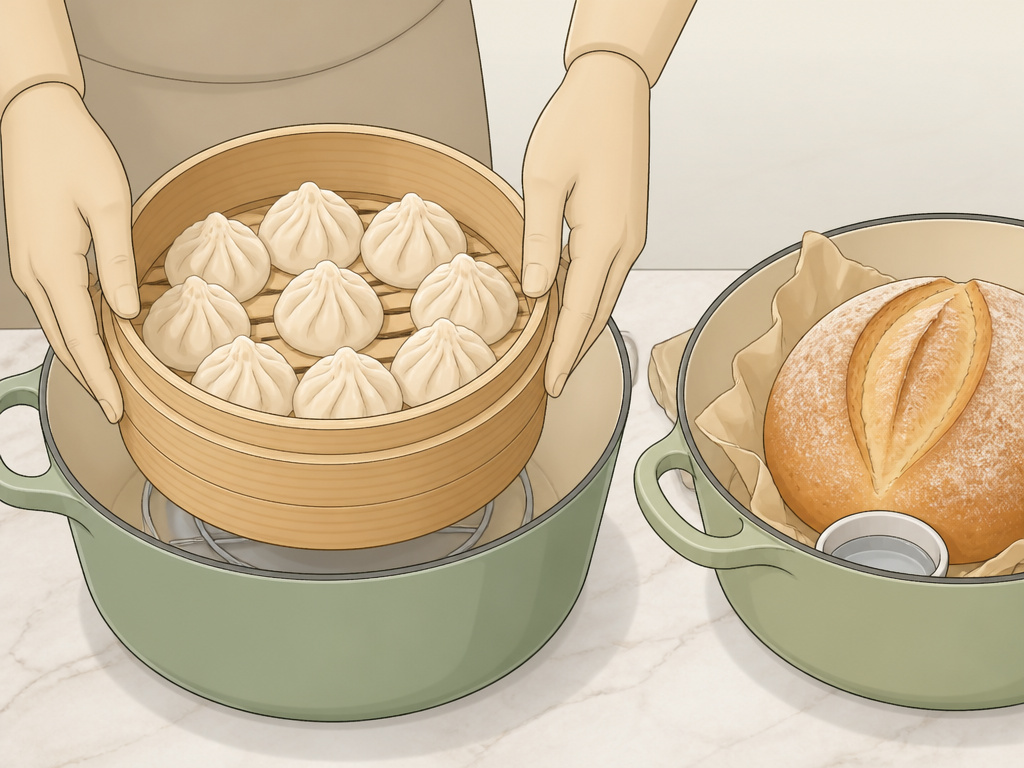
Steaming: As the technical snippet detailed, this is a volume game. For home-sized braisers, use a collapsible steamer basket. The principle is the same: minimal water, a tight lid, and steady heat. It’s perfect for dumplings, fish fillets, or a full head of cauliflower.
Holding & Food Safety: If you’re serving buffet-style, a braiser is your best friend. Transfer cooked food into it, set the thermostat to 145°F, and it will hold safely for hours without drying out or overcooking. This is a standard practice in commercial kitchens that translates directly home.
Proofing Bread Dough: A cold kitchen kills yeast activity. Your braiser is a proofing box. Place your shaped dough inside on parchment, add a cup of warm water for humidity, set the dial to 90°F, and cover. It will rise in half the time. It’s a more controlled environment than your oven with the light on.
These functions overlap with other tools. For example, you can make soup in a casserole pot, but a braiser gives you more surface area for reducing and developing flavor first.
What You Cannot (And Should Not) Make
The limits matter as much as the possibilities.
Do Not Deep Fry. This is the manufacturer’s explicit rule. The manual for the Vulcan braiser states: “Restreignez l’activité de friture au bac peu profond (film d’huile pas plus de 1/8 po [0.3 cm] d’épaisseur).” A film of oil for sautéing is fine. A deep bath of oil is a fire hazard and can damage the heating elements.
Avoid Delicate, Quick-Cooking Foods. A braiser has a lot of thermal mass. It takes time to heat up and cool down. Cooking a single piece of fish or a small omelet is inefficient. Use a smaller skillet.
It’s Not a Pressure Cooker. Don’t try to force it to be one. A pressure cooker like a Presto model seals to create an 80 kPa environment, dramatically speeding up cook times for beans or tough meats. A braiser works with time and moisture, not pressure.
If speed is the goal, an electric skillet might be a better choice for certain quick-cook meals.
Braiser vs. Dutch Oven vs. Slow Cooker: Picking the Right Pot
This is the decision every cook faces. They overlap, but each has a specialty.
Braiser vs. Dutch Oven: The Dutch oven, like a classic Le Creuset, has higher, straighter sides. It’s the champion for soups, deep stews, and baking bread (it traps steam better). The braiser wins on surface area. You get a better sear on more pieces of meat at once. For a pot roast, the Dutch oven might hold more liquid around the meat, but the braiser gives you a superior initial sear. Need to clean a Dutch oven after baking bread? That’s a different process than cleaning a braiser.
Braiser vs. Slow Cooker: A slow cooker like a Breville Fast Slow Pro is a “set and forget” tool for all-day, low-temperature cooking. It’s convenient but doesn’t brown. A braiser requires more attention but delivers fond and caramelization a slow cooker cannot. You can start a stew on the stovetop in a braiser to develop flavor, then transfer it to a slow cooker to finish if you need to leave the house.
The choice often comes down to the first step. If the recipe starts with “brown the meat in batches,” reach for the braiser. If it starts with “add all ingredients to the pot,” a Dutch oven or slow cooker might suffice.
Care and Maintenance: Keeping Your Braiser in Service
A braiser is an investment. Treat it right.
- Cool Before Cleaning. Never shock a hot braiser with cold water. Let it cool, then use warm, soapy water. For stuck-on food, simmer a little water in it to loosen the residue.
- Mind the Gasket. If your model has a silicone sealing gasket around the lid (common in electric models), check it regularly for cracks or food debris. A faulty gasket won’t seal properly for steaming or proofing.
- Store It Correctly. Per the Breville BSC420 manual, store it “upright with the removable crockery bowl and the lid in position. Do not place anything on top.” This prevents warping and damage to the lid seal.
- Know When to Call It. Like any tool, it can wear out. If the heating element becomes inconsistent or the interior coating chips extensively, it might be time. For enameled cast iron, learn the signs of a ruined Dutch oven, many of the same principles apply to braisers.
Frequently Asked Questions
Can you make soup in a braiser?
Absolutely. Its wide surface is excellent for sweating vegetables and building flavor before adding broth. It’s ideal for large-batch soups that benefit from reduction. For dedicated soup-making, you might also consider the best pots for soup, which often have taller sides.
Is a braiser the same as a Dutch oven?
No. They are cousins. A Dutch oven is taller with a smaller base, better for liquids and baking. A braiser is wider and shallower, designed for browning and braising with less liquid. Understand the full scope of a braiser pan to make the right choice.
What size braiser do I need for a family of four?
3.5 to 4.5-quart braiser is perfect for most family meals, allowing you to sear 4-6 chicken thighs or a small roast comfortably. For larger gatherings or meal prepping, a 5-quart model offers more flexibility.
Can you bake bread in a braiser?
You can, but a Dutch oven is typically better. A Dutch oven’s higher sides trap more steam, which is crucial for a good oven spring and crispy crust. If a braiser is all you have, it will work, but the loaf may spread more. For techniques without either, explore how to make sourdough without a Dutch oven.
How do I choose a good braiser?
Look for heavy-gauge construction (cast iron or thick tri-ply stainless steel), a tight-fitting lid, and comfortable handles. Enameled cast iron is classic for heat retention. For specific model recommendations, our guide to the best braiser pans breaks down the top contenders.
The Bottom Line
A braiser is the most versatile heavy pot you’ll own. It replaces a skillet, a stockpot, a steamer, and a warming tray for any recipe scaled for a crowd or a week’s worth of meals. Its superpower is transformation: it turns tough cuts tender, raw vegetables soft, and simple ingredients into complex dishes through the alchemy of wide-surface browning and trapped steam.
Forget the single-tasker. Your braiser is your kitchen’s anchor. Use it to sear, simmer, steam, and hold. Just keep the oil shallow and the heat consistent. The rest is just ingredients and time.
