
Discover What Cookware Works on Induction Cooktops and Why
This post contains affiliate links. As an Amazon Associate, we earn from qualifying purchases.
Induction cooktops work with cookware made from ferromagnetic metals, materials a magnet sticks to. This includes cast iron, carbon steel, and magnetic stainless steel (often labeled 18/0). Unsuitable materials are pure aluminum, copper, glass, ceramic, and non-magnetic stainless steel (like 18/10). The pan’s base must also be flat and match the size of the cooking zone, or the hob may shut off automatically within three minutes.
That magnetic rule is the starting point, not the finish line. A pan that passes the magnet test can still heat unevenly, trigger error codes, or simply underperform because of its base construction.
What follows is a breakdown of the three core materials that work, the one official symbol to trust, and the specific mistakes, like using a pan with a cracked base or the wrong diameter, that stop an induction hob cold.
Key Takeaways
- The magnet test is essential but incomplete; a pan must also have a thick, flat, and smooth base to heat efficiently and avoid automatic shutdowns.
- Magnetic stainless steel (18/0), cast iron, and carbon steel are the three primary compatible materials; many multi-clad pans with a magnetic core also work.
- Look for the official induction symbol (a coiled spring or spiral) on packaging or the pan’s base, but verify with a magnet as some markings can be misleading.
- If cookware is unsuitable or too small, most induction hobs will flash a power level and shut off automatically after 3 minutes as a safety feature.
- The base diameter, not the pan’s wider top, must match the cooking zone size; a mismatch causes slow heating, wasted energy, or error codes.
The Magnetic Test (And Why It’s Not Perfect)
Hold a standard refrigerator magnet to the center of your pan’s base. If it grips firmly, the cookware is ferromagnetic and will work with an induction cooktop. If it slides off or holds weakly, the pan is not compatible.
This works because induction hobs generate a magnetic field. The field induces electrical currents, called eddy currents, in any ferromagnetic metal placed above it. Those currents generate heat directly within the pan’s base. No magnetic attraction means no current, and no heat.
The induction coil creates a magnetic field that reacts directly with the base of the pan and heats it up. The cooking zone itself is heated up indirectly by the heat given off by the pan. Miele Operating Instructions
But a passing grade on the magnet test doesn’t guarantee good performance. The base must also be perfectly flat and smooth. A warped or concave base creates an air gap, weakening the magnetic coupling. You’ll hear more buzzing, get slower heating, and the hob might mistake the pan for being too small.
Where this goes sideways: Relying solely on the magnet test with thin, warped pans. A cheap magnetic steel skillet from a discount store might attract a magnet but have a base that bows upward in the center. It will heat in a small, intense ring directly over the coil while the outer edges stay cool. Your sauces burn in the middle and don’t simmer at the edges.
The base also needs enough mass to distribute heat. This is why sandwich-base construction, a layer of magnetic stainless steel or aluminum clad between outer layers of stainless steel, is so common in quality induction-ready cookware. The magnetic layer interacts with the hob, while the clad aluminum or copper core spreads the heat sideways to prevent hot spots.
| Material | Magnet Test | Best For | Performance Caveat |
|---|---|---|---|
| Cast Iron | Strongly Attractive | Searing, frying, Dutch ovens | Extremely heavy; slow to heat and cool. Can scratch glass tops. |
| Carbon Steel | Strongly Attractive | Searing, sauteing; lighter than cast iron | Requires seasoning; can warp if heated empty on high. |
| Magnetic Stainless (18/0) | Strongly Attractive | Saucepans, stockpots, multi-clad sets | Can have hotspots if base is too thin; often part of a clad “sandwich”. |
| Clad “Sandwich” Pan | Attractive (core layer) | Even heating for sauces, searing | Quality varies by thickness of the magnetic and conductive layers. |
| Enameled Steel | Strongly Attractive | Dutch ovens, saucepans | The enamel coating is non-stick but can chip; the steel base is magnetic. |
The Three Materials That Actually Work
Forget memorizing a long list. Compatible special cookware for induction boils down to three core ferromagnetic materials. Everything else is either a combination of these or a workaround.
1. Cast Iron
This is the original induction cookware. It’s intensely magnetic, holds heat brilliantly, and is virtually indestructible. A cast iron on induction skillet delivers a fierce, steady sear.
The drawback is weight and maintenance. It’s slow to respond to temperature changes, and sliding a 12-inch cast iron pan on a glass cooktop is a good way to scratch it. Always lift it into place.
2. Carbon Steel
Think of carbon steel as cast iron’s lighter, more responsive cousin. It’s equally magnetic and fantastic for high-heat cooking. Professional chefs use it because it heats fast, seasons like cast iron, and is easier to maneuver.
Its weakness is a tendency to warp. Heating an empty carbon steel pan on maximum induction power can cause the thin base to expand unevenly and buckle. Start on medium heat and let it warm gradually.
3. Magnetic Stainless Steel
Not all stainless steel works. The common “18/10” grade (18% chromium, 10% nickel) is non-magnetic. You need “18/0” or “400-series” stainless, where the nickel content is low or zero, making it ferromagnetic.
Most high-quality stainless steel cookware uses a multi-clad design. The core includes a layer of magnetic stainless steel or aluminum to interact with the hob, bonded between outer layers of non-magnetic 18/10 stainless for corrosion resistance and a cooking surface. This is the standard for most best cookware for induction sets from brands like All-Clad, Cuisinart Multiclad, and Tramontina.
Easy to miss: The upper diameter of a saucepan is often larger than its base diameter. Cookware manufacturers usually list the upper diameter, but you need to match the base diameter to the cooking zone. Bosch User Manual
The One Symbol You Should Trust
Scouring the bottom of a pot for a marking? Look for a symbol that resembles a coiled spring, a spiral, or the letter “I” with loops. This is the international symbol for induction compatibility.
Finding this induction cookware symbol means the manufacturer certifies the pan for use on induction hobs. It’s more reliable than vague terms like “induction safe” printed on a box.
But trust, then verify. Some porcelain or glass pots may have this symbol printed on them, indicating they have a hidden magnetic base layer. According to LG’s support page, these can still have “weak heating power” or even break. The symbol is a good first filter, but the magnet test is the final judge.
What Doesn’t Work (And the Tricky Exceptions)
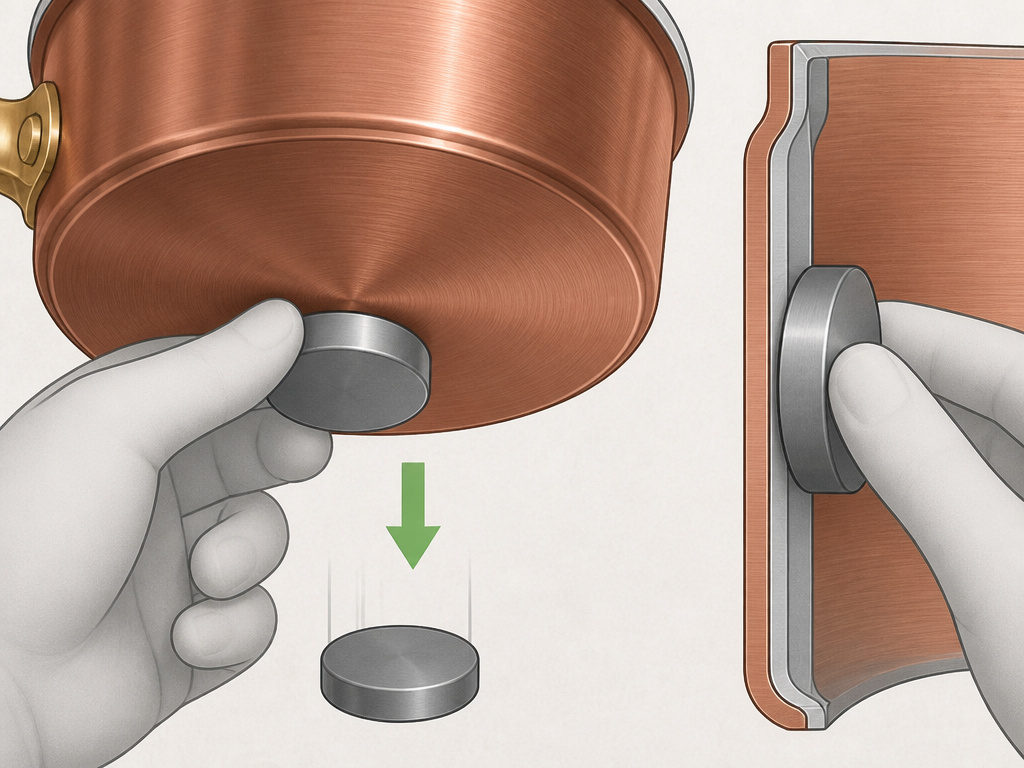
The list of incompatible materials is shorter but full of common kitchen items. * Pure Aluminum & Copper: Excellent conductors, but non-magnetic. They will not work unless they have a magnetic base plate bonded to the bottom. * Glass, Ceramic, Stoneware: Non-conductive and non-magnetic. A pot like the classic CorningWare dish will not heat. * Non-Magnetic Stainless Steel (18/8, 18/10): Your everyday stainless steel cutlery is likely 18/10. If a magnet doesn’t stick to your pot, it’s this grade and won’t work.
The exceptions are where people waste money. You can buy an induction interface disk, a separate magnetic steel plate you place on the hob, then set your non-magnetic pot on top. The disk heats up and transfers heat to the pot like a traditional electric burner. It’s a workaround that sacrifices the speed, efficiency, and control that make induction great. It also adds another item to store.
Another trap is copper cookware on induction. Pure copper pans are out. However, high-end copper cookware often has a stainless steel or magnetic metal lining bonded to the copper exterior. The magnet will stick to that lining, making it compatible. You’re paying for the copper’s even-heating properties, but the hob is talking to the inner magnetic layer.
The 3-Minute Rule and Other Hob Protections

Induction hobs are smart. They sense what’s on them and have built-in safeguards that often get mistaken for malfunctions.
The 3-Minute Auto-Shutdown: This is the most common surprise. If you place a pot that’s too small, an unsuitable material, or no pot at all on an active cooking zone, the hob will react. The Miele manual states the set power level will flash, and “the cooking zone will automatically turn off after 3 minutes.” It’s not broken; it’s preventing you from heating an empty coil.
Overheat Protection: Induction is fast. Heating an empty pan or a splash of oil on high power can make the base temperature soar. The electronics monitor this. The Aervoe Pro-Chef manual notes its glass cooktop sensor will trigger a shutdown at 464°F (240°C). Other models will simply reduce the power level automatically to cool things down.
The Diameter Mismatch: Every cooking zone has a minimum and optimal base diameter. Place a 6-inch pot on an 8-inch zone, and the hob may only activate the inner portion of the coil, leading to slow, inefficient heating. It might also interpret the small pan as “unsuitable” and begin the 3-minute shutdown countdown. For the fastest boil, the pan’s base should cover at least 70% of the zone’s marked area.
Troubleshooting: When “Compatible” Cookware Fails
Your pan passes the magnet test but still acts up. Here are the likely culprits.
- The Base is Cracked or Damaged: A hairline crack in the base of a cast iron skillet or enameled Dutch oven can break the magnetic circuit. The hob may detect the pan intermittently, causing the power to cycle on and off.
- The Base is Not Flat: Warping is a common failure for thin steel pans. Set the pan on a counter and see if it rocks. A warped base creates an air gap, reducing efficiency by over 50% and causing loud buzzing.
- There’s a Label or Residue: A thick, glued-on manufacturer’s label or a layer of baked-on carbon on the bottom can act as an insulator. Clean the base thoroughly with a scouring pad and hot soapy water.
- It’s the Wrong Size: That 10-inch skillet might have an 8-inch magnetic base. If the base is smaller than the hob’s minimum required diameter (often 4-5 inches for portable units), it won’t activate.
Common mistake: Assuming a new pan with the induction symbol is flawless. Always check for flatness and clean the base before first use. A warped pan from the factory is rare, but it happens.
If you’ve checked all this and a zone still won’t heat, consult your hob’s manual. An “E0” or “U” error code typically means no cookware is detected. An “E01” or “E02” points to an internal or surface overheat condition, let the unit cool completely and ensure the vents aren’t blocked.
Frequently Asked Questions
Can I use my existing stainless steel pots on induction?
Maybe. Test each piece with a magnet. If the magnet sticks firmly to the center of the base, it will work. Many older stainless steel pots are magnetic (18/0). If the magnet doesn’t stick, the pot is a non-magnetic grade like 18/10 and will not work. For more detail, see our guide on stainless steel on induction.
Do non-stick pans work on induction?
Yes, but only if they have a magnetic base. Most modern non-stick pans achieve this by using a magnetic stainless steel or aluminum body beneath the non-stick coating. Always check with a magnet. Inexpensive aluminum non-stick pans typically will not work.
Why does my induction hob buzz or hum?
Some noise is normal, especially at high power levels. It’s caused by vibrations between the pan’s base and the magnetic field. Heavier pans with thick, flat bases (like cast iron or multi-clad stainless) buzz less. High-pitched whistling can occur with sandwiched-base pans when using linked cooking zones like a “booster” function.
Can I use a wok on an induction cooktop?
Traditional round-bottomed carbon steel woks will not work because only a tiny point contacts the flat glass. You need a flat-bottomed induction wok, which is made of magnetic carbon steel or stainless steel with a wide, flat base that makes full contact. These are specifically designed for the job.
What if I only have one or two induction-compatible pans?
That’s enough to start. You can build your collection over time. Focus on getting a versatile induction compatible pots and pans piece first, like a 10-inch skillet with a sandwich base or a 3-quart saucepan. For other cooking, an induction interface disk is a stopgap, but it negates most of the technology’s benefits.
The Bottom Line
Finding what cookware works on induction isn’t a mystery. Grab a magnet. If it sticks, you’re most of the way there. The final step is ensuring that magnetic base is also thick, flat, and roughly matches the size of the cooking zone you’re using.
Forget about your pure aluminum, copper, and glass pieces unless they have a bonded magnetic base. Your cast iron, carbon steel, and magnetic stainless steel are your new workhorses. When shopping, let the official spiral symbol guide you, but keep that magnet in your pocket for a final check. That combination of simple tools and specific knowledge is all you need to cook with confidence on any induction hob.
