
What Is a Large Saucepan? The Standard 4-Quart Cooking Pot
This post contains affiliate links. As an Amazon Associate, we earn from qualifying purchases.
A large saucepan is a 4-quart (3.8 liter) pot with straight sides, a single long handle, and a diameter of about 8 inches. This specific capacity is the industry benchmark for family-sized cooking, bridging the gap between a medium saucepan and a stockpot.
That 4-quart number isn’t a suggestion. It’s the line that separates a daily driver from a specialty tool. European brands might label a 3.5-liter pan as large, and a 5-quart pan might get the same tag. You have to check the stamped capacity on the base. Relying on the marketing term alone puts the wrong pan in your hand.
What follows is a breakdown of the three specs that matter, the two pans a large saucepan routinely gets confused with, and the one material flaw that can wreck a premium pan inside a year.
Key Takeaways
- The definitive large saucepan holds 4 quarts (3.8L), measures roughly 8 inches in diameter, and stands about 5 inches tall.
- Its straight sides and single long handle differentiate it from a curved saucier (for stirring) and a dual-handled stockpot (for bulk boiling).
- A helper handle on the opposite side is critical for safely moving a full 4-quart pan, which can weigh over 8 pounds with food.
- Clad stainless steel (like All-Clad’s tri-ply) offers the best heat control, but the exposed aluminum core at the rim can corrode in the dishwasher.
- Choose a large saucepan for tasks that need more room than a 2-quart pan but less than a 6-quart stockpot: boiling pasta for four, making a big batch of rice, or simmering family-sized sauces.
The 4-Quart Standard: Dimensions That Define “Large”
Forget vague labels. In professional and home kitchens, “large” means one thing: 4 quarts. That’s 3.8 liters of capacity. This volume is the sweet spot for family-sized side dishes and sauces that need to reduce without boiling over.
An 8-inch diameter is the other half of the equation. It matches a standard stovetop burner for even heating and provides enough surface area for whisking a roux. The pan’s height is usually around 5 inches. This depth gives you a several-inch buffer above the liquid line, a critical margin for preventing messy spills when you’re simmering pasta water or bubbling tomato sauce.
A true 4-quart large saucepan provides approximately 8 inches of diameter and 5 inches of height. This geometry offers sufficient surface area for evaporation and reduction while maintaining enough depth to submerge ingredients and prevent boil-overs during vigorous cooking.
Those dimensions create a specific tool. It’s wider and deeper than a medium saucepan, which typically tops out at 3 quarts. The jump in capacity is meaningful. A 4-quart pan can handle a full pound of pasta or six servings of rice comfortably. A 3-quart pan will be filled to the absolute brim for the same job, risking a stovetop disaster.
The handle is part of the spec. A large saucepan has one long, primary handle, usually 7 to 9 inches, for leverage. Look for a secondary helper handle on the opposite side. This isn’t a luxury. A 4-quart saucepan empty might weigh 3.5 pounds. Filled with water, it’s over 8 pounds. The helper handle gives you a second point of control for pouring into a colander or moving it to the sink. Without it, you’re balancing a heavy, hot, precarious load.
| Specification | Standard Large Saucepan | Why It Matters |
|---|---|---|
| Capacity | 4 Quarts (3.8 Liters) | Industry benchmark for family-sized recipes; prevents overfilling. |
| Diameter | 8 inches (20 cm) | Matches standard burner size for efficient, even heating. |
| Height | ~5 inches (13 cm) | Provides “headspace” to prevent boil-overs during simmering. |
| Handle | Single long handle + helper handle | Ensures safe, controlled handling of a heavy, full pot. |
What a Large Saucepan Actually Does (And What It Doesn’t)
A large saucepan’s job is contained boiling and simmering. Its straight, high sides trap heat and limit evaporation, which is perfect for tasks where you want to keep the liquid in. Think of it as your go-to for water-based cooking that serves three to four people.
Its best uses are clear: 1. Boiling pasta, grains, or potatoes for a family. 2. Simmering soups, stews, or chili in a moderate batch. 3. Preparing sauces like marinara, béchamel, or gravy that need to reduce slowly. 4. Blanching vegetables like a full bunch of asparagus or green beans. 5. Reheating leftovers like soup or baked beans without using a massive stockpot.
These are all core saucepan uses. The pan’s size makes it efficient. You’re not wasting energy heating a huge pot of water to cook two servings of spaghetti. You’re also not cramming ingredients into a small saucepan that’s guaranteed to boil over.
Where this goes sideways: Using it for deep frying or searing meat. The high sides make it difficult to monitor oil temperature or flip food, and the single handle offers poor stability when moving a pan full of hot oil. That’s a job for a wide, low-sided skillet.
The large saucepan has a natural limit. When a recipe calls for boiling a full gallon of water for pasta or making stock from a whole chicken, you’ve crossed into stockpot territory. The difference between saucepan and pot is partly about capacity, but also about design. A stockpot (6 quarts and up) has two short loop handles for two-handed lifting of very heavy, liquid-filled loads. A saucepan’s long handle would be a liability.
Saucepan vs. Saucier vs. Stockpot: Picking the Right Vessel
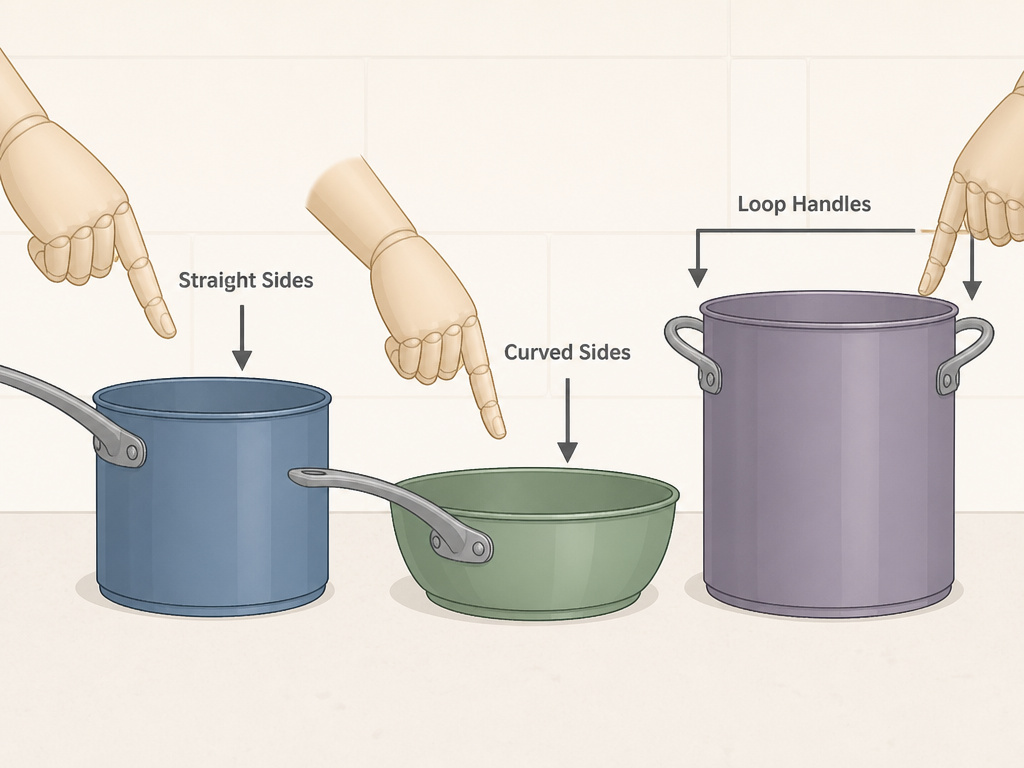
These three pots often get lumped together. They shouldn’t. Each has a shape engineered for a different primary task. Choosing wrong makes cooking harder.
Large Saucepan vs. Saucier
This is the most common mix-up. Both might be 3 or 4 quarts. The difference is in the curves. – Saucepan: Straight, tall sides and a flat bottom. Ideal for boiling, simmering, and making rice. The corners are sharp, which can make whisking a tight roux slightly trickier. – Saucier: Sloped, curved sides and a rounded bottom. Designed for constant stirring and whisking. The curved sides let a whisk reach every part of the pan effortlessly, making it the default for risotto, custards, and delicate pan sauces.
The winner depends on your motion. If you’re mostly bringing water to a boil or cooking something that simmers untouched, the saucepan wins. If your recipe says “stir constantly,” reach for the saucier.
Large Saucepan vs. Stockpot
This is a question of scale. – Large Saucepan (4 quarts): Single long handle. Your everyday pot for sides and sauces for up to 4-6 people. – Stockpot (6+ quarts): Two short loop handles. Your bulk boiler for making stock, cooking soup for a crowd, or boiling pasta for a big party.
The part nobody mentions: The 2-quart capacity gap is a cliff, not a slope. A 4-quart saucepan filled with a pound of pasta and water is manageable. A 6-quart stockpot filled to the same relative level is a 12-pound hazard that demands two hands and serious caution. If your 4-quart pan is consistently full to the brim, you don’t need a slightly larger saucepan, you need a stockpot.
| Vessel | Best For | Handle Setup | When to Reach for It |
|---|---|---|---|
| Large Saucepan | Boiling, simmering, making rice/pasta for 4. | Single long handle + helper. | Daily driver for family-sized side dishes and sauces. |
| Saucier | Stirring-intensive tasks: risotto, custard, roux. | Single long handle. | Any recipe where the whisk is your main tool. |
| Stockpot | Large-batch boiling: stock, soup for 8+, whole chicken. | Two short loop handles. | Meal prep, hosting, or any recipe that starts with “make a gallon of stock.” |
Anatomy and Materials: What to Look For
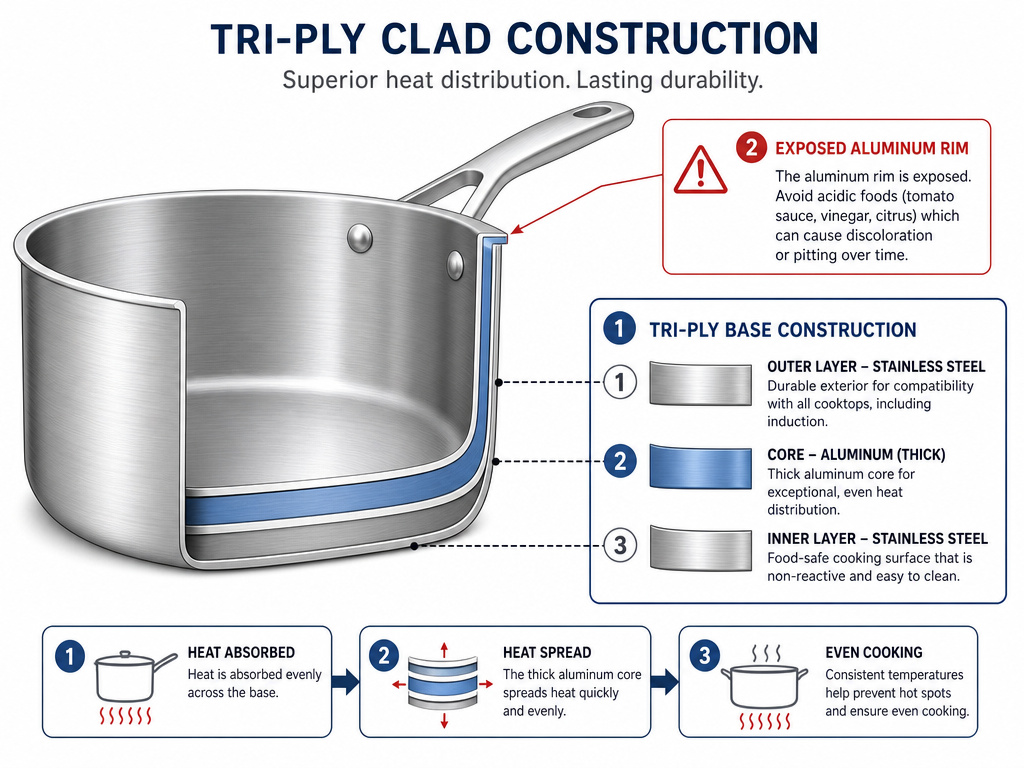
The best large saucepan disappears into your routine. It heats evenly, feels balanced in your hand, and doesn’t react with your food. Getting there means understanding a few key construction details.
The Base: It’s All About Even Heat
A warped pan is a useless pan. Thin, single-ply metal warps when it hits high heat, creating hot spots that scorch your rice or sauce. You want a clad base. “Clad” means multiple layers of metal are bonded together. – Tri-ply: The standard for performance. A core of aluminum (for heat spread) is sandwiched between two layers of stainless steel (for durability and non-reactivity). In a fully clad pan, this aluminum core extends up the sides. – 5-ply / 7-ply: More layers, often with extra copper or aluminum cores. These are premium, heavier, and offer supremely even heat. They’re also more expensive and overkill for most home cooks.
A heavy-bottomed saucepan with a clad base is non-negotiable. It’s the difference between a sauce that burns on the bottom and one that cooks uniformly. The weight is a feature, not a bug, it’s mass that holds and distributes temperature.
The Handle: Safety and Balance
The handle must stay cool. Look for stainless steel or silicone-wrapped stainless. Cheap plastic handles can melt or degrade. The handle should be riveted or welded on securely, no wiggling. The helper handle opposite the main handle is essential for a 4-quart pan. It transforms a precarious lift into a stable, two-handed carry.
The Lid and The Rim
A tight-fitting lid is crucial for trapping heat and moisture when simmering. Glass lids are convenient for monitoring without lifting, but stainless steel lids retain heat slightly better. Pay attention to the rim. On a fully clad pan, the very edge at the top is often raw aluminum core. This is the flaw.
Common mistake: Running a clad saucepan through the dishwasher. The detergent and high heat attack that exposed aluminum edge. Over time, it oxidizes and pits. The pan might still work, but the rim becomes stained and rough. All-Clad’s manual suggests hand-washing “to keep your cookware looking brand new.” That’s not just aesthetics, it’s preserving the material.
Material Matters: Reactive vs. Nonreactive
For a versatile large saucepan, you want a nonreactive saucepan. Reactive metals like plain aluminum or unlined copper can discolor foods and impart a metallic taste, especially with acidic ingredients like tomatoes or wine. Stainless steel is the default choice because it’s nonreactive, durable, and dishwasher-safe (aside from the rim issue). It’s the workhorse. Enameled cast iron is another superb nonreactive option, though it’s significantly heavier.
Choosing Your Large Saucepan: A Recommendations Framework
You don’t need a dozen options. You need one that fits your stove, your grip, and your cleaning habits. Here’s how to narrow it down.
First, answer two questions: 1. What’s your stovetop? If you have induction, you need a magnetic stainless steel or cast iron base. Not all stainless is induction-compatible. Look for an induction saucepan specifically tested for it. 2. Will you hand-wash it? If the answer is no, be prepared for the clad rim on premium pans to deteriorate. You might prioritize a fully stainless steel pan with no exposed core, or simply accept the cosmetic wear.
For most home cooks, a 4-quart tri-ply clad stainless steel saucepan is the lifetime purchase. The All-Clad D5 3-Quart is the critic’s darling, but its 3-quart size is technically a medium-large. For the true 4-quart large standard, the Made In 4-Quart Stainless Clad is a direct competitor with a slightly more comfortable handle shape for some. Both will perform flawlessly on gas, electric, or induction.
Worth knowing before you start: Handle comfort is subjective and critical. A pan that’s awkward to lift will live in your cabinet. If you can, go to a store and grip a few. The handle should feel like an extension of your arm, not a separate tool.
Consider a saucepan set if you’re building a kitchen from scratch. A typical set includes 1.5-quart, 3-quart, and 4-quart pans. This covers all your bases, but ensure each piece has the same quality clad construction, cheap sets often have clad bases only on the larger pans.
Skip nonstick for a large saucepan. The high-heat, long-simmering tasks it’s built for will degrade nonstick coatings faster than a skillet’s duties. Stick with stainless or enameled cast iron.
Frequently Asked Questions
Is a 3-quart saucepan considered large?
No. A 3-quart pan is generally classified as medium or medium-large. The industry benchmark for a true large saucepan is 4 quarts. That extra quart is the difference between comfortably cooking for four and constantly risking a boil-over.
What is the most versatile saucepan size?
For a family, the 4-quart large saucepan is the most versatile single size. It handles big batches of sides and sauces but isn’t so huge it’s awkward for smaller tasks. For a single person or couple, a 3-quart pan might be more versatile as a daily driver.
Can I use a large saucepan as a stockpot?
You can, but you’ll hit limits quickly. A large saucepan lacks the dual handles needed to safely lift a very heavy, liquid-filled pot. For making large quantities of stock, soup for a crowd, or boiling a full bag of pasta, a dedicated 8-quart stockpot is safer and more efficient.
What’s better: straight sides or curved sides?
It depends on the job. Straight sides (saucepan) are better for boiling, simmering, and cooking grains. Curved sides (saucier) are better for stirring-intensive tasks like making risotto or pastry cream. Most kitchens benefit from having one of each in a 3 or 4-quart size.
Are all large saucepans oven-safe?
Not all. Check the manufacturer’s specs. Stainless steel handles are generally oven-safe to high temperatures (often 500°F or more). Pans with silicone-gripped handles, plastic knobs on lids, or nonstick coatings have much lower oven-safe limits, if any. Always confirm oven safety for saucepans before baking.
The Bottom Line
A large saucepan is a specific tool: 4 quarts, 8 inches wide, with a long handle and straight sides. It’s for feeding a family, not just reheating soup. Ignore marketing labels and check the capacity stamped on the base.
Choose clad stainless steel for even heating and a helper handle for safety. Remember that premium clad construction often comes with a dishwasher caveat, that exposed rim will pay the price over time.
For one pan that does the heavy lifting, get the 4-quart size. It’s the backbone for countless dinners. Pair it with a smaller saucepan for quick tasks and a large stockpot for big projects, and you’ve covered 95% of what a pot can do.
