
What Is the Largest Size Instant Pot? The 10-Liter Model
This post contains affiliate links. As an Amazon Associate, we earn from qualifying purchases.
The largest size Instant Pot is the 10-liter Duo Nova 100, available in European and UK markets. In North America, the largest widely available models are 8-quart (7.6-liter) units like the Instant Pot Pro 80 and Duo Evo Plus 80. Capacity isn’t just about volume, it dictates minimum liquid requirements, power draw, and physical footprint on your counter.
That 10-liter figure changes the decision for anyone feeding a crowd or batch-cooking. Most US-focused guides stop at 8 quarts, but a family of six or a serious meal-prepper needs to know the 10-liter option exists, even if it means ordering from a different region.
What follows: the exact specs for each flagship large model pulled from their official manuals, a breakdown of why minimum liquid requirements are non-negotiable, and the real-world trade-offs between an 8-quart workhorse and the 10-liter titan.
Key Takeaways
- The Instant Pot Duo Nova 100 is the largest model at 10 liters, but it’s primarily sold in the EU and UK, not North America.
- 8-quart (7.6 L) models like the Pro 80 and Duo Evo Plus 80 are the largest commonly available in the US and require a minimum of 2 cups (500 mL) of liquid to pressurize safely.
- Bigger pots demand more power (1200–1400W), weigh over 15 pounds empty, and need significant clearance under overhead cabinets.
- Ignoring the minimum liquid requirement printed in the manual risks the pot failing to pressurize or, in extreme cases, triggering safety shutdowns for burn protection.
- For yogurt making, large pots have much higher minimum milk volumes, 6 cups for an 8-quart, versus 4 cups for a 6-quart.
The Largest Instant Pot Model by Liter Capacity
Forget quarts for a moment. The global capacity king is the Instant Pot Duo Nova 100, a 10-liter model. You won’t find it on US retailer shelves. This unit is designed for the European and UK markets, where it meets different electrical standards (220-240V) and consumer preferences for metric sizing.
The Duo Nova 100 requires 625 mL of minimum liquid for pressure cooking, per its official manual. That’s a full 125 mL more than an 8-quart model needs. The inner pot alone is larger than some stockpots.
Its specs are substantial: 1440W of power, a weight of 9.5 kg (about 21 pounds), and dimensions of 42 cm L × 39.3 cm W × 37.5 cm H. This isn’t just a big Instant Pot; it’s a countertop appliance that needs a dedicated landing pad. The trade-off is sheer volume, it can handle a 6-pound roast or a massive batch of chili for a crowd with ease.
For North American shoppers, the ceiling is 8 quarts, which translates to 7.6 liters. The flagship models here are the Instant Pot Pro 80 and the Instant Pot Duo Evo Plus 80. Both are 8-quart/7.6-liter machines with 1400W heating elements for the US market.
| Model Name | Max Capacity | Primary Market | Key Differentiator |
|---|---|---|---|
| Instant Pot Duo Nova 100 | 10 Liters | EU / UK | Largest overall capacity; 625 mL min liquid. |
| Instant Pot Pro 80 | 8 Quarts (7.6 L) | North America | Pro-grade controls, sous vide, and baking functions. |
| Instant Pot Duo Evo Plus 80 | 8 Quarts (7.6 L) | North America | Updated Duo series with improved lid and steam divertor. |
| Instant Pot Duo 80 v3 | 8 Liters | UK / EU | Slightly larger metric capacity than US 8-quart; 1200W. |
Where this goes sideways: Assuming an 8-quart pot is an 8-liter pot. They’re close, 7.6 liters, but not identical. A UK-market “8-liter” Duo 80 v3 actually holds about 8.45 US quarts. This regional sizing quirk means you must check the exact liter or quart specification in the model number, not just the marketing name.
8-Quart Models: The North American Standard for Large Capacity
In the US and Canada, when someone asks for the biggest Instant Pot, they’re almost always pointed to an 8-quart model. Two stand out: the Pro 80 and the Duo Evo Plus 80. They share core specs but cater to different users.
The Instant Pot Pro 80 is the feature-heavy option. It’s built for someone who uses the appliance as a true multi-cooker, not just a pressure cooker. Its dial-and-button control panel offers precise settings for sous vide (with a temperature range) and even a bake function. The manual states it requires 2 cups (500 mL) of minimum liquid to build pressure safely. For yogurt, the minimum milk volume jumps to 6 cups (1.5 L).
The Instant Pot Duo Evo Plus 80 is the evolution of the classic Duo line. It often comes at a more accessible price point than the Pro. Its signature upgrade is a redesigned lid that stores the condensation collector and a steam release divertor to direct vapor away from cabinets. It has the same 1400W, 8-quart capacity and 500 mL minimum liquid requirement as the Pro.
Here’s what those numbers feel like in a real kitchen: * Weight: Empty, each unit is about 16 pounds. Filled with a stew, you’re lifting over 25 pounds. Use the side handles. * Countertop Footprint: You need a space roughly 15 inches square. Remember to account for the steam release path, at least 8 inches of clearance above the vent is non-negotiable. * Power: A 1400W draw on a standard 120V circuit is fine, but don’t share the outlet with a toaster or microwave during the pressurization phase.
For most families batch-cooking meals or making stock, an 8-quart Instant Pot is the practical ceiling. It balances usable volume with the physical constraints of most kitchen counters. If your needs are more modest, our guide to small Instant Pots covers the other end of the spectrum.
What the Manuals Say About Safety and Cleaning
The official user manuals for these large pots are operational requirements for a sealed, pressurized cooking system. The Pro manual uses stark language: failure to follow cleaning instructions “may result in catastrophic failure, which may lead to property damage, severe personal injury.”
That warning concerns the maintenance that keeps the safety systems functional. For large pots, which generate more residue, this is critical.
The non-negotiable rules from the source documents:
- Minimum Liquid: 500 mL for 8-quart/7.6L models, 625 mL for the 10-liter Duo Nova. This is the volume needed to create sufficient steam to pressurize the pot and prevent a “burn” error. Using thick sauces or condensed soup? You still must meet this water-based liquid threshold.
- Cleaning Prohibitions: “Do not use metal scouring pads, abrasive powders or harsh chemical detergents on any of the Instant Pot’s parts or accessories.” Abrasives scratch the inner pot’s surface and can damage the silicone sealing ring.
- Dry Storage: “All surfaces must be allowed to dry thoroughly before use and before storage.” Trapped moisture under the lid or in the base can lead to mildew on the sealing ring or electrical issues.
Common mistake: Assuming a quick wipe of the inner pot is enough. The sealing ring absorbs odors from garlic, curry, or broth. If your large pot starts leaking steam around the lid after a year, the ring has likely hardened and lost its elasticity, replace it immediately.
Following these rules ensures the multiple safety valves, the lid lock, and the pressure sensors work as designed for the decade-plus lifespan of the appliance. For more on using all its functions safely, see our article on the Instant Pot as a pressure cooker.
Big Pot, Big Requirements: Minimum Liquid and Yogurt Rules
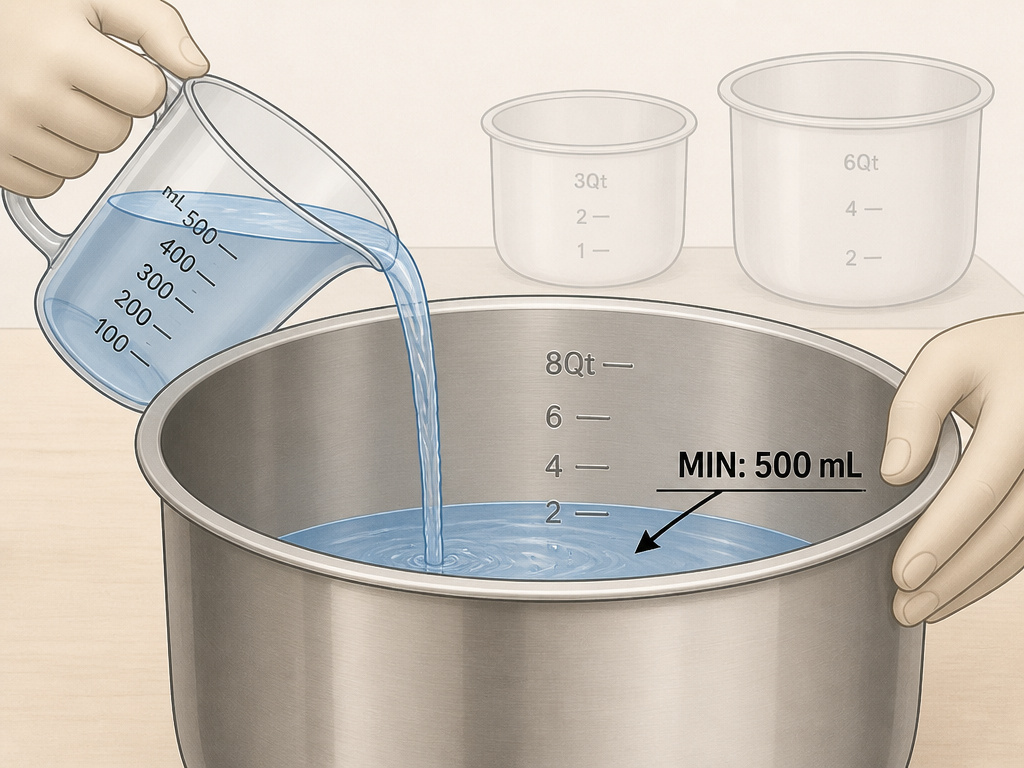
Capacity dictates recipe rules. A larger volume of air inside the pot requires more steam to displace it and reach pressure. That’s why the minimum liquid requirement scales with size.
| Instant Pot Size | Minimum Liquid for Pressure Cooking | Minimum Milk for Yogurt (Pasteurize) |
|---|---|---|
| 3 Liters / ~3 Quarts | 250 mL | 500 mL |
| 5.7 Liters / 6 Quarts | 375 mL | 1000 mL (4 cups) |
| 7.6 Liters / 8 Quarts | 500 mL (2 cups) | 1500 mL (6 cups) |
| 10 Liters (Duo Nova) | 625 mL | 2000 mL (8+ cups) |
These figures come straight from the Duo Nova and Pro user manuals. Ignoring them has direct consequences.
If you use less than the minimum liquid:
The heating element at the bottom of the pot can overheat the small amount of liquid before enough steam is generated. The pot’s burn-protection sensor will trip, the display will show a “burn” message, and it will shut down. You’ll have to release pressure, add more liquid, and restart the cooking cycle, adding 20-30 minutes to your meal.
The yogurt function has its own separate minimums because it’s a non-pressure program. The pot needs enough milk to cover the bottom of the inner pot evenly for consistent heating during the pasteurization phase. Trying to make a single quart of yogurt in an 8-quart pot will likely fail because the thin layer of milk will heat unevenly.
This is a key reason to choose your size based on actual need, not hypothetical “bigger is better” thinking. A best Instant Pot for a couple is rarely an 8-quart model.
How to Choose Between 8-Quart and 10-Liter Models
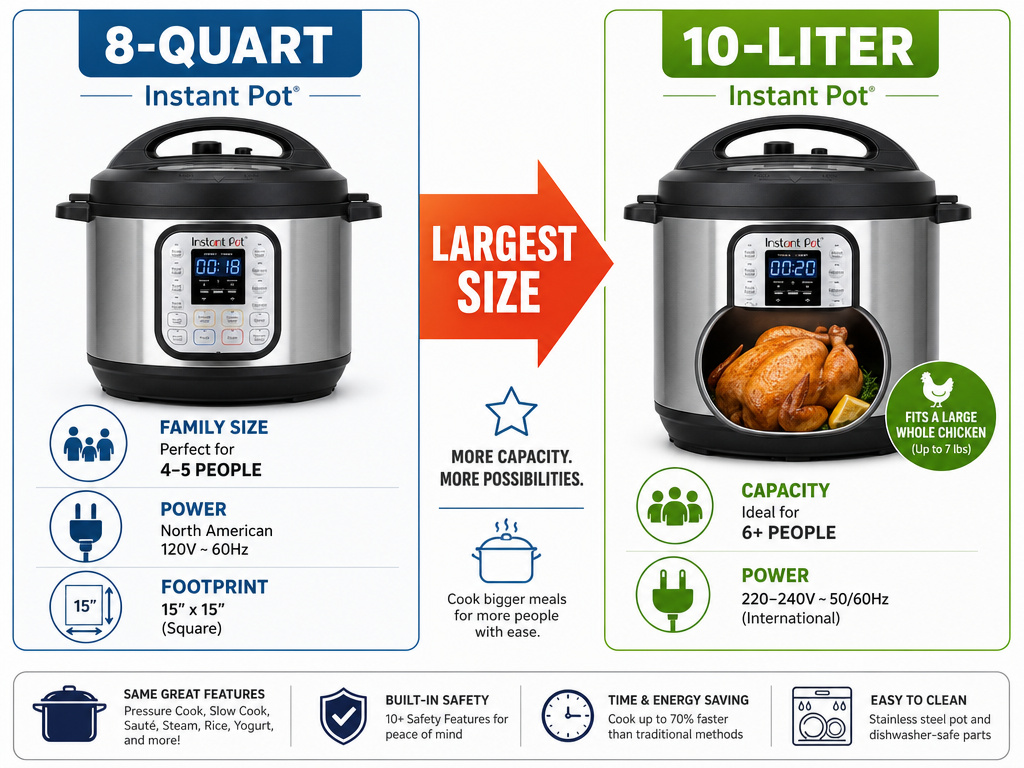
This choice involves availability, kitchen infrastructure, and what you’re really cooking.
Choose the 10-liter Duo Nova 100 if:
- You regularly cook for 6+ people or want to meal-prep lunches for a week in one batch.
- You have a dedicated, sturdy counter space with ample overhead clearance (over 16 inches).
- You live in the UK, EU, or are willing to import an appliance with a 220-240V plug (requiring a voltage converter in the US).
- You need to fit very large cuts of meat, like a whole chicken or a large pot roast.
Choose an 8-quart model (Pro 80 or Duo Evo Plus 80) if:
- You’re feeding a family of 4-5 or are an avid meal-prepper for a smaller household.
- You need a plug-and-play appliance for North American outlets.
- Counter space is at a premium, but you can still allocate a 15″ x 15″ spot.
- You value advanced features like sous vide (Pro) or a cleaner steam release system (Duo Evo Plus).
The part nobody mentions: The larger the pot, the longer it takes to come to pressure. An 8-quart model can add 5-10 minutes of “pre-heat” time compared to a 6-quart when starting with a cold, full pot. For the 10-liter model, budget even more time. This affects weeknight cooking more than weekend batch sessions.
Also, consider the ecosystem. Larger pots need larger Instant Pot accessories, like a bigger steamer basket or a wider trivet. If you love making yogurt, the 6-cup minimum means you’re committing to making a lot of it at once.
Frequently Asked Questions
Is the 10-liter Instant Pot available in the United States?
The 10-liter Instant Pot Duo Nova 100 is built for 220-240V electrical systems in Europe and the UK and is not officially sold for the US market. While you might find it through third-party importers, using it in the US would require a heavy-duty step-up voltage converter, which is not recommended by the manufacturer and voids warranties.
What’s the difference between an 8-quart and an 8-liter Instant Pot?
An 8-quart Instant Pot holds 7.6 liters. An 8-liter Instant Pot, like the UK-model Duo 80 v3, holds about 8.45 US quarts. The difference is roughly one large cup of liquid. This discrepancy exists because US models are marketed in quarts, while many international models use rounded liter figures. Always check the exact specification in the product manual.
Can I use my 8-quart Instant Pot to make just two servings of soup?
Technically yes, but you must still add the full 2 cups (500 mL) of minimum liquid required for the pot to pressurize safely, regardless of recipe size. This can result in a very brothy soup. For small-batch cooking, a 3-quart or 6-quart model is far more efficient and avoids the minimum liquid constraint.
Does a larger Instant Pot use more electricity?
Yes. An 8-quart Instant Pot Pro 80 uses a 1400W heating element, while a 6-quart Duo Nova uses 1000W. The larger wattage is necessary to heat the greater mass of food and liquid. However, because pressure cooking is generally faster than conventional methods, the total energy consumed per meal may still be lower than using an oven or stovetop for a longer duration.
Are the inner pots for 8-quart and 10-liter models interchangeable?
No. Inner pots are specifically sized for their corresponding cooker base. An 8-quart inner pot will not fit or seal correctly in a 10-liter base, and vice-versa. Even within the 8-quart family, inner pots can vary slightly between model lines (Pro vs. Duo Evo Plus). Always use the inner pot that came with your unit or an exact manufacturer-approved replacement.
The Bottom Line
The largest size Instant Pot is the 10-liter Duo Nova 100, a powerhouse built for European kitchens. For most North American cooks, the realistic maximum is an 8-quart model like the Instant Pot Pro 80 or Duo Evo Plus 80.
Your decision hinges on three things: how many mouths you feed regularly, the physical space on your counter, and your patience for longer come-to-pressure times. Remember the binding rules, the 500 mL minimum liquid for 8-quart models, the heft of a full pot, and the critical cleaning routines that keep the safety systems intact.
Choose capacity based on your typical cooking, not your most ambitious holiday meal. An oversized pot battling its minimum liquid requirement is more frustrating than a slightly smaller one that works perfectly every Tuesday night.
