
What Is the Safest Bakeware? A Guide to Materials & Safety
This post contains affiliate links. As an Amazon Associate, we earn from qualifying purchases.
The safest bakeware is made from inert, non-porous materials like borosilicate glass, high-fired ceramic, or 18/10 stainless steel, and it carries a legitimate safety certification like NSF P393 or meets the NF EN 13834 standard. The critical limit is temperature: silicone fails above 220°C (428°F), and nonstick coatings degrade over 260°C (500°F). Current safety testing often happens at room temperature, but real baking at 95°C can increase chemical migration from some items by 5 to 10 times.
That gap between the test lab and your hot oven is where the actual risk lives. Regulations in North America and Europe still base their pass/fail on a 24-hour soak at 22°C, a condition no cake or casserole will ever see. A 2024 European study changed the game by testing at baking temperatures and finding that enameled metal items, in particular, release far more nickel and cobalt when heated.
What follows: the three certifications that mean something, the exact temperature where each common material fails, and the one test result that should make you look at your colorful ceramic pie dish differently.
Key Takeaways
- Glass and stainless steel are the baseline for inert safety because they have no coatings to degrade and leach nothing into food, even at high heat.
- Silicone’s 220°C (428°F) limit is a hard ceiling; exceeding it breaks down the polymer, and the bakeware may never recover its shape or safety.
- Safety certifications are not all equal. Look for NSF P393 (oven bakeware) or EN 13834 (EU standard), these are performance-based, not just material claims.
- Repeated use lowers risk for ceramics and enamel. The first bake is the worst for chemical migration; the amount released drops by about half on the second use.
- Avoid nonstick bakeware for high-heat roasting or broiling. The convenience isn’t worth the risk of coating degradation and fume release above 260°C.
The Core Safety Standards You Can Actually Trust
Forget marketing terms like “non-toxic” or “eco-friendly.” Those are claims, not proof. Real safety is verified by independent organizations that publish testable standards. In the bakeware world, two systems matter: NSF International’s protocols and the European Norm (EN) standards.
The NSF home products standards are a suite of protocols developed with regulators. For bakeware, NSF P393 is the one that counts. It sets minimum food protection and safety requirements for oven bakeware, cake pans, pie dishes, casserole dishes, made from glass, ceramic, silicone, and metal. A product with this certification has been tested for material safety and durability under defined conditions. It’s a baseline, but a strong one.
NSF P393 establishes minimum food protection and safety requirements for oven bakeware. It covers material safety, durability, and labeling, and is recognized by regulators in the U.S., Canada, Mexico, and the EU.
Across the Atlantic, the NF EN 13834 European standard (often just called EN 13834) specifies safety and performance requirements for cookware and ovenware used in traditional domestic ovens. It applies to all oven-going items regardless of material. This standard includes tests for heat resistance, handle fatigue, and coating durability. If you’re buying European-made bakeware, this is the mark of a tested product.
These standards represent a floor, not a ceiling. They tell you a product meets minimum regulatory requirements. They don’t tell you which material is best for your 500°F pizza stone.
Why Room-Temperature Testing Is a Broken Promise
Here is the single biggest flaw in how bakeware is deemed “safe.” The current EU Directive and the international ISO standard 6486 specify that migration testing for elements like lead, cadmium, nickel, and cobalt must be done at room temperature, 22°C for 24 hours. Manufacturers design and test to this standard.
Your oven does not bake at 22°C.
A pivotal 2024 study by the European Commission’s Joint Research Centre (JRC) exposed this gap. Researchers tested ceramic and enameled bakeware at a realistic baking temperature of 95°C for 2 hours. The results were stark: migration of elements increased significantly for all items compared to the room-temperature test. For enameled metal bakeware, the increase was 5 to 10 times higher.
| Test Condition | Temperature | Time | Key Finding |
|---|---|---|---|
| Standard (ISO 6486) | 22°C (72°F) | 24 hours | Baseline for legal compliance |
| Realistic Baking (JRC Study) | 95°C (203°F) | 2 hours | Migration increased 5-10x for enameled items |
| Successive Use (JRC Study) | 95°C | Repeated tests | Migration halved from 1st to 2nd use |
The study also found that the first use is the worst. The amount of elements that migrated out of the bakeware dropped by roughly half between the first and second heating cycle. This means a brand-new, vibrantly colored ceramic dish poses a higher initial risk that diminishes with each bake. The industry’s engineering standards for bakeware are being rewritten in light of this data, but for now, the label on the box likely references the old, cooler test.
Material-by-Material Safety Breakdown
Your choice of material dictates the rules you need to follow. Each has a failure point.
Glass (Borosilicate and Tempered Soda-Lime)
Glass is chemically inert. It won’t react with acidic tomato sauce or alkaline baking soda, and it leaches nothing. Borosilicate glass (like Pyrex) handles thermal shock better than standard tempered soda-lime glass. The risk with glass is physical, not chemical: impact breakage and thermal shock if you move it from a hot oven to a wet counter. For pure material safety, it’s the benchmark.
Ceramic and Stoneware
High-fired ceramic and stoneware are excellent, inert choices, when made correctly. The danger is in the glaze, which can contain lead or cadmium to achieve bright colors. In Canada and the U.S., glazes must meet strict leaching limits. The problem, as the JRC study shows, is that those limits are tested at room temperature. A stoneware baking pan with a dubious glaze is a higher risk at baking heat.
Where this goes sideways: Buying brightly glazed ceramic bakeware from unregulated markets or artisanal stalls. The glaze may not be food-safe at any temperature, let alone at 200°C.
Your safest bet is to choose ceramic with a plain, matte finish or to purchase from brands that explicitly test for heavy metal leaching at elevated temperatures. The Cookware & Bakeware Alliance standards provide material safety guidelines that reputable manufacturers follow.
Stainless Steel (18/10 or 18/8)
Like glass, stainless steel baking pans are non-reactive and inert. The 18/10 designation (18% chromium, 10% nickel) denotes a high-quality, corrosion-resistant alloy. It won’t pit, rust, or impart flavors. The downsides are that it’s a poor heat conductor (leading to hot spots) and food sticks fiercely unless you use ample fat or parchment. For safety, it’s nearly bulletproof. It’s the core material in commercial kitchens for a reason.
Silicone
Silicone bakeware is flexible and non-stick, but it has a strict temperature boundary. Health Canada and other agencies set the maximum continuous use temperature for silicone at 220°C (428°F). Exceed this, and the polymer chains start to break down. The pan may warp permanently, become tacky, and potentially release siloxanes.
Most home ovens don’t exceed 250°C, but the broiler element or a pizza oven can. Always check your oven’s calibration. The benefits of silicone baking pans, easy release and storage, come with the responsibility of watching the thermostat.
Nonstick Coatings (PTFE/PFOA-Free)
Modern nonstick coatings for bakeware are generally PFOA-free, but they are still polymer-based. The primary risk is overheating. Above 260°C (500°F), these coatings can begin to decompose, releasing irritating fumes. This is most likely to happen if you preheat an empty non-toxic sheet pan under a broiler or forget a pan in a hot oven.
The coating itself is inert at normal baking temperatures, but it wears thin over time. Once scratched, the exposed metal base (usually aluminum) can react with food. Treat nonstick bakeware as a moderate-heat convenience tool, not a workhorse for high-heat roasting.
Aluminum (Unglazed)
Aluminum is a fantastic heat conductor, making for even baking. But it is reactive. Cooking acidic foods (like rhubarb crisp) or storing food in an aluminum pan can cause the metal to oxidize and transfer into the food, giving it a metallic taste and discoloring the pan. For safety, uncoated aluminum is a poor choice for anything beyond short-term baking of neutral foods. Anodized aluminum solves the reactivity issue by creating a hard, inert surface through electrolysis.
The 3-Step Checklist Before You Buy New Bakeware
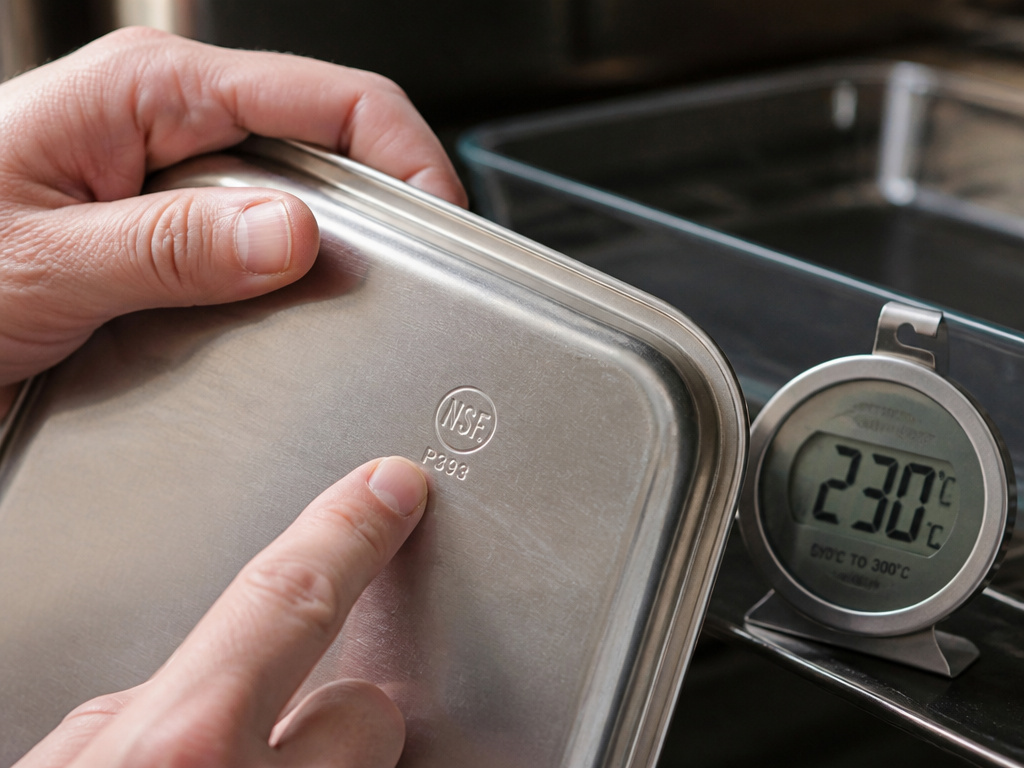
- Identify the primary use and maximum temperature. Are you baking bread at 230°C? Roasting vegetables at 220°C? Making a lemon bar? This decides the material. For high-heat and acidic foods, default to glass or stainless steel bakeware.
- Look for a legitimate certification mark. Turn the item over. Look for “NSF P393” or evidence of compliance with “EN 13834” or the industry engineering standards for bakeware. A generic “FDA-approved” stamp is meaningless for bakeware safety.
- Research the brand’s testing practices. A quick search can reveal if a brand discusses heavy metal testing or elevated-temperature migration. Brands that are transparent about their cookware material safety standards are generally more trustworthy.
Frequently Asked Questions
Is scratched nonstick bakeware dangerous to use?
Scratched nonstick coating is more of a performance failure than an acute toxicity risk. The coating itself is inert at baking temperatures. The danger is that food will stick to the exposed metal, making cleaning difficult and potentially leading to rust if the base is aluminum or steel. The flakes of coating you might ingest are biologically inert and will pass through your system. However, a heavily damaged pan is a sign to replace it for cooking quality, not necessarily a health emergency.
Can you put silicone bakeware directly on an oven rack?
Yes, but you must use a supporting sheet pan or tray if the silicone is floppy, like a muffin cup. Rigid silicone molds can usually go directly on the rack. The crucial rule is to ensure the silicone does not sag and touch the heating element at the bottom of the oven, as this could create a localized hot spot exceeding its 220°C limit.
How can I test my old ceramic bakeware for lead?
Home test kits are available, but their reliability is questionable for glazed ceramics. They are designed for paint and dust. The most accurate method is to send a sample to a laboratory that uses X-ray fluorescence (XRF) testing. Given the cost and effort, a more practical approach is to retire any old, brightly colored ceramic dish with a glossy glaze, especially if it’s chipped or from an unknown origin. When in doubt, use it as a fruit bowl, not a baking dish.
Is cast iron bakeware safe?
Cast iron is exceptionally safe from a chemical leaching perspective. It’s elemental iron. Cooking in it can actually increase the iron content of your food, which can be beneficial for some people. The “seasoning” is polymerized oil, a stable carbon layer. The only safety considerations are its extreme weight (a drop hazard) and the fact that it requires specific cleaning to maintain its seasoning. For baking cornbread or Dutch oven bread, it’s a superb, safe choice.
What is the absolute safest material for baking at high temperatures?
Borosilicate glass. It is completely inert, non-porous, and can withstand thermal shock and temperatures far beyond any home oven setting. Its only weakness is physical impact. For any recipe where you are pushing past 220°C, like artisan bread or high-temperature roasting, a glass or ceramic loaf pan designed for high heat is the safest bet. Stainless steel pans are a close second, provided you manage sticking.
Before You Go
The safest bakeware isn’t a single product. It’s the right material matched to your recipe’s temperature and acidity, with a verifiable certification to back up the claims. Glass and stainless steel are your zero-worry foundations. Silicone demands a watchful eye on the oven dial. Nonstick requires a promise to never use the broiler.
Remember the JRC study’s lesson: what passes a room-temperature safety test can behave very differently at baking heat. Your best defense is knowledge of those limits. Choose bakeware you trust, not just bakeware that is convenient.
