
Does All-Clad Cookware Work on Induction Cooktops? Find Out
This post contains affiliate links. As an Amazon Associate, we earn from qualifying purchases.
Yes, the vast majority of All-Clad cookware works perfectly on an induction cooktop. The brand’s core stainless steel and clad collections, including D3, D5, and Copper Core, are explicitly designed for induction. The compatibility hinges on a ferromagnetic stainless steel layer in the pan’s base. You can confirm this yourself in seconds with a simple refrigerator magnet test.
That magnetic layer is the non-negotiable requirement. An induction cooktop generates a magnetic field that directly heats that layer. If the magnet sticks firmly to the center of the pan’s base, the pan will work. This test overrides any label or doubt, giving you a physical answer.
What follows is the breakdown of which All-Clad lines pass the test, the one edge case where a nonstick pan might fail it, and the specific practices, like matching pan size to burner, that keep your high-end cookware performing safely on an induction hob for years.
Key Takeaways
- Perform the refrigerator magnet test on the center of any pan’s base. A firm stick means induction compatibility, regardless of the collection name.
- All-Clad’s stainless steel and clad collections (D3, D5, Copper Core, B1) are fully induction-compatible. Their nonstick lines (HA1, NS1, NS Pro) are usually compatible but require the magnet check due to their aluminum cores.
- For efficiency and to prevent warping, match your pan’s diameter to your induction burner’s size and always start cooking at a low power setting.
- Never subject a hot All-Clad pan to cold water. The thermal shock can warp even multi-ply bonded cookware.
- While most All-Clad is oven-safe up to 600°F, nonstick variants have a lower threshold, typically 500°F. Always check your specific pan’s manual.
The Simple Magnet Test (And What It Actually Means)
Grab a magnet from your fridge. Place it against the flat center of your All-Clad pan‘s base. If it holds firmly, you have your answer. This isn’t a suggestion, it’s the definitive physical check for the ferromagnetic metal an induction cooktop requires.
“The most important consideration for cooking with an induction appliance is owning cookware that’s made of ferromagnetic metal, such as cast iron or some types of stainless steel,” says Gill Stansfield of Johnson & Wales University. His recommended trick is the magnet test.
The science is straightforward. Induction hobs don’t use a heating element. They create an oscillating magnetic field. When a pan with a ferromagnetic base (like magnetic stainless steel or cast iron) sits on the hob, that field induces electrical currents inside the metal. Those currents generate heat directly in the pan. No magnetic layer, no heat. This is why a pure aluminum or copper pan won’t work unless it has a magnetic layer clad to its bottom.
Where this goes sideways: Testing only the edge of the pan. Some pans have a non-magnetic outer cladding for aesthetics. The critical magnetic layer is in the center cooking surface. Test there.
For All-Clad, this test confirms the engineering. Their stainless steel cookware uses a magnetic grade of steel as part of its bonded layers. Their nonstick pans have an aluminum body for even heating, but they are clad with a magnetic stainless steel plate on the bottom specifically for induction compatibility. If your magnet falls off an All-Clad nonstick pan, it’s an older or specific model not meant for induction.
Which All-Clad Collections Are Induction Compatible?
All-Clad designates its induction-compatible lines clearly. The rule is simple: if the collection is built around stainless steel or a multi-ply clad construction, it works. The nonstick lines work if they include that magnetic base plate.
Here’s the breakdown by collection type:
| All-Clad Collection | Core Material | Induction Compatible? | Key Notes |
|---|---|---|---|
| D3 Stainless | 3-ply stainless | Yes | The entry-level stainless workhorse. Fully magnetic. |
| D5 Stainless | 5-ply stainless | Yes | Added layers for superior heat retention. Fully magnetic. |
| Copper Core | 5-ply with copper | Yes | Copper core for precision; magnetic stainless outer layers. |
| B1 (Budget Stainless) | Single-ply stainless | Yes | Basic, fully magnetic stainless steel. |
| HA1 Hard Anodized Nonstick | Hard-anodized aluminum | Check with magnet | Has a magnetic base plate. Magnet must stick. |
| NS1 & NS Pro Nonstick | Aluminum with nonstick coating | Check with magnet | Designed with induction in mind, but verify. |
The takeaway is that you rarely need to worry with All-Clad’s stainless lines. The uncertainty only enters with nonstick. Consumer Reports notes that while most nonstick pans are aluminum, some are clad with magnetic metal for induction. Your All-Clad HA1 or NS Pro pan likely is, but the magnet gives the final yes.
The One All-Clad Scenario That Might Not Work
You own an older All-Clad nonstick pan, or a specialty piece like a chef’s pan with an aluminum core, purchased before induction was a mainstream concern. The magnet slides off. This pan will not work on your new induction range. It’s not defective; it was simply built for conventional electric or gas heat.
The fix isn’t to force it. Using a non-magnetic pan on an induction hob does nothing, the hob won’t activate. You have two paths: retire that piece to a secondary gas cooktop, or use an induction interface disk. These steel plates sit on the burner, heat up, and transfer heat to your pan like a traditional electric coil. They work but are slow, inefficient, and defeat the speed and control benefits of induction.
How to Use All-Clad on Induction: Not Just Compatibility, But Correctly
Compatibility gets the pan hot. Using it correctly keeps it from warping, scorching, and wearing out prematurely. Induction delivers intense, direct heat faster than any other method. Your technique needs to adapt.
- Match the pan to the burner. This is All-Clad’s own guidance. For maximum energy efficiency and stability, the pan’s base should closely match the diameter of the induction burner ring. A small pan on a large burner concentrates fierce heat on a small area, risking warping and hot spots.
- Start low, then go. Never slam a cold pan onto high power. Begin at a low or medium-low setting to allow the bonded layers to heat evenly. Gradually increase to your desired temperature. This prevents thermal shock.
- Preheat with a medium setting. You don’t need high heat to preheat. A medium setting will get your pan to the right temperature for searing or sautéing without overshooting.
- Use the right utensils. This is always true for All-Clad, but especially on induction. Metal utensils can scratch the surface. Stick with wood, silicone, or high-quality nylon.
Before you start: Never place a scorching hot All-Clad pan under cold running water. The extreme temperature differential can warp the pan’s flat base permanently. Let it cool first.
The control is induction’s superpower. A stainless steel pan like the All-Clad D3 or Copper Core skillet responds almost instantly to temperature adjustments. You can drop from a sear to a simmer in seconds. This precision is why many chefs prefer induction with high-performance clad cookware.
Stainless Steel vs. Nonstick: Does Material Change the Rules?
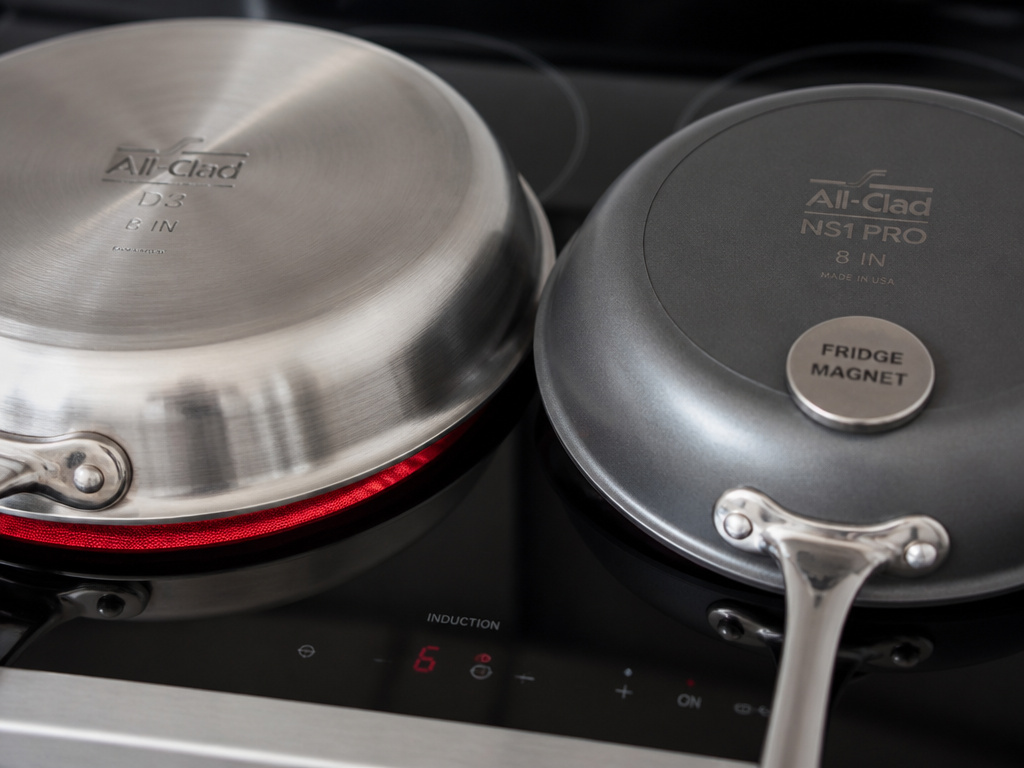
Your choice between a stainless All-Clad skillet and a nonstick one changes the cooking experience, but the induction rules are nearly identical. The difference is in the construction and the care.
Stainless/Clad (D3, D5, Copper Core):
- Construction: Multiple bonded layers of magnetic stainless steel (and sometimes copper/aluminum). The entire base is ferromagnetic.
- Induction Guarantee: 100%. No check needed.
- Best For: Searing, deglazing, building fond, and going from stovetop to a 600°F oven.
Nonstick (HA1, NS Pro):
- Construction: An aluminum body for even heat, coated with nonstick, and a separate magnetic stainless steel plate bonded to the bottom.
- Induction Guarantee: High, but requires the magnet test.
- Best For: Eggs, fish, delicate foods, and low-fat cooking. Oven-safe only to 500°F.
The performance gap is real. A Copper Core fry pan offers unbeatable, even thermal response for a perfect sear. An NS Pro nonstick pan gives effortless release for pancakes. Both work on induction, but they are tools for different jobs. Your best induction cookware set will likely include pieces from both families.
Frequently Asked Questions
Are all All-Clad pans induction compatible?
No, but the vast majority are. All stainless steel and multi-ply clad All-Clad collections (D3, D5, Copper Core, B1) are fully compatible. The brand’s nonstick lines (HA1, NS1, NS Pro) are designed to be compatible, but you must verify with a magnet test on the base, as some pure aluminum nonstick pieces exist.
How can I tell if my old All-Clad works with induction?
Use the refrigerator magnet test. Place a strong magnet on the center of the pan’s cooking base. If it sticks firmly and doesn’t slide off easily, the pan is induction-compatible. This test is more reliable than looking for a label or remembering the collection name.
What if my All-Clad nonstick pan isn’t magnetic?
If a magnet will not stick to the base of your All-Clad nonstick pan, it is not induction-compatible. It was likely manufactured before induction compatibility became a standard feature for nonstick lines. You can use it with an induction interface disk, but for best results, consider replacing it with a newer induction-ready nonstick pan.
Is All-Clad better on induction than other cooktops?
Many chefs argue yes. Induction provides instantaneous, precise temperature control that pairs perfectly with All-Clad’s responsive, even-heating bonded layers. The pan heats evenly and adjusts to temperature changes faster than on gas or electric, giving you superior command over the cooking process.
Do I need special cookware for an induction cooktop?
Yes, but “special” just means it must have a ferromagnetic base. Cast iron and magnetic stainless steel (like that used in All-Clad) are the standard. You do not need to buy a dedicated, separate set of induction cookware if your existing pots and pans pass the magnet test.
Before You Go
The short answer is a confident yes for most All-Clad in your kitchen. The long answer is that induction compatibility is a feature of physics, not marketing. The magnet test is your unfailing guide.
If you’re building a new kitchen or upgrading, start with a core stainless steel workhorse like the All-Clad D3 12-inch fry pan. Add a dedicated nonstick like the NS Pro for eggs if you want. Both will work flawlessly on a modern induction hob, giving you decades of precise, enjoyable cooking. Just remember to match the pan size to the burner, start on a low setting, and let the pan cool before you wash it. That’s how you keep premium cookware performing like new.
