
Can You Put Your Electric Griddle in a Dishwasher? Model Guide
This post contains affiliate links. As an Amazon Associate, we earn from qualifying purchases.
You can put some electric griddles in a dishwasher, but most should not. The answer is not universal; it is printed in your specific model’s instruction manual. Models like the Presto 0704405 and the Presto Liddle Griddle 07211 are dishwasher-safe with the heat control removed. Models with ceramic nonstick coatings, like the Presto 22-inch 07061 and the Dash Everyday Griddle DEG20C, are explicitly not dishwasher safe, as repeated cycles degrade the coating and cause discoloration.
That manual clause is the whole game. If you skip it, you’re gambling with the appliance’s nonstick surface and its appearance. The difference between a yes and a no often comes down to the coating chemistry and the manufacturer’s testing.
What follows: a breakdown of the five specific models we found with clear OEM instructions, the chemical reason dishwasher detergent wrecks ceramic coatings, and the hand-wash method that sidesteps the damage entirely. By the end, you’ll know how to check your own model and clean it without shortening its life.
Key Takeaways
- Check your manual first. The only reliable answer is in your specific model’s instruction booklet or PDF.
- Ceramic coatings fail in the dishwasher. High-pH, caustic dishwasher detergents slowly degrade the nonstick properties of ceramic surfaces, leading to sticking and discoloration within a dozen cycles.
- Remove the heat control always. If your model is dishwasher-safe, this is the non-negotiable first step to prevent electrical damage.
- Hand washing is the safe default. For any model without an explicit “dishwasher safe” stamp in its official manual, hand wash with warm, soapy water.
- Discoloration is a warning sign. A gray residue or dulling on the bottom of the griddle after a dishwasher cycle signals chemical damage from detergent.
The One Question That Decides It
What is your griddle’s exact model number? This is not a general brand question. Presto makes models you can and cannot put in the dishwasher. Dash does the same. The answer lives on page one or two of the product manual, usually under “Care” or “Cleaning.”
For electric griddles, dishwasher safety is a binary specification determined by the manufacturer’s materials testing. It is not a recommendation but a published rating based on the coating’s chemical resistance to high-temperature, alkaline detergents.
If you’ve lost the paper manual, search online for “[Brand] [Model Number] instruction manual PDF”. The OEM’s website is the primary source. Do not trust third-party retail descriptions; they often copy generic text and get it wrong.
Common mistake: Assuming all Presto or all Dash griddles are the same. This assumption costs you the nonstick surface. One Presto model is fully immersible; another from the same brand warns that dishwashing will “slowly diminish” its ceramic coating.
A Model-by-Model Breakdown from the Manuals
We pulled the official instruction PDFs for six common models. The language is specific, and it shows how narrow the safe zone is.
| Brand & Model | Dishwasher Safe? | Key OEM Instruction Quote | Primary Risk |
|---|---|---|---|
| Presto 22-inch (0704405) | Yes | “Fully immersible and dishwasher safe with heat control removed.” | Electrical damage if heat control is not removed. |
| Presto Liddle Griddle (07211) | Yes, with caveat | “Completely immersible and dishwasher safe with the heat control removed.” Notes possible discoloration. | Bottom may discolor; gray residue may transfer. |
| DASH Griddle (CKRVGRFM10) | Yes | “Griddle (with TEMPERATURE CONTROL PROBE removed) and GREASE TRAY may be washed in the dishwasher.” | Electrical damage if probe is not removed. |
| Presto 22-inch (07061) | No | “Do not wash the griddle in the dishwasher. Repeated washings… Will cause the nonstick properties of the ceramic coating to slowly diminish.” | Loss of nonstick performance; discoloration. |
| Presto Slimline (07072) | No | “Do not wash the griddle in the dishwasher. Repeated washings… Will cause the nonstick properties of the ceramic coating to slowly diminish.” | Loss of nonstick performance; discoloration of trim. |
| Dash Everyday Griddle (DEG20C) | No | “The Ceramic Everyday Griddle is NOT dishwasher safe and should never be submerged in water; it must be hand-washed.” | Coating damage; electrical shock risk. |
The “yes” models share a trait: they typically use a standard, durable nonstick coating (often Teflon-based). The “no” models are frequently the ones with ceramic nonstick surfaces, which are marketed as healthier but are more chemically vulnerable.
Where this goes sideways: Putting a ceramic-coated griddle in the dishwasher because a different model from the same brand says it’s okay. The coating type, not the brand name, dictates the rule.
For a broader look at what’s available, our guide to the best electric griddles details construction and coating types.
The Chemical Reason It’s Usually a No
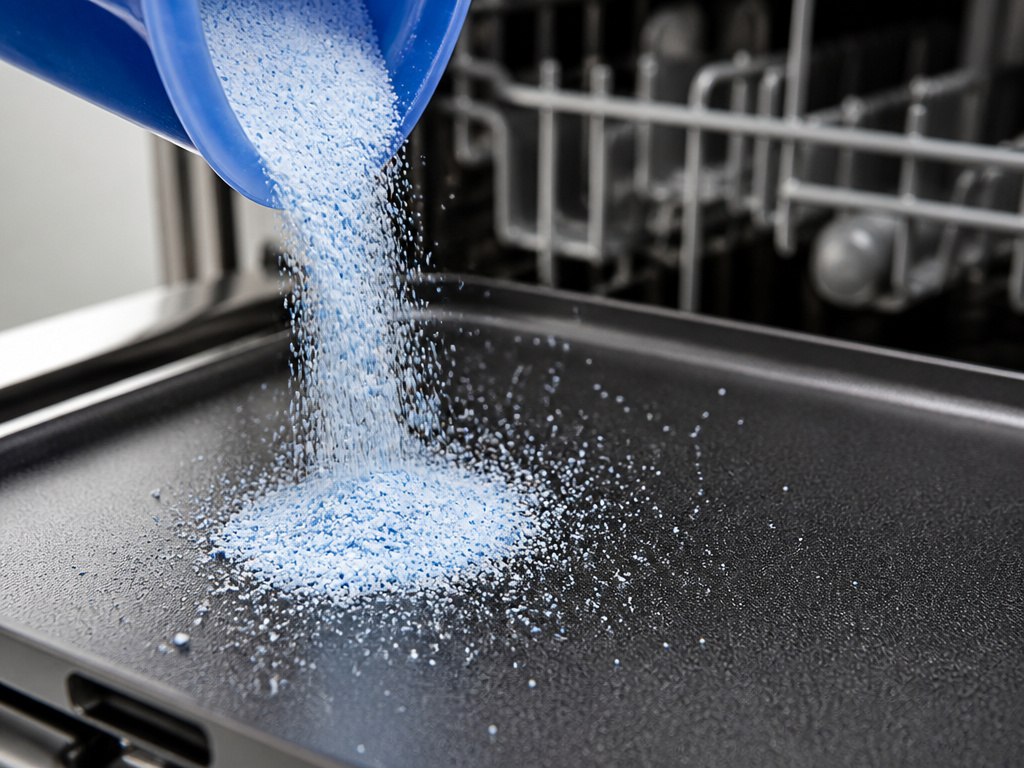
Dishwasher detergent is not gentle soap. It’s a high-pH, alkaline chemical blend designed to dissolve baked-on food and grease. That alkalinity is what attacks certain nonstick coatings, especially ceramic.
Ceramic nonstick is essentially a glass-like layer fused to the metal. Alkaline solutions can slowly etch this layer. The Presto manual for the 07061 model states the result clearly: the nonstick properties “slowly diminish.” This isn’t immediate. You might get five or six cycles before you notice eggs starting to stick a little more. After a dozen, the surface may feel rough and food will consistently bond.
The second damage vector is oxidation. The detergent can react with the aluminum body underneath the coating, causing the “gray residue” the Presto manuals mention. This residue can rub off on kitchen towels or your hands. It’s a sign the body metal is corroding.
Hand washing avoids both reactions. Warm water and a mild dish soap have a near-neutral pH. They clean without the corrosive chemical activity. This is why the safe step-by-step cleaning guide for most griddles never includes the dishwasher.
If Your Model Says Yes: The 3 Critical Steps
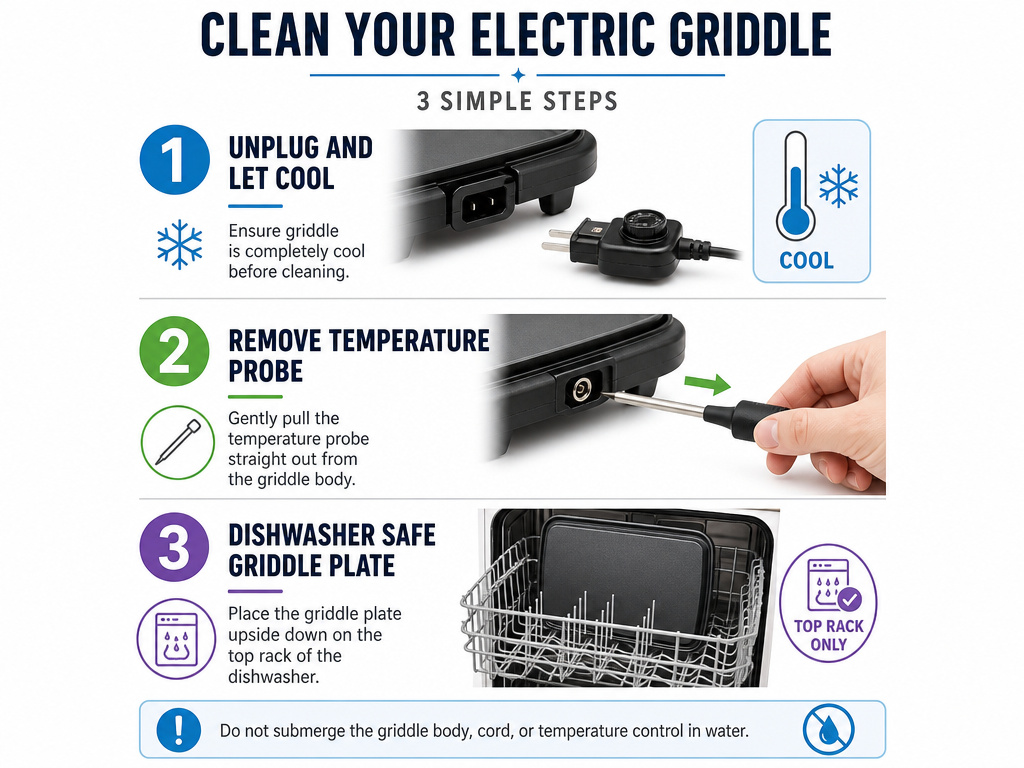
For the minority of griddles rated dishwasher-safe, follow this sequence exactly. Missing one step risks the appliance and voids any warranty.
- Unplug and Cool Completely. This is non-negotiable. Never handle a warm griddle, and never put any part of the electrical system near water until it’s at room temperature.
- Remove the Heat Control / Temperature Probe. This is the part that must stay dry. Unplug it from the griddle body. For models like the DASH CKRVGRFM10, this is the “TEMPERATURE CONTROL PROBE” mentioned in the manual. Wipe it with a damp cloth only.
- Place Griddle on Top Rack, Upside Down. Position it so the cooking surface faces down. This minimizes pooling of water and detergent on the nonstick surface during the cycle. The grease tray, if removable, can go on the bottom rack.
Skip this if: The cycle includes a heated dry setting. The extreme dry heat can sometimes warp thin aluminum griddle plates. Let it air-dry instead.
What happens if you skip step 2? You risk electrical shock and permanently damaging the temperature control unit. Water will ingress into the probe’s connection point, leading to corrosion inside. The griddle may not heat properly afterward, or it could trip a household GFCI outlet.
The Safe, Manual Cleaning Method for Everyone
This method works for every electric griddle, regardless of its dishwasher rating. It’s the default for a reason.
- Cool, Unplug, Disassemble. Let the griddle cool to room temperature. Unplug it. Remove the heat control probe. Take out the slide-out drip tray or grease tray.
- Wipe and Degrease. Use a paper towel to wipe away the majority of loose grease and food bits from the cooking surface. This prevents a greasy, gunky slurry from forming in your sink.
- Clean with Warm, Soapy Water. Use a soft sponge or cloth with mild dish soap. For stuck-on debris, use a plastic griddle scraper or one of the recommended griddle cleaners. Never use steel wool or abrasive pads.
- Rinse and Dry Thoroughly. Rinse all soap off completely. Dry every part with a towel, paying special attention to the probe connection socket on the griddle body. Any leftover moisture here is the enemy.
- Reassemble When Bone-Dry. Only reconnect the heat control probe when you are certain both the probe plug and the griddle’s socket are 100% dry.
This process is the core of proper cleaning methods and it preserves the life of the coating. For a brand-new surface, this careful cleaning is the first step before you even think about how to season a new griddle.
When Things Go Wrong: Discoloration & Residue
You ran the risk and put a non-dishwasher-safe griddle through a cycle. Now the bottom has a dull, gray patch or a powdery residue. What now?
First, understand what it is. That residue is likely oxidized aluminum or a detergent salt. The Presto 07061 manual explicitly warns it “may transfer onto towels, and/or skin.” Wipe it off with a damp cloth and dry it. The discoloration itself is usually permanent cosmetic damage.
The more serious issue is the coating. If your eggs or pancakes are now sticking where they didn’t before, the nonstick layer has been compromised. You cannot restore a ceramic coating that has been chemically etched. Your options are to live with a stickier surface or replace the griddle.
This is distinct from rust. If you see orange-brown spots, that’s rust on a griddle, often from a damaged coating exposing the base metal. You can learn how to remove rust from a cast iron griddle, but for an electric model with a compromised nonstick surface, rust is a sign of significant wear.
Easy to miss: The inside lip of the griddle or the decorative trim. These areas can discolor first because detergent pools there during the cycle. Check these spots after any accidental dishwasher run.
Frequently Asked Questions
Are all Presto electric griddles dishwasher safe?
No. Presto manufactures both dishwasher-safe and non-dishwasher-safe models. The Presto 22-inch model 0704405 is safe; the Presto 22-inch model 07061 with a ceramic coating is not. You must check your specific model’s instruction manual.
What happens if I put a non-dishwasher-safe griddle in the dishwasher?
Two primary things happen, both gradual. First, the high-pH detergent degrades the nonstick coating, causing food to stick more over several washes. Second, the detergent can react with the metal body, causing permanent discoloration and a gray, transferable residue on the bottom.
Can I wash just the griddle plate in the dishwasher?
Only if the manufacturer’s instructions say you can detach and wash the plate separately. On most electric griddles, the cooking surface is not designed to be separated from the heating element and body. Submerging the entire unit is the risk. Always follow the OEM guide for cleaning your griddle.
Is the grease tray dishwasher safe?
Usually, yes. Most models have a removable grease or drip tray that is made of durable plastic or coated metal. These are typically dishwasher-safe on the top rack. Confirm in your manual, but it’s a common safe exception.
How do I clean my electric griddle without a dishwasher?
Cool, unplug, and disassemble. Wipe off excess grease. Wash with a soft sponge, warm water, and mild dish soap. Use a plastic scraper for stuck bits. Rinse thoroughly and dry all parts completely before reassembly. This is the standard griddle cleaning method.
Can dishwasher damage void my warranty?
Yes. If the manufacturer’s instructions explicitly state “Do not wash in dishwasher” and you do it anyway, any resulting damage (coating failure, electrical issues, discoloration) will likely not be covered under the product warranty.
Before You Go
The dishwasher question has a clear, if inconvenient, answer: look it up. Your model’s manual is the final authority. When in doubt, hand wash. The two minutes of scrubbing preserve the nonstick surface for years, while the convenience of a dishwasher cycle can shorten your griddle’s effective life to a single season.
For a ceramic-coated model, the answer is almost always no. For a standard nonstick model from a brand like Presto or Dash, you might get a yes—but only for specific model numbers. Treat that manual as part of the appliance. And if you’re shopping, factor this into your decision; a dishwasher-safe model like the Presto 0704405 offers one less daily chore.
Now you know how to check, how to clean, and what to do if you see that telltale gray residue. Your pancakes will thank you.
