
Instant Pot Pressure Frying: Why the Manual Says It’s a Hard No
This post contains affiliate links. As an Amazon Associate, we earn from qualifying purchases.
No, you cannot pressure fry in an Instant Pot. Every official manual states “DO NOT use this appliance for deep frying or pressure frying with oil.” The sealed system is designed for water-based liquids, not hot oil under pressure. Attempting it risks a grease fire, explosive pressure release, and voids your warranty.
That prohibition is printed in the safety instructions. The distinction isn’t about temperature; it’s about the fundamental physics of what happens when you seal a pot full of boiling oil versus a pot of water or broth.
What follows is a breakdown of the manufacturer’s warnings, the mechanical reasons behind them, and the safe, approved methods your Instant Pot can handle to get crispy, delicious results without turning your kitchen into a hazard zone.
Key Takeaways
- Every Instant Pot manual, from the Duo to the Pro WiFi, explicitly prohibits pressure frying and deep frying.
- Oil does not boil and release steam like water; it superheats, creating explosive pressure that can blow the safety valves.
- The Sauté function is your tool for shallow frying and browning, but the lid must stay off and the pot must never be pressurized.
- For true pressure-fried texture, you need a dedicated pressure fryer or an Instant Pot with a certified air fryer lid.
- Ignoring this warning can melt the sealing ring, warp the inner pot, and cause a grease fire that voids all warranty claims.
The Manufacturer’s Verdict Is Unambiguous
Open any Instant Pot manual. The safety section is not subtle. The language is consistent across models released from 2021 through 2025.
The Instant Pot Duo manual states: “Never use the pressure cooker in its pressurised mode for deep or shallow frying of food.” This is crucial. It bans not just submerging food in oil (deep frying) but also cooking with a small amount of oil in a pressurized state (shallow frying).
For models like the Instant Pot Pro WiFi and Pro Plus, the warning is even more direct: “DO NOT use this appliance for deep frying or pressure frying with oil.” This is a blanket prohibition.
Where this goes sideways: Assuming the Sauté function is a loophole. Sauté is for open-lid, unpressurized cooking. The moment you lock the lid and engage a pressure program with oil inside, you’ve violated the core safety rule.
These warnings exist because the appliance’s safety systems, the anti-block shield, float valve, and sealing ring, are engineered for steam, not vaporized oil. The engineers who built your Instant Pot pressure cooker defined its limits, and oil under pressure is a hard boundary.
The Physics of Pressure Frying vs. Pressure Cooking
Pressure cooking works because water turns to steam at 100°C (212°F) at sea level. Inside the sealed Instant Pot multicooker, that steam builds pressure, which raises the boiling point of the water to about 120°C (248°F). This hotter, pressurized environment cooks food faster. The steam is also a uniform heating medium and, critically, it’s what the pressure release valves are designed to manage.
Oil behaves completely differently. It doesn’t “boil” into a gas like water. Instead, as it heats past its smoke point (around 200°C/400°F for many cooking oils), it breaks down, produces acrid smoke, and can spontaneously ignite. In a sealed pot, this superheated oil creates pressure through thermal expansion of the liquid itself and the decomposition gases, not through a controlled phase change like steam.
| Aspect | Pressure Cooking (Water/Broth) | Attempted Pressure Frying (Oil) |
|---|---|---|
| Working Fluid | Water-based liquid (water, stock, soup) | Cooking oil |
| Primary Pressure Source | Water turning to steam | Thermal expansion and decomposition of oil |
| Temperature Ceiling | ~120°C (248°F) at high pressure | Can exceed 200°C (400°F+) rapidly |
| Safety System Designed For | Steam release | Not designed for oil vapors or grease |
| Predictable Outcome | Even, fast cooking | Uncontrolled pressure spike, potential for grease fire |
The pressure cooking method relies on a predictable relationship between temperature and pressure. Oil shatters that predictability. The safety valves may not open in time, or worse, hot oil could be ejected through them, creating a blowtorch effect.
What Happens If You Try It Anyway?
Let’s walk through the failure sequence. You ignore the manual, add a few cups of oil to the inner pot, add food, lock the lid, and hit “Pressure Cook.”
First, the oil heats far beyond its smoke point because the sealed environment prevents smoke from escaping. You might smell a faint, burnt odor seeping out. The pressure indicator will likely rise, but it’s not measuring steam pressure, it’s measuring dangerous, expanding superheated oil and its breakdown gases.
Common mistake: Thinking a quick release is safe. Turning the valve to “Venting” with superheated oil inside could spray scalding oil and flammable vapors across your kitchen. The Instant Pot’s quick-release valve is a steam vent, not a grease vent.
The sealing ring, made of food-grade silicone, is not rated for prolonged contact with oil at extreme temperatures. It can degrade, swell, or melt, compromising the seal on all future cooks. The inner pot’s non-stick coating can also blister and fail under this abuse.
Most critically, the oil’s temperature can soar past its flash point. If those flammable vapors find an ignition source, like the heating element or a spark from the electronics, you have a grease fire inside a sealed, pressurized bomb. The result is catastrophic appliance failure at best, and a kitchen fire at worst.
This is why the manual’s warning is non-negotiable. It’s not guarding against a messy cleanup; it’s guarding against a house fire.
Safe Alternatives: How to Get “Fried” Results in Your Instant Pot
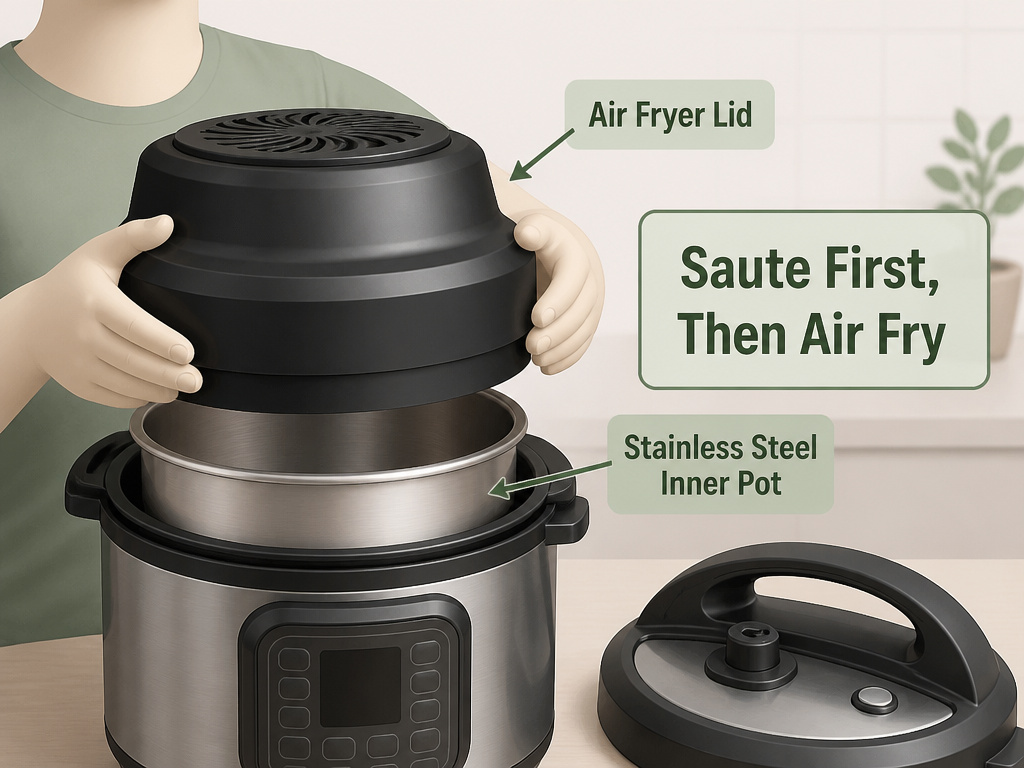
Your Instant Pot is a versatile tool, but it’s not a deep fryer. To achieve crispy, browned, and flavorful results, you have to use its approved functions in sequence.
1. The Sauté Function: Your Browning Tool
This is the key to building flavor. The Sauté function brings the inner pot to a high temperature with the lid off, perfect for searing meat, caramelizing onions, or shallow-frying in a small amount of oil.
How to use it safely:
- Ensure the lid is off and the sealing ring is clean and seated.
- Add a tablespoon or two of oil and let the display read “Hot.”
- Cook your food, stirring frequently. It’s a stovetop-style process.
- Never lock the lid on while sautéing. The function is designed for open-pot cooking.
You can sauté first, then deglaze with broth or water and proceed with pressure cooking. This gives you deep, caramelized flavor without any safety risk.
2. The Air Fryer Lid: The Official Crispy Solution
For the texture closest to pressure frying, you need an Instant Pot with air fryer capabilities. Models like the Instant Pot Duo Crisp or the Instant Pot Pro Crisp come with a dedicated air fryer lid that uses superheated air, not oil, to crisp food.
This is a separate appliance mode. You must fully release all pressure from a previous cook, remove the pressure lid, and attach the air fryer lid. It is convective baking at high heat, which produces remarkably crispy wings, fries, and nuggets.
If you have a standard Instant Pot, you can often purchase an air fryer lid as one of the most useful Instant Pot accessories. It transforms your multi-cooker into a much more versatile station.
3. The “Double Cook” Method: Crispy Pressure-Cooked Meat
For dishes like carnitas or pulled chicken with crispy edges: 1. Season and pressure cook the meat until tender (using water or broth). 2. Carefully remove the meat, shred it, and spread it on a baking sheet. 3. Use your oven’s broiler for 3-5 minutes to crisp the edges.
Remember, a standard Instant Pot has no broiling function. The “Keep Warm” or “Yogurt” settings won’t get hot enough to brown. You need your oven or a separate countertop air fryer for that final crisp.
Pressure Fryer vs. Instant Pot: Why Dedicated Gear Wins
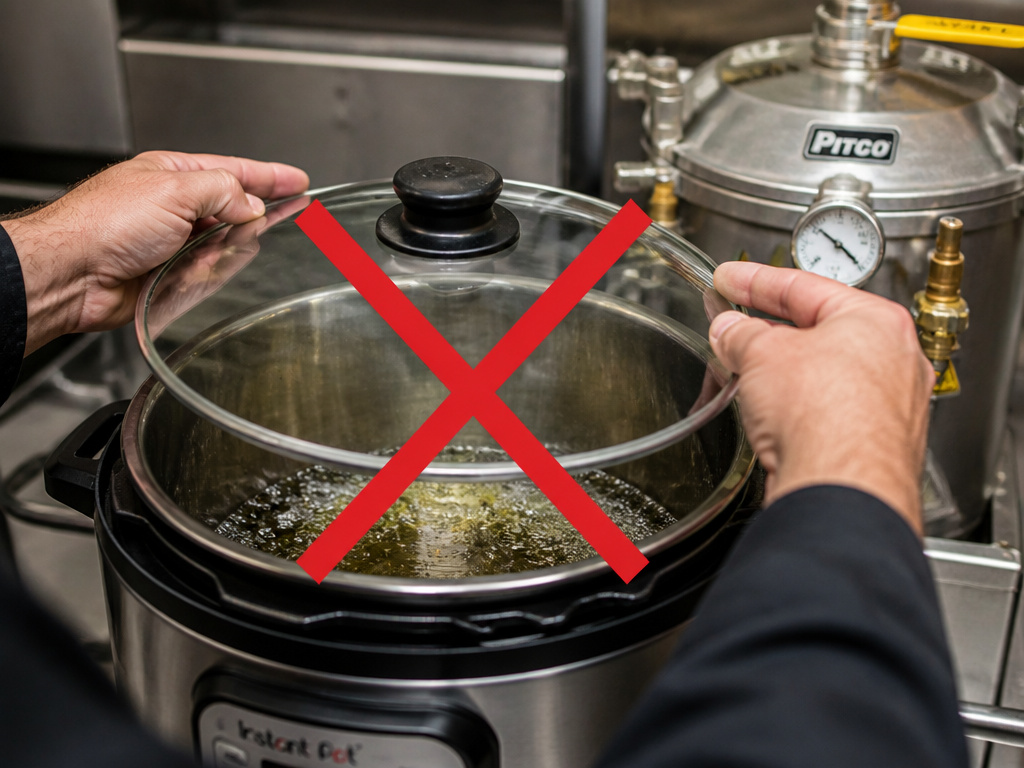
A commercial pressure fryer, like those used for famous fried chicken, is a fundamentally different appliance. It’s built like a heavy-duty tank with specialized safety valves for oil vapor, a powerful filtration system, and a sealing mechanism designed for the specific pressures generated by oil.
Comparing a $100 multifunction pressure cooker to a $1000+ pressure fryer is like comparing a sedan to a dump truck. Both have wheels, but only one is built for the extreme load. This is the core difference between Instant Pot and slow cooker logic, each appliance is optimized for a specific task.
For the home cook wanting that style of food, a dedicated pressure cooker air fryer combo or a high-quality countertop air fryer is a far safer and more effective investment than misusing a tool never meant for the job.
Easy to miss: The manual for the Instant Pot Pro Plus specifies that “Pressure cooking liquids should be water-based, such as broth, stock, soup or juice.” Oil is not water-based. This isn’t a vague guideline; it’s a specification for the physical medium the cooker requires to operate safely.
Your Instant Pot’s Real Job Description
So, what can your Instant Pot do? Almost everything else. It’s a superb pressure cooker for beans and stocks, a slow cooker for braises, a steamer for vegetables, and a yogurt maker. It can sauté, warm, and sterilize. When equipped with the right accessories, its versatility expands further.
The prohibition against pressure frying is a single, clear line in its otherwise broad capabilities. Respecting that line keeps you safe and ensures your appliance lasts for years. For those craving fried food, the solution is to use the Sauté function smartly, invest in an air fryer lid, or use a separate appliance designed for the task.
Bottom line: Your Instant Pot is a kitchen workhorse, but it is not a pressure fryer. The manuals are unequivocal, the physics are unforgiving, and the risks are real. Use it for what it’s brilliant at, and use the right tool for the job when you need truly fried food.
Frequently Asked Questions
Can you deep fry in an Instant Pot on Sauté mode?
You can shallow fry with the lid off using the Sauté function, but you cannot safely deep fry (submerge food in oil). The Sauté function is not designed to maintain the consistent, high-volume oil temperature needed for deep frying, and it’s dangerous to have a large volume of oil heating unattended in an open pot.
What is the difference between pressure frying and pressure cooking?
Pressure cooking uses pressurized steam from water-based liquids to cook food quickly at a higher temperature. Pressure frying submerges food in hot oil inside a sealed, pressurized vessel. The oil doesn’t boil like water; it superheats, creating a different and more hazardous type of pressure that standard pressure cookers are not built to contain.
Will using oil in my Instant Pot ruin it?
Using a small amount of oil for sautéing is fine and intended. Attempting to pressure cook or pressure fry with oil can permanently damage the appliance. It can melt or deform the sealing ring, degrade the inner pot’s coating, clog the anti-block shield with solidified grease, and potentially warp the lid or base due to excessive, uneven heat.
Are there any Instant Pot models that allow pressure frying?
No. No model in the standard Instant Pot line (Duo, Pro, Ultra, etc.) is certified or designed for pressure frying. The warning against it is universal across all manuals. Only dedicated, commercial-grade pressure fryers are built for this task.
What’s the best way to make crispy chicken in an Instant Pot?
For crispy skin, use the Sauté function to brown the chicken pieces with the lid off first. Then, add a small amount of liquid (like broth) and pressure cook to make it tender. Finally, transfer the chicken to a baking sheet and finish under your oven’s broiler or in a separate air fryer for a few minutes to re-crisp the skin.
If pressure frying is so bad, why do people ask about it?
The question arises because pressure frying is a famous method used by some restaurants for incredibly juicy and crispy fried chicken. People naturally wonder if their versatile Instant Pot multicooker can replicate that magic. The answer is a firm no due to engineering and safety limits, not a lack of creativity.
Before You Go
The manual’s warning is your best friend. It protects you, your home, and your appliance. Your Instant Pot is a marvel for turning tough cuts tender, cooking grains perfectly, and making weeknight dinners effortless. Its pressure cooking function is a game-changer.
But its design has hard limits. Oil under pressure is the brightest of those red lines. For crispy cravings, embrace the Sauté button, consider an air fryer lid, or fire up your oven. Don’t gamble with a pot of sealed, superheated oil. Good cooking is about control, and the first rule of control is using the right tool for the job.
