
How Cookware Transfers Iron: The Cast Iron Skillet Science
This post contains affiliate links. As an Amazon Associate, we earn from qualifying purchases.
Yes, you can get iron from a cast iron skillet. Cooking in one transfers iron from the cookware into your food. The amount depends on three things: the food’s acidity, the cooking time and temperature, and the type of iron cookware. Acidic foods like tomato sauce simmered for an hour can see their iron content increase by several milligrams per 100 grams, while a quick fry of an egg adds almost none.
That transfer is a measurable chemical process, not kitchen folklore. The skillet doesn’t just sit there; it reacts. The iron ions move from the metal surface into the food, particularly when that food provides a slightly acidic, wet, and hot environment to pull them loose.
What follows is a breakdown of the peer-reviewed numbers, the conditions that maximize or minimize the transfer, and the real-world debate over whether this actually moves the needle on your health. We’ll look at the studies that found dramatic increases, the ones that found almost none, and the specific mistakes that make the difference.
Key Takeaways
- Acidity is the main driver. Tomato sauce, apple sauce, or wine-based stews pull significantly more iron from the pan than neutral or alkaline foods.
- Time and heat matter. A 60-minute simmer at 97°C can release over 6 mg/L of iron into a citrate buffer, while a 5-minute sear does very little.
- The health impact is contested. Some studies show a meaningful rise in hemoglobin; others, especially in malaria-endemic regions, show no significant change.
- A passivation film can form. Cooking the same pot for over 50 minutes can create a surface layer that actually reduces further iron release.
- It’s a supplemental source, not a primary one. The iron transferred is non-heme iron, which the body absorbs less efficiently than the heme iron from meat.
How Much Iron Actually Transfers?
The numbers from controlled studies give us a concrete range. They are not guesses.
A 1991 study often cited in later reviews found apple sauce cooked in an iron pot contained 6.26 mg of iron per 100 grams, compared to 0.18 mg/100g in a non-iron pot. For spaghetti sauce, the iron content was 2.10 mg/100g in the iron pot versus 0.44 mg/100g in a non-iron pot. The increase for the spaghetti sauce was statistically significant. Another study on pea paste found it contained 21.4 mg of iron per 100 grams when cooked in an iron pot, which was 3.3 times higher than when cooked in clay.
The transfer is quantifiable. In one experiment, iron release from nitrided iron pots into a citrate buffer reached 6.07 mg/L after cooking at 97 °C for 60 minutes. This was 2.13 to 2.30 times higher than the amount released from stainless steel pots under identical conditions.
These figures show the potential. But they also reveal the variability. Meat and vegetable preparations saw iron content double, while legumes increased by only 1.5 times. The food matrix itself changes the equation.
The Acidity Factor: Why Tomato Sauce Beats Scrambled Eggs
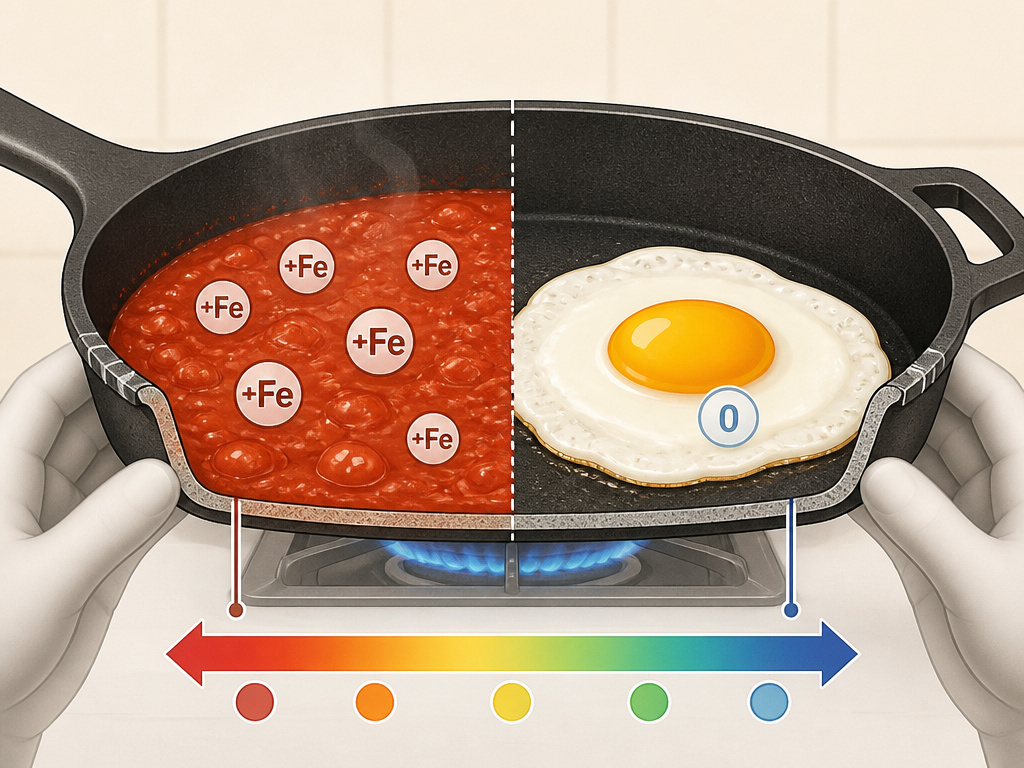
PH is the lever. Iron dissolves more readily in an acidic environment. This is basic chemistry, and it plays out directly in your skillet.
Citric acid, found in tomatoes and citrus, is particularly effective at pulling iron from the metal surface. Research indicates the highest iron release in all tested iron pots occurred in a citrate buffer. Adding citric acid to maize porridge approximately doubled the iron content compared to samples with lactic acid. Your grandmother’s long-simmered Sunday gravy is a perfect iron-transfer vehicle: acidic, liquid, and hot for a long time.
Conversely, cooking neutral or alkaline foods, like searing a steak, frying an egg, or baking cornbread, results in minimal transfer. The environment isn’t aggressive enough to pull significant amounts of iron from the pan. This is why blanket statements about “cooking in cast iron” are useless. You must ask what you are cooking.
Where this goes sideways: Assuming all foods transfer iron equally. Cooking a quick omelet adds a negligible amount. Simmering a rhubarb compote for 45 minutes could increase the iron content by several milligrams per serving.
The implication is practical. If you are specifically interested in the potential dietary iron boost, plan meals that use the skillet for acidic, wet cooking. A quick fry does almost nothing.
Cooking Time, Temperature, and the 50-Minute Wall
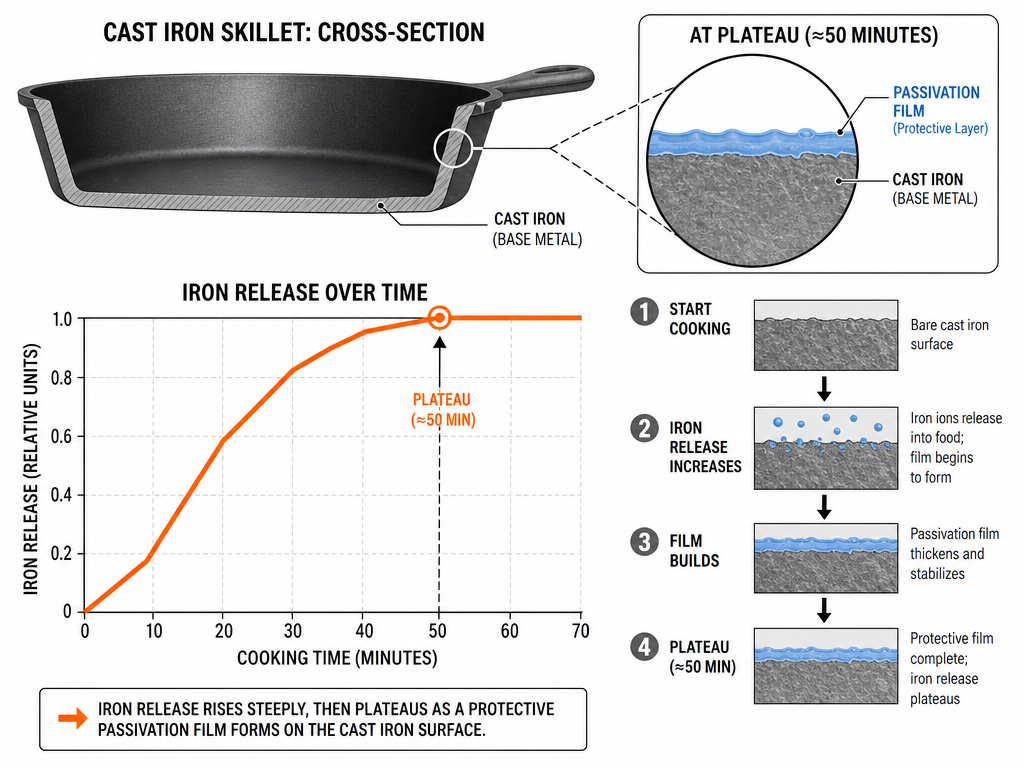
Heat accelerates the reaction, and time allows it to proceed. But the relationship isn’t linear forever.
Kinetic models developed to predict iron release show that longer cooking times at higher temperatures yield more iron in the food. One model calculated that daily iron supplementation from using nitrided iron pots could range from about 10 mg to over 20 mg per day depending on whether food was cooked at 80°C or 100°C for up to two hours. That’s a substantial portion of the recommended daily intake.
However, those same models hit a snag. When cooking time exceeded 50 minutes, the discrepancy between predicted and measured iron release grew. Researchers attribute this to the formation of a passivation film on the pot’s surface, a thin, stable layer that actually inhibits further corrosion and iron release. The pan, in a sense, begins to protect itself during very long cooking sessions.
This creates a non-intuitive curve: more time increases iron transfer, but only up to a point. After that, the rate of addition slows down.
| Cooking Variable | Effect on Iron Transfer | Practical Example |
|---|---|---|
| High Acidity (low pH) | Greatly increases | Tomato sauce, wine-braised dishes |
| Long Time (30+ min) | Increases, then plateaus | Stews, braises, simmered sauces |
| High Temperature | Increases | Boiling vs. Simmering |
| Dry Cooking | Minimal | Searing meat, frying eggs |
| Passivation Film (>50 min) | Reduces further release | All-day simmering |
Does It Actually Improve Your Iron Levels?
This is the contested part. Transferring iron into food is one thing. Getting that iron to raise your hemoglobin levels and reduce iron deficiency anemia is another.
The evidence is mixed. A systematic review noted that several studies reported a significant increase in hemoglobin levels after using iron cookware. One 12-month trial saw an increase of 1.7 g/dL. Another with preschoolers saw anemia prevalence drop from 12.2% to 8.5% after a 16-week intervention where school meals were prepared in iron pots.
Other studies found only slight, non-significant changes. In regions with high malaria prevalence, the hemolysis caused by the parasite can mask any hematological benefit from dietary iron. A study in Cambodia, where baseline iron deficiency was low, found iron ingots did not increase hemoglobin concentrations after 6 or 12 months.
The World Health Organization has identified iron cookware as a potential strategy for alleviating IDA but calls for more action-oriented research. The consensus among experts is that it can contribute as part of a broader strategy but is not a standalone solution, especially for individuals with clinically diagnosed anemia.
The part nobody mentions: The iron transferred from cookware is non-heme iron, the same type found in plants. Its bioavailability is lower than heme iron from meat and is influenced by other dietary components like vitamin C (which enhances absorption) and calcium (which inhibits it).
Cast Iron vs. Other Materials: How It Stacks Up
Not all “iron pots” are the same, and comparing them to other materials is revealing.
Nitrided iron pots (NIPs), common in some regions, are the most studied for kinetic release models. Cast iron behaves similarly. Both release far more iron than stainless steel pots (SSPs). In tests, SSPs released about 2.84 mg/L of iron under conditions where NIPs released over 6 mg/L.
Enameled cast iron is a different story. The glass-like enamel coating completely seals the iron, preventing any transfer. It’s inert. Cooking in a Le Creuset Dutch oven adds no dietary iron. This is a feature, not a defect, it means you can simmer acidic dishes forever without a metallic taste or worrying about damaging the seasoned skillet.
The choice depends on your goal. If you want the potential iron benefit and the classic properties of a cast iron skillet like heat retention, use bare cast iron. If you want zero reactivity for delicate sauces, choose enameled cast iron or stainless steel.
How to Maximize (or Minimize) Iron Transfer
You can control this process. Here’s how.
To Increase Iron Transfer:
- Cook acidic foods. Tomatoes, citrus, vinegar, and wine-based dishes are your best tools.
- Simmer or braise for longer periods. Aim for 30 minutes to an hour to allow the reaction time.
- Use a well-seasoned but not overly built-up pan. A thin, stable polymerized oil coating still allows for transfer, while a thick, carbonized layer may inhibit it slightly.
- Stir occasionally. This exposes fresh food to the metal surface.
To Minimize Iron Transfer:
- Avoid long cooks with acidic ingredients. This is the main rule for foods that are problematic for cast iron.
- Use enameled cast iron or stainless steel for acidic dishes.
- Keep cooking times short. Quick sautés, sears, and fries.
- Maintain a thick, robust seasoning layer. While it won’t block all transfer, a good protective seasoning layer acts as a barrier.
A final, crucial point: never use a damaged pan. If your cast iron rust has been improperly cleaned or the seasoning is flaking, you risk adding iron oxides (rust) to your food, which is not a bioavailable form of iron and can be harmful. Always address rust removal and re-seasoning a skillet before using the pan for cooking.
Frequently Asked Questions
Does cooking in cast iron skillet add iron?
Yes, it does. The process is called leaching, where iron ions migrate from the metal surface into the food. The amount added depends heavily on the acidity of the food and the cooking time.
What foods absorb the most iron from cast iron?
Acidic foods absorb the most. Tomato sauce, apple sauce, and dishes made with vinegar, wine, or citrus juice show the greatest measured increases in iron content after cooking in iron pots.
Is the iron from a cast iron skillet healthy?
The iron transferred is non-heme iron, which is a normal dietary form. For individuals with adequate iron levels, the small amount added is safe and may contribute to daily intake. For those with iron overload disorders (hemochromatosis), it could be a concern, and they may wish to avoid cooking acidic foods in bare cast iron.
Can you get too much iron from cast iron cookware?
It is highly unlikely for most people to reach toxic levels of iron solely from cookware transfer. The body regulates non-heme iron absorption. However, individuals with hemochromatosis should consult their doctor, as their condition impairs this regulation.
Does seasoning stop iron transfer?
Good seasoning process creates a barrier that reduces, but does not completely eliminate, iron transfer. The polymerized oil layer is semi-permeable, especially under prolonged, acidic conditions.
The Bottom Line
Cooking in a cast iron skillet can be a source of dietary iron. The science confirms the transfer, quantifying it in milligrams per 100 grams of food. The boost is most significant when you cook acidic foods for extended periods.
But don’t buy a skillet as an iron supplement. The effect is variable and the impact on actual hemoglobin levels is inconsistent across studies. The real reasons to choose cast iron remain its unmatched heat retention, durability, and natural non-stick surface when properly maintained. Consider the iron a potential bonus, not the primary feature.
If you are iron-deficient, focus on proven strategies first: dietary changes, supplementation as directed by a doctor, and addressing underlying causes. Use your cast iron cookware for what it does best, making great meals, and let any mineral transfer be a secondary benefit.
