
The Induction Cookware Symbol: What It Is & Where to Find It
This post contains affiliate links. As an Amazon Associate, we earn from qualifying purchases.
The symbol for induction cookware is a coiled loop or spring-like icon, often stamped on the bottom of the pan by the manufacturer. On the cooktop itself, a flashing symbol, usually a loop with a line through it or alternating with a power level, means no compatible pan is detected. The pan-bottom symbol is your guarantee; the cooktop symbol is an error message.
That guarantee matters because an induction cooktop doesn’t just heat a pan, it induces a current in it. The physics are non-negotiable. The coiled symbol on your cookware is the manufacturer’s stamp that the metal in the base is ferromagnetic and will couple with that magnetic field.
What follows: the exact symbol from three major appliance manuals, the magnet test that overrules any missing stamp, and the five material rules that decide whether your favorite skillet stays or goes.
Key Takeaways
- The coiled loop or spring symbol on a pan’s bottom is the official mark for induction-ready cookware.
- A flashing loop or alternating symbol on your cooktop’s display is an error, indicating it doesn’t detect compatible cookware.
- The definitive test is the magnet check, if a fridge magnet sticks firmly to the center of the pan’s base, the pan will work.
- Minimum pan size is critical; a pan smaller than the cooking zone’s specified diameter will trigger the error symbol, even if it’s magnetic.
- Irregular, warped, or rounded bottoms prevent proper contact with the glass, leading to inefficient heating and potential error messages.
The Official Induction Symbol
Look at the bottom of your pot or pan. The symbol you’re searching for is not a barcode or a serial number. It’s a pictogram: a series of four or more concentric, progressively smaller loops, resembling a coiled spring or a spiral.
The Electrolux Use & Care Manual states that induction-ready cookware will often have a symbol printed on the bottom by the manufacturer. It specifies that alternating symbols appear on the cooktop display when improper cookware is used, when a pan is missing, or when a pan is removed during cooking.
This distinction is everything. The symbol on the cookware is a permanent certification. The symbol on the cooktop is a temporary error state. Miele’s manual calls this error symbol “No or unsuitable cookware,” and it flashes for three minutes before the zone shuts off entirely.
You won’t find the error symbol on your pans. You’ll find it on the digital display of your induction range, right next to the power level indicator for the problematic zone.
| Symbol Location | What It Looks Like | What It Means |
|---|---|---|
| On Cookware | Coiled spring/loop icon | Manufacturer confirms the pan is made with a ferromagnetic base suitable for induction. |
| On Cooktop Display | Looped symbol flashing alternately with a number or power level | The cooktop does not detect compatible cookware on that zone. |
| On Cooktop Display (Miele Example) | flashing with power level |
No pan, unsuitable pan, or pan too small is detected. |
Not all induction-ready pots carry this stamp. Some manufacturers use text like “induction compatible” or rely on packaging. The absence of a symbol doesn’t mean failure, it means you move to the next verification step.
Why the Magnet Test Is Your Real Answer
The coiled symbol is a promise. A magnet is the proof. This is the core mechanism of how induction works: the cooktop’s coil creates a rapidly alternating magnetic field, which induces eddy currents in any ferrous (iron-containing) metal placed above it.
Grab a standard refrigerator magnet. Place it directly on the center of the pan’s cooking surface, not on the sidewalls or an external clad layer.
- If it sticks with a firm, decisive pull, the cookware is ferromagnetic. It will work on an induction cooktop.
- If it slides off or holds weakly, the base material is not suitable for induction.
This test is cited by experts like Gill Stansfield of Johnson & Wales University and is the basis for the Consumer Reports induction compatibility guide. It cuts through marketing and missing symbols.
Common mistake: Testing only the very edge of the pan’s bottom. Some multi-ply cookware has a magnetic stainless steel outer layer only in the center, with a non-magnetic aluminum or copper core. The magnet must stick to the primary cooking surface.
This is why some high-end copper cookware works, it has a magnetic stainless steel plate bonded to the bottom. The same goes for many aluminum non-stick pans. The magnet test reveals the truth the symbol can only suggest.
Materials That Work (and Why)
Induction compatibility is a material science question, not a branding one. Your cookware must contain enough iron to respond to the magnetic field.
Cast Iron and Carbon Steel: These are the gold standard. They are highly ferromagnetic, have excellent heat retention, and work flawlessly. Their naturally rough texture can scratch glass cooktops if dragged.
Magnetic Stainless Steel: Not all stainless steel is created equal. Austenitic grades (like common 304) are non-magnetic. Ferritic or martensitic grades (like 430) are magnetic. Your magnet test instantly tells you if your stainless steel cookware is the right type.
Enameled Steel: The underlying steel is magnetic, so the porcelain enamel coating doesn’t interfere. These are excellent, induction-ready cookware options.
Multi-Ply Clad Cookware: Most high-quality clad pans (like All-Clad D3) use a magnetic stainless steel as the outer layer, making them compatible. Always verify with the magnet.
Materials That Fail (and the Exceptions)
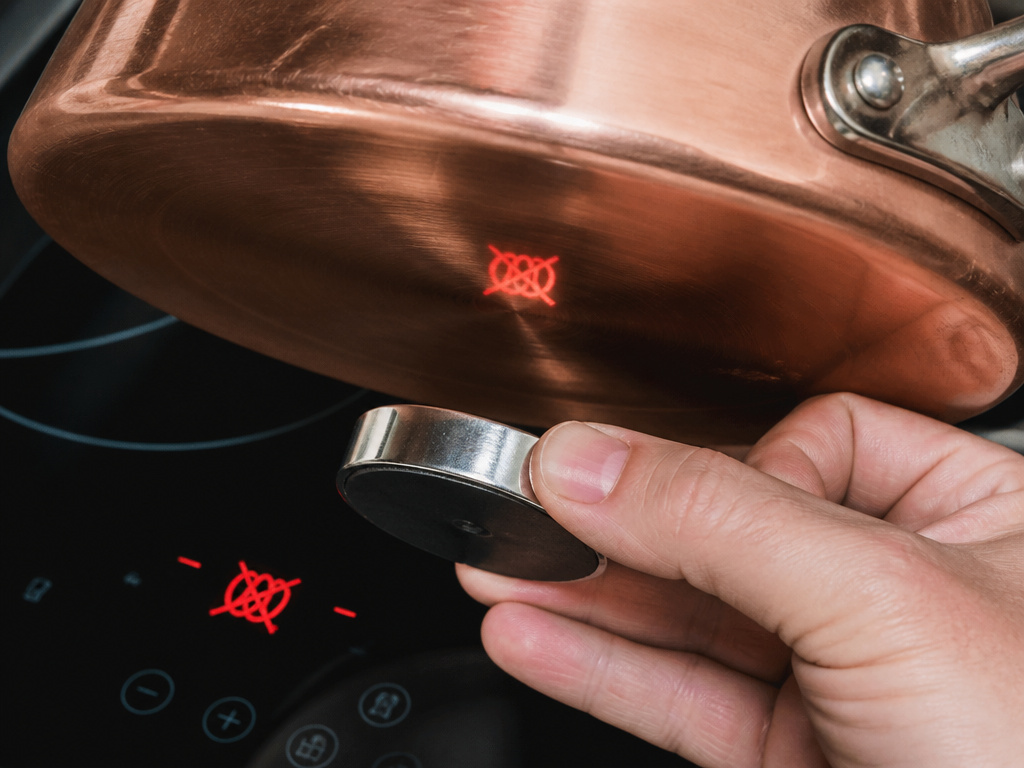
Some materials simply cannot carry the induced current required for induction cooking principles. The cooktop will flash its error symbol because, physically, there’s nothing to heat.
- Pure Aluminum: Non-magnetic. A standard aluminum pot will not work.
- Pure Copper: Non-magnetic. Traditional copper pans will not work.
- Glass, Ceramic, Earthenware: Non-conductive. These include glass cookware like Pyrex and most stoneware.
- Non-Magnetic Stainless Steel: If the magnet doesn’t stick, it’s the wrong alloy.
The exception is when these materials are hybridized. An aluminum pan with a thick, magnetic stainless steel disk laminated to its bottom will work. A copper pan with a ferrous base plate will work. The magnet test identifies these hybrids.
Why Pans Get Rejected (Beyond Material)
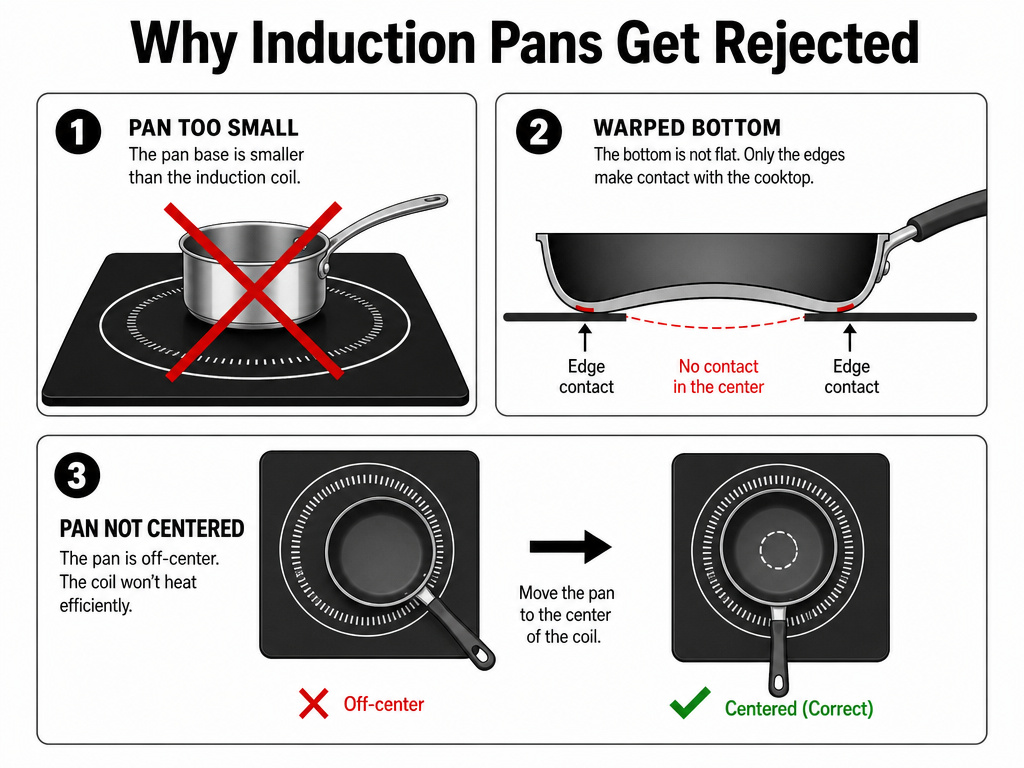
Your pan is magnetic, but the cooktop still blinks the error symbol. This usually breaks down to one of three physical mismatches.
1. The Pan Is Too Small. Every induction cooking zone has a minimum pan diameter. The Miele manual specifies zones requiring pans between 4–11 inches. Place a small 6-inch saucepan on a large 11-inch zone, and the sensor ring can’t detect enough metal to engage safely. It flashes the error.
2. The Bottom Is Warped or Irregular. The Electrolux manual warns that “use of cookware with an irregular bottom could affect the efficiency of the heating system and even prevent the pan from being detected.” A warped skillet makes partial contact, confusing the sensor.
3. The Pan Isn’t Centered. The magnetic field is strongest in the center of the coil. Place a pan off-center, and the coupling is weak. The cooktop may detect it intermittently, causing the power to pulse or the error light to flicker.
Where this goes sideways: Using an “induction adapter plate”, a metal disk you place under non-compatible cookware. Miele’s manual explicitly warns these can damage or destroy the induction generators. Don’t use them.
Choosing and Testing Your Cookware
You don’t need to buy all new pots. Start with an audit of your kitchen.
- Gather your most-used pans.
- Perform the magnet test on each one. Sort into “works” and “doesn’t work” piles.
- Check the bottoms of the “works” pile for warping. Spin them on a flat countertop.
- Measure their base diameters. Compare them to your cooktop’s zone sizes (check your manual).
- Fill any gaps with purpose-built induction compatible pieces.
When shopping for new cookware for induction cooktops, the magnet is your best tool. Take one to the store. If the pan is boxed, look for the coiled symbol or “induction” text on the label. For a lasting set, consider our picks for the best pans for induction, which are selected for flatness, magnetic response, and durability.
Frequently Asked Questions
Is the induction symbol the same on all cookware?
The core design, a coiled loop, is generally consistent, but stylization varies by brand. Some may use a simpler spiral, others a more detailed spring. Text like “induction” or “induction ready” may accompany it. The magnet test is the universal decoder.
Can I use my old pots on an induction cooktop?
You can if they pass the magnet test. Many older cast iron and some stainless steel pots are perfectly compatible. The technology requires magnetic material, not a modern patent.
Why does my induction cooktop beep and show a symbol when I put a pan on it?
This is usually a pan detection error. The most likely causes are: the pan is not made of a magnetic material (fails the magnet test), the pan’s base diameter is smaller than the zone’s minimum, or the pan is not centered on the zone. Refer to your cooktop’s “troubleshooting” section.
Does the symbol mean the cookware is high quality?
No. The symbol only certifies that the base material is ferromagnetic and will work with induction. It says nothing about the pan’s even heating, handle durability, lid fit, or non-stick performance. A pan can bear the symbol and still be poorly made.
What if my cookware has no symbol but the magnet sticks?
Your cookware is induction compatible. The manufacturer may have certified it on the packaging instead of stamping each piece. The physical magnet test overrides the absence of a symbol.
The Bottom Line
The coiled symbol on your pan is a useful shortcut, but a ten-cent magnet is the final authority. Induction cooking operates on a clear physical principle: magnetic fields induce heat in iron. If your pan contains enough iron to hold a magnet, it contains enough to get hot. Focus on flat, centered pans that meet your cooktop’s size minimums. That combination, verified by a magnet, guarantees you’ll never see that flashing error symbol again.
