
What Is the Safest Nonstick Cookware? Your Guide to Safe Use
This post contains affiliate links. As an Amazon Associate, we earn from qualifying purchases.
The safest nonstick cookware uses a PTFE-free ceramic coating from a brand that verifies its PFAS-free status through independent testing, like Green Pan or Our Place. For PTFE-based nonstick, safety is entirely about temperature control, never heating an empty pan past 260°C (500°F) and avoiding the polymer’s decomposition point of 360°C (680°F) where hazardous gases form.
That temperature threshold is the physical limit where the most common nonstick polymer breaks down. The German Federal Institute for Risk Assessment (BfR) set that line in a July 2025 update, and it reframes the entire safety conversation from vague warnings to a measurable, avoidable event.
What follows is a breakdown of that 360°C limit, the lab tests that revealed “PFOA-free” labels as unreliable, and the specific migration standards that separate marketing from verified safety. By the end, you’ll be able to read any nonstick pan’s spec sheet and know exactly what risks you’re accepting, or avoiding.
Key Takeaways
- PTFE (standard nonstick) decomposes at 360°C (680°F), releasing hazardous gases. Safety means never letting an empty pan reach that point.
- “PFOA-free” labels on PTFE pans are not reliable. Consumer Reports testing found PFOA and other PFAS in a PTFE pan with that claim.
- Verified PTFE-free ceramic coatings (like those from Green Pan) showed no detectable PFAS in the same tests.
- The BfR’s Specific Migration Limits, including a total fluorine limit of 0.05 mg/dm², are the regulatory benchmarks for coating safety.
- No coating is permanent. Plan for eventual wear and have a replacement strategy that considers environmental disposal challenges.
The 360°C PTFE Decomposition Temperature (And Why It Matters)
The safety of traditional nonstick cookware hinges on a single number: 360 degrees Celsius (680°F). This is the specific temperature at which the polytetrafluoroethylene (PTFE) polymer, the basis of coatings like Teflon, begins to decompose measurably.
PTFE polymer decomposition occurs at around 360 °C and above, releasing hazardous gases without visible smoke. Overheating to temperatures higher than 360 °C can lead to the formation and release of invisible gases which may be hazardous to health. . German Federal Institute for Risk Assessment (BfR), FAQ issued 2 July 2025
This changes how you use a pan. The risk isn’t cooking food; it’s preheating an empty pan, especially on high-output burners like induction or gas. An empty pan can hit 360°C in under three minutes on a powerful stove. Once there, the coating breaks down chemically, not just visually. You won’t always see smoke.
The presence of food or liquid acts as a heat sink. Water caps temperature at 100°C until it boils off. Cooking oil smokes between 110°C and 270°C, giving you a clear visual and olfactory warning long before the 360°C danger zone. The rule is simple: never heat a PTFE-coated pan empty. Always have at least a film of oil or your ingredients ready to go in.
How Different Stoves Affect Overheating Risk
Your stove type dictates your margin for error. Induction cooktops deliver intense, direct heat to the pan’s base incredibly fast. A pan left empty on high induction can reach critical temperature before you realize it. Gas flames can lick up the sides of a pan, heating areas not in contact with food. Electric coil and radiant elements heat more slowly and evenly, giving you more time to react.
The BfR explicitly calls out induction and gas stoves for requiring “particular care.” If you use these, consider them a reason to lower your burner setting when preheating a nonstick pan. Medium heat is almost always sufficient.
Ceramic vs. PTFE: The Lab Test Results That Rewrote the Rules
For years, “PFOA-free” was the gold standard for nonstick safety. That changed when Consumer Reports tested pans from three brands in 2024. Their investigation revealed a gap between label claims and lab reality that should make any buyer skeptical.
They tested a Swiss Diamond pan (PTFE-coated, marketed as PFOA-free), an Our Place Always Pan (ceramic-coated, PTFE-free), and a Red Copper pan (ceramic-coated, PTFE-free). The results were stark. The ceramic pans from Our Place and Red Copper showed no detectable levels of any of the 96 PFAS chemicals tested. The PTFE-coated Swiss Diamond pan tested positive for PFOA and 15 other PFAS compounds.
The manufacturer contested the findings, but Consumer Reports stood by its methodology. More importantly, they acted on the data: they removed the “PFOA-free” designation from their ratings for all PTFE-coated cookware. Their chemists concluded that PFOA can appear as a manufacturing byproduct even when not intentionally added.
Because CR’s tests and research show that even products made without PFOA may contain the compound because of how they’re manufactured, we have decided to no longer display “PFOA-free” in our ratings of nonstick cookware. Such claims may not be reliable for PTFE-coated products. . Consumer Reports non-toxic cookware investigation
This doesn’t mean all PTFE pans are equally contaminated. It means the “PFOA-free” label on a PTFE pan is not a guarantee of being PFAS-free. If avoiding this chemical family is your goal, the only verified path in the test was to choose a PTFE-free ceramic coating.
The Performance Trade-Off: Is Ceramic as Good?
The same Consumer Reports testing found performance was nearly identical. Ceramic and PTFE pans were “neck-and-neck” in tests for cooking evenness and food release. The only measurable difference was in a durability abrasion test, where some ceramic pans scored Excellent, but many PTFE pans also scored that high. For everyday cooking, a quality ceramic pan like a Green Pan performs the core nonstick function without the PFAS ambiguity.
The Regulatory Benchmarks: BfR Specific Migration Limits
Beyond marketing claims, there are actual regulatory standards for what can migrate from a coating into food. The BfR’s “Recommendation LI” for temperature-resistant polymer coatings sets strict, measurable limits. These are the rules manufacturers aiming for the European market must follow.
For a coating to be deemed safe, the amount of specific substances that transfer to food simulants under standardized test conditions must not exceed these limits:
| Substance | Migration Limit (max) | What It Means |
|---|---|---|
| Total Fluorine | 0.05 mg/dm² | Caps all fluorine-containing compounds, including PFAS precursors. |
| Phenolic Substances | 0.05 mg/dm² | Limits compounds like bisphenols, which can be endocrine disruptors. |
| Primary Aromatic Amines | Not detectable | Banned from detection; some are known carcinogens. |
| Formaldehyde | Complies with EU 10/2011 | Must meet strict plastic regulation limits for this irritant and carcinogen. |
These are not “guidelines.” They are pass/fail criteria for safety certification. A pan meeting the BfR’s Recommendation LI has proven through lab testing that its coating does not leach harmful quantities of these substances. When you see a brand referencing compliance with German or European safety standards, this is the technical backbone they’re talking about.
Most reputable brands design to these standards, but they are not always prominently advertised. This standard is a more reliable signal of safety than a “green” or “non-toxic” badge on the box. This is the kind of verified safety data you should look for when evaluating safe nonstick cookware.
Choosing Your Nonstick Type: A Decision Matrix

Your choice depends on your priorities: absolute chemical avoidance, maximum durability, or budget-friendly convenience. Each type has a clear best-use case.
| Nonstick Type | Best For | Key Safety Consideration | Lifespan Expectancy |
|---|---|---|---|
| PTFE-Based (e.g., Teflon) | Occasional, low-to-medium heat cooking (eggs, fish). | Temperature management is everything. Never heat empty. Discard if scratched or flaking. | 2-5 years with careful use. |
| Ceramic-Coated (PTFE-Free) | Daily drivers for buyers wanting to avoid PFAS. | Verify PFAS-free claims with third-party testing (e.g., Green Pan). Can be less abrasion-resistant. | 3-5 years; can chip if dropped. |
| Reinforced Ceramic or PEEK | High-heat searing and oven use. | Check manufacturer’s max oven-safe rating. PEEK is a high-performance plastic used in some premium lines. | 5+ years; more durable base. |
| Seasoned Cast Iron or Carbon Steel | The ultimate chemical-free, permanent nonstick. | Safety revolves proper cast iron safety and maintenance to prevent rust. | Lifetime, with upkeep. |
If your primary goal is to eliminate PFAS exposure from your cookware, the decision is straightforward. Choose a ceramic-coated pan from a brand that publishes independent verification, like Green Pan. Their ceramic nonstick products are a direct answer to that need.
If you are comfortable with the temperature discipline required for PTFE and want a proven, inexpensive performer, many classic brands work fine. Just ignore the “PFOA-free” marketing and focus on the 360°C rule. For the highest heat and longevity without a synthetic coating, the learning curve of cast iron cookware safety is worth the investment.
The Long-Term View: Wear, Disposal, and Real Sustainability
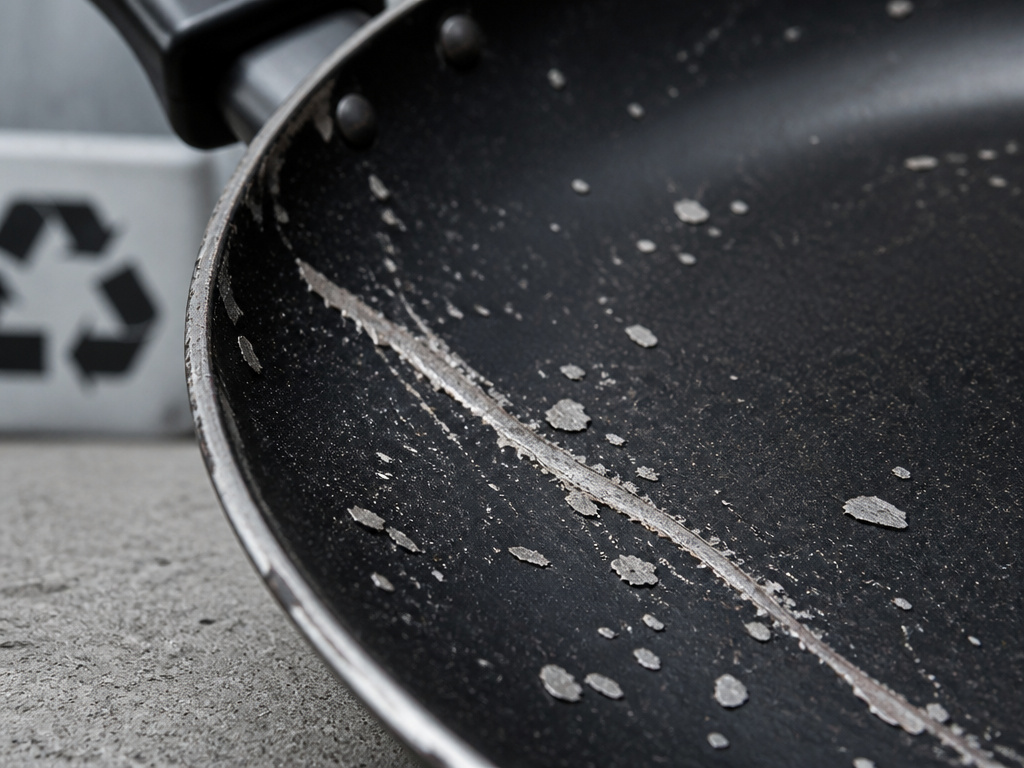
No nonstick coating lasts forever. Even ceramic coatings eventually lose their slickness. Planning for the end of a pan’s life is part of a truly safe kitchen.
Scratches are the main failure mode. Using metal utensils or abrasive scouring pads will accelerate wear dramatically. Once the coating is gouged, it’s time to retire the pan. Cooking on a damaged surface is ineffective, and it may increase the potential for coating particles to enter food. While the BfR notes no illness cases from household use of PTFE, a flaking pan is a sign it’s no longer fit for purpose.
Where this goes sideways: Assuming a scratched pan is just “well-loved.” Deep scratches compromise the coating’s integrity, creating spots where food burns and cleaning becomes difficult. Performance degrades long before you see bare metal.
Disposal is the industry’s dirty secret. Most nonstick cookware, ceramic or PTFE, ends up in a landfill. The PFAS chemicals in the coating do not break down. Some municipal recycling programs accept metal cookware, but the coating must be removed first, an industrial process not available to consumers. The FoodPrint nonstick cookware guide highlights this as a major environmental hurdle.
This reality makes durability a sustainability metric. A pan that lasts five years creates less waste than one replaced every two. It also argues for investing in permanent alternatives like stainless steel cookware safety or cast iron for most tasks, reserving nonstick for the few jobs where it’s essential.
Frequently Asked Questions
Is Teflon still dangerous?
Teflon (PTFE) itself is not considered dangerous when used correctly. The danger arises from overheating it past 360°C, where it decomposes into hazardous gases. The PFOA formerly used in its manufacture has been phased out, but other PFAS compounds may still be present. Safe use requires never heating an empty pan.
What is the healthiest nonstick pan to use?
The healthiest nonstick pan uses a PTFE-free ceramic coating that has been independently verified as PFAS-free, such as those from Green Pan. This eliminates the PFAS exposure risk entirely. For a non-coated option, well-seasoned cast iron or carbon steel provides a natural, chemical-free nonstick surface.
When should you throw away nonstick pans?
Throw away nonstick pans when the coating is visibly scratched, flaking, or peeling. Significant scratches harbor food and bacteria and can allow coating particles to mix with food. Also discard any pan that has been severely overheated, indicated by discoloration (brown or blue spots) or a warped base.
Does ceramic cookware have PFAS?
High-quality ceramic cookware that is explicitly marketed as “PTFE-free” and “PFAS-free” should not contain PFAS. However, “ceramic” can sometimes refer to a silica-based coating over a PFAS-containing base. The only way to be sure is to choose brands like Green Pan that provide third-party testing verification, as cited in resources like the Cookware & Bakeware Association PFAS guide.
Can you use nonstick cookware in the oven?
It depends on the manufacturer’s rating. Many PTFE and ceramic-coated pans are oven-safe up to 260°C (500°F), but you must check the specific pan’s handle and coating rating. Avoid using the broiler (direct top heat) and never put a nonstick pan in a self-cleaning oven, as those cycles far exceed safe temperatures.
The Bottom Line
The safest nonstick cookware is defined by two proven paths. For a synthetic coating, choose a PTFE-free ceramic option from a brand that verifies its PFAS-free status with published testing.Green Pan is the benchmark here. If you opt for traditional PTFE nonstick, your safety protocol is non-negotiable: control temperature, never preheat empty, and replace the pan at the first sign of deep scratches.
The 360°C decomposition point and the unreliable “PFOA-free” label are the facts that matter. Everything else is marketing. Your safest long-term investment might not be a nonstick pan at all, but a set of durable stainless steel cookware sets or a cast iron skillet you learn to season. Reserve the nonstick for eggs and fish, and you’ll minimize risk while keeping cooking simple.
