
What Is a Medium Saucepan | The 3-Quart Rule & Why It Fails
This post contains affiliate links. As an Amazon Associate, we earn from qualifying purchases.
A medium saucepan is a long-handled pot with a capacity of 2 to 3 quarts, sides 3.5 to 4.5 inches high, and a top opening 6.5 to 7.5 inches in diameter. It’s the default size for recipes that say “medium saucepan” and the workhorse for tasks from boiling pasta to reducing sauces.
That definition is correct, but it’s also incomplete. The label “medium” is relative, not absolute. In a cookware set, a “medium” might be 4 quarts. On an induction cooktop, the printed top diameter tells you nothing about the base that actually contacts the heat. And the expensive, fully-clad pans everyone recommends have a hidden flaw that dishwashers exploit in a matter of months.
This guide cuts past the volume number. We’ll map the physical dimensions that matter, explain why construction decides your pan’s lifespan, and name the specific models that get the details right.
Key Takeaways
- Recipes mean 2–3 quarts. When a recipe writer says “medium saucepan,” they are picturing a 2 or 3-quart pot. A 4-quart pan from a set will throw off cooking times for sauces and grains.
- Measure the base, not the top. The diameter printed on the box is for the top opening. For even heating on any stovetop, especially induction, the base diameter must match your burner’s size.
- Dishwashers destroy clad rims. Fully-clad pans like the All-Clad D5 have exposed core material at the rim. Dishwasher detergent erodes it, creating sharp edges and compromising the pan within a year.
- Weight predicts performance. A good medium saucepan weighs 3 to 4 pounds empty. Lighter pans warp and develop hot spots; they’re disposable.
- 3-quart is the universal default. If you own one saucepan, make it a 3-quart model. It handles everything a 2-quart can but also boils pasta for two and makes soup.
The Standard Answer (and Where It Falls Short)
Most guides will tell you a medium saucepan holds 2 to 3 quarts. Some stretch it to 4.5 quarts. That’s the commodity answer, true, but not useful enough to pick a pan.
The functional definition comes from recipe writing. After 17 years of editing cookbooks, Peggy Paul Casella quantified it: a long-handled, 2 to 3-quart pot with sides that are 3½ to 4½ inches high and a top opening that’s 6½ to 7½ inches in diameter.
The generally agreed-upon capacity for medium saucepans is 2 to 3 quarts. So, when I use the term “medium saucepan” in my own recipes… I mean a long-handled, 2 to 3-quart pot with sides that are 3½ to 4½ inches high and a top opening that’s 6½ to 7½ inches in diameter.
That specificity matters. A pan with those proportions creates an ideal environment for reduction. The tall sides contain splatter and slow evaporation, while the narrow base concentrates heat directly under your sauce. A wider pan with the same 3-quart capacity would spread your liquid thin, causing it to reduce too quickly and likely burn at the edges.
Where the standard answer fails: It assumes all 3-quart saucepans are created equal. They are not. The more critical specifications are the ones recipe writers don’t list: base diameter, weight, and rim construction. These are the factors that determine whether your “medium saucepan” performs for a season or a lifetime.
The Three Dimensions That Actually Matter
Forget quarts for a minute. When you’re cooking, three physical dimensions dictate success: height, top diameter, and base diameter.
Height: 3.5 to 4.5 Inches
This range is the sweet spot. It’s tall enough to prevent boil-overs when cooking pasta or grains, yet shallow enough that a standard whisk can reach the bottom corners for emulsifying a hollandaise. A pan shorter than 3.5 inches becomes a saucier, great for stirring, terrible for containing a rolling boil.
Top Diameter: 6.5 to 7.5 Inches
This is the number often stamped on the pan’s bottom. It determines how much surface area is exposed to the air, which controls reduction speed. A 6.5-inch top is perfect for slowly reducing a pan sauce without risk. A 7.5-inch top is better for tasks like boiling eggs or steaming vegetables, where you want faster evaporation. Most 3-quart pans land around 7 inches.
Base Diameter: The Hidden Spec
This is the most important measurement, and it’s almost never on the box. The base is the part that contacts the heat source. For even cooking and energy efficiency, the base should match the diameter of your stovetop burner or induction element.
If you want to use your saucepan on an induction cooktop, choose one with a base stated to be induction suitable… The measurement printed on packaging is usually for the top opening, not the base.
A mismatch causes two problems. First, if the base is smaller than the burner, the outer ring of the burner heats empty air, wasting energy. Second, if the base is larger, the edges of the pan hang over the heat source, staying cooler than the center. This creates a hot spot right in the middle where your sauce will scorch while the periphery barely simmers.
The fix: Before you buy, check the manufacturer’s spec sheet for the actual base diameter. Don’t guess from the top measurement.
| Dimension | Ideal Range | Why It Matters | Consequence of Mismatch |
|---|---|---|---|
| Height | 3.5 – 4.5 inches | Contains boils, allows whisk access | Too short: boil-overs. Too tall: awkward to stir. |
| Top Diameter | 6.5 – 7.5 inches | Controls reduction rate & portion size | Too wide: sauces reduce too fast. Too narrow: limits portion size. |
| Base Diameter | Should match burner size | Ensures even heating, energy efficiency | Smaller than burner: wastes energy. Larger than burner: creates scorching hot spot. |
The Construction Trap: Why “Fully Clad” Isn’t a Free Pass
The best saucepans are fully clad, meaning the conductive core (usually aluminum) runs through the entire body, base to rim. This gives you even heating up the sides, which is crucial for sauces that climb the wall of the pan. Tri-ply (three layers) and 5-ply are the common constructions.
But there’s a trap. To create the smooth, rounded rim on these pans, the outer stainless steel layer is folded over the core. At that folded edge, the aluminum core is exposed. It’s a microscopic seam, but it’s a fatal flaw.
Dishwasher detergent is highly alkaline. Over time, it reacts with that exposed aluminum, causing it to corrode. The corrosion breaks down the bond between the metal layers.
The edge of the rounded lip at the top of the pan is exposed, which means the core can deteriorate over time in the dishwasher (something we’ve experienced first hand with All-Clad cookware).
This isn’t theoretical. Reviewers of the All-Clad D5 and the Tramontina Steel Tri-Ply Clad have documented the core deteriorating after just a few months of dishwasher use. The rim develops a rough, sharp edge. Eventually, the layers can separate, ruining the pan’s heat distribution and making it unsafe.
The manufacturer’s advice is telling. All-Clad’s manual doesn’t say “not dishwasher-safe.” It recommends hand-washing “to keep your All-Clad looking brand new.” That’s code. If you want your investment to last decades, you hand-wash it. Every time.
This turns the common “dishwasher-safe” marketing claim on its head. A pan can be technically dishwasher-safe (won’t melt or discolor immediately) but not dishwasher-durable. For clad cookware, the two are mutually exclusive.
How to Choose Your Medium Saucepan
You need to match the pan to your kitchen’s reality. Your stove, your cleaning habits, and your typical recipes decide the winner.
For Induction Cooktops: Mind the Base
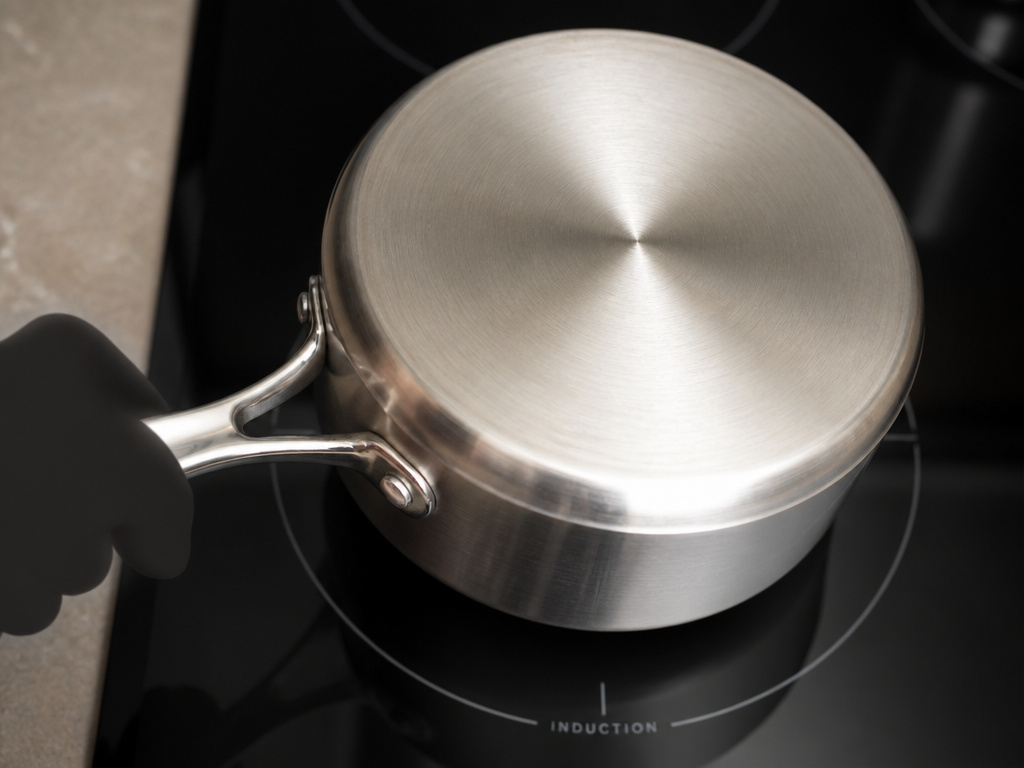
Your primary filter is the base. Look for a pan marketed specifically for induction with a full, magnetic base. Don’t assume. Check that the base diameter matches your most-used burner. Brands like Demeyere are excellent here, as they often publish detailed base specs. A mismatched base will be a constant source of frustration and uneven meals.
For Gas & Electric Cooktops: Prioritize Weight and Cladding
You have more flexibility. Focus on heft. A good saucepan should feel substantial, 3 to 4 pounds empty is a reliable indicator of quality. This weight usually comes from thicker-gauge metal (16-20 gauge is standard for professional pans). Thicker metal resists warping and distributes heat evenly, preventing the hot spots that scorch delicate custards.
For the Dishwasher-Dependent: Choose a Single-Ply or Disc-Bottom Pan
If hand-washing is a non-starter, you must avoid fully-clad pans with exposed rims. Instead, look for two options: 1. Single-ply stainless steel: A pan made from a single piece of magnetic stainless steel has no layers to separate. It won’t heat as evenly as a clad pan, but it’s indestructible in the dishwasher. 2. Disc-bottom construction: These pans have a thick aluminum disk bonded only to the base. The sides are single-ply stainless. Since the rim is solid stainless with no core, it survives dishwasher cycles. Just know that heat distribution won’t be as good up the sides.
This is the trade-off. Convenience costs you some performance. You can’t have the perfect even heating of a clad pan and the durability of dishwasher cleaning. Pick one.
The Universal Recommendation: A 3-Quart, Fully-Clad Pan
If you cook most nights and are willing to hand-wash one pot, the answer is straightforward. Get a 3-quart, fully-clad saucepan. It’s the most versatile size, bridging the gap between small tasks and cooking for two.
The All-Clad D5 3-Quart is the benchmark for a reason. Its 5-ply construction heats supremely evenly, and its helper handle provides stability when pouring. Just hand-wash it. For a slightly more affordable entry into clad performance, the All-Clad D3 3-Quart offers nearly identical results with 3-ply construction. The performance difference in everyday cooking is negligible.
For a budget-friendly clad option that still demands hand-washing, the Tramontina Tri-Ply Clad series is a strong contender. Whichever you choose, that 3-quart capacity is the workhorse size. It does the job of a small saucepan when you need it to, and it prevents you from constantly overfilling a large saucepan.
Frequently Asked Questions
Is a 2-quart or 3-quart saucepan better?
3-quart saucepan is almost always better. It can do everything a 2-quart pan can do, melt butter, heat soup for one, make oatmeal, but it also boils pasta for two, makes a batch of rice, and simmers a decent amount of chili. The 2-quart size is limiting. The 3-quart is the true single-pan default.
What is the difference between a saucepan and a pot?
It’s about proportions and handles. A saucepan has one long handle and taller, straighter sides relative to its diameter, designed for liquid-based tasks and precise heating. A pot (or stockpot) has two loop handles, a wider base, and is designed for large volumes, like boiling pasta for a crowd or making stock. The line blurs, but the saucepan vs pot distinction is useful when following recipes.
Can I use a medium saucepan on an induction cooktop?
Yes, but you must check that the base is made of a magnetic-grade stainless steel (ferrous metal). Simply test it with a fridge magnet. If the magnet sticks strongly to the center of the base, it’s induction-compatible. Remember, the base diameter matching your burner size is critical for induction performance.
Why did my expensive saucepan get a sharp rim?
You almost certainly put it in the dishwasher. The alkaline detergent corrodes the exposed aluminum core at the rim of fully-clad pans like All-Clad or Tramontina. This deterioration creates a rough, sharp edge and can eventually delaminate the pan. The only fix is prevention: hand-wash clad cookware.
What are the most common uses for a saucepan?
Its core function is managing liquids. That includes boiling water for eggs, pasta, or grains; simmering soups and stews; reducing pan sauces, glazes, and syrups; steaming vegetables with a basket insert; and preparing delicate emulsions like hollandaise. Its tall sides make it the designated pot for anything that might splatter or needs controlled evaporation.
Before You Go
A medium saucepan isn’t defined by its quarts. It’s defined by a set of dimensions, roughly 3 quarts, 4 inches tall, 7 inches across the top, that recipe writers rely on. Your job is to find a pan that fits those specs and is built for your kitchen.
Ignore the top-diameter number on the box and find the base diameter. Feel the weight; a light pan is a temporary pan. And if you invest in a beautiful clad piece, commit to washing it by hand. That’s the price of decades of even heat.
Start with a single 3-quart clad saucepan. Learn its quirks. Once you know how a proper one performs, you’ll understand what to look for in other types of saucepans and saucepan sets. It’s the foundation piece. Get it right, and everything else you cook gets easier.
