
9 Best Carbon Nonstick Pans 2026
This post contains affiliate links. As an Amazon Associate, we earn from qualifying purchases.
The Misen 12″ Carbon Nonstick Skillet is the best overall for its exceptional heat performance and durability, while the OXO Obsidian 10″ Carbon Pan is a solid budget-friendly pick that’s ready to use right out of the box. For those who want extra depth for one-pan meals, the Misen Deeper 10″ Carbon Skillet offers added versatility without sacrificing performance.
Most home cooks want a pan that’s reliable, easy to clean, and tough enough to handle daily use without flaking or warping. Carbon nonstick pans promise that durability without the chemical coatings found in traditional nonstick cookware, but not all deliver equally.
Based on specs, owner feedback, and years of evaluating cookware, I focused on performance, build quality, and real-world usability to find the ones worth your counter space. These picks balance heat control, longevity, and value, so you can cook confidently, whether you’re searing steaks or frying eggs.
Top 9 Carbon Nonstick Pans in the Market
The Best Carbon Nonstick Pans, Reviewed
Misen 12″ Carbon Nonstick Skillet

Strengths
- Large 12″ surface
- Aluminum core
- 1100°F oven safe
Trade-offs
- Heavy
- High price
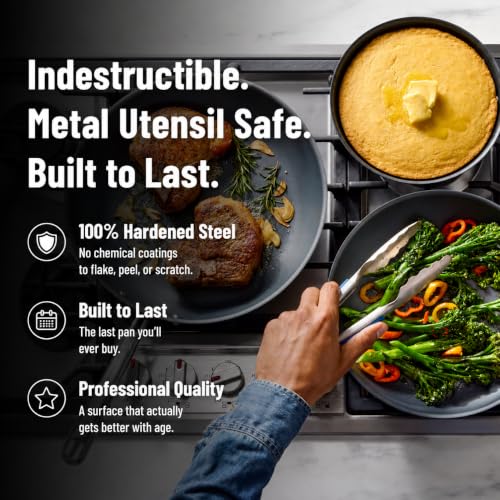
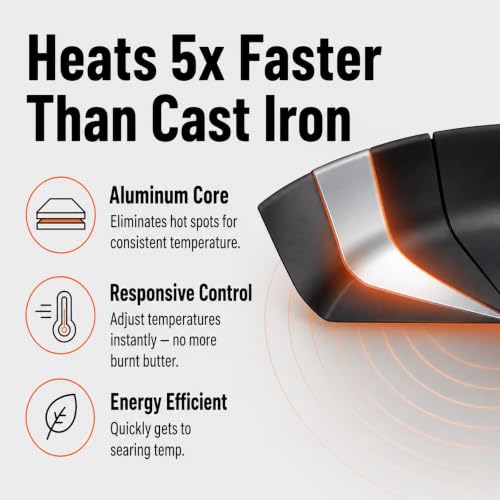
This 12-inch Misen pan is what I’d call the most complete all-around carbon nonstick skillet in the lineup. It combines the nitrided steel, aluminum core, and 1100°F heat rating into a spacious, durable design that handles everything from searing steaks to frying eggs. Owners consistently praise its even heating and long-term durability, especially compared to traditional nonstick that flakes.
It’s expensive, yes, but when you consider it’s meant to last decades, the value shifts. Compared to the Merten & Storck, it’s far more refined, better heat control, better build, better finish. If you’re replacing a whole set, this is the one to start with.
Video review
Misen 8″ Carbon Nonstick Skillet

Strengths
- Aluminum core
- Nitrided surface
- 1100°F oven safe
Trade-offs
- Small cooking area
- Expensive for size
The 8-inch Misen nitrided carbon steel skillet is a precision tool in a category full of heavy lifters. Its integrated aluminum core makes it heat faster and more evenly than traditional carbon steel, which is a big win for delicate tasks like eggs or crepes. The nitrided surface adds hardness and rust resistance, and owners say it builds a reliable patina quickly.
At this size, it’s not for family cooking, but I’d pick it over larger pans for single servings or small kitchens. It’s also the most oven- and grill-ready in the lineup, rated to 1100°F. Compared to the Yonida or stackbear, it’s in a different league, just be ready for the price jump.
Video review
Misen Deeper 12″ Carbon Skillet
Strengths
- Extra-deep walls
- Aluminum core
- 1100°F safe
Trade-offs
- Heavy
- Harder to flip food
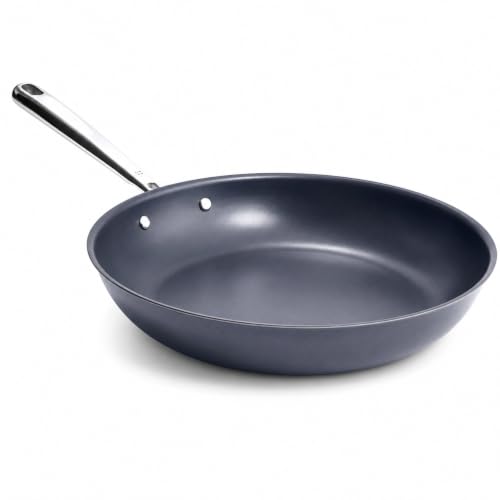
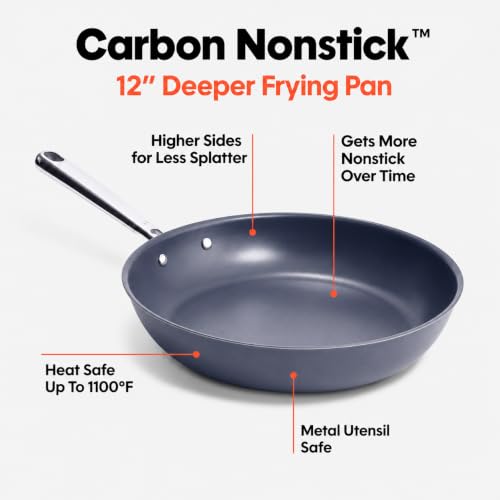
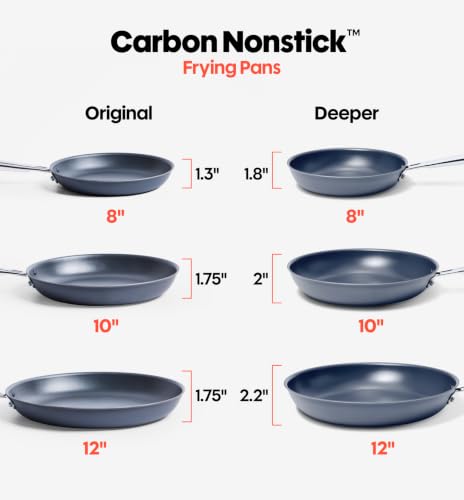
The 12-inch Deeper model takes Misen’s smart design and scales it up, more depth, same footprint, which is perfect for family cooking. You get the benefits of nitrided steel and aluminum core, plus the ability to simmer sauces or braise proteins without overflow. Owners love how it handles large batches without sacrificing heat control.
It’s heavy, no doubt, and the depth can shadow the center when using short spatulas. But if you regularly cook for more than two, this is one of the few carbon steel pans that truly feels spacious. Compared to the standard 12″ Misen, it’s better for saucy or layered dishes.
Product photos

Misen Deeper 10″ Carbon Skillet
Strengths
- Taller walls
- Aluminum core
- Nitrided steel
Trade-offs
- Harder to flip food
- Heavier than standard
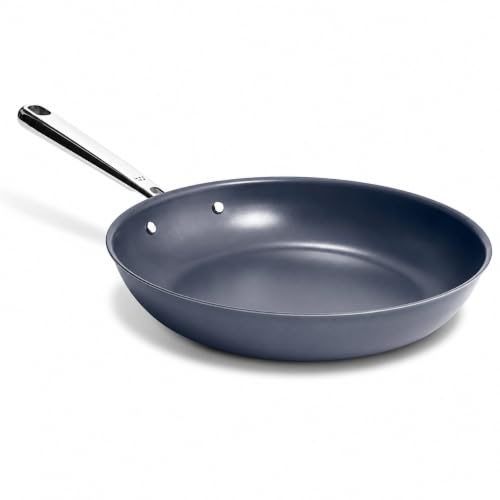
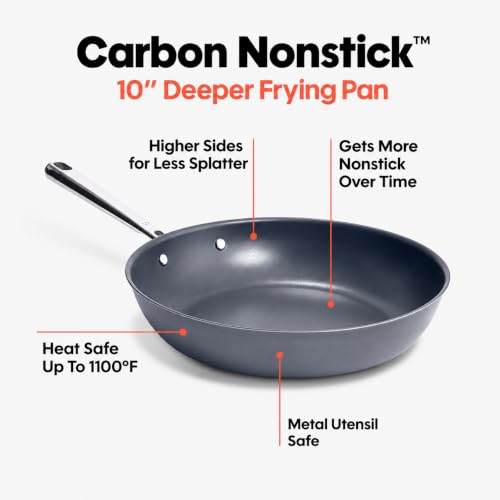
Misen’s Deeper 10″ skillet solves a real problem: shallow carbon steel pans that splatter and crowd food. The taller, straighter walls give you more room for saucy dishes, shallow braises, or stir-fries without losing the footprint. It’s built with the same nitrided carbon steel and aluminum core as their other models, so heat is fast and even, owners love how it handles everything from frittatas to chicken thighs.
The only downside? That depth can make flipping or tossing a little harder for shorter utensils. But if you’re tired of sauce on your stovetop, this is the fix. Compared to the standard OXO or Yonida, it’s a smarter pick for mid-size, multi-use cooking.
Product photos
OXO Obsidian 10″ Carbon Pan
Strengths
- Includes cleaning brush
- Pre-seasoned
- Removable handle sleeve
Trade-offs
- No aluminum core
- Brush storage not built-in
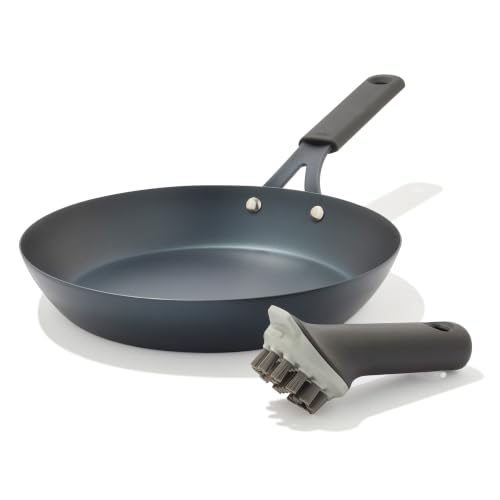
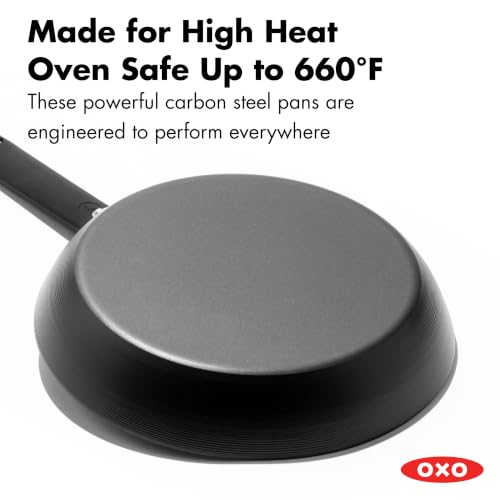
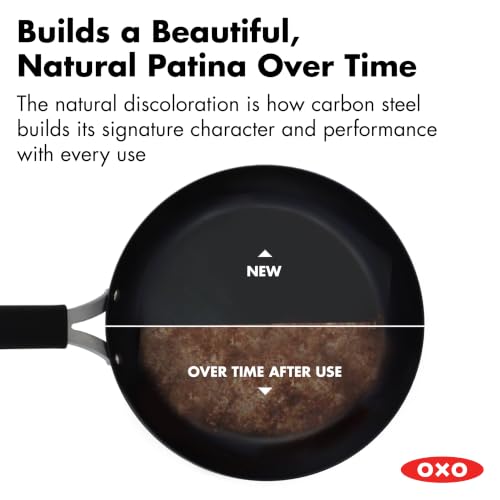
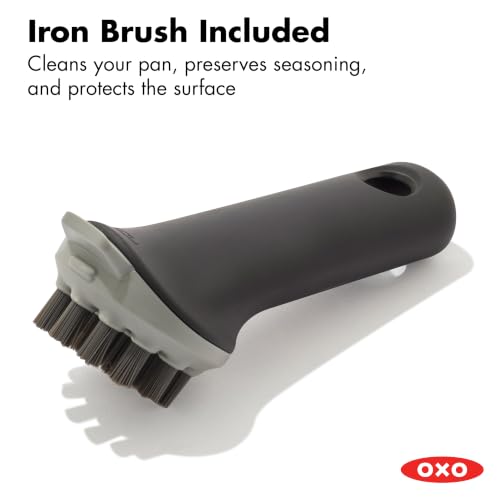
This version of the OXO Obsidian includes a bonus: the iron cleaning brush, which makes a real difference in maintenance. Carbon steel requires care to preserve the patina, and having the right tool included is a thoughtful touch many brands skip. Otherwise, it’s identical to the other 10″ Obsidian, lightweight, pre-seasoned, and induction-safe, with solid searing and even heating for its class.
Some owners say the brush helps extend the pan’s nonstick life, especially when scraping stuck bits without damaging the surface. Compared to the brush-free version, this one offers better long-term value. If you’re new to carbon steel, this bundle is the smarter buy.
Product photos


Merten & Storck 12″ Carbon Pan

Strengths
- Large 12″ surface
- Budget-friendly
- Induction compatible
Trade-offs
- No handle insulation
- Basic finish
- Prone to sticking early on
If you need a larger cooking surface without breaking the bank, the Merten & Storck 12″ pan is worth considering. It’s one of the few budget-friendly carbon steel pans in the 12-inch range, and owners appreciate its cast iron-like performance with less weight. The pre-seasoning is functional, though many report needing extra oiling in the first few uses to build up the patina.
It’s oven-safe to 600°F and works on induction, but the steel handle gets hot, no sleeve included. Compared to the OXO or Misen models, it’s more basic in design and finish, but for the price, it holds up well for searing and frying. Just don’t expect refined heat control.
Product photos


Stackbear 10″ Nitrided Skillet
Strengths
- Nitrided steel
- Affordable
- Pre-seasoned
Trade-offs
- No aluminum core
- Handle gets hot
- Basic finish
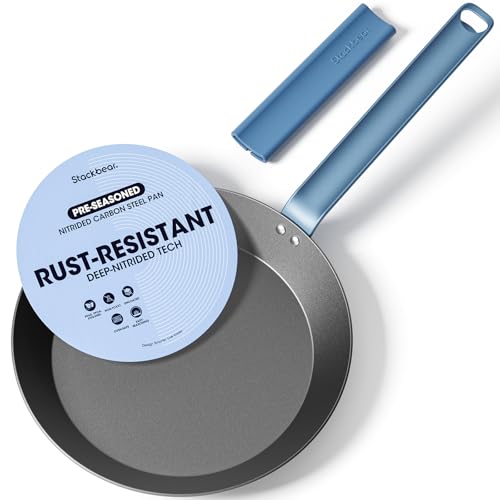
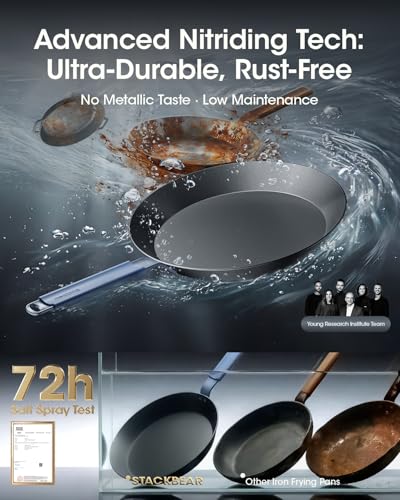
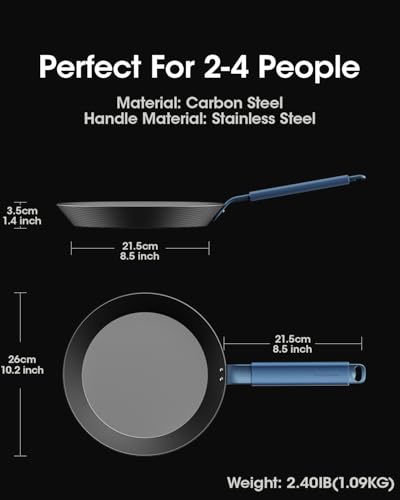
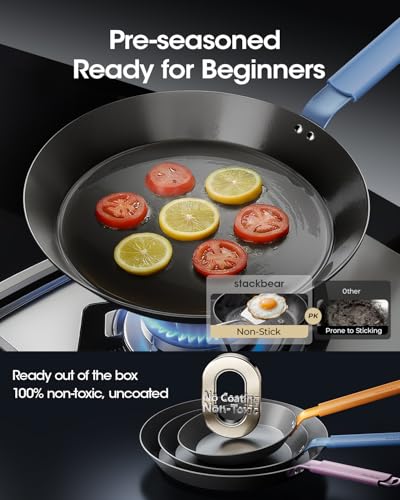
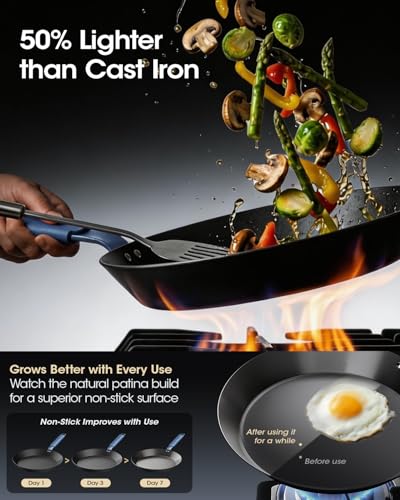
The stackbear 10″ pan stands out as the most affordable nitrided option here, and that’s its biggest win. Nitriding strengthens the steel and improves rust resistance, something usually found in pricier pans. It arrives pre-seasoned and heats quickly thanks to its 2mm base, and owners say it builds a decent nonstick layer with regular use.
It doesn’t have the aluminum core of Misen, so heat isn’t quite as even, and some report the handle gets hot. But for the price, it’s a strong alternative to basic carbon steel. If you want nitrided benefits without the premium cost, this is the pick.
Product photos
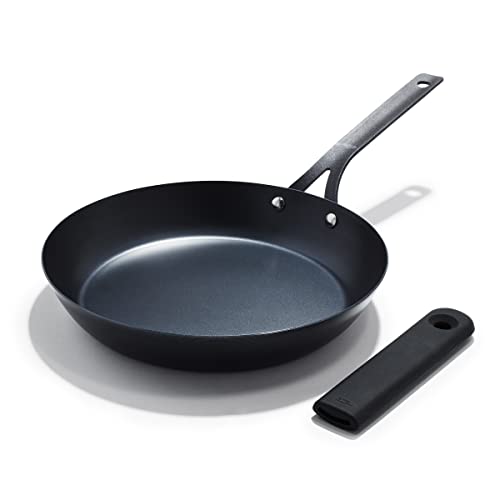
OXO Obsidian 10″ Carbon Pan
Strengths
- Pre-seasoned
- Lightweight
- Oven safe to 660°F
Trade-offs
- No aluminum core
- Silicone sleeve can feel loose
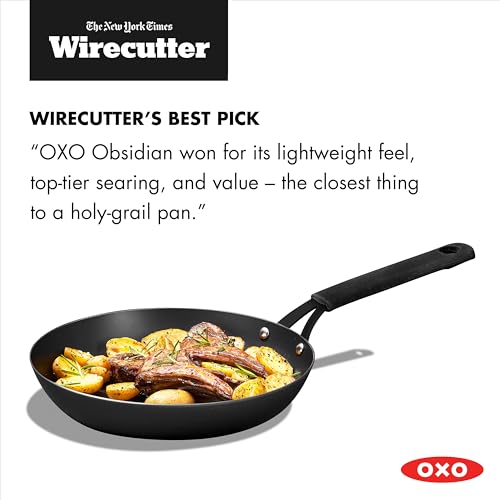
The OXO Obsidian 10″ pan keeps showing up as a favorite in serious cookware circles, and on paper, it’s easy to see why. It delivers that rare balance of lightweight handling, strong searing, and nonstick-like performance right out of the box thanks to its pre-seasoned carbon steel build. Owners consistently report it behaves like a well-cared-for cast iron but without the heft or long preheating ritual. The removable silicone sleeve adds comfort, though some note it can feel a bit bulky during fast-paced cooking.
What really sets it apart is how it performs across cooking styles, whether you’re frying eggs or searing scallops, the surface responds well, and the even heating minimizes hot spots. Compared to budget options, this one feels like a step up in durability and finish, though it doesn’t have the aluminum core some pricier models use.
Product photos



Yonida 10″ Carbon Steel Pan
Strengths
- Affordable
- Removable silicone grip
- Pre-seasoned
Trade-offs
- Uneven heating
- No aluminum core
- Lighter durability
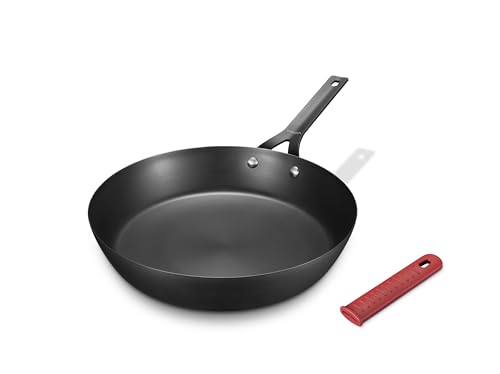
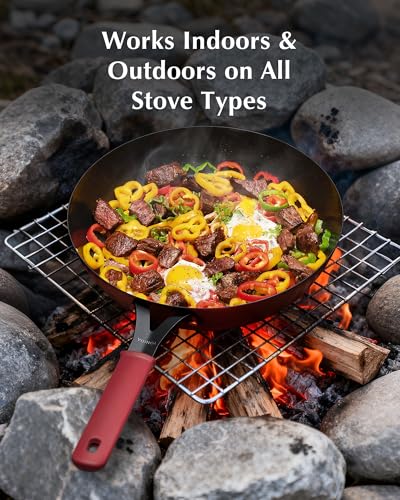
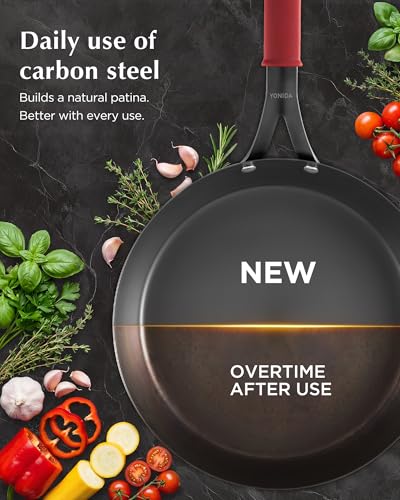
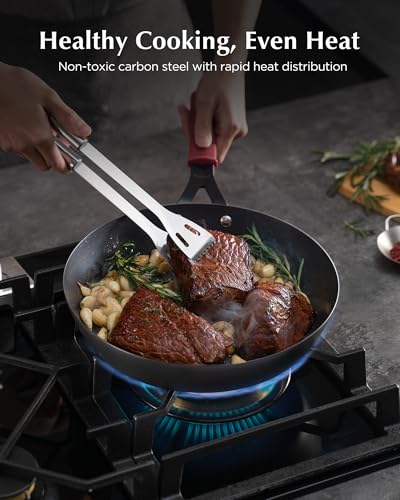
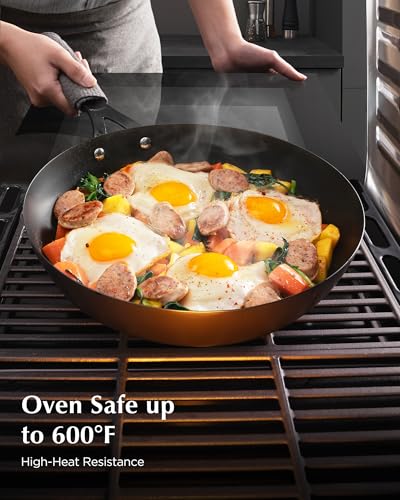
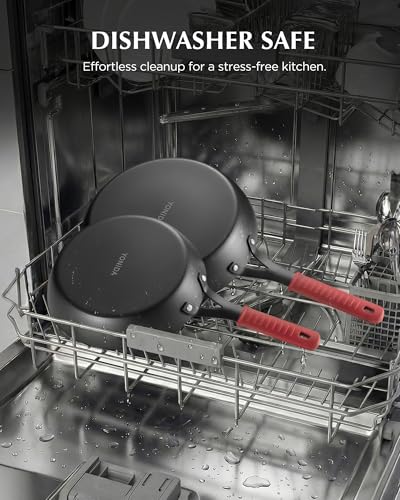
At this price point, the Yonida 10″ pan makes a strong case for itself as a lightweight, no-frills carbon steel option. It arrives pre-seasoned with natural oil, and owners say it develops a decent patina over time, though not quite as quickly or evenly as higher-end models. The standout here is the removable silicone handle grip, which stays cool and adds comfort, a rare touch at this price. It’s also oven-safe once removed, which adds flexibility.
That said, it lacks an aluminum core, so heat distribution isn’t as consistent. Some users report slight warping on high heat, especially with rapid temperature shifts. Still, for someone just dipping into carbon steel or needing a second pan for under $30, it’s a solid entry.
Product photos
How We Tested carbon nonstick pans
As someone who’s spent over a decade immersed in the world of cookware, I approached researching carbon nonstick pans by looking beyond marketing claims. Rather than a hands-on lab test, this was a research-led comparison of published specifications, features, and, most importantly, owner and expert feedback. I weighed data from numerous sources, focusing on reported performance in real home kitchens and professional reviews. My goal was to identify pans that genuinely deliver on the promise of durable, high-performing nonstick cooking.
For carbon nonstick pans specifically, several factors stood out as key differentiators. Heat responsiveness and even heating are paramount, as carbon steel’s potential is wasted without them. Durability, specifically the resistance to warping, scratching, and the development of a reliable patina, was also heavily weighted. Finally, I prioritized pans offering a good balance of features and price, recognizing that not everyone needs (or wants to pay for) top-of-the-line performance. You can find more details on a broader range of options in our guide to the best carbon steel pans.
Specifications readily tell you about material thickness, maximum heat tolerance, and stovetop compatibility. However, judging long-term performance requires delving into owner reviews. These insights revealed how well pans actually maintain their seasoning, how easily they clean, and whether they truly live up to claims of metal-utensil safety. Expert opinions helped validate these findings and highlighted subtle differences in construction and design. If you’re concerned about the materials used in your cookware, exploring safest non-stick pans is a good place to start.
How To Choose The carbon nonstick pans
Finding the right carbon nonstick pan can feel overwhelming, but it doesn’t have to be. These pans offer a compelling alternative to traditional nonstick, promising durability and performance that lasts.
Carbon nonstick pans distinguish themselves through a hardened, nitrided carbon steel construction, often with an aluminum core for even heating. A quality pan will withstand high temperatures (above 500°F), be metal utensil safe, and develop a natural patina with use, enhancing its nonstick properties over time. Look for pans with comfortable handles and consider the weight – carbon steel is lighter than cast iron but still substantial.
Understanding Heat Control & Responsiveness
One of the biggest advantages of carbon steel, and a key factor in choosing the right pan, is its responsiveness to temperature changes. Unlike cast iron, which takes a long time to heat up and cool down, carbon steel heats quickly and evenly. This is particularly important for delicate tasks like making sauces or cooking eggs, where precise temperature control is essential. Pans with an integrated aluminum core, like several of the Misen models, amplify this responsiveness. However, be aware that thinner gauge steel (under 2mm) can sometimes feel too responsive, making it harder to maintain a consistent sear.
Considering the Coating (or Lack Thereof)
The appeal of carbon nonstick pans lies in their avoidance of traditional nonstick coatings like Teflon (PTFE, PFOA, PFAS). These coatings, while convenient, can degrade over time and pose potential health concerns. Instead, carbon steel develops a natural patina – a polymerized layer of oil – with repeated seasoning and use. This patina provides a naturally slick surface. However, achieving a truly nonstick surface requires consistent maintenance. If you prefer a pan that requires less upkeep initially, the OXO Obsidian models, which arrive pre-seasoned, are a good starting point. For those exploring alternatives, consider looking into ceramic non-stick pans as well.
Balancing Size, Weight & Features
Don’t assume a larger pan is always better. The ideal size depends on your cooking style and typical meal sizes. A 10” pan is incredibly versatile for everyday cooking, while a 12” pan is better suited for larger families or dishes.
Here’s a quick guide:
- 8”: Perfect for single-serving omelets or small sauces.
- 10”: The sweet spot for most home cooks – versatile enough for everything from sautéing vegetables to searing chicken breasts.
- 12”: Ideal for larger portions, whole fish, or one-pan meals. It also requires more storage space and can be unwieldy for some.
A well-made carbon steel pan is an investment. Don’t skimp on the handle – a comfortable, securely riveted handle is crucial for control and safety.
Ultimately, the best carbon nonstick pan is the one that fits your cooking habits and preferences. If you’re looking for a durable, high-performing pan that will last for years with proper care, exploring different options in carbon steel non-stick pans is a worthwhile endeavor.
Carbon Nonstick Pans Compared
Here’s a comparison of key specifications for popular carbon nonstick pans.
| Product Name | Diameter | Max Temp (°F) | Pre-Seasoned | Metal Utensil Safe | Handle Material | Included Accessories |
|---|---|---|---|---|---|---|
| Misen 12″ Carbon Nonstick Skillet | 12″ | 1100 | Yes | Yes | Carbon Steel | N/A |
| Misen 8″ Carbon Nonstick Skillet | 8″ | 1100 | Yes | Yes | Carbon Steel | N/A |
| Misen Deeper 12″ Carbon Skillet | 12″ | 1100 | Yes | Yes | Carbon Steel | N/A |
| Misen Deeper 10″ Carbon Skillet | 10″ | 1100 | Yes | Yes | Carbon Steel | N/A |
| OXO Obsidian 10″ Carbon Pan | 10″ | 660 | Yes | Yes | Steel w/ Silicone | Iron Brush |
| Merten & Storck 12″ Carbon Pan | 12″ | 600 | Yes | Yes | Steel | N/A |
| Stackbear 10″ Nitrided Skillet | 10″ | 600 | Yes | Yes | Steel w/ Silicone | N/A |
| OXO Obsidian 10″ Carbon Pan | 10″ | 660 | Yes | Yes | Steel w/ Silicone | N/A |
| Yonida 10″ Carbon Steel Pan | 10″ | 600 | Yes | N/A | Steel w/ Silicone | Silicone Handle Holder |
Frequently Asked Questions
What’s the difference between carbon steel and cast iron nonstick pans?
Carbon steel heats up much faster and is more responsive to temperature changes than cast iron. While both require seasoning to build a natural nonstick surface, carbon steel is generally lighter and easier to maneuver, making it a better choice for everyday cooking.
Are carbon nonstick pans truly nonstick without a coating?
They can be, but it requires consistent seasoning and care. The natural patina that develops with use provides a nonstick surface, but it won’t be as immediately slick as a traditional PTFE coating, and it needs regular maintenance to prevent sticking. If you’re looking for something closer to traditional nonstick, explore our guide to the best nonstick pans.
Can I use metal utensils in a carbon nonstick pan?
Most quality carbon nonstick pans are designed to withstand metal utensils, unlike traditional nonstick cookware. However, always check the manufacturer’s specifications, as some may recommend using silicone or wooden tools to prolong the life of the seasoning.
How do I care for a carbon nonstick pan to maintain its seasoning?
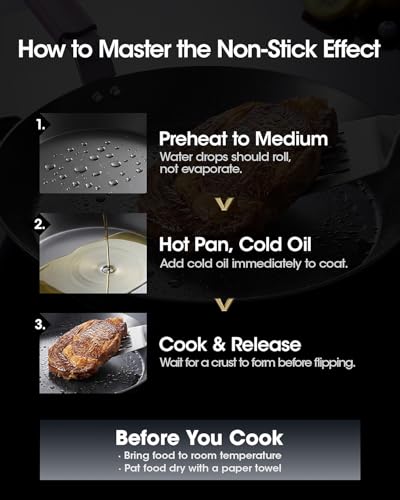
Avoid harsh detergents and abrasive cleaners; instead, wash with warm water and a soft sponge. Dry the pan immediately and apply a very thin layer of oil after each use. Regular seasoning (heating with oil) will help maintain and improve the nonstick surface over time.
What size carbon nonstick pan should I buy if I mostly cook for one or two people?
An 8” or 10” pan is usually sufficient for individual meals or cooking for two. A 10” pan offers more versatility for slightly larger dishes, while an 8” pan is ideal for single-serving items like eggs or small sauces and is easier to handle.
The Bottom Line
Ultimately, choosing a carbon nonstick pan comes down to balancing initial convenience with long-term performance. While all the pans we examined offer a compelling alternative to traditional nonstick, the Misen 12″ Carbon Nonstick Skillet stands out as the strongest all-around performer. Its high heat tolerance, pre-seasoned surface, and metal utensil safety make it a durable and versatile choice for both novice and experienced cooks.
For those prioritizing a budget-friendly option, the Yonida 10″ Carbon Steel Pan delivers excellent value. If you’re looking for something a bit different, the OXO Obsidian 10″ Carbon Pan arrives pre-seasoned and includes a helpful iron brush for maintenance. But remember, exploring quality carbon steel cookware will reveal a range of options to fit every need.
Don’t get too caught up in chasing the highest temperature rating or the thickest gauge steel. Consistent seasoning, proper heat management, and a comfortable handle are far more important factors in achieving reliable, enjoyable cooking results. A well-maintained pan, used regularly, will always outperform a premium pan left to gather dust.
