
Can I Leave Food in Slow Cooker Overnight Off? Safety Rule
This post contains affiliate links. As an Amazon Associate, we earn from qualifying purchases.
You can leave food in a turned-off slow cooker for a maximum of two hours after cooking finishes. After that, you must refrigerate it. The ceramic pot holds heat like an insulator, keeping food in the bacterial “danger zone” (40°F to 140°F) long enough to become unsafe overnight. The “warm” setting is different, it actively keeps food above 140°F, but most manuals warn against using it for more than four hours.
That two-hour window isn’t a suggestion. It’s the federal food safety line drawn by the USDA and printed in manufacturer manuals like Breville’s. Overnight, a sealed ceramic pot cools so slowly that it becomes an incubator. The question isn’t whether your chili looks fine in the morning; it’s whether it spent six hours at a perfect temperature for bacteria to double every 20 minutes.
What follows is the breakdown of that rule: why two hours, what “warm” actually does, how a power outage changes everything, and the step-by-step way to handle leftovers so you don’t gamble with next-day stomach cramps.
Key Takeaways
- The absolute maximum time food can sit in a turned-off slow cooker is two hours. This is a USDA and manufacturer-mandated safety limit, not a guideline.
- The ceramic bowl is an insulator. It keeps food in the “danger zone” (40°F–140°F) for far longer than a metal pot on the stove, making overnight storage risky.
- The “warm” setting is not “off.” It actively heats food to a safe holding temperature (usually above 165°F), but most brands like Russell Hobbs explicitly say not to use it for more than four hours.
- If the power goes out while you’re not home, you must discard the food, even if it looks cooked. If you are home, you have two hours to finish cooking by another method or refrigerate.
- Never reheat leftovers directly in the slow cooker. Reheat on the stove or in a microwave to 165°F first, then transfer to a preheated slow cooker to keep warm.
The 2-Hour Safety Window and the “Danger Zone”
The core mistake is thinking a turned-off slow cooker is like a refrigerator. It’s the opposite. A slow cooker is designed to retain heat. The thick stoneware insert is a thermal mass. When you turn it off, that mass doesn’t chill; it slowly releases its stored energy, keeping the contents warm for hours.
Food must not remain in the “danger zone”, between 40°F and 140°F, for more than two hours total. In this range, bacteria like Staphylococcus aureus and Clostridium perfringens can double in number every 20 minutes.
This is the mechanical reason the two-hour rule exists. Your pot roast might drop from a cooking temperature of 200°F to 135°F in 90 minutes. It then lingers between 135°F and 40°F for the next five hours. That’s five hours in the prime reproduction range. By morning, a harmless bacterial load can become a significant risk.
| Scenario | Time in ‘Danger Zone’ | Safety Outcome |
|---|---|---|
| Food refrigerated within 2 hours of cooking | Minimal (<2 hrs) | Safe |
| Food left in off cooker for 4 hours | Extended (4+ hrs) | Potentially Hazardous |
| Food left in off cooker overnight (8+ hrs) | Prolonged (8+ hrs) | Unsafe — Discard |
The federal government slow cooker safety document states this directly: “When you are at home, and if the food was completely cooked before the power went out, the food should remain safe up to two hours in the cooker with the power off.” The same logic applies when you manually turn it off. The clock starts the moment the heating element stops.
What About the “Warm” Setting?
This is where people get tripped up. The warm setting is a low-energy heating mode, not just a residual heat. It actively cycles the element to maintain a holding temperature, usually between 145°F and 165°F, which is above the danger zone. This is why leaving food on “warm” is fundamentally different from leaving it in an “off” cooker.
But “warm” has its own strict timer. It’s for holding dinner until the family gets home, not for overnight storage. The heating is gentle and uneven at the edges of the pot. Over many hours, moisture evaporates, textures break down, and the temperature at the periphery can drift down into the danger zone.
Where this goes sideways: Using “warm” as a set-it-and-forget-it holding bin. The Russell Hobbs RHSC7 manual is explicit: “Do not keep foods on the WARM setting for more than 4 hours.” The Cuisinart PSC-350C defaults to an 8-hour warm cycle after cooking, but that’s a maximum, not a recommendation for everyday use.
If your model has a programmable warm function, treat four hours as a hard stop. For longer holds, the only safe method is to properly refrigerate and then reheat later.
Step-by-Step: How to Handle Leftovers Safely
This process isn’t just about safety. It’s about preserving texture and flavor. Stew that sits lukewarm for hours becomes mushy. Follow this sequence.
- Plan Your Finish Time. Aim for the cooker to finish 30 minutes before you plan to eat. If that’s not possible, plan to handle leftovers immediately after the cook cycle ends.
- Portion and Store. Do not leave the entire batch in the ceramic pot to cool. Ladle leftovers into shallow, airtight containers. A shallow layer cools to refrigerator temperature far faster than a deep pot, slowing bacterial growth.
- Refrigerate Promptly. Get those containers into the fridge within two hours of the cooker turning off. If the room is very warm (above 90°F), make that one hour.
- Reheat Correctly. This is the step every manual agrees on. Do not try to reheat cold leftovers directly in the slow cooker. It takes too long to pass through the danger zone.
- Reheat leftovers on the stove or in a microwave until they reach 165°F internally, measured with a food thermometer.
- Then, and only then, you can transfer the piping-hot food to a preheated slow cooker on the “warm” setting to keep it hot for serving.
Skipping step 4 is how people get sick. A slow cooker brings cold food up to temperature so slowly that it can spend hours in the danger zone, effectively cooking a bacteria farm.
The Power Outage Wild Card
A storm knocks out the power while your slow cooker is unattended. The food was done, but now it’s cooling without any control. This scenario has a zero-tolerance rule.
The USDA slow cooker food safety guidelines are absolute: “If you are not at home during the entire slow-cooking process and the power goes out, throw away the food even if it looks done.” You cannot know how long the power was off or what temperature the food reached.
Some newer digital models, like the Russell Hobbs RHSV6000, have a memory function. Its manual notes that if power is restored within two hours, it resumes cooking. If the outage was longer, the display flashes “—-” as a discard warning. Most basic models offer no such clue. When in doubt, throw it out.
If you are home when the power fails: * If the food was fully cooked before the outage, you have the standard two-hour window to refrigerate it. * If the food was not yet cooked, you must finish cooking it immediately by another means, a gas stove, an outdoor grill, or at a neighbor’s house.
Choosing a Safer Slow Cooker
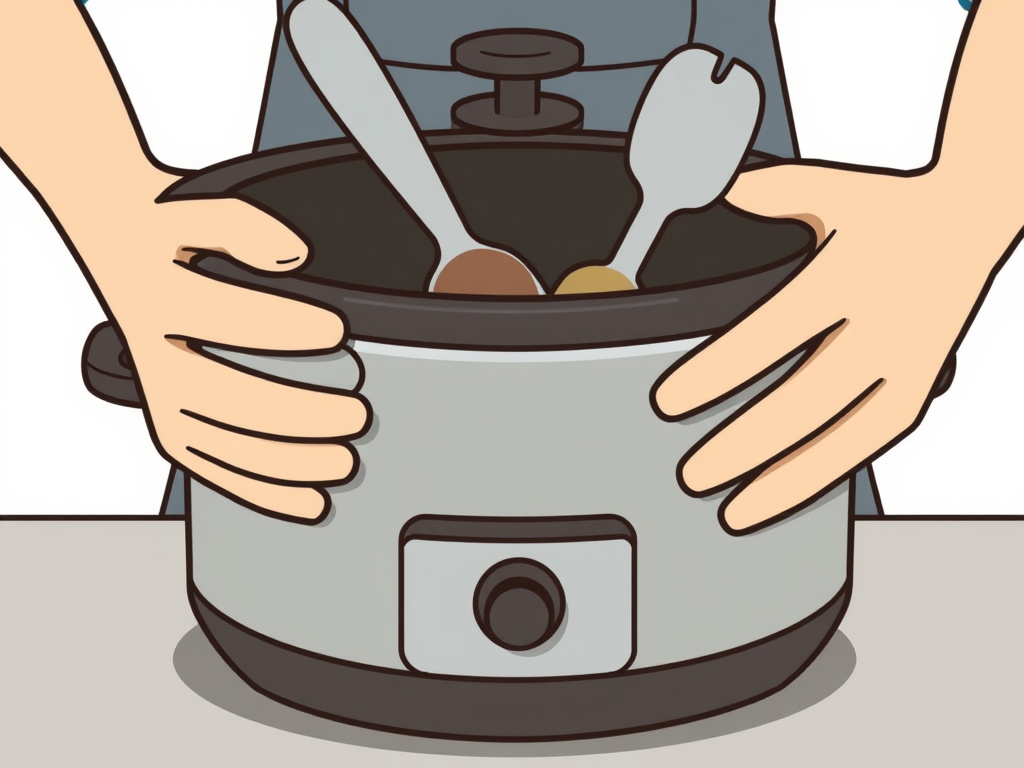
Not all cookers are equal for safety-minded use. When selecting a slow cooker, look for features that give you more control and built-in safety nets. A good slow cooker today has clear digital controls and failsafes that older dial models lack.
| Feature | Why It Matters for Safety | Example Model |
|---|---|---|
| Digital Timer with Auto-Warm | Prevents overcooking and automatically shifts to a safe holding temp. | Cuisinart PSC-350C |
| Programmable Delay Start | Lets you add refrigerated ingredients just before cooking starts, reducing pre-cook time at room temp. | Gourmia GSC517 |
| Locking Lid | Secures the lid for transport and prevents accidental spills, but also helps maintain a safe, sealed temperature. | Many Hamilton Beach models |
| Clear Temperature Settings | Displays actual “Warm” temp (e.g., 165°F) so you know it’s above the danger zone. | Breville Slow Cooker |
The basic operating principles of a slow cooker remain the same, a heating element, a ceramic bowl, and a tight lid. But digital controls remove guesswork from timing. The auto-shift to warm means you never accidentally leave food on a cooking setting overnight. For unattended cooking, these features are worth the upgrade.
I prefer a model with a probe thermometer. You insert it into the meat, set a target temperature, and the cooker switches to warm when it’s hit. It turns guesswork into a guarantee. That’s the difference between hoping the chicken is done and knowing it reached 165°F three hours ago.
Frequently Asked Questions
Can I leave my slow cooker on warm overnight?
No, you should not. Most manufacturer manuals, including those from Russell Hobbs and Cuisinart, advise against using the warm setting for more than four hours. While it keeps food above 140°F, prolonged holding degrades quality and risks uneven cooling at the edges of the pot.
Is it safe to leave a slow cooker unattended?
Yes, but with critical caveats. It is safe to leave a slow cooker unattended during its active cooking cycle on Low or High, as it’s designed for this. It is not safe to leave it unattended on “Warm” for extended periods, or to leave cooked food in it after it’s turned off. Always ensure it’s on a stable, heat-resistant surface away from curtains and cabinets.
What happens if I leave food in the slow cooker too long?
Bacteria multiply rapidly in the “danger zone” (40°F–140°F). This can lead to foodborne illness, with symptoms like stomach cramps, diarrhea, and vomiting. The food may not look, smell, or taste spoiled, but the toxins produced by bacteria are still present and dangerous.
Can I put the whole ceramic pot in the fridge?
You can, but it’s inefficient. The thick ceramic takes a very long time to cool down in the refrigerator, which can raise the fridge’s internal temperature and put other foods at risk. It’s much safer and faster to transfer leftovers to shallow storage containers.
How can I tell if my slow cooker gets hot enough to be safe?
The MSU Extension safe slow cooking guide recommends a simple test: Fill the cooker 2/3 full with water, heat it on Low for 8 hours, then check the temperature with a food thermometer. It should reach at least 185°F. If it doesn’t and the unit is under warranty (typically 2 years), contact the manufacturer. An older unit that fails this test may be unsafe to use.
Before You Go
Leaving food in an unplugged slow cooker overnight is a gamble with a predictable loser. The two-hour rule exists because physics and biology don’t negotiate. The ceramic bowl that makes slow cooking so effective is the same thing that makes overnight storage risky.
Your safest path is simple: treat the slow cooker as a cooking appliance, not a storage container. Cook, portion, refrigerate within two hours, and always reheat thoroughly. If you want a hot meal ready in the morning, use a programmable model with a delay start, not the “off” switch. That’s the difference between a convenient tool and a kitchen hazard.
