
Can I Put Saucepan in Oven | The 500°F Rule & Handle Check
This post contains affiliate links. As an Amazon Associate, we earn from qualifying purchases.
You can put a saucepan in the oven if every part of it—the pan body, handle, lid, and any knobs—is rated for the oven’s temperature. Stainless steel and cast iron bodies often handle 500°F, but plastic or silicone handles typically fail between 350°F and 375°F. The weakest component sets the limit.
That limit isn’t a suggestion. It’s the temperature at which a handle’s plastic core softens, a silicone grip begins to off-gas, or a nonstick coating starts to break down. You don’t get a warning smell until it’s already happening.
What follows: how to read a manufacturer’s spec sheet for the real number, the three materials that almost always work, and the one common kitchen mistake that warps a pan before the food is even done.
Key Takeaways
- The handle material, not the pan body, is usually the weakest link. Phenolic (Bakelite) or plastic handles often fail at 350°F.
- Stainless steel and cast iron saucepan bodies are typically oven-safe to 500°F (260°C), per brands like Cuisinart.
- Glass lids are almost always the second weakest point, often rated for only 350°F to 425°F.
- True oven-safe means the entire unit is rated. If the lid or handle isn’t safe, the pan isn’t safe for the oven.
- Always verify using the manufacturer’s manual for your specific model—assumptions based on material alone will ruin cookware.
The 500°F Rule: Why Stainless Steel and Cast Iron Win
Most quality stainless steel and cast iron saucepans share a common ceiling: 500 degrees Fahrenheit (260°C). This isn’t an arbitrary number. It’s the tested thermal limit for the 18/10 stainless steel used in handles and the seasoning stability of cast iron.
Cuisinart’s manual for its stainless steel line states the cookware “can be used in the oven at any baking temperature up to 500°F.” Their cast iron manual echoes the same 500°F limit. This rating assumes every component, including the riveted stainless steel handles, can endure that dry heat.
Cookware can be used in the oven at any baking temperature up to 500°F (260°C) and can go from burner to broiler to table when placed on a heat-resistant trivet. NOTE: Glass covers are only oven-safe up to 350°F (177°C). Cuisinart Stainless Cookware Use & Care Guide
The “broiler to table” clause matters. A pan rated for 500°F can handle the intense, direct heat of a broiler, which many nonstick and ceramic pans explicitly forbid. This is why a fully stainless steel saucepan or a cast iron one is the default choice for recipes that start on the stovetop and finish under high heat.
For a deeper look at why this metal is so reliable, our guide on oven-safe stainless steel breaks down the alloy science.
Where this goes sideways: Assuming all stainless steel is created equal. A cheaper pan with thinner-gauge steel can warp at high temperatures, especially if you move it from a hot oven to a cold countertop. The thermal shock creates uneven contraction. You’ll hear a faint ping and the pan will rock on a flat surface.
| Material | Typical Oven-Safe Temp | Best For | Fails If… |
|---|---|---|---|
| Stainless Steel (clad) | 500°F (260°C) | Searing, braising, broiling | Thin gauge warps under rapid temp change |
| Cast Iron | 500°F+ | Baking, roasting, high-heat frying | Seasoning burns off above 550°F over long periods |
| Hard-Anodized Aluminum | 400-500°F | Even baking, casseroles | Handle attachment is often the weaker link |
| Reinforced Nonstick | 350-400°F | Low-heat baking, egg dishes | Exceed 450°F and coating degrades, releasing fumes |
The Handle Is The Weak Link
The saucepan body might be forged from indestructible metal, but its oven safety is decided by the handle. This is the component that fails first, and often catastrophically.
Handle materials fall into three categories, each with a hard thermal ceiling:
- Stainless Steel or Cast Iron (500°F+): The gold standard. As seen in the Lowe’s product spec for KitchenAid cookware, “The stainless steel handles are oven safe up to 500°F.” These are solid or hollow tubes riveted directly to the pan.
- Stainless Steel with Silicone Inserts (375°F): A common “cool-touch” design. GreenPan specifies that stainless handles with a silicone insert are only oven-safe to 375°F. The silicone insulates your hand but begins to break down inside the oven.
- Phenolic (Bakelite) or Plastic (350°F): The most common limit. GreenPan notes phenolic handles are “only oven-safe up to 350°F.” This is a hard plastic that will melt, smoke, and release toxic fumes if exceeded.
Common mistake: Putting a pan with plastic-handled lids in the oven. The knob is often the same phenolic material as a handle and has the same 350°F limit. It softens, warps, and can fuse to the glass.
You cannot guess this limit. You must find the manual for your specific pan. The difference between a 350°F phenolic handle and a 500°F stainless one is the difference between a successful pan sauce and a kitchen filled with acrid smoke.
This principle applies to all pan types. For example, checking the handle is just as critical for oven-safe frying pans and oven-safe Calphalon pieces, where handle designs vary widely.
Lids, Knobs, and The “Lid Vacuum” Edge Case
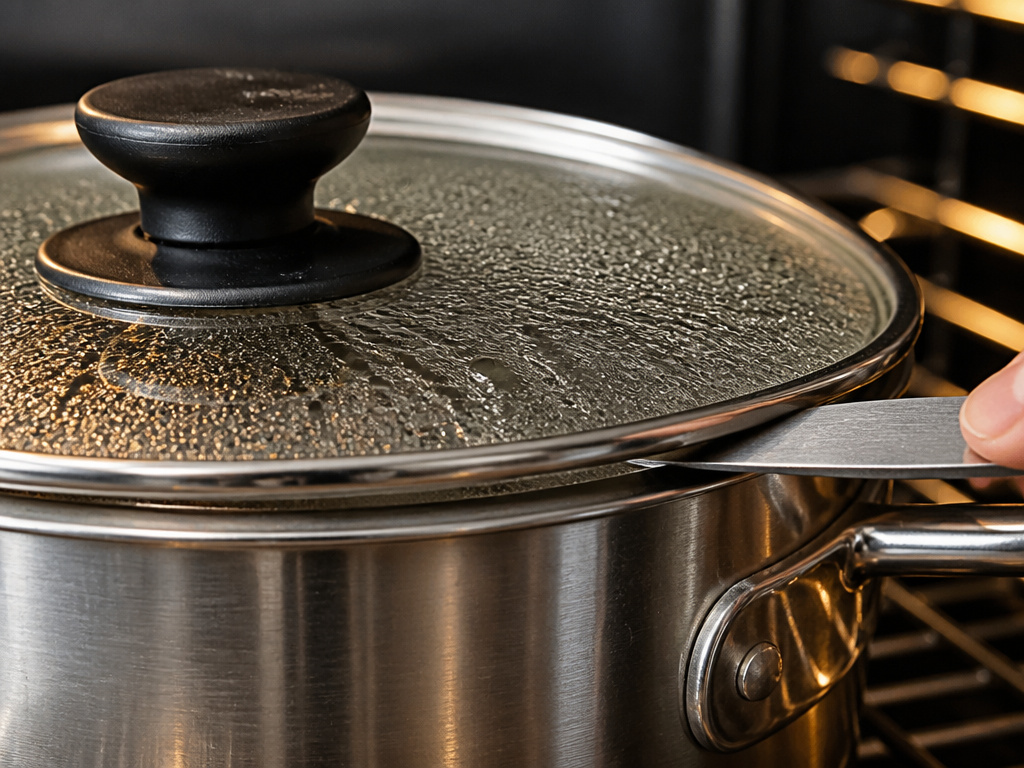
If the handle doesn’t stop you, the lid will. Glass lids are nearly universal, and their temperature rating is almost always lower than the pan’s body.
- Tempered Glass Lids: Often rated between 350°F and 425°F. Cuisinart’s stainless line notes “Glass covers are only oven-safe up to 350°F.” GreenPan states lids with stainless handles are safe to 425°F.
- Stainless Steel Lids: Less common, but they can match the pan’s high heat rating, sometimes up to 600°F.
The knob on the lid is a frequent failure point. It’s usually made of the same phenolic plastic as cheaper handles. If the lid is oven-safe but the knob is rated for 350°F, the entire lid’s limit drops to 350°F.
Then there’s the physical oddity no manual mentions until you’re in it: the lid vacuum.
If a lid vacuum occurs, do not attempt to remove the lid. First, turn off the heat source and move the entire pan away from the burner. Then, slowly release the lid. KitchenAid Stainless Steel Cookware Manual
A vacuum seal happens when cooling air inside the pan contracts, pulling the lid shut with surprising force. Prying it can shatter the glass or burn your hands. The fix is patience: let the pan cool fully, or gently slide a thin utensil under the lid’s edge to break the seal.
Nonstick and Ceramic: The 20-Minute, 350°F Zone

Nonstick and ceramic-coated saucepans operate under strict, short-term rules. Their coatings are applied to an aluminum core, which heats quickly but cannot tolerate sustained high heat like cast iron or stainless steel.
Cuisinart’s nonstick cookware manual is explicit: “Cuisinart® Cookware can be used in the oven up to 350˚F (176°C) for short amounts of time, not to exceed 20 minutes.” It also explicitly says “Do NOT place… Under the broiler.”
The 20-minute limit exists because the coating and the aluminum core expand at different rates. Prolonged heat stresses the bond, leading to crazing (tiny cracks in ceramic) or delamination of nonstick layers. For dedicated nonstick users, our article on oven-safe nonstick skillet limits dives deeper.
Why-Layer: Nonstick coatings like PTFE (Teflon) begin to thermally decompose around 500°F, releasing fumes that can cause polymer fume fever in humans and are lethal to birds. The 350-400°F limit is a safety buffer, not just a durability guideline.
- Preheat the pan on the stovetop, not in the oven.
- Never place an empty nonstick saucepan in a hot oven.
- Use only low to medium oven temperatures for baking.
If your recipe calls for higher heat or longer baking, transfer the food to a oven-safe ceramic baking dish or a stainless steel pan.
The 4-Step Pre-Oven Safety Checklist
Don’t rely on memory or a symbol stamped on the bottom. Follow this sequence every time.
- Consult the Original Manual. This is the only authoritative source. Search the brand’s website for your model’s PDF “use and care guide.” Digital copies of manuals for brands like Cuisinart and GreenPan are readily available online.
- Identify the Weakest Component. Find the temperature rating for each part: pan body, handle, lid, knob. The lowest number is your maximum safe oven temperature.
- Perform a Physical Inspection. Look for cracks in glass lids, deep scratches in nonstick coatings, or loose handles. Damaged cookware fails unpredictably under heat stress.
- Preheat the Oven with the Pan Inside (Optional but Smart). For stainless steel or cast iron, placing a cold pan in a preheated oven is generally fine. For anything with a nonstick coating or a tight composite construction, letting the pan heat with the oven reduces thermal shock. This is a standard practice for oven-safe Dutch oven use to prevent cracking.
What happens if you skip the manual check? You’ll base your decision on the pan’s primary material, which is how someone ruins a perfectly good nonstick saucepan with a 350°F-rated handle by baking bread at 425°F. The bread is fine. The handle is not.
What Never Goes in the Oven
Some materials and constructions are immediate disqualifications. This list is non-negotiable.
- Saucepsans with Wooden Handles or Accents: Wood dries, cracks, and can ignite.
- Pans with Epoxy or Decal Exteriors: The decorative finish will bubble, melt, and release fumes.
- Pans with Unknown Origins or No Markings: If you can’t identify it, don’t risk it.
- Cookware with Teflon Coating Under a Broiler: The direct, intense heat will destroy the coating in minutes.
- Pans with Severely Warped Bottoms: The uneven surface creates hot spots that can lead to further warping or failure.
Similarly, just as you’d avoid certain pans, you must also know which other kitchen tools have limits. The principles of material safety extend to items like oven-safe copper, where the handle attachments and lining material dictate the rules.
Frequently Asked Questions
Can I put a saucepan with a plastic handle in the oven?
It depends entirely on the plastic type. Phenolic (Bakelite) handles are often rated for 350°F. If your oven exceeds that, the handle will soften, warp, and potentially release harmful fumes. You must check your specific model’s manual. Never assume.
How can I tell if my saucepan is oven-safe?
Find the manufacturer’s use and care guide. Look for the terms “oven-safe” followed by a temperature. Also inspect for an oven-safe symbol (usually a square with a zigzag line inside) stamped on the bottom of the pan, though this is less common than explicit text in the manual.
What is the highest oven temperature for a saucepan?
For home cookware, 500°F (260°C) is a common high limit for all-metal construction (stainless steel or cast iron body with stainless steel handles). Some commercial-grade or specialty pans may be rated higher, but 500°F is the standard ceiling for reputable brands like Cuisinart and All-Clad.
Can I put a nonstick saucepan in a 400 degree oven?
Probably not. Most nonstick coatings have a maximum safe temperature between 350°F and 400°F, and many are also limited by their plastic handles. A 400°F oven is at the extreme top end of this range and risks degrading the coating or melting the handle. Always defer to your pan’s manual, which will state a limit like “up to 350°F for 20 minutes.”
Before You Go
The question isn’t “can a saucepan go in the oven.” It’s “can my specific saucepan, with its specific handle and lid, go in my oven at this specific temperature for this specific time?“
The answer lives in a PDF you can find in five minutes. Ignore that step, and you’re gambling with a smoking, melted handle and ruined dinner. Verify the handle’s limit, respect the lid’s lower rating, and remember that nonstick means low-and-slow in oven terms. Your oven-safe cookware is a tool for seamless cooking, but only if you know its actual rules.
