
Is Stainless Steel Cookware Oven-Safe? Key Limits & Exceptions
This post contains affiliate links. As an Amazon Associate, we earn from qualifying purchases.
Yes, stainless steel cookware can go in the oven. The standard limit is 500°F (260°C) for the metal body and handles. Glass lids are a separate category, typically rated for 350°F to 450°F (177°C to 232°C), and nonstick stainless steel should never go under a broiler. The real answer is matching your specific pan’s construction to the heat source.
That 500°F benchmark comes straight from manufacturer manuals for brands like Cuisinart and Tramontina. It’s not a guess. It’s the temperature at which the bonded layers of metal in tri-ply or 5-ply construction are tested to stay stable without warping or separating. Go higher, and the warranty clauses about “high heat or prolonged heat exposure” kick in.
What follows: the three specs that change the rule (handles, lids, nonstick coatings), the one move that warps a pan instantly, and how to read your own cookware’s manual in ten seconds.
Key Takeaways
- Most stainless steel bodies are oven-safe to 500°F (260°C), but premium lines like Viking 5-Ply are rated for 600°F (315°C).
- Glass lids have a lower limit, usually 350°F to 450°F (177°C to 232°C), and should never be used under a broiler or in a preheating oven.
- Never submerge a hot pan in cold water. This thermal shock is the fastest way to warp the metal and void the warranty.
- Nonstick stainless steel cookware is oven-safe but never broiler-safe; the coating degrades under direct, intense radiant heat.
- Always check the manufacturer’s manual for your specific model, oven-safe ratings are not universal across all stainless steel.
The Universal 500°F (260°C) Benchmark
Stainless steel cookware is oven-safe up to 500°F (260°C) per most manufacturer specifications, including Cuisinart and Tramontina. This rating applies to the metal body and stainless steel handles. The limit is set to prevent warping or layer separation in multi-ply construction under prolonged high heat.
Open a Cuisinart MCP-12NC manual or a Tramontina Tri-Ply guide. The number is the same: 500°F (260°C). This isn’t an arbitrary safety margin. It’s the temperature at which the core aluminum or copper layer sandwiched between stainless steel is engineered to expand and contract uniformly with the outer layers.
Exceed it, and the differential expansion rates can cause the layers to delaminate. You won’t see it happen in one bake. But over time, repeated cycles above the rated limit stress the bonds. The warranty for Viking cookware explicitly excludes damage from “high heat or prolonged heat exposure.” That’s the legal language for “you baked at 550°F and the pan warped.”
Some high-end lines are built for more. Viking’s 5-Ply Stainless Steel Cookware (without lids) is rated for 600°F (315°C) and is even broiler-safe to that same temperature. The difference is in the grade and mass of the metal. For the vast majority of home cookware sitting in cabinets, 500°F is the ceiling.
What About the Lid?
The lid is almost always the weakest thermal link. If your stainless steel pan has a glass lid, its limit is lower, often much lower.
Common mistake: Assuming a glass lid has the same oven-safe rating as the pan. Most are only safe to 350°F or 450°F.
Check the manuals. A Cuisinart stainless steel pan is rated for 500°F, but its glass covers are only oven-safe up to 350°F (177°C). Tramontina rates its glass lids slightly higher, at 450°F (232°C). Viking strongly discourages oven use for glass lids at all, but if you must, they cap it at 400°F (204°C) and explicitly warn against broiler use.
Why the gap? Glass and metal expand at different rates. Heating a sealed glass lid too quickly or too hot can cause it to crack or shatter, especially if it has a microscopic scratch. Furthermore, placing a cold glass lid into a preheating oven or under a broiler is a guaranteed way to break it. The thermal shock is immediate.
The rule is simple: if you’re using the pan in the oven with the lid on, the lid’s lower rating governs the entire operation. For a braise at 325°F, you’re fine. For a high-heat roast at 475°F, take the lid off.
Handles, Knobs, and the “Everything Gets Hot” Reality
Stainless steel handles are generally oven-safe to the same temperature as the pan body. But “oven-safe” doesn’t mean “cool to the touch.” It means the material won’t degrade.
That’s a critical distinction. A riveted 18/10 stainless steel handle on a pan from Lowe’s is rated for 500°F. It will also be too hot to touch bare-handed within minutes. The GreenPan manual notes that stainless steel handles can discolor in the oven, a golden or blue tint, but that this doesn’t affect safety or performance. The discoloration is a surface oxidation, not a failure.
Where you get into trouble is with handles made of other materials. Silicone-wrapped handles, Bakelite knobs, or hollow stainless handles filled with a heat-dissipating material may have their own lower limits. If your pan has these, the manual will say so. When in doubt, assume all handles get dangerously hot and always use a dry oven mitt.
The Nonstick Stainless Steel Exception
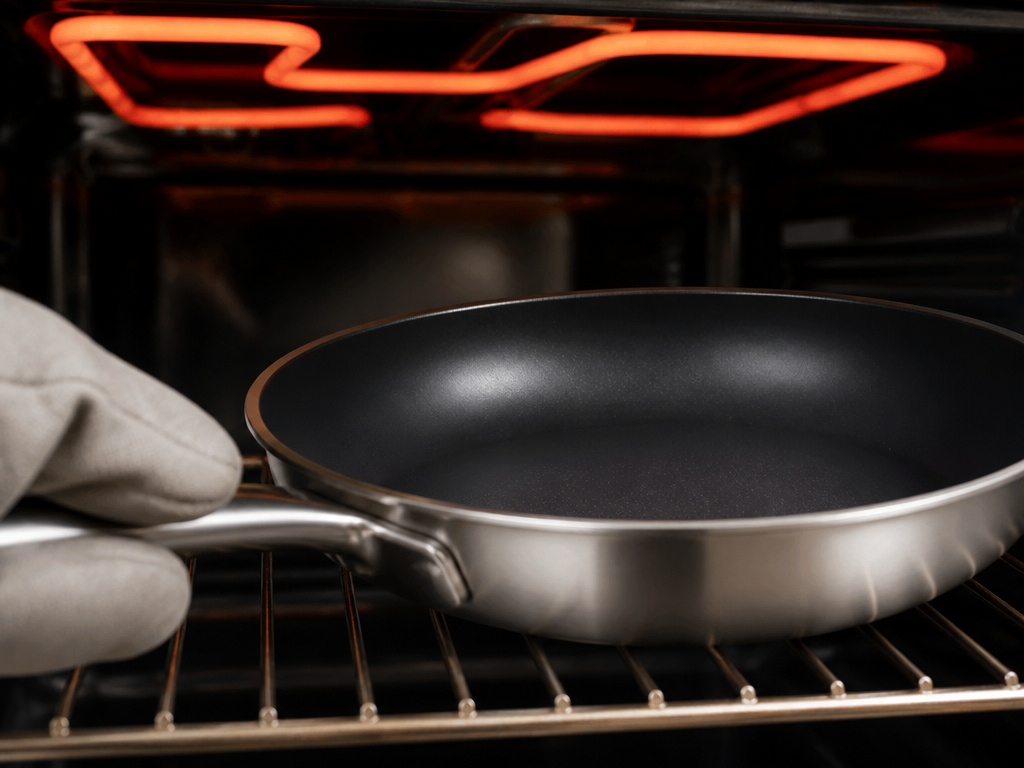
Some stainless steel cookware has a nonstick interior coating. This changes the rules dramatically.
While the stainless steel body can handle oven heat, the nonstick coating cannot withstand a broiler’s direct, radiant heat. Every manual we reviewed, from Viking to Tramontina, contains the same line: “Never put nonstick cookware under a broiler.”
The coating polymers break down at extreme localized temperatures, releasing fumes and degrading the nonstick surface. For oven use, these pans have a lower overall limit. Viking’s nonstick stainless steel line is rated for 500°F (260°C) for oven use, versus 600°F for their plain stainless.
If you have a nonstick stainless pan, treat it as a hybrid. The base metal is robust, but the interior finish is the limiting factor. Stick to the lower temperature rating and keep it away from the broiler element.
The Instant Warp: Thermal Shock and Warranty Voidance
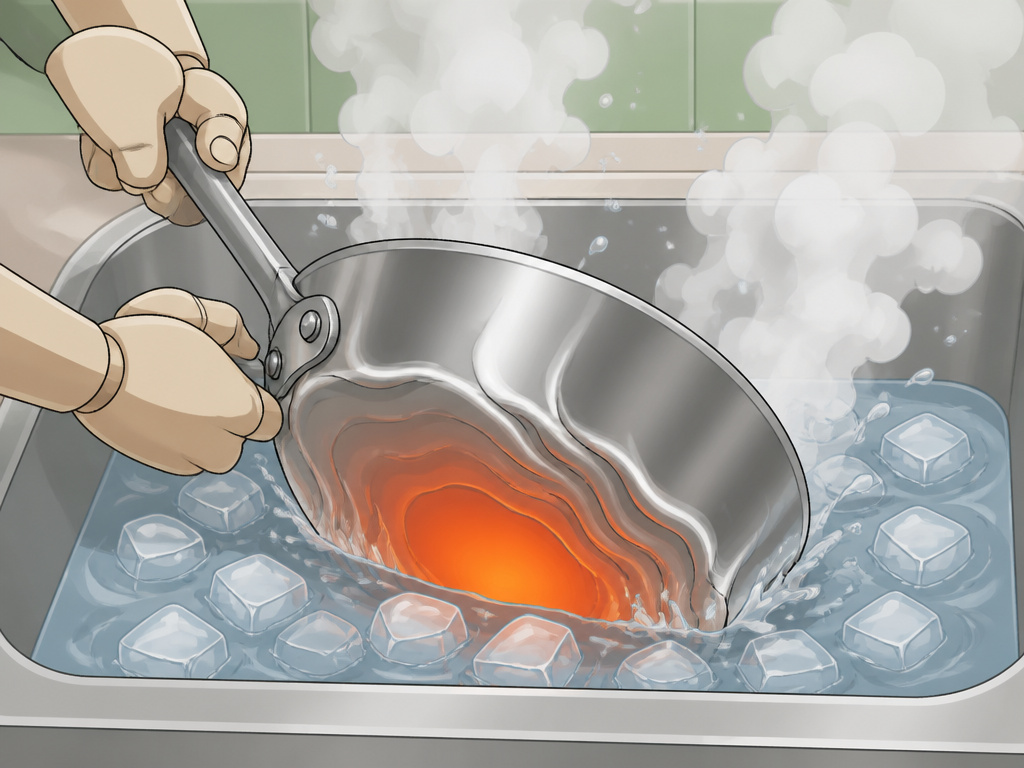
A sudden, extreme temperature change is the number one way to ruin a stainless steel pan.
Where this goes sideways: Plunging a searing-hot pan straight from the oven into a sink of cold water. The metal contracts unevenly, warping the flat base in seconds. This voids nearly every manufacturer’s warranty.
This is called thermal shock. The Viking manual states that “sudden changes in temperature may cause any metal to warp, resulting in an uneven bottom and voiding the warranty.” The Cuisinart and Tramontina guides echo this. A warped pan won’t sit flat on your cooktop, leading to uneven cooking and hot spots.
The correct method is to let the pan cool naturally on a heat-resistant surface or trivet. Once it’s near room temperature, then you can wash it. This single habit preserves the pan’s geometry for decades.
| Action | Risk | Timeline to Damage |
|---|---|---|
| Plunge hot pan into cold water | Warping of base | Immediate (seconds) |
| Use glass lid under broiler | Cracking/breaking | Within minutes |
| Exceed stated oven-safe temperature | Layer separation, handle damage | Over repeated uses |
| Use metal utensils on nonstick interior | Coating scratches | First use |
How to Find Your Pan’s Exact Rating (A 30-Second Guide)
Don’t guess. The information is printed on the paperwork that came with your pan or is available online.
- Locate the model number. It’s usually etched on the bottom of the pan or printed on a label on the handle.
- Search online. Type “[Brand Name] [Model Number] use and care manual” into a search engine.
- Find the “Oven Use” or “Cooking Temperature” section. The exact Fahrenheit and Celsius limits will be listed.
If the manual is lost, a safe conservative rule for unknown stainless steel is 450°F (232°C). This protects against the possibility of a lower-rated lid or handle material. For any pan with a nonstick interior, avoid the broiler entirely and cap oven use at 500°F.
Broiler Use: Yes, No, and “It Depends”
The broiler is a different beast than standard oven heat. It’s direct, radiant heat from a top element.
- Plain Stainless Steel (no lid, no nonstick): Often broiler-safe. Viking’s 5-ply line is rated for broiler use up to 600°F. Many other brands implicitly allow it if the pan is oven-safe, but check the manual.
- Stainless Steel with Glass Lid: Never. The glass cannot handle the intense, direct heat.
- Nonstick Stainless Steel: Never. The coating will be damaged.
- Stainless Steel with Other Handle Materials: Unlikely. If the handle isn’t solid metal, the broiler’s heat can melt or damage it.
The bottom line on broilers: unless your cookware’s manual explicitly says “broiler-safe,” assume it is not. The risk of damage is high.
Frequently Asked Questions
Can I put my stainless steel pan from the stove into the oven?
Yes, this is a key advantage of stainless steel. It’s designed to go from stovetop to oven. Just remember to use an oven mitt, as the handle will be as hot as the pan. Ensure your oven is set at or below your pan’s rated temperature limit.
Is all stainless steel cookware oven-safe to 500°F?
No. While 500°F is a common benchmark, it is not a universal standard. Always verify your specific model’s rating. Higher-end lines like Viking are rated for 600°F, and some budget pans with mixed-material handles may be rated lower.
What happens if I accidentally put a plastic handle in the oven?
The plastic will melt, likely ruining the handle and releasing toxic fumes into your oven and kitchen. You will need to replace the entire pan. This is why identifying handle material is a critical first step before any oven use.
Can stainless steel go in a convection oven?
Yes. A convection oven uses a fan to circulate hot air, but the ambient temperature is the same as a conventional oven. Your pan’s temperature rating (e.g., 500°F) still applies. The convection setting doesn’t change the material’s limits.
Why did my stainless steel pan change color in the oven?
Blue, gold, or brown rainbow discoloration on the stainless steel is normal. It’s caused by oxidation from high heat and does not affect performance or safety. It can usually be removed with a non-abrasive cleaner like Bar Keepers Friend if you dislike the look.
Is stainless steel or non-stick better for oven use?
Stainless steel is more versatile for high-heat oven and broiler use. While you can find oven-safe non-stick cookware, it typically has lower temperature limits and is never broiler-safe. For searing and finishing dishes in the oven, stainless is the default choice.
Before You Go
Stainless steel’s oven safety is one of its biggest strengths, but that strength has defined limits. Trust the 500°F rule for the pan body, but always check the finer print on lids and handles. Remember that thermal shock from rapid cooling is a bigger threat than the oven itself. Your pan’s manual is the map that keeps a lifetime warranty valid. When you know the limits, you can use the full heat of your kitchen without a second thought.
