
Discover Why This Classic Cookware Is Called a Dutch Oven
This post contains affiliate links. As an Amazon Associate, we earn from qualifying purchases.
A Dutch oven gets its name from a specific 17th-century trade practice: English industrialists imported superior cast-iron cooking pots from Dutch foundries, which used advanced sand-casting techniques to produce thinner, smoother pots than English makers could. The name stuck to the heavy, lidded pot design, not the country of origin.
That trade story explains the label, but it doesn’t explain the pot. The design that earned the name is a thick-walled, lidded vessel built for even, retained heat from stovetop to oven. What separates it from a standard pot is its mass and its tight-fitting lid, which turns it into a self-basting, steam-trapping chamber.
What follows is the full story of that name, the specific design features that define a true Dutch oven, and the material limits that determine whether yours is actually oven-safe. We’ll cover the historical footnote, the three critical specs, and the one manufacturer warning that voids warranties.
Key Takeaways
- The name originated in the 1600s when English manufacturers imported thinner, smoother cast-iron pots from Dutch foundries, coining the term “Dutch oven” for the superior design.
- A true Dutch oven is defined by three features: significant thermal mass (usually cast iron), a tight-fitting lid with a self-basting design, and overall oven-safe construction.
- Not all Dutch ovens are fully oven-safe; plastic or wooden knobs melt, and enamel coatings chip above 450°F (232°C), while plain cast iron can handle 500°F (260°C).
- Thermal shock, placing a cold pot in a hot oven or adding cold liquid to a scorching one, is the fastest way to crack enamel or warp a pan, a failure most warranties exclude.
- For most home cooking, a 5 to 6-quart round, enameled cast iron Dutch oven from brands like Staub or Le Creuset covers braising, baking, and stewing without specialized care.
The 17th-Century English Trade Origin
The name is a historical artifact, not a geographical one. In the early 1700s, English ironworkers produced brittle, thick cast-iron pots. Dutch foundries, particularly in the Netherlands, had perfected a method using dry sand molds. This process yielded castings that were thinner, smoother, and more uniform.
English industrialist Abraham Darby traveled to the Netherlands to study the technique. He later patented a similar sand-casting process in England. However, the association with Dutch quality was already cemented. English merchants and settlers began calling these superior lidded pots “Dutch ovens” to denote their provenance and advanced manufacture. The name traveled to the American colonies, where it became the generic term for the heavy camp ovens used by settlers and pioneers.
The Dutch oven’s name is a fossil of industrial espionage. Abraham Darby’s 1707 English patent for sand-casting copied Dutch methods, but the market kept the label that signaled thinner walls and better cooking performance.
This origin story underscores a core principle of Dutch oven design: it was always about performance engineering, not just a heavy pot. The Dutch process delivered a specific advantage, even heat distribution from thinner, denser iron, that defined the category from the start.
What Makes a Dutch Oven Different?
Forget the name for a minute. The functional definition rests on three physical traits that enable its unique cooking techniques.
First is thermal mass. This usually means cast iron, though some are made from cast aluminum or ceramic. The mass soaks up heat from a burner or oven and releases it slowly and evenly. This prevents hot spots that burn a stew’s bottom and maintains a steady temperature for braising tough cuts of meat for hours.
Second is the lid. A standard pot lid sits on top. A Dutch oven lid is designed to seal. Many, like those from Staub, have interior spikes that collect condensation and drip it back onto the food, a self-basting system. The tight fit traps steam and moisture, creating a miniature convection oven inside the pot. This is the mechanism that enables no-knead bread baking; the dough’s own steam creates a crisp, glossy crust.
Third is oven-safe construction. A true Dutch oven moves from stovetop browning to oven finishing. This function requires that every component, body, lid, and knob, withstand oven temperatures. This is where modern versions can fail, as not all materials are created equal.
| Feature | Standard Pot | True Dutch Oven | Consequence of Difference |
|---|---|---|---|
| Primary Material | Often thinner stainless or aluminum | Thick cast iron or enameled cast iron | Dutch oven retains heat for hours; standard pot cools quickly off the burner. |
| Lid Design | Simple cover, often lightweight | Heavy, tight-fitting, often with self-basting spikes | Dutch oven lid creates a sealed, humid environment for braising and baking bread. |
| Oven Safety | May have plastic handles or glued components | Fully metal or with high-temp resin knobs (≥ 480°F) | Dutch oven can finish a sear in a 450°F oven; many pots cannot leave the stovetop. |
The difference from a pot is one of capability, not just shape. A pot holds water for pasta. A Dutch oven browns, braises, and bakes in one vessel because of these three design commitments.
Is Your Dutch Oven Actually Oven-Safe?
 Here is the most common point of failure. The pot body is almost always fine. The problem is the lid, the knob, and the coating.
Check the knob on the lid. If it’s plastic or phenolic resin, it has a temperature limit, usually between 390°F and 480°F (200°C–250°C). Baking bread often requires 450°F to 500°F. At that range, a plastic knob will warp, discolor, or melt. The fix is to replace it with a stainless steel knob from the manufacturer before high-heat oven use.
Common mistake: Assuming the lid knob is as oven-safe as the pot. Plastic and wood knobs are for stovetop use only; they fail within one bread-baking cycle at 500°F.
Next, identify your Dutch oven materials. The safety rules split here: * Plain Cast Iron (like Lodge): Can handle temperatures up to 500°F (260°C) or more. The limit is your oven’s max, not the metal. * Enameled Cast Iron (Le Creuset, Staub): Keep at 450°F (232°C) or lower. Higher heat can damage the glass-like coating, causing it to craze (develop hairline cracks) or discolor permanently. * Ceramic or Stoneware: Check the manufacturer’s limit. Some high-fired ceramics go to 500°F; many glazed pots max out at 425°F. * Stainless Steel: Less common, but safe for medium oven temperatures. Avoid high-heat baking.
The Hawkins die-cast nonstick Dutch oven manual states a clear limit: oven temperature must not exceed 250°C (482°F) for more than 60 minutes. It also warns against dry heating, heating the empty pot, which can damage the nonstick coating immediately. These are specific, sourced limits that override general advice.
Where this goes sideways: Thermal shock. Placing a room-temperature Dutch oven into a preheated 450°F oven, or adding cold stock to a pot just off a high sear, can crack enamel or even plain cast iron. Always preheat gradually with the oven or add warm liquids.
The Critical Role of the Lid and Shape
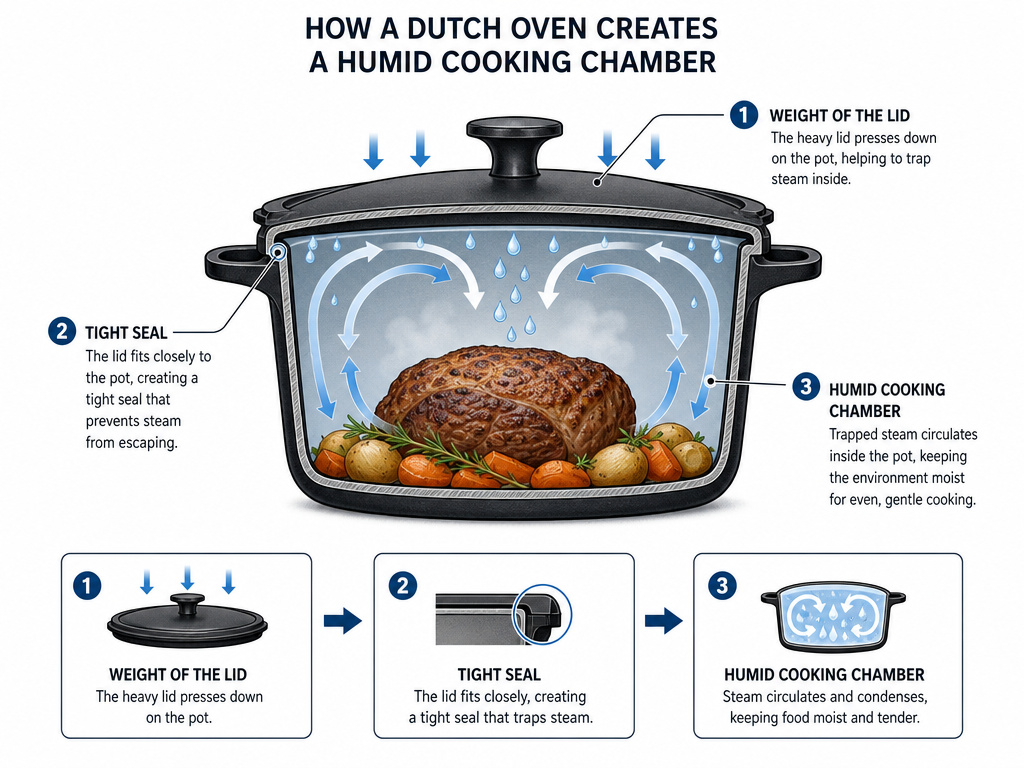 The lid does more than cover. Its weight and fit are what enable the pot’s signature Dutch oven cooking. A heavy lid presses down, creating a better seal that minimizes steam escape. This trapped steam tenderizes meat, plumps grains, and creates the humid chamber essential for artisan bread.
Lid design varies. Staub lids have those interior spikes. Le Creuset lids are domed to create condensation channels. Camp Dutch ovens, like those from Lodge, have a flanged lid designed to hold coals on top, turning the entire vessel into an oven. This design is the ancestor of the modern double Dutch oven, which uses a deep lid as a second cooking chamber.
Shape matters just as much. Round ovens provide the most even heat distribution on a standard circular burner. Oval ovens are better for roasts or baguettes but can have cooler spots at the ends on a stovetop. The best all-purpose shape is round.
Capacity is the final variable. A large Dutch oven is typically 7 quarts or more, suited for big batches of soup or feeding a crowd. The versatile sweet spot for a family of four is 5.5 to 6 quarts. It’s large enough for a whole chicken but not so massive that it’s unwieldy.
Material Guide: Cast Iron, Enameled, and Alternatives
Your choice of material dictates care, performance, and oven ceiling. This isn’t about brand loyalty. It’s about matching the material properties to how you cook.
Bare Cast Iron (Lodge)
- Pros: Highest oven-safe temperature (500°F+), extremely durable, develops a natural nonstick seasoning over time.
- Cons: Requires seasoning to prevent rust, reactive with acidic foods (tomatoes, wine) which can strip seasoning and impart a metallic taste, heavier than enameled.
- Best for: High-heat baking, campfire cooking, and cooks willing to maintain seasoning.
Enameled Cast Iron (Le Creuset, Staub)
- Pros: Non-reactive surface perfect for long-simmered tomato sauces and braises, no seasoning required, easy to clean, wide color range.
- Cons: Lower heat limit (450°F), enamel can chip if struck or thermally shocked, often the most expensive option.
- Best for: Everyday braising, stewing, sourdough baking at 450°F, and cooks who want low-maintenance performance.
Ceramic / Stoneware
- Pros: Excellent non-stick properties, often beautiful presentation, good for slow, even baking.
- Cons: Fragile, severe thermal shock risk, usually lower temperature limits, not for stovetop use.
- Best for: Oven-baked casseroles and desserts where it goes from fridge to oven and then to the table.
The best materials debate ends with enameled cast iron for most home kitchens. It removes the maintenance headache of bare iron while providing 95% of the thermal performance. The one exception is for dedicated bread bakers who need the 500°F ceiling, where a pre-seasoned plain cast iron like a Lodge is the pragmatic choice.
Dutch Oven vs. Other Slow Cookers
It’s easy to confuse a Dutch oven with a slow cooker or crockpot. They both make tender meat, right? The difference is control and outcome.
A crock pot heats food slowly at a low, steady temperature, often over 8 hours. It’s a dedicated appliance for unattended cooking. A Dutch oven on the stovetop or in a low oven (300°F) also braises slowly, but it first requires you to sear and brown ingredients. This Maillard reaction, the browning of proteins and sugars, creates a foundational layer of flavor that a slow cooker cannot replicate because it never gets hot enough.
Furthermore, a Dutch oven reduces sauces as it cooks, concentrating flavors. A slow cooker traps all moisture, often resulting in a watery sauce that needs reduction afterward. The Dutch oven is an active, one-pot cooking tool; the slow cooker is a passive, set-and-forget device. They produce different dishes.
For weeknight ease, a slow cooker wins. For depth of flavor and a superior finished texture, the Dutch oven is the tool. They are not interchangeable.
Choosing and Using Your First Dutch Oven
If you’re buying one, start with a 5.5 to 6-quart round, enameled cast iron model. This size handles most family recipes. The round shape ensures even heating. Enameled means no seasoning and safe for tomato sauce.
Among Dutch oven brands, Staub and Le Creuset are the benchmarks. Staub’s matte black interior enamel hides stains and its spike-lid bastes beautifully. Le Creuset’s smooth light sand interior makes it easier to monitor browning. Both are lifetime investments. For a more budget-conscious entry, brands like Cuisinart and Tramontina offer solid enameled performance.
Once you have it, avoid these two pitfalls: 1. Using metal utensils. They can scratch enamel or chip the surface. Use wood, silicone, or nylon. 2. Cleaning while hot. Placing a scorching-hot Dutch oven under cold tap water is a guaranteed thermal shock. Let it cool until warm to the touch before washing.
The pot’s history is a footnote. Its future in your kitchen is defined by the sears, braises, and loaves it will produce. Choose the material that fits your habits, respect its temperature limits, and use that heavy lid to its full potential.
Frequently Asked Questions
Did Dutch ovens originate in the Netherlands?
Not exactly. The design and advanced casting techniques were refined in Dutch foundries in the 17th century. English merchants imported these pots and called them “Dutch ovens” to denote their superior quality and origin. The design was then replicated in England and America, but the name stuck.
Can you put a Dutch oven in a 500-degree oven?
It depends entirely on the materials. A plain cast iron Dutch oven with a metal knob can handle 500°F. An enameled cast iron Dutch oven should be kept at 450°F or lower to protect the coating. Always check the manufacturer’s instructions, the Hawkins die-cast model, for example, has a strict 250°C (482°F) limit.
What’s the difference between a Dutch oven and a French oven?
There is no functional difference. “French oven” is a marketing term used primarily by brands like Le Creuset and Staub to describe their enameled cast iron Dutch ovens. It’s the same piece of cookware.
Why are Dutch ovens so expensive?
The cost comes from materials and manufacturing. High-quality enameled cast iron involves sand-casting heavy iron, applying multiple layers of enamel glaze, and firing at extremely high temperatures. This process is labor and energy-intensive. The result is a piece of cookware that, with proper care, can last for decades.
The Bottom Line
A Dutch oven is called that because of a 300-year-old trade story about superior cast iron. What matters today is its design: a heavy, lidded pot that moves from stovetop to oven to trap heat and steam. Your main job is to verify its oven safety by checking the knob material and the temperature limit of its coating. For most kitchens, a 5.5-quart enameled cast iron model is the default. It braises, bakes bread, and makes a stew without the maintenance of bare iron. The name is history. The pot is a workhorse.
