
Oven-Safe Frying Pans: Can You Put Yours in the Oven? (51 chars)
This post contains affiliate links. As an Amazon Associate, we earn from qualifying purchases.
You can put a frying pan in the oven if every part of it, the body, handle, and any lid or coating, is rated for the temperature you plan to use. Stainless steel and cast iron pans with all-metal construction typically handle 500°F or more. Non-stick pans and those with plastic, wood, or silicone components have strict limits, often between 350°F and 500°F. The handle material is almost always the weakest link.
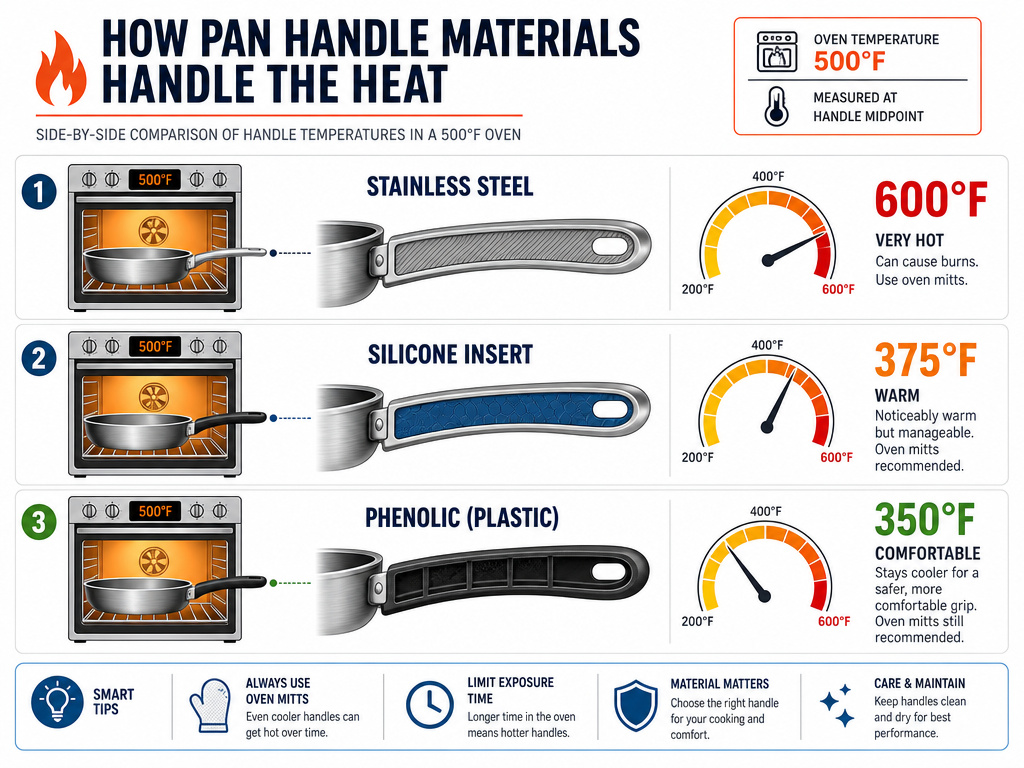
That handle limit is the line between a versatile pan and a melted, warped, or fume-releasing disaster. A stainless steel pan with a riveted metal handle is built for the broiler. The same pan body with a silicone grip taps out at 375°F. You need to know which one you own.
What follows: a four-step visual check, a breakdown of exactly where each material fails, and the one mistake that ruins more non-stick coatings than any other.
Key Takeaways
- The handle decides. A pan’s oven-safe rating is the temperature its weakest component can handle. For most pans, that’s the handle material, plastic melts at 350°F, silicone grips fail around 375–400°F, while riveted metal handles have no practical limit in a home oven.
- “Oven-safe” is not “broiler-safe.” The broiler’s direct, radiant heat stresses coatings and materials differently than ambient oven heat. Many pans rated for 500°F in the oven should never go under the broiler.
- Non-stick has a short life at its max rating. Using a PTFE-coated pan regularly at its maximum rated temperature (e.g., 500°F) degrades the coating faster. The surface may look fine but lose its non-stick properties within months.
- Never guess on an unmarked pan. If the base lacks an oven-safe symbol or temperature stamp, the manufacturer did not certify it for oven use. Relying on material knowledge is a risk.
- Thermal shock cracks glass and warps metal. Moving a cold glass lid into a hot oven or placing an empty pan under intense heat can cause immediate, irreparable damage.
The 4-Step Check Before Any Pan Goes In
Do not rely on memory or assumptions. Follow this visual and tactile check every time you consider moving a pan from stovetop to oven. Missing one step is how pans get ruined.
Step 1: Find the stamp on the bottom.
Flip the pan over. Look for a small square symbol with wavy lines inside (the oven icon) or the phrases “oven-safe” or “oven-proof.” The gold standard is a number stamped beside it, like “500°F.” That number is your ceiling. If you see only the symbol without a number, you must find the manufacturer’s specification online. A pan with no marking at all was not certified for oven use by its maker.
Step 2: Identify the handle material.
Run your fingers over the handle. Is it one continuous piece of cool, hard metal riveted to the pan? That’s your best-case scenario. Does it have a soft, rubbery, or plastic coating? Does it feel like painted wood? These are your limiting factors. A plastic or phenolic handle often caps out at 350°F. A silicone sleeve or grip typically fails between 375°F and 400°F.
Common mistake: Assuming a stainless steel pan is fully oven-safe. The body can handle 600°F, but a silicone grip turns it into a 375°F pan. You have to check the grip’s rating, not the metal’s.
Step 3: Assess the lid and knobs.
If your recipe requires a lid in the oven, you have a second set of limits. Tempered glass lids are generally safe to 350–400°F. A plastic knob on that lid might be rated for only 350°F. A metal lid without plastic components is as safe as the pan body. The rule is the same: the lowest-rated part sets the limit for the entire assembly.
Step 4: Know your coating.
Look at the cooking surface. A classic silver non-stick coating (PTFE/Teflon) should never see an oven above 500°F due to degradation and fume risk. Modern PFOA-free versions still have strict limits, often 400–500°F. Ceramic non-stick coatings vary widely; some are rated to 550°F, others only to 350°F. Bare cast iron, carbon steel, and stainless steel have no coating to worry about.
If you pass all four checks, your pan is cleared for use. The next step is understanding why those limits exist, material by material.
Material-by-Material Oven Safety Limits
Not all metals and coatings behave the same under heat. This table breaks down the typical safe temperature ranges for common pan bodies and their most frequent constraints.
| Pan Material | Typical Oven-Safe Range | The Usual Weak Point | Failure Consequence |
|---|---|---|---|
| Stainless Steel (all-metal) | Up to 600°F+ | None for body; silicone grips fail at ~375°F. | Grip melts, deforms, or off-gasses. |
| Cast Iron / Carbon Steel | Up to 500°F+ | None for body; seasoning can burn off above 500°F. | Handle transfers heat instantly—requires a mitt. |
| Non-Stick (PTFE Coating) | 350°F to 500°F | The coating itself; plastic/phenolic handles. | Coating degrades, releases fumes; handles melt. |
| Hard-Anodized Aluminum | Up to 500°F | Non-stick coating or silicone handles. | Coating degrades; handles fail. |
| Copper (stainless-lined) | Up to 500°F | Tin lining in vintage pans (melts ~450°F). | Lining melts, ruining the pan. |
A fully stainless steel pan with riveted metal handles is oven safe at any temperature a home oven produces. The stainless steel body isn’t the constraint. The handle material almost always is.
Stainless steel is the benchmark for oven-to-stovetop cooking. Brands like All-Clad design their D3 and D5 lines for this. The All-Clad D3 stainless steel frying pan is rated to 600°F. Its handle is a continuous, welded piece of stainless steel. There is no glue, no coating, no separate piece to fail. This is what “oven-safe” means without caveats.
Cast iron and carbon steel are thermally robust but demand respect. A bare cast-iron handle pulled from a 425°F oven is the same temperature as the pan. There is no insulating air gap or plastic buffer. You must use a dry oven mitt or a handle sleeve every single time. The seasoning process on these pans, a baked-on polymerized oil layer, can also begin to break down if subjected repeatedly to temperatures above 500°F, leading to food sticking.
Non-stick coatings are the most misunderstood. The PTFE (Teflon) coating on a pan is a thin layer bonded to metal. Heat accelerates its breakdown. A pan rated for 500°F will survive a short bake at that temperature, but doing it regularly shortens the coating’s effective life. It becomes less slick, more prone to scratching, and eventually fails. This is why many manufacturers of oven-safe nonstick pans recommend lower continuous use temperatures.
Copper requires a lineage check. Modern copper pans are lined with stainless steel, making them as oven-safe as stainless. Vintage copper pans, however, were often lined with tin. Tin has a melting point around 450°F. Putting a beautiful antique tin-lined copper pan in a 475°F oven will ruin it in minutes.
Why Handles, Lids, and Knobs Are the Real Limiting Factors
The pan body is often the strongest part. The accessories are where manufacturers cut costs and where your safety check must be most diligent.
Plastic and phenolic handles are the most restrictive. The GreenPan help center provides a perfect case study. Their pans with stainless steel handles are oven-safe to 600°F. The same pan body with a phenolic (plastic) handle is only safe to 350°F. That’s a 250-degree difference determined solely by the handle. These materials don’t gradually soften, they can melt, warp, or release unpleasant odors when pushed past their limit.
Silicone grips and sleeves are temperature-specific. Silicone is heat-resistant, not heat-proof. Most silicone grips on brands like GreenLife or some GreenPan models are rated to 375°F or 400°F. The grip is often removable. If you can take it off, leaving a bare metal handle underneath, you might restore the pan’s full heat tolerance. Always verify the underlying handle material is metal first.
Glass lids have a lower tolerance than your oven. A tempered glass lid is generally safe to about 350–400°F. The danger is thermal shock. Placing a room-temperature glass lid directly into a 425°F oven can cause it to crack or shatter. The same risk applies if you pull a hot lid and set it on a cold, wet counter. Always preheat the lid with the oven or add it later.
Plastic knobs are single points of failure. That small knob on your Dutch oven lid or saucepan might be rated for only 350°F, even if the lid is glass-rated for 400°F and the pot is cast iron rated for 500°F. The knob sets the limit. Many high-end brands like Staub and Le Creuset sell metal knob upgrades specifically for oven use.
The Critical Difference Between Oven-Safe and Broiler-Safe
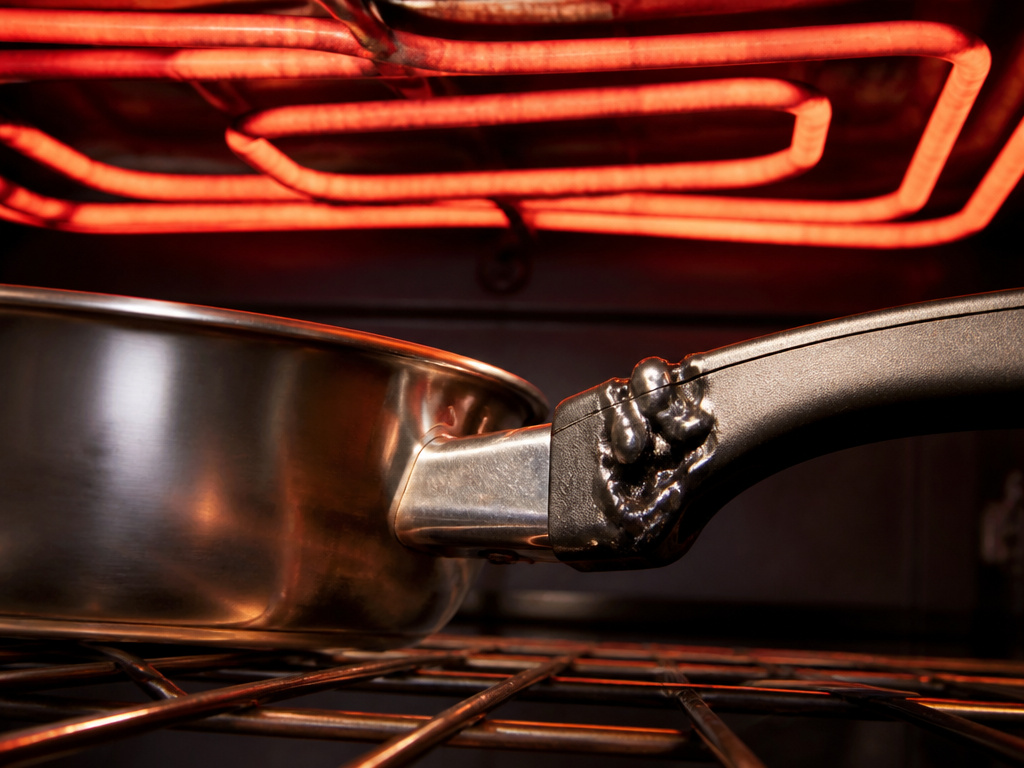
This is the distinction that destroys pans. Oven heat is ambient, it surrounds the pan evenly. Broiler heat is direct, radiant heat from above, like holding a pan six inches from a blowtorch.
Most non-stick pans should avoid the broiler entirely. The intense, direct radiation can overheat the coating even if the oven’s air temperature is within the pan’s rating. The coating blisters, discolors, and fails. The rule is simple: unless the manufacturer explicitly states “broiler-safe,” assume your non-stick pan is not.
What about other materials? All-metal stainless steel, cast iron, and carbon steel pans are typically broiler-safe because there’s no coating to damage. However, you must ensure the handle is also all-metal. A stainless steel pan with a stainless handle, like the Made In stainless steel frying pan, can handle the broiler. A pan with any plastic, silicone, or epoxy in the handle cannot.
Where this goes sideways: Using a pan under the broiler because it’s “oven-safe to 500°F.” The broiler’s radiant heat can create localized temperatures on the pan’s surface far above the oven’s set temperature, melting handles or degrading coatings that would have been fine in a 500°F bake.
Always look for a separate “broiler-safe” designation on the pan’s packaging or spec sheet. If you don’t see it, don’t risk it.
Specific Brand and Model Ratings You Can Trust
General guidelines are useful, but real decisions happen with specific pans in your hand. Here are verified ratings for common models, drawn from manufacturer specifications.
| Brand & Model | Type | Rated Oven-Safe Temp | Key Limiting Factor |
|---|---|---|---|
| All-Clad D3 Stainless Steel | Stainless Steel | 600°F | None (all-metal construction). |
| Made In Carbon Steel | Carbon Steel | 1200°F | Seasoning maintenance; handle is bare metal. |
| GreenPan Rio | Ceramic Non-Stick | 350°F | Phenolic (plastic) handle. |
| All-Clad HA1 | Non-Stick (PTFE) | 500°F | PTFE coating integrity over time. |
| Anolon Advanced | Non-Stick (Hard-Anodized) | 400°F | Non-stick coating and handle design. |
GreenPan’s explicit handle-based ratings are a masterclass in clarity. According to their help center, their pans with stainless steel handles are safe to 600°F. Stainless handles with a silicone insert drop to 375°F. Phenolic handles are limited to 350°F. This tells you exactly what to look for when buying.
The All-Clad HA1 non-stick pan shows the high end of PTFE tolerance. At 500°F, it’s at the absolute ceiling for PTFE coatings. Using it regularly at that temperature will shorten its non-stick life. It’s a pan for occasional high-heat finishing, not for daily 500°F roasting.
For maximum versatility without guesswork, choose all-metal. The materials for frying pans that give the fewest headaches are stainless steel, cast iron, and carbon steel with no attached non-metal parts. A cast iron skillet or a fully stainless saucepan moves from stovetop to oven to broiler without a second thought. This is why they dominate professional kitchens.
What Happens When You Get It Wrong?
The consequences range from a ruined pan to a health hazard. Understanding the failure mode makes the safety rules stick.
Melting and warping are the most common physical failures. A plastic handle doesn’t just droop, it can drip onto your oven floor, creating smoke and a terrible smell. A pan with a bonded base (like clad stainless) can warp if placed empty in a very hot oven or under a broiler. The uneven heating causes the layers to expand at different rates, creating a permanent wobble.
Toxic fume release is the serious risk. PTFE coatings begin to decompose at temperatures above 500°F, releasing particles and gases that can cause polymer fume fever (flu-like symptoms in humans) and are lethal to birds. This is why the 500°F hard ceiling exists for traditional non-stick. Old pans made before 2013 may contain PFOA, which poses additional risks.
Thermal shock is instant and dramatic. Placing a cold glass lid into a hot oven or running a hot pan under cold water can cause immediate cracking or shattering. With metal, sudden temperature changes weaken the molecular structure, making it more prone to future warping or failure.
Never put an empty frying pan in the oven. Without food or oil to absorb and distribute the heat, the metal can overheat in spots, leading to warping on clad pans or damage to coatings on non-stick pans.
If you damage a pan, it’s often not just the coating. Warping affects heat distribution forever. A melted handle is a permanent flaw. It’s almost always cheaper to replace the pan than to repair it, which is why the pre-check is non-negotiable.
Frequently Asked Questions
Can I put a pan with a wooden handle in the oven?
No. Wood dries out, cracks, and can catch fire in the dry heat of an oven. Even if it doesn’t ignite, the glue securing the handle can fail, causing it to loosen or fall off. Pans with wooden handles, like many classic French copper models, are for stovetop use only.
My pan says “oven-safe” but has no temperature. What can I assume?
You cannot assume a temperature. A generic “oven-safe” stamp without a number is a marketing placeholder, not a specification. You must find the official temperature rating from the manufacturer’s website, product manual, or customer service. Without it, the safest assumption is a conservative 350°F limit.
Is it safe to put a non-stick frying pan in the oven at 350°F?
It can be, but you must verify two things. First, check that the specific model is rated for at least 350°F. Many are. Second, ensure the handle material is also rated for that temperature. Many non-stick pans have plastic or phenolic handles that cap out at exactly 350°F. If both conditions are met, a short bake is fine.
Can I use aluminum foil to protect a plastic handle?
This is a dangerous workaround. Aluminum foil does not insulate from heat; it conducts it. The foil will quickly become as hot as the oven interior, transferring that heat directly to the plastic handle. It may slow melting by a minute or two, but it will not prevent it. Do not rely on foil.
How do I know if my pan is broiler-safe?
Look for an explicit “broiler-safe” designation on the pan itself, its packaging, or the official product specifications. If you only see “oven-safe,” the pan is not broiler-safe. The broiler’s intense, direct heat requires more robust construction, typically all-metal with no coatings or glued components.
Are ceramic non-stick pans better for oven use?
They can be, but it’s model-specific. Some ceramic coatings, like those on Caraway pans, are rated to 550°F, which is higher than most PTFE coatings. However, ceramic pans often have the same plastic or silicone handle limitations as other non-stick pans. Always check the rating for the specific model, not just the coating type.
Before You Go
The answer isn’t a simple yes or no. It’s a checklist. Find the stamped temperature on the base. Identify the handle material, metal, plastic, or silicone. Remember that a lid and its knob have their own, lower limits. Finally, respect the brutal difference between ambient oven heat and a direct broiler.
For worry-free stovetop-to-oven cooking, your safest investment is in cookware materials with all-metal construction. A stainless steel skillet like the All-Clad D3 or a seasoned cast iron skillet won’t just survive the oven; it will thrive there for decades. For everything else, know its limits, and never push past the weakest link.
