
Can You Soak a Cast Iron Skillet? Experts Reveal the Truth
This post contains affiliate links. As an Amazon Associate, we earn from qualifying purchases.
You can soak a cast iron skillet, but only under specific conditions. For traditional bare cast iron, most manufacturers explicitly advise against soaking to prevent rust and seasoning damage. However, some OEM manuals permit short, warm-water soaks of 15–20 minutes to loosen food, and all warn that submerging a hot pan in cold water (thermal shock) voids warranties and can crack the iron.
That permission for a brief soak comes with a critical timer. The risk isn’t just rust, it’s a physical crack from temperature change that no amount of reseasoning can fix.
What follows is a breakdown of the three cast iron types, the manufacturer specs that contradict common advice, and the exact steps to clean a pan when food is welded on. By the end, you’ll know whether your specific pan can handle water and for how long.
Key Takeaways
- Check your manual first. KitchenAid’s guide permits a 15–20 minute warm soak for its enameled cast iron, while Lodge and Vollrath advise against soaking bare iron entirely.
- Thermal shock voids warranties. Placing a hot skillet into cold water is listed as “abuse” in the Vollrath manual and is not covered, the pan can crack instantly.
- Heat-treated and enameled iron change the rules. Lodge’s heat-treated iron is rust-resistant and dishwasher-safe (but they still don’t recommend soaking), and enameled surfaces don’t require seasoning at all.
- Boiling water is the safer alternative. For stuck-on food, the consensus fix is to boil water in the pan for 5-10 minutes, then scrape with a plastic or wood tool.
- Dry it completely, every time. Immediate, thorough drying is the non-negotiable step after any contact with water, regardless of your pan’s type.
The 15-Minute Soak Rule (And Why It Exists)
Most blanket advice says never to let cast iron sit in water. The KitchenAid Cast Iron Cookware Use and Care Guide includes this line in its cleaning section: “Food residues can be removed by soaking with warm water for 15 to 20 minutes before washing.” This is a non-commodity data point, a manufacturer’s explicit, timed instruction that contradicts the folk wisdom.
The permission hinges on two things: water temperature and duration. A warm soak for 15–20 minutes is a controlled chemical reaction. It allows water to soften carbonized food proteins without initiating the electrochemical process that causes rust on bare iron. Go beyond that window, and moisture penetrates the microscopic pores of the seasoning, lifting the polymerized oil layer from the iron beneath.
The part nobody mentions: That 20-minute limit isn’t arbitrary. It’s roughly the time it takes for water to penetrate a well-seasoned layer and reach the raw iron underneath. Leave it for an hour, and you’ll likely see the telltale orange speckles of surface rust after drying.
This rule applies primarily to enameled cast iron or very well-seasoned traditional skillets. For a brand-new or poorly seasoned pan, even 15 minutes is too long. Your first line of defense for stuck food should always be the boil-out method.
The Boil-Out Method: A Soak Alternative That Always Works
When a soak feels too risky, boiling water in the pan is the universally approved, manufacturer-endorsed alternative. This method uses heat and steam instead of time.
- Add water: Pour about an inch of water into the dirty, cooled skillet.
- Simmer: Place the skillet on a burner and bring the water to a gentle simmer for 5-10 minutes. Use a wooden spoon to scrape at the stuck bits as they loosen.
- Scrape and rinse: Carefully pour out the water and use a plastic pan scraper or stiff nylon brush to remove the softened debris.
- Dry immediately: Rinse with hot water and dry the pan thoroughly with a towel, then place it on a warm stovetop burner for 5 minutes to evaporate any residual moisture.
This process is directly recommended in the Vollrath Cast Iron Care and Use guide: “If food debris is stuck to the cookware, fill the cookware with water and boil to loosen the food.” It achieves the same goal as soaking, loosening bonds, without the prolonged water exposure. It’s the safest way to clean a burnt skillet when scrubbing alone fails.
The Thermal Shock That Voids Warranties
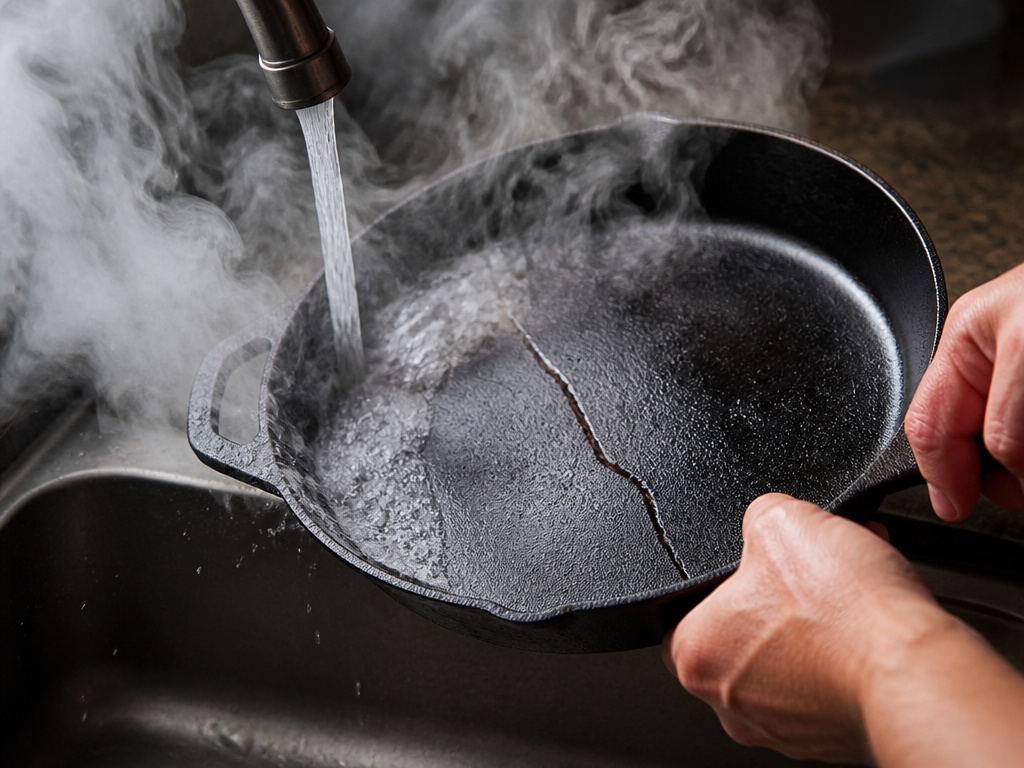
The greater danger than a careful soak is thermal shock. This is when a sudden, drastic temperature change causes the dense iron to expand or contract unevenly, creating stress cracks.
The Vollrath manual is blunt. In its “Washing” section, a notice states: “Do not fill hot cast iron cookware with or soak in cold water. This can damage the cookware. This type of abuse is not covered under warranty.” The document is dated Part No. 351329-1 ml 10/8/18, making this a specific, sourced manufacturer stance.
Where this goes sideways: Taking a searing-hot pan off the stove and running it under the tap. The exterior cools and contracts instantly while the interior remains expanded. The result is often a hairline crack near the rim or a full warp that prevents the pan from sitting flat. The damage is immediate and irreparable.
The same warning appears in other care guides. It’s the reason the universal first step in any proper cleaning is to let the pan cool completely before it touches water. This isn’t just about protecting seasoning; it’s about preserving the structural integrity of the cookware itself. A warped pan is a candidate for the recycling bin, not the reseasoning rack.
What Your Warranty Actually Covers (And What It Doesn’t)
| Scenario | Likely Warranty Coverage | Reason |
|---|---|---|
| Thermal shock crack | Not covered (Vollrath explicitly cites this as abuse) | User-induced damage from improper handling. |
| Enamel chipping from factory defect | Potentially covered | Defect in materials or workmanship. |
| Rust forming after normal hand wash & dry | Not covered | Considered a maintenance issue, not a product failure. |
| Handle loosening under normal use | Potentially covered | Could indicate a manufacturing flaw in the attachment. |
Manufacturer warranties typically cover defects in materials and craft. They do not cover damage from misuse, which includes thermal shock, dishwasher use, or using metal utensils on enamel. Understanding this distinction is a key part of learning how to maintain a cast iron skillet for the long term.
Not All Cast Iron Is Created Equal: 3 Types, 3 Rules
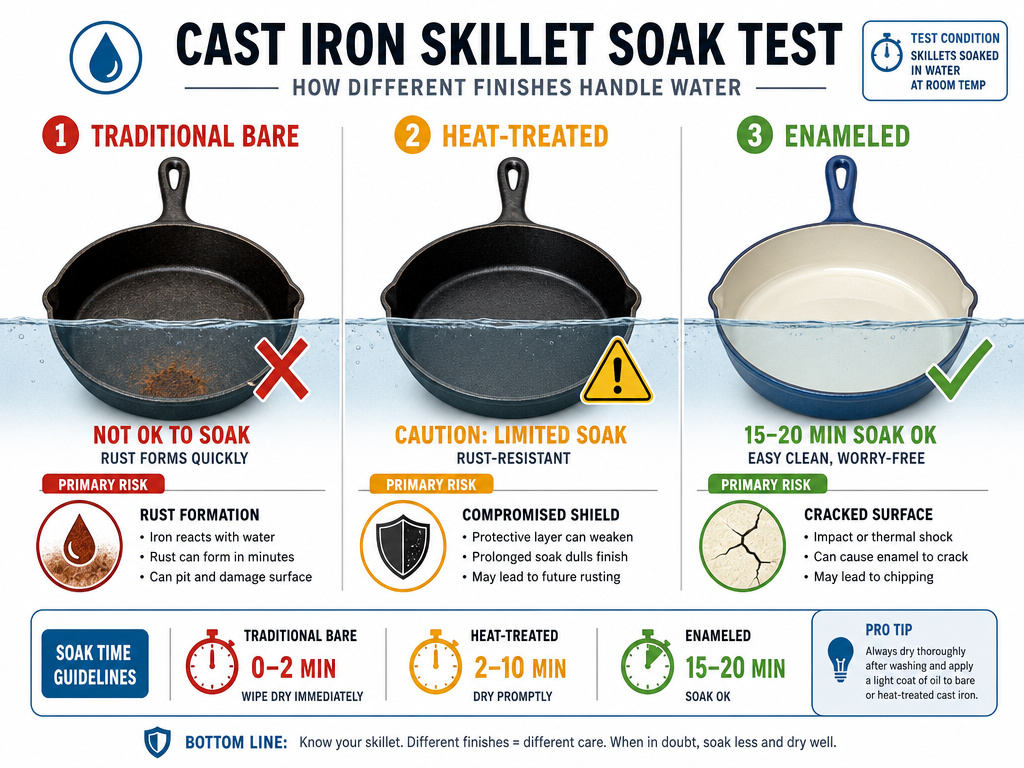
The “never soak” rule is a one-size-fits-all answer that doesn’t fit all. Your pan’s construction dictates its relationship with water.
1. Traditional Bare Cast Iron (e.g., standard Lodge skillet)
This is the classic, black, seasoned pan. The rule here is strictest. Lodge’s care pages consistently advise against soaking. Water is the enemy of the polymerized coating that provides non-stick properties. Prolonged contact leads directly to rust, which then requires you to remove rust and reseason. Immediate drying is non-negotiable.
2. Heat-Treated Cast Iron (e.g., Lodge Heat-Treated Serveware)
This is a game-changer. Lodge subjects this iron to a patented high-temperature process that alters its molecular structure, making it rust-resistant. The company states it is even dishwasher-safe. However, their guidance still includes: “we do not recommend soaking your pan.” The resistance isn’t absolute immunity. For stubborn food, they recommend a nylon brush and warm water. This type forgives more mistakes but still benefits from dry storage.
3. Enameled Cast Iron (e.g., KitchenAid, Le Creuset, Staub)
This is cast iron coated in a glass-like enamel. There is no seasoning to protect. The KitchenAid manual notes its enamel is “dishwasher durable” and colorfast. Soaking is explicitly permitted for cleaning. The primary risk here isn’t rust; it’s thermal shock (which can crack the enamel) or chipping from impact. You can wash with soap freely on these pans.
| Cast Iron Type | Can You Soak? | Primary Risk | Seasoning Required? |
|---|---|---|---|
| Traditional Bare | Not recommended | Rust, seasoning damage | Yes, constantly |
| Heat-Treated | Not recommended (but rust-resistant) | Compromising factory finish | Pre-seasoned, maintain occasionally |
| Enameled | Yes (15-20 min warm soak) | Thermal shock, enamel chips | No |
The Right Way to Clean & Dry After a Soak (Or Any Wash)
If you’ve determined a short soak is appropriate for your pan, the post-soak protocol is critical. This is where most people ruin a cast iron skillet, not with the water, but with the aftermath.
- Scrub gently. Use a nylon brush, scrubby sponge, or plastic scraper. For enamel or heat-treated iron, a small amount of mild dish soap is fine. For traditional iron, many still avoid soap, though modern, mild soaps are generally considered safe and won’t strip a well-established seasoning.
- Rinse with hot water. This helps evaporate moisture faster.
- Dry with a towel, then with heat. Wipe the pan completely dry with a dish towel. Then, place it on a low stovetop burner for 5-10 minutes until all traces of moisture are gone. You should see no water beading or feel no cool spots.
- Apply a micro-thin layer of oil (for bare iron). Once the pan is warm and dry, add a few drops of neutral oil to a paper towel. Wipe the entire interior surface, then use a clean towel to buff off almost all of it. The pan should look matte, not greasy. This step replenishes the protective layer and prevents skillet rust.
Skipping the heat-dry step is the most common error. Air-drying guarantees residual moisture, which is all it takes to start oxidation overnight. That thin coat of oil is your insurance policy.
When Things Go Wrong: Rust and Gunk
Even with perfect care, issues arise. Here’s the fast fix for two common problems:
- Spot Rust: Don’t panic. For small spots, use a Lodge Rust Eraser on a cool, dry pan, then wash and dry. For larger areas, a paste of salt and water or a mild vinegar solution can help scrub it away. After rust removal, you may need to cure a cast iron skillet again in the oven.
- Sticky, Gummy Surface: This is from too much oil during seasoning. It hasn’t polymerized; it’s just baked-on grease. Scrub the pan with warm, soapy water to remove the excess, then dry and re-season with a much thinner layer of oil.
Knowing how to safely scraping your cast iron skillet with a plastic or wood tool is part of essential skillet maintenance. Metal utensils can gouge the seasoning on bare iron or chip enamel.
Frequently Asked Questions
Can you soak a cast iron skillet overnight?
Absolutely not. Soaking a traditional cast iron skillet overnight is a surefire way to cause severe rust and strip the seasoning. Even rust-resistant heat-treated iron shouldn’t be subjected to this. If food is that stuck, use the boil-out method.
Does soaking ruin cast iron seasoning?
Yes, prolonged soaking breaks down the polymerized oil seasoning on bare cast iron. Water seeps into the microscopic pores of the coating, causing it to lift and flake off. A short, warm soak of 15-20 minutes on a well-seasoned pan is less risky, but boiling water is a safer alternative.
Can enameled cast iron be soaked?
Yes, enameled cast iron like KitchenAid or Le Creuset can be soaked in warm water for short periods (15-20 minutes as per some manuals) because it has no oil-based seasoning to protect. The main risk is thermal shock or chipping the enamel, not rust.
How do you dry a cast iron skillet completely?
After rinsing, towel-dry it thoroughly. Then, place it on a low stovetop burner for 5-10 minutes until the entire pan is warm to the touch and all moisture has evaporated. This heat-drying step is non-negotiable for preventing rust.
What if my cast iron skillet already has rust?
Small rust spots are fixable. Scour the area with a Rust Eraser, salt, or a mild abrasive until the rust is gone, wash the pan, dry it completely with heat, and then apply a thin layer of oil. For extensive rust, you may need to strip and completely reseason the pan.
The Bottom Line
The question isn’t “can you,” but “should you, and for how long?” For traditional bare cast iron, the answer leans heavily toward no, use the boil-out method instead. For enameled or heat-treated iron, the rules relax, but the timer and temperature warnings still apply.
The real insight from the manufacturer manuals is the specific, sanctioned 15–20 minute window and the stark warning that thermal shock is considered abusive, warranty-voiding behavior. Your pan’s longevity depends less on avoiding water entirely and more on managing time, temperature, and, most crucially, ensuring bone-dry storage every single time.
