
Do You Put Water in a Slow Cooker? The Crucial Liquid Guide
This post contains affiliate links. As an Amazon Associate, we earn from qualifying purchases.
You need liquid in a slow cooker, but the amount is not a recipe suggestion. The USDA and every manufacturer’s manual require a minimum liquid level to generate enough steam for safe, even cooking. A slow cooker must reach at least 185°F to keep food out of the temperature danger zone where bacteria multiply. Most models specify filling the ceramic pot at least half-full but no more than three-quarters full.
That 185°F target is not a guess. It’s the threshold from a Michigan State University Extension safety test. If your slow cooker can’t hit it with water, it cannot cook food safely. The rest of the rules, thawing meat first, not lifting the lid, adjusting for altitude, all depend on that baseline heat.
What follows is the breakdown of why the liquid rule exists, the exact fill levels for brands like Breville and Gourmia, and the one water test that tells you if your appliance is still safe to use. This is about preventing foodborne illness, not just making a tender roast.
Key Takeaways
- A slow cooker must reach 185°F to 200°F on the low setting to cook food safely; a simple water test verifies this.
- Manufacturer manuals (Breville, Gourmia, Kogan) universally state the ceramic pot should be at least half-full and no more than three-quarters full of food and liquid.
- Never start with a cold ceramic pot straight from the refrigerator; thermal shock can crack it.
- High humidity and altitude can extend cooking times by an hour or more, requiring more liquid to compensate.
- If a recipe calls for less than a cup of liquid for a large cut of meat, treat it as an exception, not the rule, most meals need the steam.
The 185°F Safety Test
Your slow cooker’s job is to heat food fast enough to escape the bacterial danger zone, 40°F to 140°F, and hold it at a safe temperature for hours. The benchmark for that safe temperature is 185°F.
To test your slow cooker’s heating capacity: fill it one-half to two-thirds full with water, heat it covered on low for eight hours, then check the water temperature with a food thermometer. The temperature should be 185°F to 200°F. If it’s below 185°F, the slow cooker does not heat food properly to avoid foodborne illness. , Michigan State University Extension, “Cooking Safely With a Slow Cooker”
This test is non-negotiable for food safety. A unit that can’t hit 185°F with water will never get a dense roast or stew through the danger zone quickly enough. The steam generated by the liquid is what carries the heat evenly. Without sufficient liquid, you create hot spots next to the heating element and cold pockets in the center of the food.
The USDA slow cooker safety guide underscores that keeping the lid on is part of maintaining this temperature. Every time you lift the lid, you release a massive amount of steam and heat, dropping the internal temperature by 10-15 degrees. It can take the appliance 20 minutes to recover. Peek only when absolutely necessary.
The “Quarter-Full” Rule and Why It Exists
Every manufacturer manual repeats a version of the same fill guideline. It’s not about recipe creativity. It’s about physics and safety.
| Brand & Model | Minimum Fill | Maximum Fill | Reason Cited |
|---|---|---|---|
| Breville BSC650 | Half-full | Three-quarters full | Prevents spillover, ensures even simmering |
| Gourmia GSC517 | Not specified | Three-quarters full | Prevents spillover, allows proper simmer |
| Kogan KAD-5KSC6222ASS | Half-full for best results | Not specified | Ensures adequate thermal mass for cooking |
The lower limit, half-full, ensures there’s enough thermal mass (food and liquid) for the heating element to work against. A nearly empty pot heats too quickly and unevenly, potentially cracking the ceramic and overcooking the small amount of food. The upper limit, three-quarters full, leaves room for the simmering action. Liquids expand as they heat, and starchy foods like beans or pasta foam. Exceed the line, and you’ll have a sticky, burned mess leaking onto the base.
Common mistake: Filling a slow cooker to the brim with broth and vegetables. By the two-hour mark, the simmering liquid has nowhere to go but over the rim, dripping into the housing and creating a cleanup hazard, and a potential electrical one.
This rule directly impacts your choice of appliance size. A 6-quart slow cooker making a 2-quart soup violates the half-full rule. That’s when you reach for a 3.5-quart model or double the recipe. Understanding how a slow cooker works clarifies why size matching matters: the heating coils wrap around the base and lower sides, transferring heat through the ceramic. Too little mass, and the heat has nowhere to go but into the pot itself.
When You Can (Carefully) Break the Liquid Rule
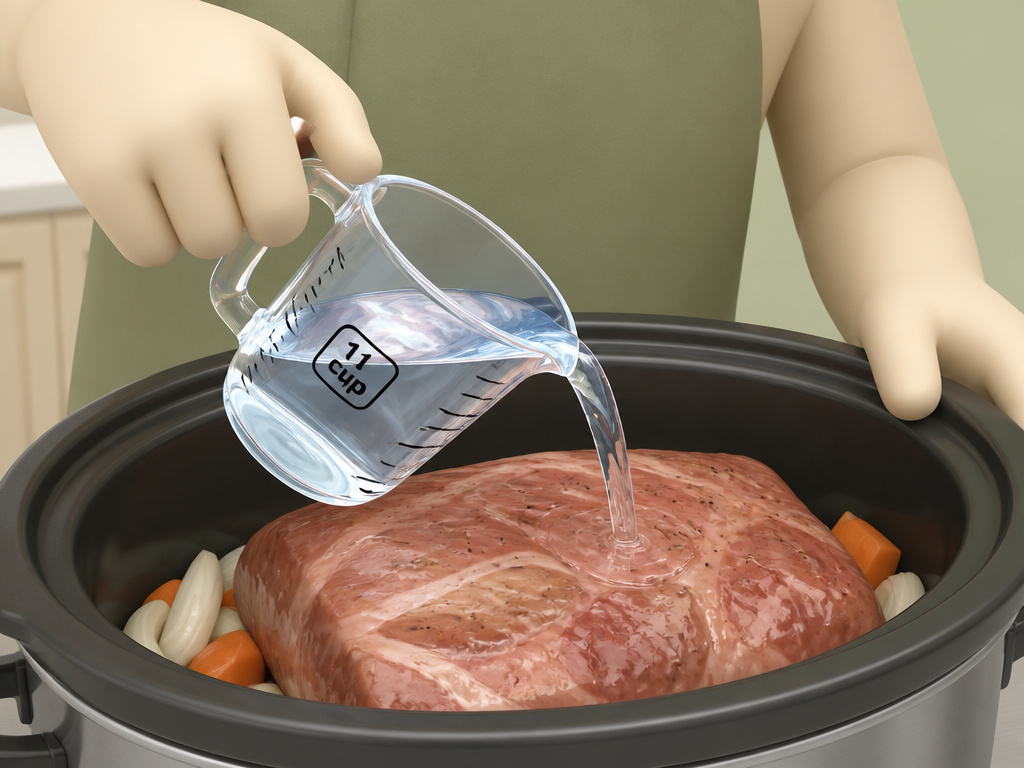
Some recipes, like a whole chicken or a fatty pork shoulder, produce a significant amount of their own juices during cooking. A user on Seasoned Advice documented cooking a 3.5 lb corned beef with vegetables using only a half cup of liquid successfully. These are the exceptions, and they come with strict conditions.
You can reduce added liquid only when: 1. The main ingredient is naturally high in moisture (most meats, poultry, watery vegetables like zucchini). 2. You are not using absorbent ingredients like rice, beans, or pasta that will soak up all available liquid. 3. The slow cooker is filled to at least the halfway point with these moist ingredients.
Even then, adding at least a cup of broth, wine, or water is cheap insurance. It guarantees a base of steam from the start and gives you a built-in sauce or gravy. The difference between a succulent pot roast and a dry, stringy one is often just that initial cup of liquid creating a humid environment.
This principle is similar to, but distinct from, the requirements of a pressure cooker, which needs a minimum amount of water solely to create steam for pressure. A slow cooker needs liquid primarily for heat transfer and moisture.
The Four Non-Negotiables for Safe Slow Cooking
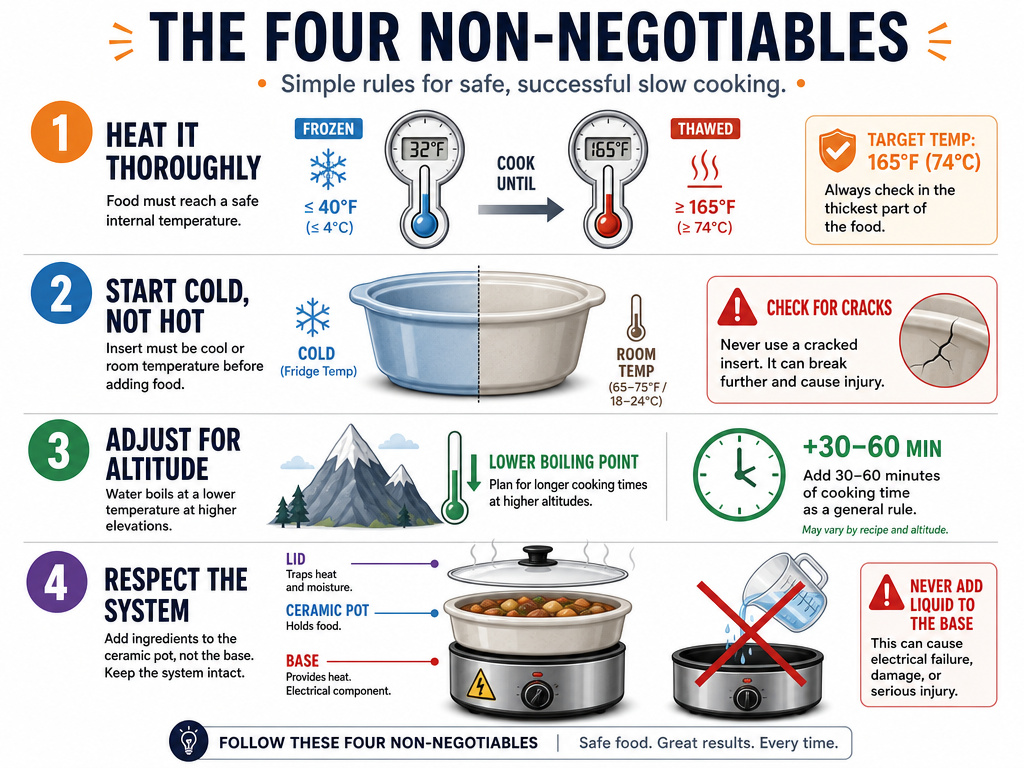
Beyond the water question, four other rules prevent ruined meals and food safety risks. Get these wrong, and no amount of liquid will save the dish.
- Always thaw meat completely. A frozen roast in the center of your pot acts as an ice cube, keeping the surrounding food in the danger zone for far too long. Pathogens grow quickly between 40°F and 140°F. Thaw in the refrigerator, never on the counter.
- Start with a room-temperature ceramic pot. Taking the stoneware insert from the fridge and placing it directly into the heated base is a classic crack-and-break scenario. The Kogan manual explicitly warns against this. Let the insert sit on the counter for 30 minutes if it’s been chilled.
- Factor in your environment. The Breville manual notes that “high humidity, altitude, and minor fluctuations” affect cooking times. At high altitude, water boils at a lower temperature, so reaching that 185°F safety target takes longer. You may need to add an extra 30-60 minutes to cooking times or use slightly more liquid.
- Never use the base for cooking. The metal housing is not a cooking vessel. The slow cooker is a system: the base heats, the ceramic pot holds the food, the lid traps steam. Pouring liquid or food directly into the base is a direct electrical hazard and will destroy the appliance.
These rules form the foundation of using any slow cooker safely. They explain why a good slow cooker has a heavy, well-fitting lid and a stoneware pot with consistent thickness, it’s all about maintaining that critical thermal equilibrium.
Troubleshooting: Too Much or Too Little Liquid
You followed a recipe, but the result is a swamp or a brick. Here’s how to diagnose and fix liquid issues during and after cooking.
Problem: Soup is too watery after cooking.
- Fix on HIGH: Remove the lid and run the slow cooker on the high setting for 30-45 minutes to allow evaporation. Stir occasionally.
- Fix with Slurry: Mix one tablespoon of cornstarch with two tablespoons of cold water. Stir this slurry into the hot liquid in the pot. It will thicken within 10-15 minutes on high.
Problem: Stew at the bottom is scorched; top is undercooked.
- Cause: This is a classic sign of insufficient liquid. The heat couldn’t circulate.
- Fix: For future cooks, increase liquid by at least a cup. For now, carefully transfer the unscorched top portion to a new pot, add a cup of broth or water, and finish cooking on the stove. Do not scrape the burned bottom into the new pot.
Problem: No liquid left; meat is dry.
- Cause: The lid was not sealed properly, or it was removed too often, letting all the steam escape. Alternatively, the cooking time was too long for the amount of liquid.
- Fix: For next time, check the lid’s seal. If the rubber gasket is cracked or the lid is warped, it’s time for a replacement. Consider a model with an automatic sealing lid from our list of best slow cookers.
Remember, a slow cooker is a closed system. The amount of liquid you start with is largely what you finish with, minus a small amount of evaporation. If you’re consistently ending up with too much or too little, your starting measure is the variable to change.
Frequently Asked Questions
Can a slow cooker boil water?
Yes, but not rapidly like a kettle. On the high setting, a functioning slow cooker will eventually bring water to a simmer (around 200°F). It will not achieve a rolling boil. This is by design to prevent scorching during long, unattended cooks. For more on thermal limits, see our article on whether a slow cooker can boil water.
Is it safe to put raw meat and vegetables in a slow cooker?
Yes, that’s its primary function. The key is ensuring the cooker reaches a safe temperature quickly. This is why the minimum fill level is critical. A half-full pot with a roast and vegetables covered in liquid will heat safely. A single chicken breast with a splash of broth may not.
Do you put water in the bottom of a slow cooker?
Never. The only thing that should be in the metal base housing is the ceramic cooking pot. Adding water to the base is an electrical shock hazard and can permanently damage the heating element. This is different from a roaster oven, which often uses a water pan to create steam.
How much water do you put in a slow cooker for a roast?
General rule is at least one to two cups of liquid for a 3-4 pound roast. The liquid should come about one-third to halfway up the sides of the meat. This provides enough moisture for steam and braising without boiling the meat.
Can you overcook food in a slow cooker?
Absolutely. While slow cookers are forgiving, proteins like chicken breast or lean pork can become dry and stringy after 8 hours on low. Dense vegetables like potatoes and carrots can turn to mush. Most meals have a ideal window, often 6-8 hours on low or 3-4 hours on high. A programmable cooker that switches to “keep warm” is the best defense.
The Bottom Line
The water in your slow cooker isn’t just an ingredient; it’s the medium for safe heat transfer. Ignore the half-full minimum, and you risk foodborne illness. Ignore the three-quarters full maximum, and you’ll have a boil-over mess. Start every cooking session by ensuring your appliance passes the 185°F water test. Then, match the liquid to your recipe, your ingredients, and your environment. A cup of broth is a small price for safety and a guaranteed succulent result. That’s the difference between hoping dinner turns out and knowing it will.
