
How Does a Pressure Cooker Work? Key Safety Specs Explained
This post contains affiliate links. As an Amazon Associate, we earn from qualifying purchases.
A pressure cooker works by trapping steam inside a sealed pot, which raises the internal pressure. This higher pressure elevates the boiling point of water from 100°C (212°F) to between 115–121°C (239–250°F), cooking food significantly faster. Modern units maintain specific pressures, like 0.6 bar or 15 psi, via a weighted or spring-loaded regulator and are protected by redundant safety valves.
That temperature jump is the whole game. It turns a two-hour braise into a 45-minute weeknight dinner. But the mechanism isn’t magic; it’s a simple physical principle harnessed by a specific set of components.
What follows is a breakdown of those components, the exact pressures and temperatures they create, and the non-negotiable safety systems that make the process reliable. You’ll see why that minimum water line matters more than any recipe timing.
Key Takeaways
- The sealing ring and locked lid create the initial seal; without it, pressure never builds.
- Gauge pressure, the pressure above atmospheric, determines your cooking temperature. Common settings are 0.7 bar (~10 psi) for 114°C or 1.0 bar (~15 psi) for 121°C.
- Never skip the minimum liquid requirement (often 0.25 litres). An underfilled pot can overheat, damage the cooker, and trigger safety releases.
- Modern safety is a three-layer system: a primary pressure regulator, a secondary safety valve, and a final backup safety pressure window.
- Altitude changes everything. At 2,000 meters, water boils at 93°C. A pressure cooker restores a sea-level effective cooking temperature.
The Core Mechanism: Pressure, Temperature, and a Locked Lid
Forget the food for a moment. A pressure cooker is a simple physics lab. You have a pot, a locking lid, a rubber seal, and a small hole with a weight on it.
A pressure cooker raises the boiling point of water by increasing the internal pressure. At sea level, a typical high-pressure setting of 1 bar (100 kPa) gauge pressure results in an internal temperature of approximately 121°C (250°F). This is achieved by a sealed vessel and a pressure-regulating valve that maintains the set pressure by releasing excess steam.
The process starts cold. You add food and liquid, at least 0.25 litres as the IKEA 365+ manual mandates, and lock the lid. As the pot heats, the liquid boils. Steam expands, but with the lid sealed and the regulator initially open, air is pushed out. Once the air is purged, the rising steam pushes the regulator closed. Now the vessel is sealed.
Steam continues to generate. Since it can’t escape, the molecules pack tighter, increasing the pressure inside the pot. According to the phase diagram of water, higher pressure directly raises the boiling point. The water inside no longer boils at 100°C; it must get hotter to make steam, so the entire cooking environment superheats.
This is the faster cooking engine. Proteins denature quicker, starches gelatinize faster, and connective tissue in meats breaks down in a fraction of the time.
The Critical Components (And What Breaks)
Every part has one job. If one fails, the next one should catch it.
The Sealing Ring (Gasket)
This rubber or silicone ring sits in a channel on the underside of the lid. It compresses against the pot rim to form an airtight seal. It’s the first and most vulnerable part of the system.
Where this goes sideways: A hardened, cracked, or food-flecked gasket leaks steam from the lid’s edge. The cooker never reaches full pressure, and your cooking time stretches out indefinitely. A leak here also constantly vents water vapor, risking a boil-dry scenario.
Check it before every use. It should be pliable and clean. Most manufacturers recommend replacement every 12-18 months with regular use.
The Lid Lock
This is a bayonet or interlock mechanism that physically prevents the lid from being opened while internal pressure exists. The Indian Standard IS 2347 mandates that the fastening device must prevent lid release until pressure falls below 0.18 bar.You cannot force it open when it’s pressurized.
The Pressure Regulator
This is the traffic cop. It’s a weighted valve or a spring-loaded piston that sits over the vent pipe. Once the internal pressure matches its set weight or spring tension, it lifts slightly, releasing just enough steam to maintain that pressure.
- Weighted Jigglers: Common on classic models like the Presto 01264. The weight rocks or jiggles, releasing periodic puffs of steam.
- Spring-Valve Regulators: Found on many European and modern electric models. They are quieter and often have multiple pressure settings (e.g., IKEA’s 0.6 bar and 1.0 bar).
The regulator maintains the gauge pressure, the pressure above the surrounding atmosphere. That’s the number that matters for cooking.
| Pressure Setting | Gauge Pressure | Approx. Temperature | Best For |
|---|---|---|---|
| Low / Setting 1 | 0.6–0.7 bar (8-10 psi) | 114–116°C (237–240°F) | Delicate vegetables, fish, fruits |
| High / Setting 2 | 1.0 bar (15 psi) | 121°C (250°F) | Meats, beans, stocks, most recipes |
Modern Safety Systems: A Redundant Trio
Fear of explosion is the main reason pressure cooker ownership dropped from 37% of U.S. Households in 1950 to 20% by 2011. Modern engineering has addressed this with overbuilt, redundant safety.
The IKEA 365+ manual clearly outlines a three-layer system, which is representative of most quality cookers:
- The Pressure Regulator: The primary control. It should keep pressure constant. Some continuous steam escape here is normal.
- The Safety Valve: A secondary, independent outlet. If the regulator fails shut and pressure keeps rising, this valve is designed to blow open first, releasing a large amount of steam with a loud hiss. It’s a resettable warning.
- The Safety Pressure Window: The last resort. If both the regulator and safety valve fail, a sealed metal disc in this window will deform or rupture, creating a permanent, large opening to safely vent all pressure. The cooker is typically rendered unusable afterward.
Before you start: Always point the pressure regulator away from yourself and any walkways. If the safety valve releases or the safety window ruptures, a jet of superheated steam will erupt from that spot. Turn off the heat immediately and let the cooker sit, untouched, until it’s completely depressurized.
This layered approach is why a modern pressure cooker safety incident is exceedingly rare when the device is used correctly. The standards are stringent. The IS 2347 standard requires the vessel itself to withstand a bursting pressure of at least six times its nominal cooking pressure.
What You Can (And Absolutely Cannot) Cook
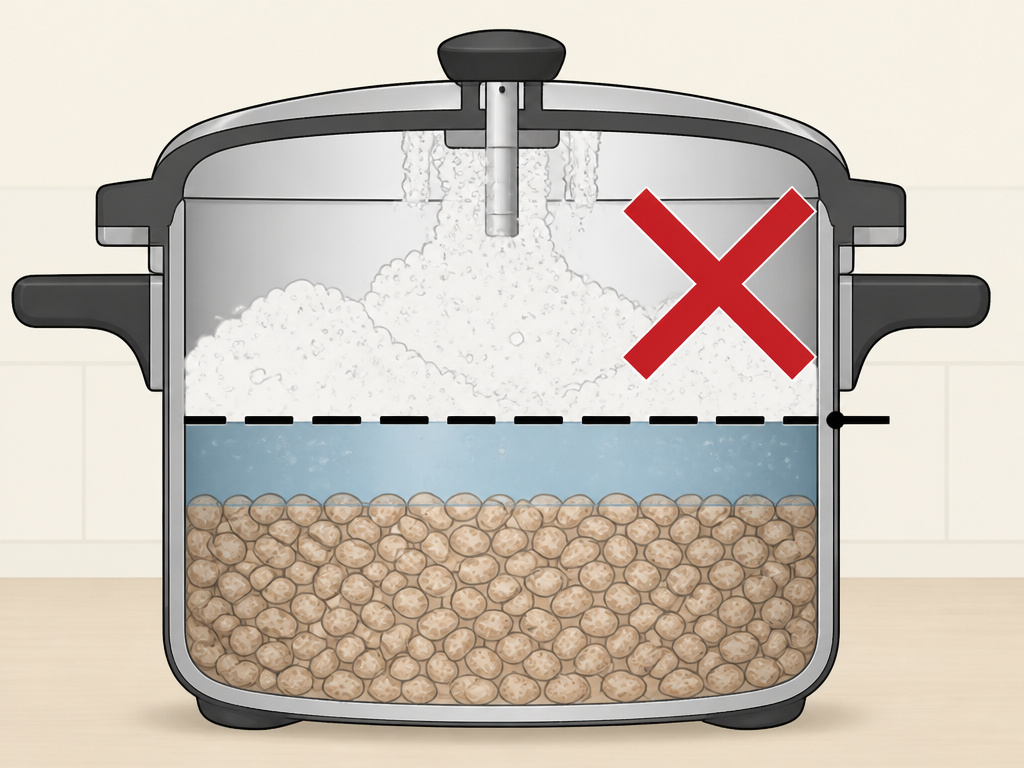 The system has limits defined by physics, not recipe books.
The Liquid Rule is Non-Negotiable
You must have enough water to generate steam for the entire cooking cycle. The minimum liquid level, often 1/2 cup or 0.25 litres, is a safety spec, not a suggestion. Operating without sufficient liquid lets the pot overheat, which can warp the base, melt the gasket, and force the safety systems to engage.
The Fill Line is a Physics Limit
Even with enough liquid, you cannot overfill the pot. Most manuals state a maximum fill line at two-thirds capacity for general cooking. For foods that foam (beans, oatmeal, pasta) or expand (rice, dried legumes), the limit is half full.
Common mistake: Filling a pot halfway with dry beans and then adding water. The water requirement is separate. The total volume of beans plus water must not exceed the half-full line. Presto manuals explicitly warn that exceeding this when cooking dry beans can clog the vent pipe with foam, a primary cause of safety valve activation.
The Altitude Adjustment
This is where a pressure cooker proves its genius. At 2,000 meters, atmospheric pressure is lower, so water boils at about 93°C. Food cooks slower. But inside a sealed pressure cooker, the gauge pressure is what sets the temperature. While the absolute pressure inside will be lower, the cooker still creates a higher cooking temperature relative to the outside.
Most manuals include altitude adjustment charts, often requiring a 5-20% increase in cooking time and sometimes a touch more liquid. The Siemens pressure cooker explainer uses this exact scenario to teach the underlying physics.
Pressure Cooker vs. Multi-Cooker: What’s the Difference?
 Your Instant Pot is a pressure cooker. But not all pressure cookers are an Instant Pot.
A traditional stovetop pressure cooker is a single-function tool. You control the heat manually to bring it to pressure and then maintain it. An electric pressure cooker like the Instant Pot or Power Pressure Cooker XL integrates the heat source and a computer. It automates the come-to-pressure time, holds a precise temperature, and often includes other functions like slow cooking and yogurt making.
The core pressure cooking mechanism is identical. The electric model just manages the process for you, which can be a significant safety and convenience benefit for new users. For a deep dive on these versatile appliances, see our article on the benefits of a multi-cooker.
Frequently Asked Questions
Does a pressure cooker work without water?
No. Water is the working fluid. It turns to steam to create the pressure. Running a pressure cooker without the minimum liquid level risks overheating and severe damage. Always ensure at least the manufacturer-stated minimum, typically 0.25 to 0.5 litres.
Can a pressure cooker explode?
Modern pressure cookers with intact safety systems are designed to prevent explosion. They have multiple redundant pressure-release mechanisms (regulator, safety valve, safety window). The safety of modern pressure cookers is high, provided you keep the vents clean, replace worn gaskets, and follow the manual’s fill limits.
What is the natural release method?
Natural release means turning off the heat and letting the pressure drop on its own as the cooker cools, which can take 10-25 minutes. It’s essential for foods that foam (like beans) or are mostly liquid (like soups), as a quick release can cause liquid to surge up and clog the vent pipe.
How do I use a pressure cooker as a steamer?
Use the steaming function by employing a trivet or steamer basket to keep food above the water line. Add water according to your manual (usually 1-2 cups), place the food on the rack, and pressure cook as usual. The steam circulates around the food, cooking it gently and evenly.
Is high pressure always better?
Not always. The high pressure setting (around 1 bar/15 psi) is for most meats and beans. The low setting (around 0.7 bar/10 psi) is better for delicate foods like fish, asparagus, or peaches, where the higher temperature of the high setting can turn them to mush.
The Bottom Line
A pressure cooker is a sealed pot that uses steam pressure to raise cooking temperature, governed by a regulator and protected by backup valves. The real skill is straightforward operation.It’s in respecting its limits: the minimum water, the maximum fill, and the condition of the gasket.
For weeknight cooks, an electric model like the Instant Pot automates the vigilance. For purists who want direct heat control, a stovetop model like the stainless steel IKEA 365+ or an aluminum Presto gets the job done. Both rely on the same century-old principle, now wrapped in engineering that makes the process safe, fast, and utterly reliable.
