
How Do You Clean a Rusty Wok? Settling the Scrubber Debate
This post contains affiliate links. As an Amazon Associate, we earn from qualifying purchases.
To clean a rusty wok, you must physically scrub off the rust, dry the metal completely, and immediately re-season it. Use an abrasive scourer or steel wool for light rust, or a vinegar soak for heavy rust. The critical step is drying the wok on the stove after washing, air-drying guarantees flash rust within hours. Re-seasoning with a high-smoke-point oil like canola or grapeseed creates a protective polymerized layer that prevents rust from returning.
That drying step is the whole game. Rust is iron oxide, and it forms when bare carbon steel meets oxygen and water. Your wok is not ruined; it’s just reacting exactly as raw iron should. The process of restoring it is mechanical, not magical.
What follows: a breakdown of the scrubber debate manufacturers can’t agree on, the exact three-step removal process, and the re-seasoning method that sticks. You’ll also learn the single maintenance habit that stops rust from ever starting again.
Key Takeaways
- Scrub rust with steel wool or an abrasive pad, this contradicts some brands but is the only way to remove oxidation from the metal surface.
- Dry the wok on the stove burner for 3-5 minutes after every wash. Air-drying in a rack invites humidity and guarantees new rust spots within a day.
- Re-season immediately after drying. A thin layer of high-smoke-point oil, heated until it smokes, polymerizes into a hard, rust-proof patina.
- Avoid prolonged contact with acidic ingredients like tomato sauce or vinegar. A five-minute simmer can strip the seasoning and expose bare metal.
- Factory “pre-seasoning” is often just a shipping protectant. Scrub it off with soap and start fresh with your own seasoning layers.
Why Your Carbon Steel Wok Rusts (It’s Not a Flaw)
Carbon steel is mostly iron. Expose iron to water and oxygen, and you get iron oxide, rust. This isn’t a design failure. It’s the material’s natural state. A seasoned wok works because you’ve coated that reactive iron with a layer of polymerized oil that blocks moisture.
Rust happens when that protective layer is compromised. The most common causes are leaving the wok wet, storing it in a humid cabinet, or cooking acidic foods that break down the seasoning. A pre-seasoned wok from the factory gives you a head start, but that layer is thin. If you don’t dry it thoroughly after its first wash, you’ll see spots by morning.
The environment matters. A wok stored near a steamy dishwasher or in a basement will rust faster than one kept in a dry pantry. This is why understanding why woks rust is the first step to preventing it.
The part nobody mentions: Flash rust can appear in under an hour on a freshly scrubbed, bone-dry wok if the room humidity is above 60%. That’s not you doing it wrong, it’s chemistry. The fix is to move from washing to drying to oiling in one continuous, swift workflow.
The Abrasive Scrubber Debate: What the Manuals Actually Say
Here’s where manufacturer advice splits, and it’s the clearest sign of a commodity answer. Most generic guides say “use a gentle scrubber.” The OEM service manuals tell a different story.
The IKEA VARDAGEN manual explicitly says to use “steel wool or an abrasive sponge” to clean rust or burnt-on food before re-seasoning. Lakeland’s School of Wok leaflet instructs users to “scrub with an abrasive scourer to remove all the rust.” Yosukata’s restoration video shows an abrasive scrubber in use.
Then there’s Misen. Their care page advises “only non-metallic scrubbers and brushes” for general cleaning, warning that “highly abrasive materials will strip off the seasoning.”
So who’s right? Both, for different stages.
- For routine cleaning a carbon steel wok, use a non-metallic brush or sponge. This preserves your hard-earned patina.
- For removing rust, you have no choice. Rust is a physical deposit on the metal. You must abrade it off. A green Scotch-Brite pad or fine-grade steel wool (grade 00 or 000) is the tool for the job. You will strip the seasoning in that spot, that’s the point. You then rebuild it.
| Scenario | Tool Recommended | Goal | Risk if You Skip It |
|---|---|---|---|
| Light surface rust | Fine steel wool (00) or abrasive nylon pad | Remove oxidation without deep scratches | Rust spreads under seasoning, causing pitting |
| Heavy, crusted rust | Coarse steel wool or vinegar soak | Break down thick iron oxide layers | Rust becomes pervasive, requiring sandpaper |
| Burnt-on food (no rust) | Bamboo brush or stiff nylon scrubber | Lift residue without damaging patina | Carbon buildup creates sticky, uneven cooking surface |
| Routine cleaning after use | Soft sponge or brush with hot water | Maintain seasoning between cooks | Grease turns rancid, flavors transfer |
The takeaway: reach for the abrasive only when you’ve already lost the seasoning to rust. Using it daily is how you end up constantly re-seasoning and asking why is my wok sticky.
The Three-Step Rust Removal Process
This is the core physical work. You’re not cleaning the wok; you’re prepping raw metal for a new coat.
Step 1: Scrub the Rust Off
Wash the wok with hot water and a drop of dish soap. Then, take your abrasive pad and scrub the rusty areas in a circular motion. Apply firm, even pressure. You’ll see black or orange residue coming off on the pad. Rinse and check your progress. The metal should feel smooth to the touch, not gritty.
For stubborn rust, make a paste with baking soda and water or use a dedicated rust remover gel. Apply, let it sit for 10 minutes, then scrub. For a completely seized wok, a white vinegar soak (1:1 with water for 30 minutes) will dissolve the rust, but it will also strip any remaining good seasoning. This is a nuclear option.
Common mistake: Scrubbing with the grain of the metal. Always use a circular motion. Linear scratching along the steel’s grain creates microscopic channels where water and rust can hide, making your next seasoning job fail faster.
Step 2: Dry It Completely. No Exceptions
This is the non-negotiable step. Place the scrubbed wok on a stovetop burner over medium heat. Let it heat for 3-5 minutes, moving it around to evaporate water from the sides. You’re aiming for the point where all visible moisture is gone and the pan is almost too hot to touch.
Do not “dry it with a towel and call it good.” Towels leave behind lint and microscopic moisture. Do not let it air-dry. The moment the wok cools to room temperature after an air-dry, condensation forms and rust begins.
Step 3: Re-Season Immediately
While the wok is still hot (but not scorching), add about a teaspoon of a high-smoke-point oil. Canola, grapeseed, or soybean oil work perfectly. Using a wad of paper towels held with tongs, spread the oil in a thin, even film over the entire interior surface.
Now, turn the heat to medium-high. Watch for the oil to start smoking. Once it smokes lightly, keep it there for a minute, then turn off the heat. Let the wok cool on the burner. You’ve just created the first layer of polymerized oil. For a durable finish, repeat this thin-oil-and-smoke cycle 2-3 more times.
This process is the foundation of seasoning a carbon steel wok. The polymerization bonds the oil to the metal, creating that slick, black, protective patina.
Re-Seasoning vs. Maintenance: What Your Wok Actually Needs
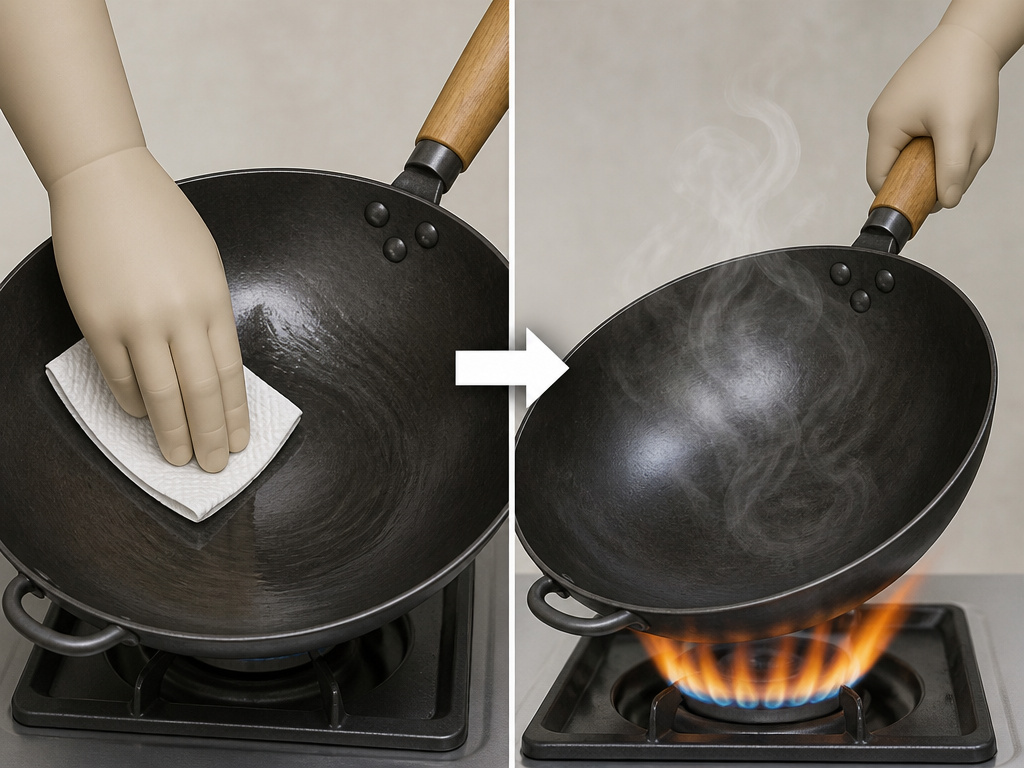
You’ve removed the rust. Now you need to protect the steel. This is where most guides blur two distinct processes: initial re-seasoning and ongoing maintenance.
Re-seasoning is building a base coat on bare metal. It requires multiple thin layers, each polymerized with heat. Think of it as primer and paint.
Maintenance seasoning is what you do after normal cooking. It’s a single, ultra-thin layer of oil applied to a warm, dry wok to fill in microscopic gaps. It’s like a protective wax coat.
| Context | Process | Frequency | Sign It’s Done |
|---|---|---|---|
| After rust removal | 3-4 layers of oil, smoked each time | Once, after stripping | Wok is a uniform dark brown or black |
| After cooking a fatty meal | Quick wipe with oiled paper towel | After each use | Surface feels slick, not dry |
| After cooking acidic food | Wash, dry thoroughly, apply one oil layer | After each use | Prevents the dull, silver spots of stripped seasoning |
| Storage (humid climate) | Light oil coat before putting away | Every few weeks if unused | No new rust spots appear |
If your wok feels sticky after seasoning, you used too much oil. The layer should be invisible, a “dry” look. Sticky means the oil pooled and polymerized into a tacky resin. The fix is to heat the wok empty until the stickiness smokes off, then wipe it down and start with a much smaller amount of oil.
For the specifics on choosing seasoning oil, remember that refined, neutral oils with high smoke points (over 400°F) polymerize best. Avoid olive oil or butter.
How to Prevent Rust from Coming Back
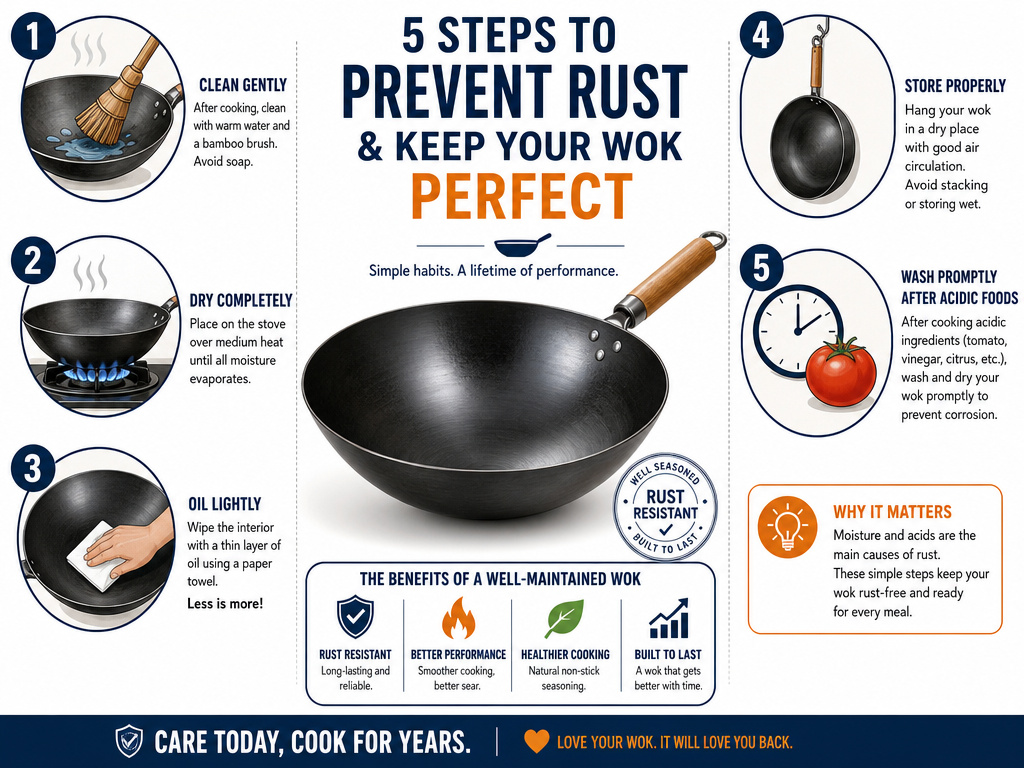
Prevention is simpler than repair. It comes down to one habit: never let your wok go to bed wet.
- Wash while warm. After cooking, let the wok cool slightly. Add hot water and use a bamboo brush to dislodge food. For cleaning a seasoned wok after sticky rice or eggs, a little soap is fine.
- Dry on the stove. Every single time. This 3-minute heat drive-off is your rust insurance.
- Oil for storage. After drying, while the wok is still warm, wipe the interior with a drop of oil on a paper towel. You’re not re-seasoning; you’re applying a protective dusting.
- Store it properly. Hang it or place it in a dry cabinet. Don’t nest it with other pans where moisture can get trapped.
- Acid awareness. Enjoy your tomato-based stir-fries. But wash and dry the wok promptly after. A five-minute simmer of an acidic sauce can, according to Yosukata’s test, begin to degrade the protective oxide layer.
This routine makes the question of how often to season mostly irrelevant. If you dry and oil it after each use, the patina maintains itself.
Frequently Asked Questions
Is it safe to cook with a wok that had rust?
After you have thoroughly scrubbed all rust off and re-seasoned the wok, it is safe. The rust itself is iron oxide, which is not highly toxic in small amounts, but it tastes terrible and indicates unprotected metal. The goal is to remove it completely, not cook over it. For a detailed look at the health implications of rust, the key is complete removal.
Can I use salt to clean rust off my wok?
Salt is a mild abrasive good for cleaning burnt-on food on a seasoned wok. For actual rust, salt alone is ineffective. You need an abrasive pad or chemical dissolver (like vinegar) to break the iron oxide bond.
Why did my new wok rust immediately?
Most new carbon steel woks, like the IKEA VARDAGEN, have a thin factory oil coat to prevent shipping rust. This is not a durable seasoning. If you don’t wash this off with soap and water and apply your own proper seasoning, that thin oil can wash away or break down, exposing bare metal. Always perform an initial seasoning on a new wok, even if it’s labeled “pre-seasoned.”
Will soap ruin my wok’s seasoning?
No. Modern dish soap is mild and will not strip properly polymerized oil. Soap is essential for removing oily film and food residue that can turn rancid. The enemy of seasoning is prolonged soaking, abrasive scouring, and acid, not a quick wash with Dawn.
What’s the difference between a black patina and rust?
Black patina is smooth, slick, and bonded to the metal. It’s polymerized oil and iron oxide (specifically, magnetite) that forms a protective layer. Rust (red iron oxide, or hematite) is flaky, rough, and orange-brown. It sits on top of the metal and actively corrodes it. One protects, the other destroys.
Before You Go
A rusty wok is a temporary condition, not a death sentence. The fix is physical effort, not a special product. Scrub it smooth, dry it with heat, and lock it down with a thin layer of smoked oil.
The real secret isn’t in the restoration; it’s in the daily drill. Wash it, dry it on the burner, give it a micron-thin oil kiss, and hang it up. Do that, and you’ll spend your time cooking instead of scrubbing. Your wok will outlive its owner, which is exactly how it’s supposed to work.
