
How Do You Measure a Cast Iron Skillet for Accurate Sizing
This post contains affiliate links. As an Amazon Associate, we earn from qualifying purchases.
To measure a cast iron skillet, place it upside down and use a rigid ruler or tape measure to find the distance across the top from the outer edge of one rim to the outer edge of the opposite rim, excluding handles. This rim-to-rim diameter is the industry-standard size. The number stamped on the handle often refers to a historical stove-eye size, not inches, so you must verify.
That single measurement tells you whether a lid will fit and gives a ballpark for recipe capacity. It also hides two other numbers that matter more: the cooking surface and the base. The cooking surface is where your food actually touches, and it’s always smaller. The base diameter is what your stove’s burner heats.
What follows: how to take all three measurements, why the stamped number is a trap, and how to use your tape measure to avoid buying a skillet that won’t fit your oven or burner.
Key Takeaways
- The rim-to-rim diameter is the official skillet size. Measure it with the pan upside down, across the widest point, ignoring handles.
- The stamped number on the handle (like “No. 10”) is a vintage sizing code for woodstove eyes, not a measurement in inches. A Lodge No. 10 skillet is 12 inches across.
- Always measure the cooking surface separately; sloped sides can reduce it by over an inch compared to the rim, which changes how much food you can actually sear.
- For induction cooktops and even heating, the base diameter is critical. It must match your burner’s active zone.
- Before buying a large skillet like the Field No. 16, measure your oven’s interior width and depth to ensure the pan and its handles will fit.
The Standard Method: Rim-to-Rim Diameter
Flip your skillet over. The top, outer edge of the pan is called the rim. The industry standard for skillet size is the distance between two opposite points on this rim.
Place a metal ruler or a rigid tape measure across the center of the pan. Press it down so it sits flat against the iron. Read the number at the farthest outer edge on the opposite side. Do not include the handle or any pour spouts in this measurement. The handle is an appendage; the rim is the circular lip the lid would sit on.
For a round skillet, measure straight across the center. Take a second measurement at a 90-degree angle. If the two numbers differ by more than 1/8 inch, your pan may be warped or oval-shaped, common in older or poorly made pieces.
This rim-to-rim number is what a recipe means by a “10-inch skillet.” It’s the number you give when shopping for a lid. It’s also the first check for oven fitment. A pan that measures 13.5 inches across the rim needs an oven with at least that much clearance from rack to wall.
Why Stamped Numbers Lie (And How to Read Them)
You see a “No. 8” or “No. 10” stamped on the handle. It’s natural to think that means 8 or 10 inches. It doesn’t. That number is a relic from the days of wood-burning stoves.
Stoves had holes called “eyes.” Cookware was numbered to match those eye sizes. A No. 10 skillet fit the No. 10 stove eye. The actual diameter in inches was a secondary concern and varied by manufacturer.
This is not academic. It’s the reason you can’t shop by the stamp. | Stamped Number | Brand & Model | Actual Rim Diameter | Source | |——————–|—————————-|————————–|————| | No. 10 | Lodge L10SK3 | 12 inches | Lodge Chef | | No. 12 | Field Company No. 12 Skillet | 13 ⅜ inches | Field Spec Sheet | | No. 10 | Field Company No. 10 Skillet | 11 ⅝ inches | Field Spec Sheet |
As the table shows, a Lodge No. 10 is a 12-inch pan. A Field No. 12 is over 13 inches. If you bought a lid for a “10-inch skillet” thinking it would fit your Lodge, you’d be off by two full inches. This is the most common frustration for new cast iron cookware owners.
The fix is simple. Ignore the stamp. Use your tape measure. The only time the number matters is if you’re hunting for a matching vintage lid from the same maker and era, a niche but rewarding part of cast iron skillet restoration.
The Two Other Measurements You Actually Need
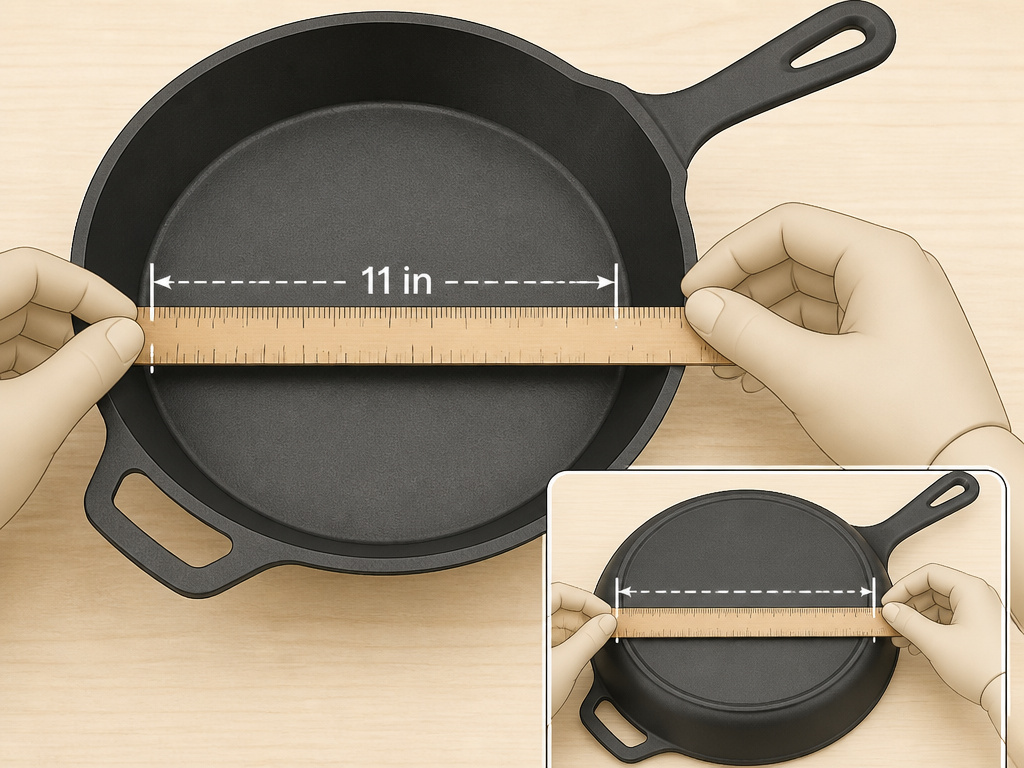 The rim tells you the lid size. These next two numbers determine how the pan performs on your stove.
1. Cooking Surface Diameter
This is the flat, circular bottom of the pan where food makes contact. Due to the skillet’s sloped sides, it is always smaller than the rim. The difference can be over an inch and a half.
To measure it, turn the skillet right-side up. Place your ruler across the flat bottom, inside the pan. Measure from where the sloped wall begins to curve upward on one side to the same point directly opposite. Exclude any curved edges.
Why it matters: This is your true cooking real estate. A recipe that fills a “12-inch skillet” is assuming about 11 inches of cooking surface. If your pan’s cooking surface is only 10 inches, you’ll overcrowd it. Food steams instead of sears, and cleanup becomes a chore. Knowing this measurement helps you visualize portion sizes and manage heat distribution for a good cast iron skillet.
2. Base Diameter
Flip the pan over again. This time, measure the width of the completely flat bottom on the exterior, the part that sits on your burner.
Why it matters (especially for induction): Your burner heats the base. If the base is significantly smaller than your burner’s heating element, the edges of the pan stay cooler. This creates uneven cooking. If the base is larger than the burner, the extreme outer edges never get direct heat, leading to cold spots.
For induction cooktops, this is non-negotiable. The base must be magnetic and should closely match the size of the induction coil for efficient energy transfer. A mismatch wastes energy and gives poor results.
How to Measure for Lids and Ovens
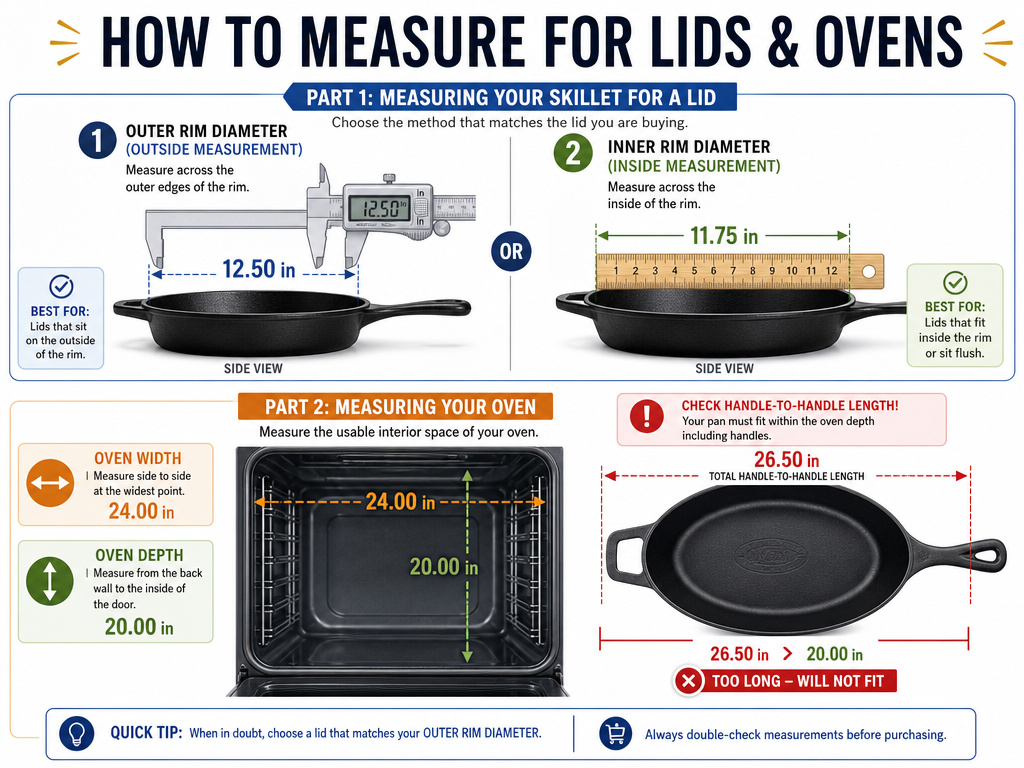 Sometimes the rim diameter isn’t enough. You need to think in three dimensions.
For a Lid That Sits On the Rim: Use your standard rim-to-rim measurement. Most universal glass or metal lids are sized this way. If your skillet has pronounced pour spouts, measure from the highest point of the rim next to a spout to the opposite side to ensure the lid won’t rock.
For a Lid That Fits Inside the Rim: This is less common but crucial for Dutch ovens or combo cookers. Here, you must measure the inner diameter of the rim. Use a ruler or calipers to measure from the inside edge of the rim directly across.
Where this goes sideways: Buying a massive skillet without checking your oven. The Field No. 16 Double-Handled Skillet has a rim width of 16 ¾ inches but a total length of over 20 inches including its two handles. It will not fit in a standard oven unless placed diagonally on a rack.
The Oven Fitment Checklist:
- Oven Width: Measure the interior distance between the oven’s side walls.
- Oven Depth: Measure from the inside of the door to the back wall.
- Skillet Length: Measure your skillet from the very tip of one handle to the very tip of the other. Your skillet’s length must be less than both the oven’s width and depth to sit safely on a rack. This is the final, critical step before investing in a skillet set meant for roasting.
Tools and Tips for Accurate Measuring
You don’t need specialty gear. A sturdy metal ruler or a retractable metal tape measure is perfect. A floppy cloth tape can sag and give a false reading.
Step-by-Step for Best Accuracy:
- Work on a flat, stable surface like a countertop or table.
- For rim diameter, ensure the skillet is upside down and stable.
- Place your ruler firmly across the center. Look directly down to avoid parallax error.
- Record the measurement to the nearest 1/8 inch.
- Rotate the ruler 90 degrees and measure again. The numbers should match closely.
- For cooking surface, hold the ruler steady and level inside the pan.
A quick check is to use a standard dinner plate or a known lid. If your 12-inch plate completely covers the skillet’s rim with a little overhang, your pan is likely under 12 inches. This is a hack, not a replacement for a real measurement.
Frequently Asked Questions
Can I measure my skillet with it right-side up?
You can, but it’s less accurate for the rim. The curved sides make it hard to pinpoint the exact outer edge. Flipping it over gives a flat, stable reference surface. For the cooking surface, right-side up is the only way.
My skillet is oval or square. How do I measure it?
The principle is the same: measure the extreme outer dimensions, excluding handles. * Oval: Measure the longest length (end-to-end) and the widest width (side-to-side) across the rim. * Square/Rectangular: Measure the length and width of one rim edge to the parallel opposite edge. Recipes for these shapes often call for a specific volume (quarts) rather than inches, so also consider a water capacity test.
Why does my 12-inch skillet only hold a 10-inch pizza?
You’re seeing the difference between the rim and the cooking surface. A 12-inch rim often yields a cooking surface of 10.5 to 11 inches. A pizza needs the flat bottom. Always check the pizza recipe, if it says “12-inch skillet,” it likely means a pan with a ~12-inch rim, which fits an 11-inch crust.
Does seasoning change the measurements?
Barely. A layer of polymerized seasoning might add a few thousandths of an inch to the cooking surface. It will not affect your rim or base measurements in any meaningful way. Measure a pre-seasoned skillet the same as any other.
How do I measure the volume or capacity?
Fill the skillet with water using a liquid measuring cup. Pour water to the very brim. The total quarts or liters is its capacity. This is useful for braising recipes or understanding how much a deep skillet like a chicken fryer can hold compared to a standard frying pan.
The Bottom Line
Put the tape measure away. You only need to pull it out three times: when you’re baffled by a stamped number, when you’re shopping for a lid, and before you buy a new pan, especially a big one.
The stamped number is a piece of history, not a useful spec. The rim diameter is the official size. The cooking surface is where your dinner happens. The base diameter is what your stove sees. Get those three numbers straight, and you’ll never crowd a pan, buy a wrong lid, or get a skillet stuck in your oven again. That’s how you move from guessing to knowing, which is the whole point of a cast iron skillet in the first place.
