
Learn How to Clean Your Cast Iron Griddle the Correct Way
This post contains affiliate links. As an Amazon Associate, we earn from qualifying purchases.
Clean a cast iron griddle by wiping it while warm, scrubbing with hot water and a non-abrasive brush, drying it immediately, and applying a whisper-thin coat of oil. For stubborn residue, use coarse salt or a chainmail scrubber. Modern dish soap is safe for a well-seasoned surface; the polymerized oil bond resists it, but avoid soap on new or poorly seasoned griddles.
That last point about soap is where every instruction manual seems to split. GE and ZLINE say to avoid it. Char-Griller says use it once. Lodge, the cast iron specialist, says soap is totally okay. The contradiction is a signal. Each manufacturer is writing for a different starting point: a factory pre-season, a shipping coat, or bare iron.
What follows is the reconciliation. You’ll get the daily three-minute routine, the method for burnt-on messes, and the one rule for rust. More importantly, you’ll get the why behind each step, so you can read your own griddle’s condition and act before the surface degrades.
Key Takeaways
- The polymerized oil seasoning on cast iron is a hardened plastic-like coating; modern dish soap cannot strip it, but abrasive pads can.
- Dry the griddle completely within five minutes of washing. Water left on the surface is the primary cause of flash rust, even on seasoned pieces.
- Re-oil after every clean with a high-smoke-point oil like vegetable, canola, or flaxseed. Buff it until the surface looks dry, visible oil will turn gummy.
- Soap use depends on the seasoning’s maturity. Avoid it on new or fragile seasoning; it’s safe on a dark, established coating.
- For stuck-on food, use coarse salt or a chainmail scrubber on a warm, not hot, griddle. Never use steel wool on a surface you want to keep.
The Daily Clean: A 3-Minute Routine
This maintenance prevents a deep clean from ever being necessary. The goal is to remove food debris and moisture, then reinforce the protective layer.
Start while the griddle is still warm, not scorching hot. About 150°F is ideal, you can hold your hand six inches above it comfortably. At this temperature, fats are liquid and most carbon bits are loose.
Scrape, rinse, dry, oil. That’s the entire sequence. If you do it within ten minutes of finishing cooking, the griddle stays non-stick for years.
First, scrape off any large debris with a metal bench scraper or a flat-edged spatula. For a ZLINE High Grate Reversible Cast Iron Griddle (HG-GRZ-NS) or similar, mind the grates; scrape along them, not across.
Next, take it to the sink. Rinse under hot running water. Use a stiff nylon brush or a non-scratch sponge to scrub the surface. This is where the soap question lands.
If your griddle has a dark, shiny, well-established seasoning, a drop of modern dish soap is fine. The fatty acids in today’s soaps aren’t strong enough to break the polymerized oil coating. Lodge’s official stance confirms this. If the seasoning is new, patchy, or you’re unsure, skip the soap. The risk is soap getting under a weak spot and promoting rust you won’t see until tomorrow.
The critical step happens next. Dry the griddle. Immediately. Use a dedicated kitchen towel and wipe until the surface is bone-dry. Air-drying is the enemy; it guarantees water spots and potential rust.
Finally, apply oil. Use a paper towel to spread less than half a teaspoon of a high-smoke-point oil, vegetable, canola, or grapeseed, over the entire cooking surface. Then, take a clean towel and buff aggressively. The goal is to leave a microscopic layer, not a visible one. If it looks oily, you used too much; that excess will turn sticky.
When Things Get Sticky or Rusty
Food gets burnt. Grease builds up in corners. A griddle left wet develops orange spots. These aren’t failures; they are scheduled maintenance reminders.
For burnt-on grease and carbonized food, you need abrasion without stripping. The best tool is coarse kosher salt.
- Let the griddle cool to just warm.
- Pour a handful of salt onto the problem area.
- Add a teaspoon of cooking oil to make a paste.
- Scrub in a circular motion with a folded paper towel or a dedicated scrub pad.
- The salt acts as a gentle abrasive, breaking up the carbon while the oil protects the seasoning.
- Rinse, dry, and re-oil as usual.
For tougher, baked-on patches, a chainmail scrubber is the professional upgrade. It knocks off debris without grinding into the metal like steel wool does. Use it with light pressure on a warm surface.
Where this goes sideways: Using steel wool on a seasoned surface you want to keep. Those fine metal strands scour off the polymerized oil layer along with the gunk. You’ll see grey, bare metal underneath, and that spot will rust within hours if not re-seasoned.
Rust happens. It’s oxidation, not a death sentence. The fix is mechanical removal followed by re-seasoning.
| Rust Level | Tool Needed | Next Step |
|---|---|---|
| Light surface | Scotch-Brite pad | Scrub off, rinse, dry immediately, apply oil and heat. |
| Moderate spots | Fine steel wool (0000) | Scrub until bare metal is clean, then perform a full re-seasoning cycle. |
| Heavy scaling | Wire brush (drill attachment) | Strip entire surface, then re-season from scratch. This is a last resort. |
The key with rust is to stop it from coming back. After you’ve scrubbed the area clean and dried it, you must re-season that spot before storing the griddle. A spot-season works: oil the bare area, heat the griddle on the stovetop until it smokes lightly, let cool, and repeat.
The Soap Debate: What the Manuals Actually Say
Manufacturer instructions create the confusion. They aren’t wrong, but they are written for specific contexts. Here’s the breakdown from the source material.
The “No Soap” Camp (GE, ZLINE, JennAir):
These brands often ship griddles with a factory-applied pre-season. Their manuals, like the one for the ZLINE HG-GRZ-NS, advise against “soap and water” to protect that initial coating during its fragile first few uses. They assume you are starting from their pre-seasoned state and want to preserve it.
The “One-Time Soap” Instruction (Char-Griller):
Char-Griller’s manual explicitly states to use hot, soapy water once, for the initial wash to remove the vegetable-oil shipping coating meant to prevent rust in the warehouse. After that, they join the “no soap” camp. This instruction is for a temporary, non-seasoning layer.
The “Soap is Okay” Authority (Lodge):
Lodge, as a primary cast iron manufacturer, states plainly: “Soap is totally okay! The soap we use for washing dishes today is no longer strong enough to remove seasoning.” This is the consensus from modern testing and chemistry. The seasoning is a chemically bonded plastic; dish detergent can’t dissolve it.
The part nobody mentions: The real risk isn’t soap on good seasoning. It’s soap hiding in a microscopic crack in a weak seasoning layer, holding moisture against the iron where you can’t see it. That’s how a seemingly clean griddle sprouts rust spots overnight.
So, who’s right? All of them, for the scenario they describe. Your decision tree is simple: * New griddle, pre-seasoned (ZLINE, GE): Avoid soap for the first 10-12 cooks to build base layers. * New griddle, with shipping oil (Char-Griller): Use soap once initially, then avoid it until seasoning darkens. * Established, black seasoning: Use a drop of soap without fear. It won’t hurt the bond. * Chrome-infused or specialty surface: Check the manual. KitchenAid notes that for chrome-infused griddles, you should skip soap altogether.
How to Deep Clean and Re-Season
 When the surface becomes sticky all over, patchy, or you’ve just removed rust, you need a reset. This is a deep clean followed by a deliberate re-seasoning.
A true deep clean means removing all the old, compromised seasoning. The most effective home method is the oven’s self-cleaning cycle, but it’s extreme. It will strip the griddle to bare, grey iron and can warp thinner pieces. For most, a less aggressive approach works.
- Heat the griddle on the stove to loosen old grease.
- Scrub with coarse salt and oil as described, but over the entire surface.
- For persistent sticky patches, use a chainmail scrubber with more pressure.
- Rinse and dry thoroughly. The surface should look uniform, even if it’s not perfectly bare.
Now, re-season. Oven seasoning is best for an even, all-over coat.
- Preheat your oven. GE Appliances specifies 350°F. Masterbuilt’s manual for model MB20183725 specifies 300°F. Follow your griddle’s manual if you have it; otherwise, 350°F is a safe standard.
- Apply the thinnest possible layer of high-smoke-point oil to every surface, including the bottom and handles. Flaxseed oil creates a very hard finish but can flake over time. Vegetable or canola oil is more forgiving.
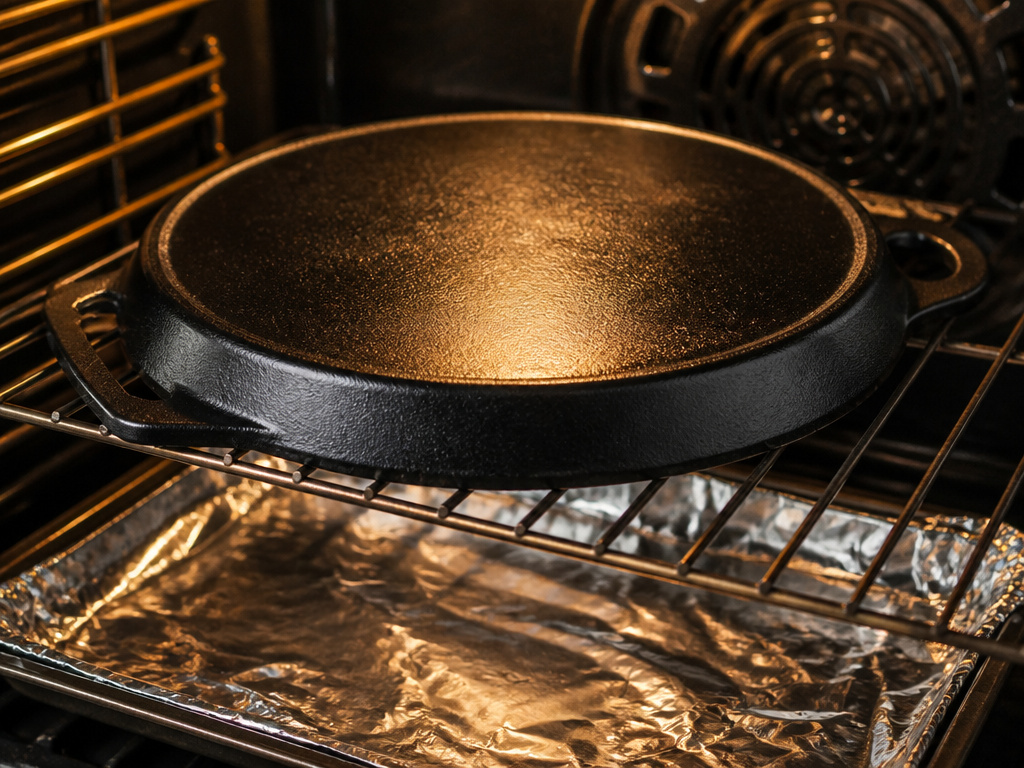
- Place the griddle upside-down on the middle oven rack. Put a foil-lined baking sheet on the rack below to catch drips.
- Bake for one hour. Turn the oven off and let the griddle cool completely inside.
- Repeat this process 2-3 times to build a durable base layer.
This process creates a non-stick surface through polymerization, the heat transforms the oil into a solid, slick coating bonded to the iron. It’s the same seasoning process used for a skillet or a cast iron Dutch oven.
What Tools You Actually Need (And What to Skip)
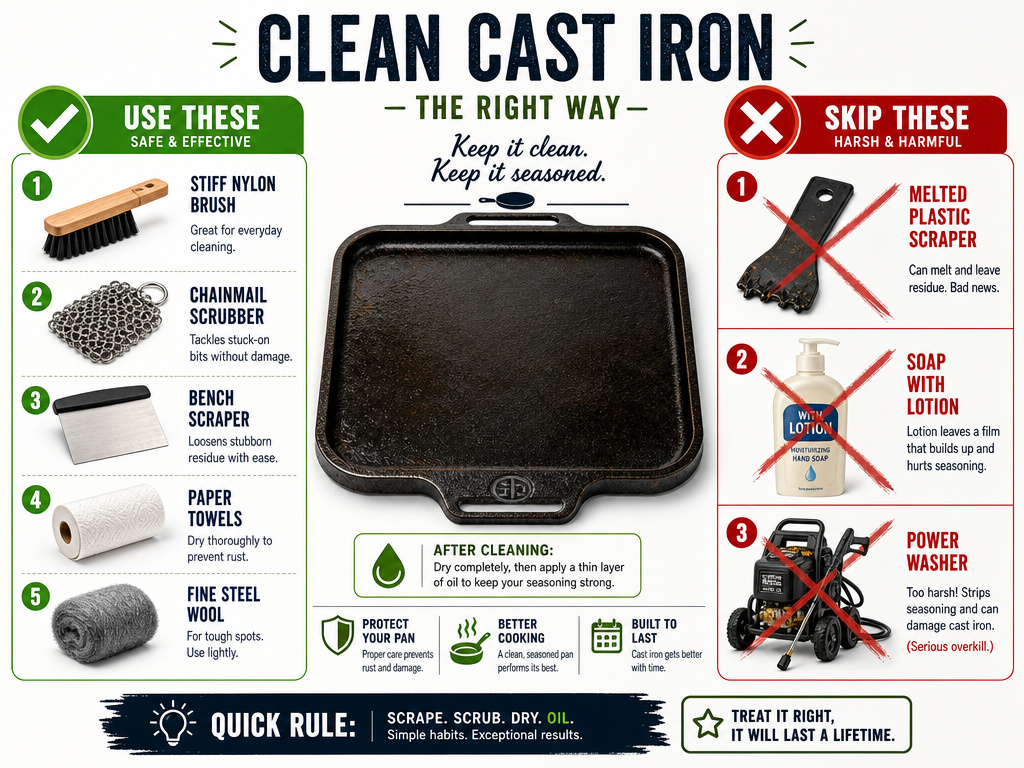 You don’t need a specialty kit. Three tools cover 99% of scenarios.
| Tool | Use For | Do Not Use For |
|---|---|---|
| Stiff Nylon Brush | Daily scrubbing under hot water. | Removing heavy rust or thick carbon buildup. |
| Chainmail Scrubber | Breaking up burnt-on food without damaging seasoning. | Scrubbing a cold surface (it’s ineffective). |
| Bench Scraper | Clearing large food debris post-cook. | Chipping at hardened carbon (you’ll gouge the metal). |
| Paper Towels | Drying and applying/buffing oil. | Scrubbing (they disintegrate). |
| Fine Steel Wool (0000) | Removing rust spots during restoration. | Cleaning a seasoned surface you want to keep. |
Skip the plastic scrapers. They melt on warm metal. Skip the dish soap with added lotions or moisturizers, they can leave a residue. Skip the power washer, obviously.
Your choice of oil matters. Avoid low-smoke-point oils like extra virgin olive oil or butter, they burn and create a tacky, uneven layer. The best oils for maintaining cast iron are refined, neutral oils with high smoke points: grapeseed, avocado, vegetable, canola.
Frequently Asked Questions
Can you use soap on a cast iron griddle?
Yes, if the seasoning is well-established. Modern dish soaps are detergents, not the lye-based soaps of the past. They are not strong enough to break the chemical bond of polymerized oil coating. However, avoid soap on new, thin, or patchy seasoning, as it can seep into weak spots and contribute to rust. When in doubt, skip it.
How do you remove rust from a cast iron griddle?
Scrub the rusted area with fine steel wool or a Scotch-Brite pad until you reach bare, grey metal. Rinse and dry the griddle immediately and completely. Then, re-season that spot by oiling it and heating it on the stove until it smokes, or by including it in a full oven seasoning process.
What’s the best oil for seasoning a griddle?
Refined oils with high smoke points are best. Grapeseed, canola, and vegetable oil are excellent, readily available choices. Flaxseed oil creates a very hard, durable coating but is prone to flaking over many cycles. Avoid olive oil, butter, or any unrefined oil.
Why is my seasoned griddle sticky after I oil it?
Stickiness means you used too much oil. The seasoning process requires a layer so thin it looks dry. Any visible oil will polymerize into a thick, tacky layer instead of a hard, slick one. The fix is to heat the griddle to burn off the excess and start over with a truly minimal amount.
Can you clean a cast iron griddle in the dishwasher?
No. Never. The prolonged exposure to hot water and powerful dishwasher detergents will strip the seasoning completely and cause rapid, severe rust. All manufacturer manuals explicitly prohibit dishwasher cleaning. Always clean a griddle by hand.
Before You Go
Cleaning a cast iron griddle boils down to three non-negotiable habits: dry it fast, oil it thin, and heat it regularly. The soap debate is a distraction, focus on the condition of the black coating on your metal. If it’s dark and smooth, a little soap won’t hurt. If it’s red or sticky, you need salt, heat, and a fresh layer of oil, not a debate about detergent.
Your griddle isn’t fragile. It’s resilient iron. The maintenance is about preserving the non-stick surface you’ve built, not babying the metal underneath. Keep a nylon brush and a roll of paper towels nearby. Scrape, rinse, dry, oil. Do that, and the griddle will outlast the stove it sits on.
