
Is a Cast Iron Skillet Oven Safe? The Real Limits & Mistakes
This post contains affiliate links. As an Amazon Associate, we earn from qualifying purchases.
A seasoned cast iron skillet is oven-safe to any temperature a home oven can produce, often 500°F and beyond. The limit is never the iron itself, but the materials attached to it: plastic knobs melt around 480°F, silicone grips fail near 450°F, and wooden handles burn. Enameled cast iron typically has a lower ceiling, around 500°F, and can crack from thermal shock if moved cold into a hot oven.
That distinction between the pan body and its attachments is where most guides stop. They miss the physical reason a skillet fails. A plastic knob doesn’t just get soft; it deforms under radiant heat from the oven’s upper element, losing its grip on the screw post. The pan becomes unstable. An enamel coat doesn’t just chip; a temperature differential of more than 300°F between a cold, wet pan and a hot oven wall creates internal stress fractures you can’t see until the next preheat.
What follows is a breakdown of the three specs that decide oven safety, the one field check you must do, and the two failure modes that destroy pans quietly. By the end, you’ll read any skillet in ten seconds and know its real limit.
Key Takeaways
- The cast iron metal is functionally indestructible in a home oven; the weakest component sets the safe temperature.
- Check for stamps, labels, or molded markings on the handle or pan bottom for the manufacturer’s stated limit, this overrides any general rule.
- Thermal shock cracks enamel. Never put a cold, wet enameled skillet into a preheated oven above 300°F.
- Storing a skillet in a cold oven is fine, but leaving it there during preheat adds 10-15 minutes to your oven’s cycle and risks overheating non-iron parts you forgot about.
- For high-heat roasting or baking above 450°F, a bare Lodge cast iron skillet is the default choice, no attached parts to fail.
The One-Step Check Before You Preheat
Flip your skillet over. Look at the bottom. Run your finger along the handle, especially near any joints or sleeves. You are searching for a stamped phrase, an embossed number, or a molded marking.
Common mistake: Assuming “cast iron” means “oven-proof.” The phrase “oven safe” is a rating for the entire assembled product, not the material. A skillet with a phenolic knob rated for 400°F is a 400°F pan, even if the iron could handle 800°F.
Manufacturers know the weak point. The honest ones label it. You might see “Oven Safe to 500°F” etched near the Lodge logo. A Vermicular skillet specifies oven-safe up to 570ºF in its online guide. A generic pan with a silicone sleeve might have a tiny “Max 450°F” molded into the grip.
If you find nothing, the next stop is the manufacturer’s website. Search the model name and “care instructions.” This isn’t busywork. GE Appliances’ owner manuals explicitly condition their advice: “Cast-Iron: If heated slowly, most skillets will give satisfactory results.” That “if” carries the weight. They are telling you the procedure matters as much as the pan.
No marking and no online manual? Default to the lowest common denominator: 350°F. That’s a safe ceiling for nearly every plastic, wood, or silicone attachment. It’s also the temperature where most unknown enamel coatings are likely stable. You give up pizza-crisping heat, but you keep your skillet intact.
Why Handles and Knobs Fail First
Metal expands when heated. Plastic and silicone expand at different rates. The screw post holding a plastic knob to a cast iron lid is steel. At 450°F, the plastic around that post has expanded, softened, and lost its mechanical grip. The knob spins freely or, worse, cracks.
A silicone grip works by trapping air for insulation. Above its rated limit, often around 446°F, the material begins to degrade, becoming brittle and porous. It won’t melt dramatically, but it will crumble over the next few cycles, leaving bare metal underneath.
The failure isn’t explosive. It’s a slow loss of function that leaves you with a dangerous, too-hot-to-hold handle mid-recipe.
Enameled vs. Bare Iron: The Coating Changes Everything
Treat enameled and bare cast iron as different tools. Their oven rules are not the same.
A bare Lodge skillet is a single piece of iron. Its seasoning, a layer of polymerized oil, is chemically bonded to the surface. Oven heat only reinforces this bond. This is why the seasoning process itself involves baking the pan at 450-500°F for an hour.
Enamel is a powdered glass fused to the iron at extreme factory heat. It is hard but brittle. Its limit is set by the glass formula. Vermicular states a 570ºF limit. Many European brands cap at 500°F. The danger isn’t just exceeding that number; it’s rapid temperature change.
Where this goes sideways: Putting a cold, wet enameled pan into a hot oven. The outer enamel layer heats and expands faster than the iron core it’s fused to. This differential stress can create a hairline crack. You might not see it until rust bleeds through the glaze months later.
For enamel, always preheat with the oven. Place the dry pan in a cold oven, then set the temperature. Let them warm together. The same rule applies when taking it out, let it cool on the stovetop, not on a cold granite countertop.
| Skillet Type | Typical Oven-Safe Limit | Greatest Risk | Best For |
|---|---|---|---|
| Bare Cast Iron (e.g., Lodge) | 500°F+ (home oven max) | Overheating attached non-iron parts | High-heat roasting, baking, broiling |
| Enameled Cast Iron (e.g., Vermicular) | 500°F – 570°F | Thermal shock cracking the glass | Braising, simmering, moderate-heat baking |
| Cast Iron with Wooden Handle | Often not oven safe | Handle charring, glue failure | Stovetop use only |
| Cast Iron with Plastic Knob | ~400°F – 480°F | Knob melting/deforming | Low-to-moderate oven finishes |
The Real-World Consequences of Getting It Wrong
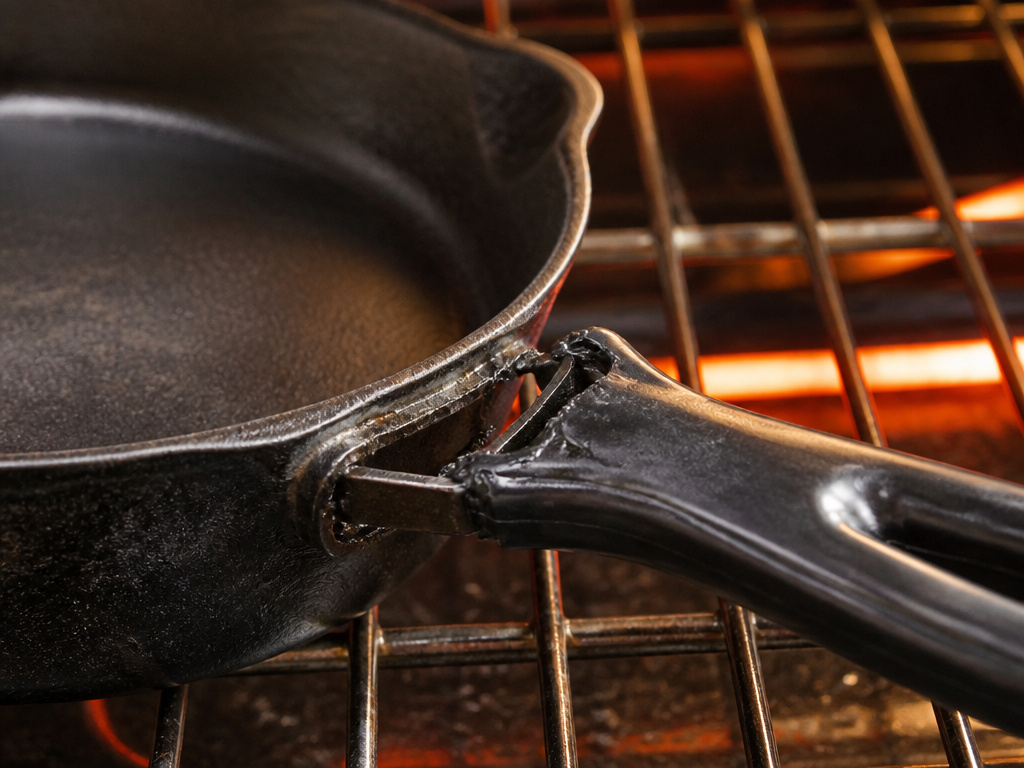 Mistakes here don’t always announce themselves with smoke. The damage is often slow and structural.
Storing skillets in the oven is a common space-saving hack. The problem isn’t the storage; it’s the forgetfulness. You preheat to 425°F for frozen fries. The three skillets sitting inside become part of the thermal mass the oven must heat. This adds time to your preheat. More critically, that Lodge skillet is fine, but the small saucepan with the Bakelite handle? Its handle is now baking at 425°F for 20 minutes straight, well past its limit. The glue fails. The handle loosens.
Using the broiler is a specific hazard for enamel. Broiler elements deliver intense, direct radiant heat from above. Enamel is designed for ambient, circulating heat. Direct broiling can overheat the glass coating, causing it to craze (develop a network of fine cracks) or discolor permanently. Most manufacturers explicitly warn against it.
The “warm and hold” oven setting seems gentle, often around 170°F. This is still a danger for pans with tight-fitting lids and plastic knobs. Over several hours, that low, consistent heat can be enough to warp a knob or weaken adhesive. It’s a failure of duration, not intensity.
Worth knowing before you start: If you ruin the seasoning on a bare iron skillet by overheating, you can always re-season it. If you crack the enamel on a $200 Dutch oven, it’s a decorative piece. The risk calculus is different.
How to Use Your Skillet in the Oven Safely
 This is the procedure that balances utility with preservation. It works for 95% of recipes.
- Identify the weak point. Is it a knob? A lid handle? A silicone sleeve? Touch it. Know its limit. If it’s a wooden handle, the answer is “zero”, keep it out of the oven.
- Preheat dry. Never put a wet pan, especially enameled, into a hot oven. For bare iron, rinse and dry it thoroughly. For enamel, make sure it’s completely dry inside and out.
- Place with care. Use oven mitts for bare iron handles, which will get hot. Position the skillet in the center of the middle rack for even heat circulation. Avoid touching the oven walls or heating elements.
- Monitor temperature. If your recipe calls for 475°F and your knob is rated for 450°F, you have a decision. Either lower the oven temp and extend cooking time, or remove the knob/lid before baking. For a pre-seasoned cast iron skillet, the pan itself doesn’t care.
- Cool gradually. When done, transfer the skillet to a stovetop burner or a trivet. Let it come to room temperature naturally. Do not plunge a hot skillet into water or place it on a cold, wet surface. This is a core part of skillet maintenance.
Following these steps prevents the two most common sources of damage: thermal shock and component overstress.
Frequently Asked Questions
Can you put a cast iron skillet in a self-cleaning oven?
No. The self-cleaning cycle generates temperatures exceeding 900°F. This will incinerate the seasoning on a bare skillet, turning it to ash and leaving you with a gray, rust-prone surface. For enameled skillets, the extreme heat can cause the glass coating to fuse, discolor, or crack. Always remove all cookware before running a self-cleaning cycle.
Is a pre-seasoned cast iron skillet oven safe?
Yes. Factory seasoning is just a thin, initial layer of polymerized oil. It is designed to be oven-safe. Brands like Lodge state their seasoned skillets are safe to any home oven temperature. The same rules apply: watch out for any secondary materials like silicone handle covers that may be included.
Why did my skillet rust after putting it in the oven?
Oven heat alone doesn’t cause rust. If rust appears, the likely sequence is: 1) The skillet was put away slightly damp, 2) The oven’s heat evaporated the water but also drove oxygen into the microscopic pores of the iron, accelerating oxidation, 3) The skillet cooled in the oven’s residual humidity. Always ensure your skillet is bone-dry before any oven use, and consider applying a very thin coat of oil after drying as part of rust prevention.
Can a cast iron skillet go from oven to stovetop?
Yes, this is one of its greatest strengths. Use a dry, heavy-duty potholder or mitt, the handle will be extremely hot. This technique is perfect for searing a steak on the stovetop and then finishing it in the oven for even cooking. Ensure your stovetop burner is appropriate for the skillet’s size to avoid warping over high, direct flame.
What’s the highest oven temperature for cast iron?
For the iron itself, there is no functional maximum within a home kitchen context. Home ovens typically max out at 500-550°F. The iron can withstand far more. Therefore, the highest safe temperature for your specific skillet is the lowest rated component attached to it. Refer to your manufacturer’s label.
Before You Go
Oven safety for a cast iron skillet is a puzzle of attachments, not a property of the metal. The iron is immortal; the knob is not. Your single most important habit is the pre-heat check: find the label, know the limit, and respect the weakest link.
For high-heat, no-worry cooking, a bare Lodge cast iron skillet remains the benchmark. For everything else, let the manufacturer’s stamp guide you. That small step is what separates a trusted heirloom from a damaged good.
