
Is a Cast Iron Skillet Non Stick? The Real Truth About Seasoning
This post contains affiliate links. As an Amazon Associate, we earn from qualifying purchases.
A cast iron skillet is non-stick when its surface is coated with a polymerized layer of oil, a process called seasoning. This layer is molecularly bonded to the iron. Most new skillets labeled “pre-seasoned” have a thin, factory-applied seasoning that prevents rust but is not fully non-stick from day one. True non-stick performance builds over months of regular cooking with fats.
That distinction between rust prevention and cooking performance is where most of the confusion lives. The factory coat is a start, but the skillet you build through use is the one that releases eggs.
What follows: the chemical reality of that black coating, why your new Lodge isn’t as slick as your grandmother’s, the one cleaning mistake that resets progress, and how to know if you even need to season your pan at all.
Key Takeaways
- “Pre-seasoned” means rust-protected, not non-stick. The factory layer is thin and meant for storage and transport.
- Real non-stick performance comes from polymerization—oil heated past its smoke point bonds to the iron, creating a slick, hardened surface.
- The skillet’s texture matters. Modern pebbled surfaces (like Lodge’s) hold seasoning well but start rougher; vintage smooth pans become non-stick faster.
- You can damage the seasoning. Cooking acidic foods for over 45 minutes, using soap with lye (rare today), or shocking a hot pan with cold water breaks down the layer.
- Enameled cast iron (KitchenAid, Le Creuset, Vermicular) has a glass coating and should never be seasoned. Seasoning enamel will just burn on and create a mess.
What “Non-Stick” Actually Means for Cast Iron
Forget Teflon. A cast iron skillet‘s non-stick property is a physical and chemical transformation, not a coating applied at the factory. When you hear a skillet is “seasoned,” that’s shorthand for a process where fat undergoes a molecular change.
Seasoning is just oil baked onto the pan through a process called polymerization. When oils or fats are heated in cast iron at a high enough temperature, they change from a wet liquid into a slick, hardened surface. This reaction creates a layer of seasoning that is molecularly bonded to the iron.
This polymer layer fills the microscopic pores in the iron. Food then rests on a slick, carbonized oil surface instead of raw metal. The more this layer builds from repeated use, the more continuous and slick it becomes.
The skillet’s innate heat retention aids this. Cast iron heats unevenly at first but holds temperature steadily once hot. This steady, high heat is perfect for triggering polymerization during cooking and for creating a consistent cooking surface that prevents food from cooling the pan and sticking.
So is a cast iron skillet non-stick? Yes, but conditionally. Its non-stick quality is a maintained characteristic, not a permanent factory specification. It’s a surface you cultivate.
The Factory Seasoning vs. Your Seasoning
Walk into any store and grab a Lodge, Victoria, or IKEA VARDAGEN skillet. The label says “pre-seasoned.” You assume it’s ready to cook an egg. It usually isn’t.
Manufacturers apply a thin layer of food-grade oil and bake it on. IKEA’s manual states this is done “to prevent corrosion during transport.” That’s the real job. This initial layer protects the iron from rusting on the shelf. It gives you a head start, but it’s a foundation, not a finished floor.
Common mistake: Treating a factory-seasoned skillet as fully non-stick. That first layer is thin and can be patchy. Slide an egg onto it cold, and you’ll spend the morning scrubbing.
Home-built seasoning is different. It’s thicker, applied with the specific oils you cook with, and baked in your oven at a temperature you control. More importantly, it’s built in the context of actual cooking. Each time you sauté onions or fry bacon, you’re adding another micro-layer of polymerized fat. These layers interlock over time.
This explains the disconnect between new owners and seasoned veterans. The veteran’s pan has years of these layers fused together into a glassy, black patina. The new pan has one uniform, industrial coat. They are not the same thing.
How Does Seasoning Actually Make Cast Iron Non-Stick?
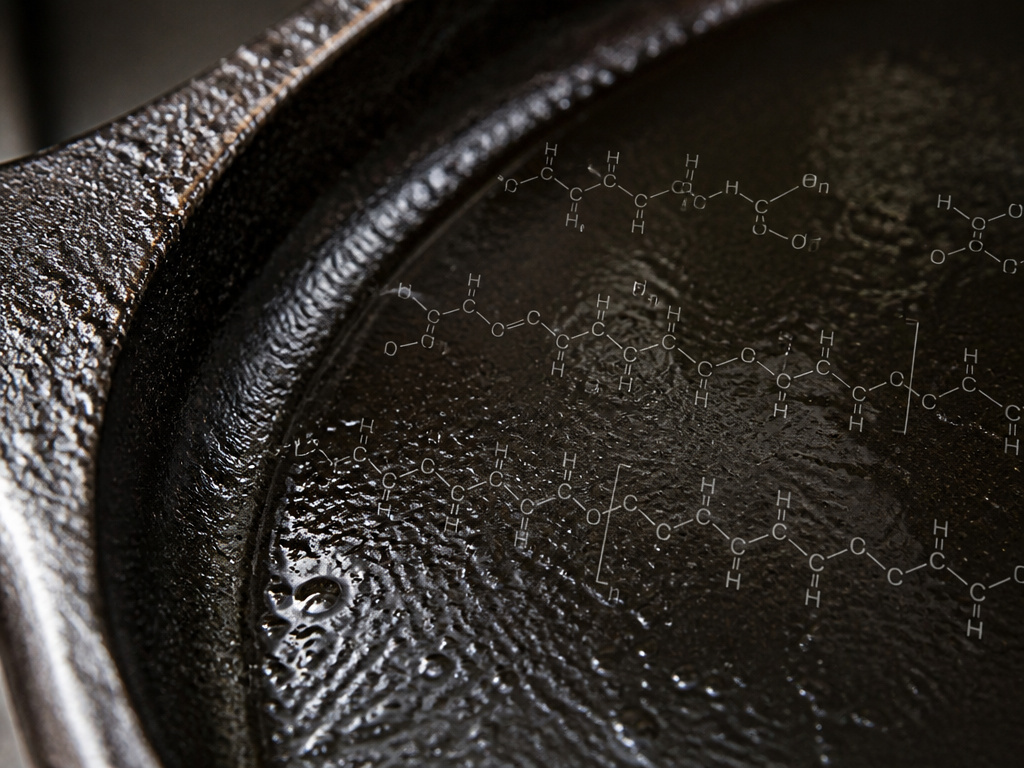
The magic word is polymerization. It’s a chemical reaction, not just “baked-on gunk.”
When you heat oil above its smoke point—that’s critical—its molecular chains break and reform into longer, cross-linked chains. These new chains form a hard, plastic-like coating that is chemically bonded to the iron surface. This coating is inert, stable, and slick.
Think of it like epoxy. Two separate liquids (the oil and the hot iron) combine to create a new, solid substance. This is why you can’t wash it off with dish soap. Modern detergents won’t touch this polymer layer; the old myth about soap damaging seasoning dates from when soap contained lye, which could strip it.
The process requires three things: 1. A clean, dry iron surface. Any rust, old food, or moisture blocks the bond. 2. A thin layer of oil. Too much oil pools, turns sticky, and carbonizes into a flaky mess instead of a hard polymer. 3. Heat above the oil’s smoke point. This is the energy that drives the molecular change. Different oils have different smoke points, which is why your choice of fat matters.
Every time you cook, you’re potentially conducting a small polymerization event. This is why the best way to season a cast iron skillet is to use it regularly, especially for cooking with fats.
The Role of Surface Texture: Smooth vs. Pebbled
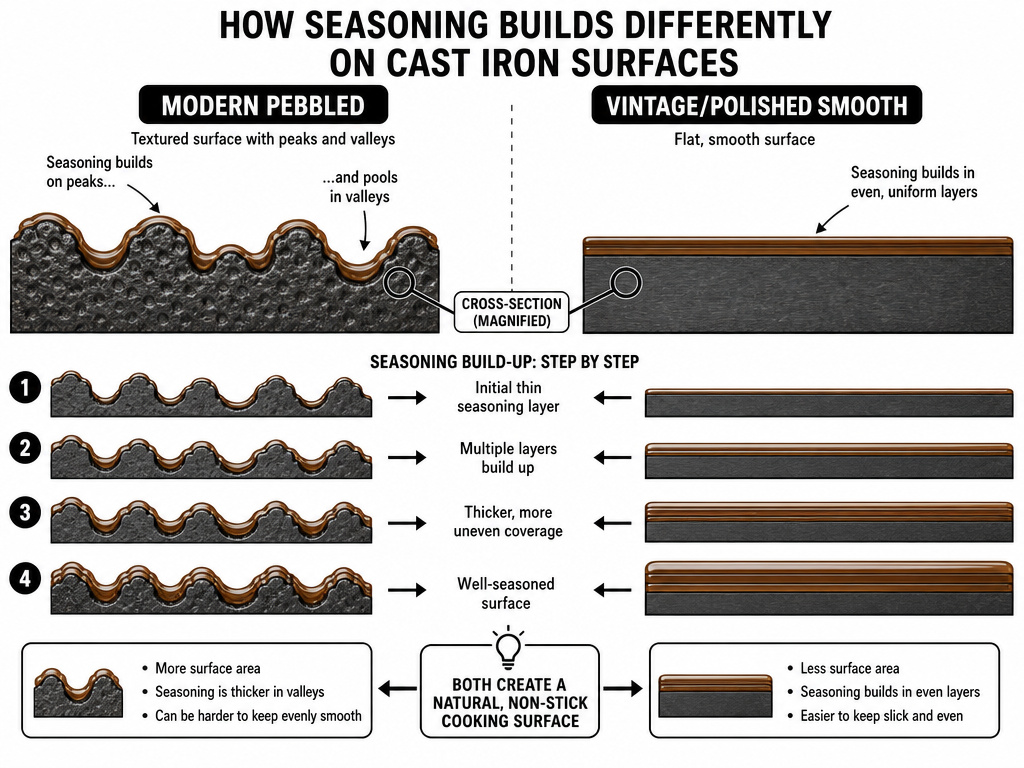
Not all iron is created equal. The texture of your skillet’s cooking surface dramatically impacts how quickly it becomes non-stick and how that finish feels.
| Surface Type | How It’s Made | Effect on Seasoning | Best For |
|---|---|---|---|
| Modern Pebbled | Sand-cast, not polished. Has a textured, pebbled finish. | The texture provides more “tooth” for the initial seasoning to grip. Holds layers well but can feel rough initially. | Beginners, high-heat searing. The texture is durable and forgiving. |
| Vintage or Polished Smooth | Machined or ground down after casting, or older production methods. | A smooth surface has fewer pores, so seasoning doesn’t grip as easily at first. However, once established, it becomes glass-slick faster. | Owners willing to put in initial maintenance for superior egg-sliding performance. |
Modern brands like Lodge embrace the pebbled texture. It’s a byproduct of their efficient sand-casting process and, as they note, provides a good anchor for the seasoned non-stick layer. The downside is that those microscopic peaks can still provide points for food to grab onto until enough polymer layers fill them in.
Some owners take sandpaper to a new Lodge to smooth it out, a controversial practice but one that demonstrates how much texture affects the outcome. A smooth pan requires more careful initial seasoning but can achieve a non-stick surface that rivals coated pans.
The Right Oil and Temperature
If polymerization needs heat above an oil’s smoke point, your choice of oil sets the success threshold.
Where this goes sideways: Using olive oil for oven seasoning. Its smoke point is around 375°F (190°C), but most oven seasoning methods call for 450°F+ (230°C+). The oil burns off before it polymerizes, leaving a sticky, carbonized residue.
You need an oil with a high smoke point. Different manufacturers recommend different specifics, but the principle is the same. * Lodge recommends 450–500°F (230–260°C) for 1 hour using vegetable oil, canola oil, or their seasoning spray. * IKEA advises a max of 300°F (150°C) for at least one hour, repeating three times for a new pan.
This wide range shows a key point: effective polymerization can happen at different temperatures as long as you exceed the specific oil’s smoke point. IKEA’s lower temperature likely uses a different oil formulation.
For home seasoning, these are reliable choices: * Grapeseed Oil: Smoke point ~420°F (215°C). A great all-arounder. * Avocado Oil: Smoke point ~520°F (270°C). Excellent for high-heat methods. * Vegetable/Canola Oil: Smoke point ~400-450°F (200-230°C). Cheap, effective, and widely available. * Crisco (shortening): Smoke point ~490°F (255°C). A traditional favorite that works very well.
The procedure is universal: a microscopically thin coat, applied to a warm pan, baked upside down so excess drips off, and cooled in the oven. The thinness is non-negotiable. If your finger leaves a visible wet streak, you’ve used too much.
What Can Damage or Prevent a Non-Stick Surface?
Seasoning is durable, but it’s not indestructible. Knowing what breaks it down is key to maintaining cast iron.
Acidic Foods: Tomato sauce, wine pan sauces, lemon juice. Acid breaks the bond between the polymer layer and the iron. Simmer a tomato sauce for an hour in a young pan, and you might see a metallic taste in your food and a patch of gray, bare iron in your skillet. A well-built seasoning can handle brief acidity, but long simmers are for enameled cast iron or stainless steel.
Thermal Shock: Pouring cold water into a screaming-hot skillet. Cast iron is brittle. Sudden, extreme temperature changes can cause it to warp or crack. From a seasoning perspective, it can also cause the polymer layer to contract differently than the metal underneath, leading to flaking.
Abrasive Cleaning: Using steel wool on a regular basis. For a well-seasoned surface, you rarely need more than hot water, a brush, and maybe some coarse salt for scrubbing. Chainmail scrubbers are popular because they clear debris without gouging the seasoning. Reserve steel wool for stripping a pan down to bare metal when you’re starting over.
Storing Wet: This attacks the iron itself. Water causes rust, and rust lifts seasoning off from underneath. Always dry your skillet thoroughly after washing—heating it on a stove burner for a minute guarantees it.
Using the Wrong Tools: Metal spatulas are actually fine. They can help smooth the seasoning surface over time. The real enemy is sharp, gouging edges or using the skillet as a cutting board.
Enameled Cast Iron: The No-Seasoning Exception
A large category of “cast iron” doesn’t play by these rules. Enameled cast iron—from brands like KitchenAid, Le Creuset, and Vermicular—has a molten glass coating fused to the iron at over 1400°F.
This coating is inert, non-porous, and naturally non-stick to a degree. The KitchenAid Cast Iron Cookware Use and Care Guide is explicit: “No seasoning is required before use. The cast iron cookware has a porcelain enamel coating that does not require seasoning.”
Never try to season an enameled skillet. The oil will not bond to the glassy surface; it will just bake on as a sticky, carbonized film that is difficult to remove and can stain the enamel.
The care rules flip. You can and should use soap. You can cook acidic foods for as long as you want. The primary danger is thermal shock (cracking the enamel) and using metal utensils that can chip the coating. If you own a colorful Dutch oven or skillet, you own enameled cast iron. Leave the oiling and polymer talk for the bare iron pieces.
How to Test and Improve Your Skillet’s Non-Stick Performance
Wondering where your pan stands? Try the egg test. 1. Heat your skillet over medium-low heat for a solid 3-5 minutes. 2. Add a small pat of butter or a teaspoon of your seasoning oil. 3. Crack an egg into the center. If it slides freely when you tilt the pan, your seasoning is excellent. If it sticks slightly but releases with a nudge, you’re on the right track. If it bonds instantly and tears, the surface needs work.
To improve it, don’t automatically strip and re-season. Often, the fix is simpler: * Cook more fatty foods. Bacon, sausage, pan-fried potatoes. These build seasoning naturally. * Correct your preheating. Cast iron heats slowly. Give it more time on a lower heat setting before adding food. * Do a stovetop seasoning refresh. After cleaning and drying, warm the pan over low heat, add a tiny amount of oil, wipe it all over with a paper towel, then heat until it just starts to smoke. Turn off the heat and let it cool.
This kind of proper maintenance after each use is what turns a patchy pan into a family heirloom. It’s the opposite of complicated. It’s just consistent, mindful use.
Frequently Asked Questions
Is a pre-seasoned cast iron skillet non-stick?
Not really, not at first. The pre-seasoning is a thin, factory-applied layer of polymerized oil designed primarily to prevent the iron from rusting during storage and transport. It provides a base, but a truly reliable non-stick surface develops after several rounds of home seasoning or months of regular cooking with fats.
Why does food stick to my cast iron even though it’s black?
Black surface doesn’t guarantee a complete polymer layer. Sticking usually means the seasoning is thin, patchy, or wasn’t formed at a high enough temperature. The most common culprit is adding food to a pan that isn’t properly preheated. Cast iron needs time to come to temperature evenly.
Can you use soap on a cast iron skillet?
Yes, with modern dish soap. The old rule originated when soaps contained lye, which could strip seasoning. Today’s mild detergents won’t harm the polymerized oil layer. Just avoid soaking the pan for hours, and always dry it thoroughly immediately after washing to prevent rust.
How often should I re-season my cast iron skillet?
There’s no set schedule. Re-season in the oven only if the surface becomes sticky, rusts, or is visually patchy and causing consistent sticking. For most skillets in regular use, occasional stovetop seasoning (a thin oil coat heated until smoking) after cleaning is enough to maintain the surface. The best seasoning comes from frequent cooking.
Before You Go
A cast iron skillet’s non-stick claim is a promise, not a guarantee. The factory gives you the iron; you provide the routine that turns it into a slick, resilient cooking surface. It’s not about any single afternoon of oiling and baking. It’s about the next hundred times you cook with it.
Skip the obsession with perfect, Instagram-black seasoning. Focus instead on proper preheating, cooking with fats, gentle cleaning, and thorough drying. That consistent practice builds the layer that makes eggs slide. Your skillet isn’t just a pan. It’s a record of every meal you’ve cooked in it. The better you keep that record, the better it cooks for you.
