
Is Ceramic Cookware Better Than Traditional Nonstick Pans?
This post contains affiliate links. As an Amazon Associate, we earn from qualifying purchases.
Ceramic cookware is not better than PTFE nonstick in terms of pure performance or lifespan. A 2025 peer-reviewed study found PTFE coatings maintain peel force up to three times lower than the best ceramic after 90 cooking cycles. Ceramic wins only if avoiding all fluoropolymers is your absolute priority, but you trade that for a shorter 1-3 year peak performance window and opaque proprietary formulas.
That three-times-lower peel force number is the whole game. It’s a measurable, sourced fact that cuts through the “nontoxic” marketing. It means a PTFE pan, when new and used correctly, will release food with less sticking force than a ceramic pan ever will. The ceramic coating might feel slick at first, but its sol-gel structure micro-cracks with heat cycles. That slickness fades, and it doesn’t come back.
What follows is a breakdown of the two coatings at the mechanical level: what they’re made of, how they fail, and the real safety landscape beyond the labels. By the end, you’ll know which coating fits a high-heat sear, which one handles daily eggs, and why “dishwasher safe” on the box is often a lie.
Key Takeaways
- PTFE (Teflon) nonstick provides measurably better food release and typically lasts 3-5 years, while ceramic coatings often degrade within 1-3 years.
- “Nontoxic” is an unregulated marketing term for ceramic; proprietary sol-gel formulas can contain unknown materials that may release chemicals if overheated.
- Both coatings are damaged by high heat, metal utensils, and abrasive cleaners. Hand-washing, even for “dishwasher safe” pieces, is non-negotiable for longevity.
- For most home cooks, a multi-layer PTFE pan from a reputable brand offers the best balance of performance, durability, and value.
- If avoiding all fluoropolymers is a firm requirement, choose a ceramic non-stick cookware set from a brand like GreenPan that publishes third-party PFAS testing, and budget for earlier replacement.
The Core Mechanical Difference: Fluoropolymer vs. Sol-Gel
This isn’t about which one looks nicer on your stove. The difference is in the chemistry applied to the metal pan, and that chemistry dictates everything, how food releases, how it wears, and when it dies.
PTFE (polytetrafluoroethylene) coatings are fluoropolymer films fused into a roughened aluminum substrate. Think of multiple sprayed layers, a primer bonded to the metal, then topcoats, that create a surface with near-zero friction. Ceramic coatings use a sol-gel process to deposit a thin, inorganic silica-based layer. This sol-gel matrix is slick when intact but is inherently more brittle.
The fluoropolymer film is flexible and resilient. The sol-gel layer is a hard, glass-like coating. One bends, the other cracks. This fundamental distinction explains why ceramic feels slicker on day one but loses its nonstick properties faster, and why PTFE, while less slick initially, maintains its performance longer under repeated thermal stress.
You can see this in the numbers. Research in the sol-gel ceramic coating study pointed to a clear performance gap. While some ceramic coatings showed promise, PTFE maintained a consistently lower peel force, the measure of how easily food releases, after repeated use. The best ceramic coating still required up to three times more force to separate food from the surface compared to PTFE after the same number of cooking cycles.
Ceramic vs. PTFE: A Head-to-Head Breakdown
Forget vague claims. This table compares the two where it matters: in your hand, on your stove, and on your timeline.
| Aspect | PTFE (Traditional Nonstick) | Ceramic Coating |
|---|---|---|
| Best Food Release | Superior. Lower peel force from day one through lifespan. | Very good when new, degrades noticeably within months. |
| Heat Resistance | ~500°F (260°C). Breaks down above this, can release fumes. | ~800°F (425°C). More resistant, but coating still decomposes if overheated. |
| Durability | More flexible, resists chipping. Lasts 3-5 years with proper care. | Brittle, prone to micro-cracking and chipping. 1-3 year peak performance. |
| Safety Profile | PTFE itself is inert at normal temps. PFOA (a processing aid) is phased out. | PTFE/PFOA-free, but proprietary sol-gel formulas are trade secrets. |
| Care Requirements | Hand-wash only. Use soft utensils. Avoid high heat and stacking. | Hand-wash only (dishwasher detergents degrade it). Same utensil and heat rules. |
| Best For | Daily drivers, eggs, fish, pancakes—anywhere flawless release is key. | Cooks prioritizing a PFAS-free kitchen, willing to replace pans more often. |
Where this goes sideways: Assuming “ceramic” means indestructible. That 800°F limit is for the base metal, not the coating. A ceramic coated cookware layer can begin decomposing at lower, sustained temperatures, sometimes within months of purchase if you regularly sear meats.
The “PFAS-free” claim of ceramic is its main advantage, but it’s a qualified one. The American Ceramic Society article on the topic highlights the problem: the exact composition of these sol-gel coatings is proprietary. Without full disclosure, it’s impossible to guarantee what, if any, materials might be released if the pan is accidentally overheated or as the coating wears down.
The Real Safety Conversation: Beyond “Nontoxic” Labels
Marketing wants this to be simple: “toxic” Teflon vs. “nontoxic” ceramic. The reality, as outlined in resources like the Clemson Extension cookware guide, is more nuanced and regulated.
First, the PTFE scare largely centered on PFOA (perfluorooctanoic acid), a processing chemical used in older manufacturing. PFOA has been phased out of U.S. PTFE production since 2013. The PTFE polymer itself is considered chemically stable and safe for food contact at normal cooking temperatures by the FDA.
Ceramic coatings avoid fluoropolymers entirely, which is a legitimate benefit. However, “nontoxic” is not a certified standard. It’s a marketing term. Two specific historical issues give regulators pause: 1. Lead & Cadmium: The FDA sets maximums for leachable lead in glazes. A 1970s incident found excessive cadmium in pigments of imported enamel cookware. 2. Proprietary Formulas: As the ceramic industry notes, the sol-gel “recipe” is a trade secret. You cannot know if it contains other potentially leachable minerals.
The part nobody mentions: “Dishwasher safe” is a longevity trap, especially for ceramic. The alkaline detergents and high-heat spray degrade the coating over time. Hand-washing is the only way to get close to the advertised lifespan.
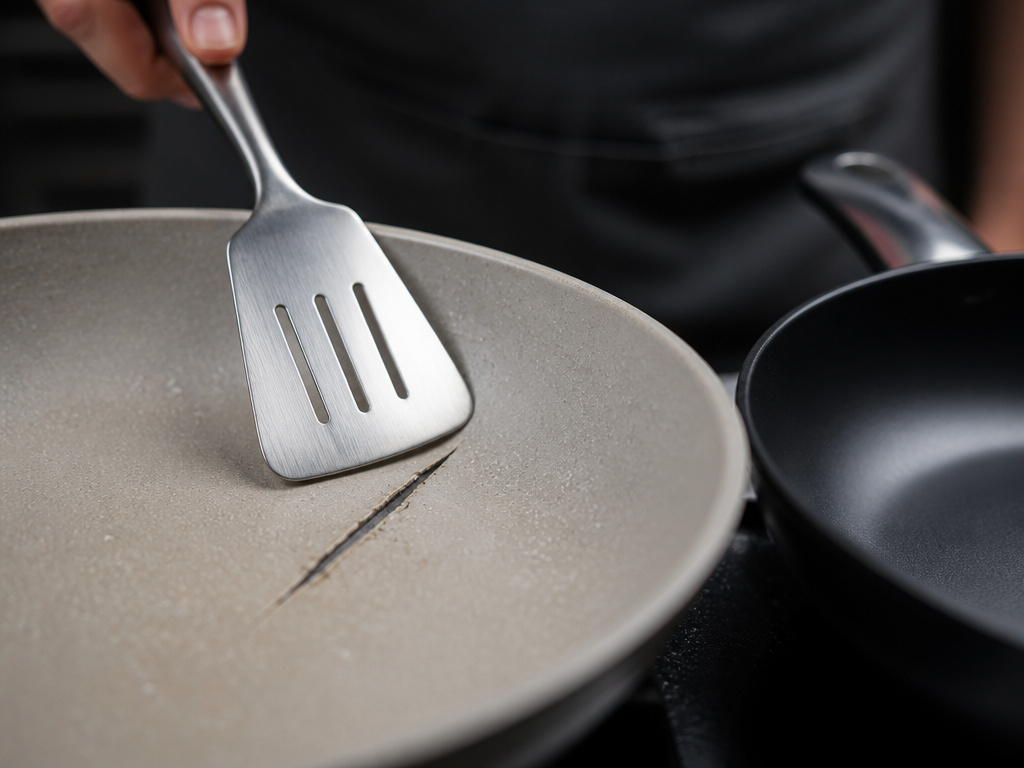
This doesn’t mean ceramic is unsafe. It means the safety of ceramic coatings relies on you buying from reputable brands that adhere to FDA limits and using the cookware as intended, with no metal tools, on medium heat, and with immediate replacement once the coating chips or scratches. A damaged coating can harbor bacteria and increase the risk of substrate metals or coating materials leaching into food.
How to Choose: A Decision Framework for Your Kitchen
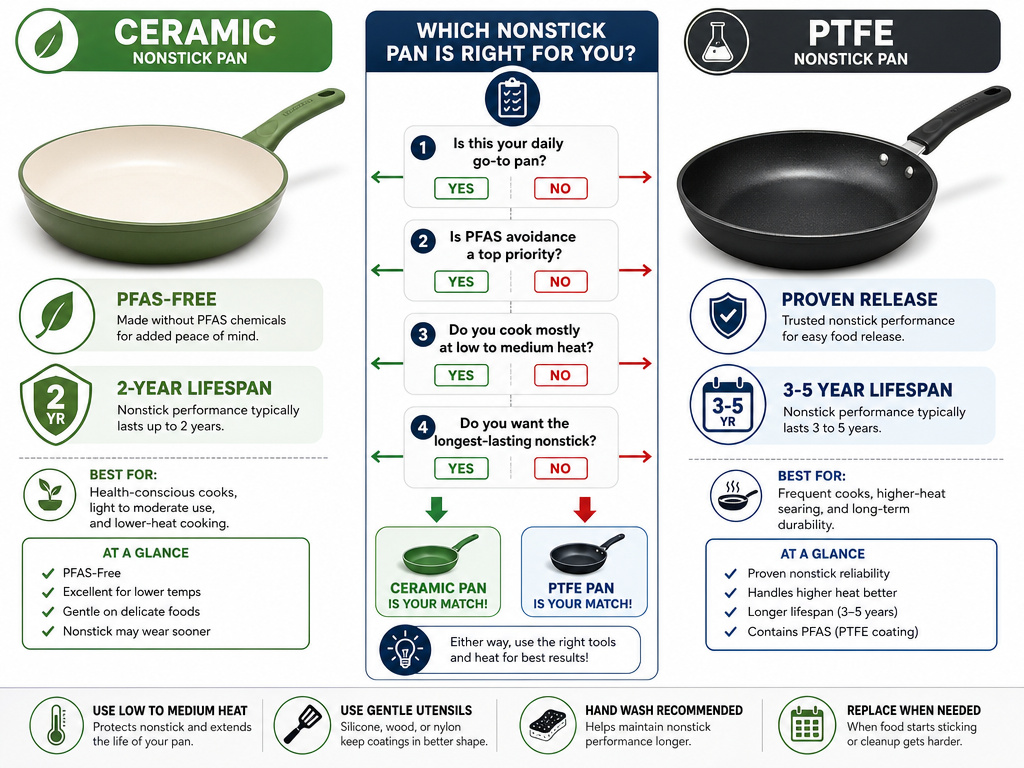
Your cooking style decides the winner. This isn’t about which is universally better; it’s about which is better for you. Ask these questions before you look at a single product.
- What’s your daily cooking routine? If you cook eggs, fish, or delicate foods daily, a PTFE pan’s consistent release is worth it. If you only need nonstick occasionally and use stainless steel cookware for searing, a ceramic pan might suffice.
- Is avoiding PFAS a non-negotiable priority? If yes, ceramic is your lane. Verify the brand’s claims with third-party testing.
- What’s your patience level for maintenance? Both require babying. If you know you’ll accidentally use a metal spatula or need to stack pans, consider a durable nonstick pan with a reinforced coating like HexClad, or switch to carbon steel.
- What’s your replacement budget? Ceramic is a 2-year item. PTFE is a 3-5 year item. Factor that into the upfront cost.
For the vast majority of home cooks who just want a reliable pan for eggs and grilled cheese, the answer is a multi-layer PTFE pan from a brand like Tramontina or Calphalon. The performance is proven, the cost is lower, and it will last longer. It remains the benchmark for best nonstick pans.
If you choose ceramic, buy one good skillet first, don’t commit to a whole set. Brands like GreenPan (their Premiere or Reserve lines) and Le Creuset have stronger track records for durability. This lets you test the ceramic nonstick safety and performance in your own kitchen without a major investment.
Care and Feeding: Making Your Coating Last
No coating survives abuse. These rules are universal, but breaking them shortens a ceramic pan’s life dramatically faster.
- Heat: Never preheat an empty nonstick or ceramic pan. Never use high heat. Medium is your maximum. High heat accelerates the micro-cracking in ceramic and breaks down PTFE.
- Utensils: Only use wood, silicone, or high-quality nylon. This is the single easiest way to prevent scratches. Our guide on the best utensils for nonstick pans has specific picks.
- Cleaning: Hand-wash only, with a soft sponge and mild detergent. For stuck-on residue, soak with warm, soapy water. Dishwasher detergent is corrosive to coatings.
- Storage: Avoid stacking. If you must, place a soft cloth or paper towel between pans. The friction of metal-on-coating during movement creates microscopic scratches.
- When to Replace: The moment you see scratches in the cooking surface, flaking, or any loss of nonstick performance. A damaged coating is a food-safety and potential chemical-exposure risk.
Following these proper ceramic cleaning methods and care rules is the only way to reach, or even extend, that 2-3 year window for ceramic or 5-year window for PTFE.
Frequently Asked Questions
Is ceramic cookware safer than Teflon?
It’s more accurate to say it’s different. Modern PTFE cookware from reputable brands, used under 500°F, is considered safe by the FDA. Ceramic is PTFE/PFOA-free, which addresses specific chemical concerns, but its proprietary coating formulas are not fully transparent. Safety for both depends on using them correctly and replacing them when damaged.
Why does my new ceramic pan stick after a few months?
This is the sol-gel coating’s main weakness. The hard, glass-like layer develops micro-cracks from repeated heating and cooling. These cracks create texture where food can grab on. Unlike PTFE, the coating cannot “heal” or redistribute. The nonstick property is literally wearing away.
Can I use ceramic cookware on high heat for searing?
No. While the base metal can withstand higher temperatures, the ceramic coating itself will degrade. Sustained high heat accelerates the decomposition of the sol-gel layer, potentially releasing unknown compounds from the proprietary formula and permanently ruining the nonstick surface. Use stainless steel or cast iron for high-heat searing.
What is the healthiest type of nonstick cookware?
There is no perfect “healthiest” option, only trade-offs. For a balance of performance, known materials, and durability, a PFOA-free PTFE pan from a trusted brand is a standard choice. For those avoiding all fluoropolymers, a well-made ceramic pan is the alternative, with the understanding that its long-term safety data is less robust and its lifespan is shorter.
Are expensive ceramic pans worth it?
Often, yes. Higher-priced ceramic pans from brands like GreenPan or Le Creuset typically use a thicker, better-formulated sol-gel coating and a higher-quality aluminum core. This combination improves heat distribution and can slow the coating’s degradation. However, even the most expensive ceramic pan will not last as long as a mid-priced PTFE pan.
The Bottom Line
Ceramic cookware is not better than PTFE nonstick, it’s a trade-off. You exchange the proven, superior food release and longer lifespan of PTFE for a coating that is free of fluoropolymers. That trade has value if avoiding PFAS is your top priority.
For the cook who just wants an egg to slide out perfectly every morning for years, the multi-layer PTFE pan is still the champion. Buy a good one, use it gently, and replace it when it wears. If you go the ceramic route, invest in a single high-quality skillet from a transparent brand, care for it meticulously, and plan to shop again in two years. Both are tools, not heirlooms. Choose the one that matches your priorities, not the marketing.
