
Is Rust on a Wok Bad for You? | The Scrub vs. Scour Debate
This post contains affiliate links. As an Amazon Associate, we earn from qualifying purchases.
Small amounts of rust on a carbon steel wok are not inherently toxic, but you must remove them. The rust itself is iron oxide, the same compound found in iron supplements, and ingesting tiny, incidental amounts from a poorly cleaned pan is not a health crisis. The real risk is a deteriorating cooking surface that harbors old food and flakes into your meal, and a wok that will eventually corrode through if left untreated.
That gap between “not toxic” and “must fix” is where most guides stop. They miss the manufacturer fight over how to scrub it off and the specific oils that can ruin your re-seasoning attempt.
What follows: the scrubber debate straight from OEM manuals, the three-step revival that actually works, and the one accessory that GE says creates a genuine health hazard on your stove.
Key Takeaways
- Rust is iron oxide; incidental ingestion in minute amounts from a revived wok is not a poisoning risk, but a flaky, pitted surface is unhygienic.
- Manufacturers directly disagree on using abrasive tools: School of Wok says use an abrasive scourer for rust; Masterbuilt and Misen say never use an abrasive scrub brush.
- Always use a high-smoke point oil like canola, grapeseed, or sunflower for re-seasoning; Lakeland’s guide explicitly warns against olive oil for this job.
- A wok ring placed over a gas burner grate traps heat and can damage the burner head, leading to improper combustion, a documented hazard per GE Appliances.
- The complete fix is scrub, dry, and re-season. Skipping the dry-heat step guarantees rust will return within days.
Is Rust on a Wok Toxic?
You see the brown flakes. Your first thought is likely ‘did I just poison my family?’ rather than about cookware maintenance.”
Relax. The rust on your carbon steel wok is iron oxide (Fe₂O₃). Your body contains iron. Some over-the-counter supplements are iron oxide. Ingesting a tiny, incidental amount from a once-rusted pan you’ve scrubbed and re-seasoned is not a toxic event.
Surface rust on carbon steel or cast iron cookware is iron oxide. While not desirable for cooking, incidental consumption of minute amounts after proper cleaning and re-seasoning is not considered a health hazard. The primary concerns are food safety degradation from a pitted surface and eventual structural failure of the cookware.
The health issue relates to the condition of the pitted pan beneath the rust, not the chemistry of the rust itself.Those pits trap moisture, old food, and bacteria. As the rust spreads, it can flake off into your stir-fry in visible chunks. That’s a textural and sanitary problem, not acute toxicity.
Think of it like a rusty bicycle chain. The rust won’t poison you, but it sure means the chain is failing and will soon snap. Your wok is the same. The rust signals a broken seasoning layer, the polymerized oil that protects the bare metal. That failure is what you need to address immediately.
The Scrub vs. Scourer Disagreement
Here’s where the manuals clash. You know you need to scrub the rust off. The question is how.
Open the Lakeland care guide for School of Wok carbon steel. It’s direct: “The wok should be scrubbed with an abrasive scourer to remove all the rust.” For a small spot, it suggests a non-abrasive scourer, but for full coverage, it calls for the abrasive tool.
Now read the Masterbuilt Karbon Steel™ Wok manual. It states plainly: “Do not use an abrasive scrub brush on your Karbon Steel™ product.” Misen’s care guide echoes this, recommending only non-metallic scrubbers.
So who’s right? Both, contextually.
| Scenario | Recommended Tool | Why |
|---|---|---|
| Surface rust, light dusting | Non-abrasive scrubber (blue Scotch-Brite) or steel wool (Grade #0000) | Removes oxidation without gouging the underlying metal. Preserves any intact seasoning around the rust. |
| Heavy rust, thick flakes | More abrasive pad (green Scotch-Brite) or coarse steel wool | Necessary to reach bare, smooth metal. The Lakeland guide assumes this level of damage when it mandates an abrasive scourer. |
| Post-rust, routine cleaning | Soft sponge, bamboo brush, or non-abrasive pad | Maintains the new seasoning layer without stripping it. This is what Masterbuilt and Misen are protecting. |
The disagreement concerns the starting condition of the wok, not philosophy. Masterbuilt assumes you’re maintaining a seasoned wok and don’t want to strip it.School of Wok’s guide addresses a wok that has already failed and needs a full reset.
Your job is to match the tool to the damage. For a full revival, you’ll likely need an abrasive to get down to clean metal. After that, you switch to the gentle routine for good.
How to Safely Revive a Rusty Wok
This is a three-act process: remove, dry, and protect. Skip one, and the rust is back in a week.
Step 1: Scrub It All Off
Grab your chosen scrubber, a little dish soap, and hot water. Scrub the entire affected area, inside and out, until the surface is smooth and uniform in color. No more orange or brown patches. Rinse thoroughly.
If you see a brown tint on your paper towel during the next steps, don’t panic. That’s residual microscopic oxidation. The heat from drying will address it.
Step 2: Dry It Completely With Heat
This is the step people skip. Towel-drying is not enough.
Place the scrubbed wok on a burner over medium-high heat. Swirl it around. You’re looking for all traces of moisture to evaporate. The metal will get hot to the touch and may change color slightly. This heat sterilization is what kills any remaining rust spores and opens the metal’s pores for oil. Heat it until it’s completely dry, about 3-5 minutes.
Step 3: Re-Seal the Metal Immediately
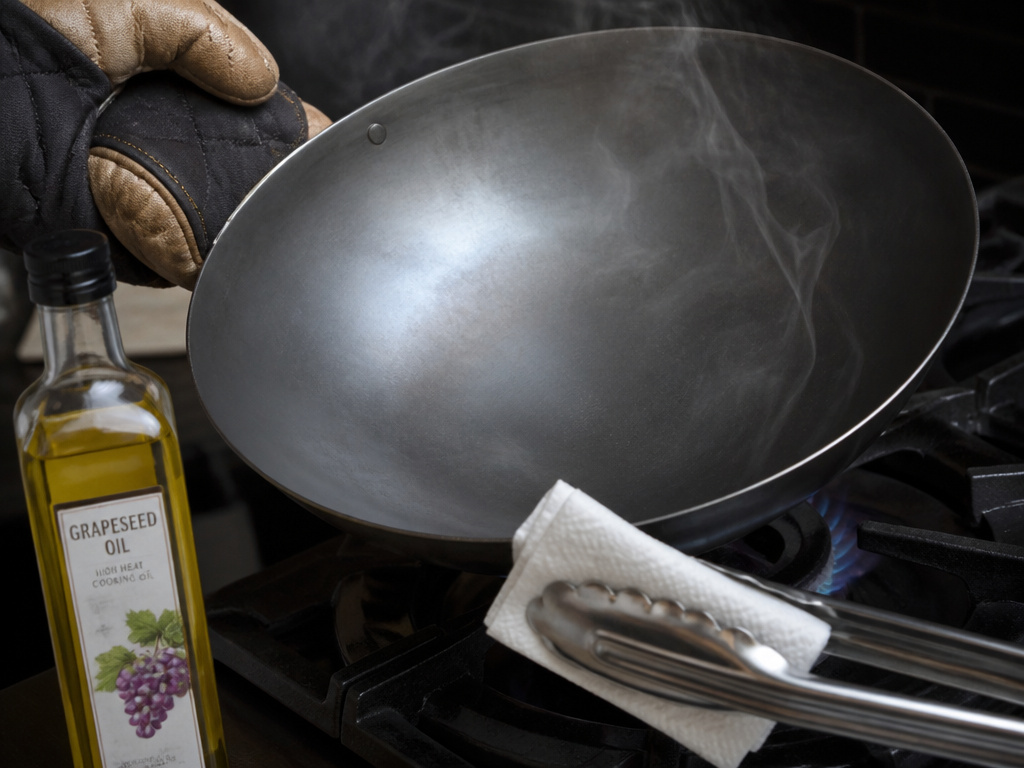
While the wok is still hot (but not scorching), add a few drops of high-smoke point oil to the center. Canola, grapeseed, or sunflower oil work best. Do not use olive oil for this, its smoke point is too low and it can polymerize unevenly, leaving a sticky residue.
Using a folded paper towel held with tongs, spread the oil in a thin, even layer over the entire interior. The goal is a sheen, not a pool. If the towel looks dry, you’ve used the right amount. Now, heat the wok until it just starts to smoke, then remove it from the heat and let it cool. This bakes on the first protective layer.
You’ll need to repeat this oil-and-heat process 2-3 times to build a base seasoning. Then, just start cooking. Fatty foods like bacon or stir-fried pork will build the seasoning stronger with each use.
What Actually Causes Wok Rust?
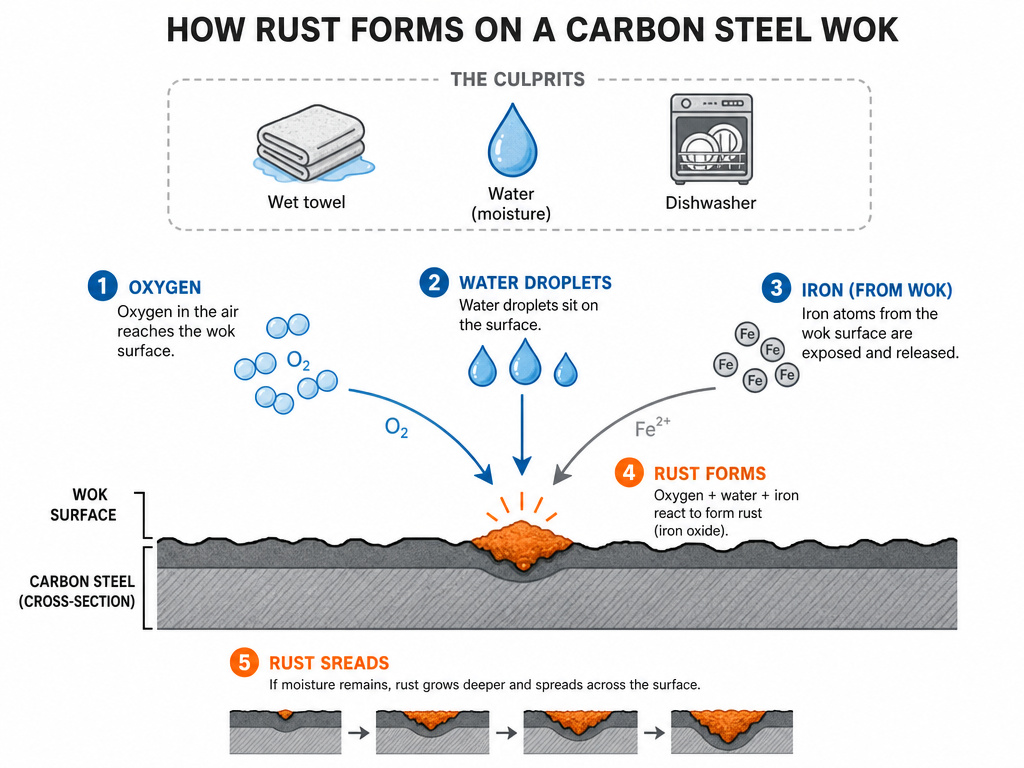
Rust needs three things: iron, oxygen, and water. Your carbon steel wok provides the iron. Your kitchen provides the oxygen. The culprit is always the water.
The most common cause is improper drying. Air-drying or a casual towel dry leaves microscopic water molecules trapped in the metal’s pores. Overnight, oxidation begins. This is why the dry-with-heat step is non-negotiable.
Humid storage is a silent killer. Tucking a wok away in a damp basement, garage, or under a sink creates a perfect rust incubator. Even a seemingly dry cupboard next to a dishwasher can have enough ambient moisture.
Dishwasher use is catastrophic. The prolonged, high-heat wash cycle, combined with harsh detergents, strips every trace of seasoning and forces water into the metal. It’s a guaranteed rust starter within a single cycle.
Finally, cooking highly acidic foods (like tomato sauce) for extended periods in a new or thin seasoning layer can break down the protective oil, exposing the bare metal to moisture in the food itself.
The One Accessory That’s a Real Hazard
While rust is a maintenance issue, one common wok accessory poses a documented safety risk.
GE Appliances explicitly warns against using a wok that has a round metal ring placed over a gas burner grate. That ring acts as a heat trap. It can warp or damage the burner grate and the burner head itself.
Where this goes sideways: Using a wok with a round metal support ring on a gas burner. GE states this can damage the burner head, causing improper gas combustion and creating a potential carbon monoxide hazard.
The fix is simple. If your gas stove didn’t come with a dedicated wok ring, use a flat-bottomed wok or purchase a stable, well-ventilated wok stand designed for your stove type. Don’t improvise with a ring that cages the flame.
Carbon Steel vs. Cast Iron: A Rust Comparison
Since both are iron-based, how does a carbon steel wok compare to cast iron for rust?
They rust for the same reasons: moisture and missing seasoning. The difference is speed and severity. Carbon steel is thinner and less dense. It can develop surface rust faster than thick cast iron, but it’s also easier to scrub clean and re-season quickly. Cast iron rust can be more stubborn, requiring more elbow grease, but its mass makes it harder for rust to penetrate deeply if caught early.
The prevention protocol is identical for both: heat-dry after every wash and keep a good layer of seasoning. If you understand rust on cast iron, you already understand rust on your wok. The revival process is the same, scrub, dry, re-season.
Frequently Asked Questions
Can I use a rusty wok if I just scrub it with soap?
No. Soap alone won’t remove the rust. You need mechanical abrasion (scrubbing) to remove the iron oxide layer, followed by immediate drying and re-oiling to prevent its instantaneous return.
Will re-seasoning make my wok non-stick again?
Yes, eventually. A single round of oil heating creates a base layer. True, slick non-stick seasoning builds over months of cooking with fats. That polymerized coating is what gives a well-loved wok its black, glossy patina and non-stick properties.
Is a stainless steel wok better to avoid rust?
Stainless steel woks, like the SIT-Connect Premium model rated to 250°C, are highly rust-resistant. They trade that benefit for less efficient heat conduction and an inability to develop a natural non-stick seasoning. You avoid rust but lose the classic wok performance.
How often should I re-season my wok?
Only when the seasoning layer is damaged, sticky, or rust appears. With proper care, gentle cleaning, thorough heat-drying, and cooking with oils, a carbon steel wok seasoning can last years without a full re-do. Spot-treat small areas as needed.
Can rust poison my food?
In the sense of acute chemical poisoning, no. Iron oxide is not a toxin. The risk is consuming flakes of corroded metal and bacteria from a pitted, uncleanable surface. It’s a food quality and safety issue, not a toxicological one.
Before You Go
Rust on your wok is a maintenance alert, not a death sentence. The rust itself isn’t poisonous, but a rusty pan is a failing pan.
Scrub it off with the appropriate tool, knowing even the manufacturers debate which one. Dry it with heat, never just a towel. Seal it with the right oil, never olive oil. And ditch that dangerous wok ring on your gas burner.
Your wok is made of carbon steel for a reason. It’s resilient. A little rust means it’s time for a refresh, not a replacement. Treat the cause, not just the symptom, and that wok will outlast your stove.
