
What Makes a Good Stainless Steel Cookware Set? Top Features
This post contains affiliate links. As an Amazon Associate, we earn from qualifying purchases.
A good stainless steel cookware set delivers excellent cooking evenness, very good or excellent food release, and sturdy handles that won’t wobble, all verified by independent lab testing on specific models like the All-Clad D3 or Henckels Clad H3. It uses a tri-ply or clad construction with an aluminum or copper core for consistent heat, is fully oven-safe (often to 500°F), and works on induction cooktops. The best sets balance these performance specs against your actual cooking style and budget.
Those three lab scores aren’t marketing fluff. They are direct measurements of how a pan behaves when you’re trying to sear a steak without hot spots, simmer a sauce without scorching, or lift a full stockpot without the handle flexing. A set that aces one test but fails another will create a specific, annoying problem in your kitchen every time you use it.
What follows is a breakdown of those lab scores, what they mean for your wrist and your dinner, and how to match a set’s specs, handle sturdiness, oven-safe temperature, lid type, to how you actually cook. We’ll use published test data to compare specific models, so you can see the trade-offs between a $200 set and a $600 set in concrete terms.
Key Takeaways
- “Excellent” cooking evenness means no hot spots. This score, from lab tests, predicts whether your pan will sear a steak evenly or burn the center while the edges steam.
- Handle sturdiness is the most common point of failure in budget sets. A “Fair” or “Poor” score means the handle will develop a wobble within a year or two of daily use, effectively ruining the pan.
- Ignore “dishwasher-safe” labels for longevity. Hand-washing is the single easiest way to prevent clouding, water spotting, and premature wear on rivets and handles, regardless of what the manufacturer claims.
- Oven-safe temperature is a hard ceiling. Exceeding it, even once, can permanently warp lids and damage handle coatings. Always check the lid’s rating separately from the pan’s.
- The best starter set isn’t the biggest one. A core trio of an 8-inch skillet, a 3-quart saucepan, and a 6-quart stockpot covers 80% of home cooking tasks without crowding your cabinets.
The 3 Lab Scores That Define “Good”
Forget brand reputation and glossy finishes. The definition of a good set lives in three quantifiable performance metrics published by testing labs. These scores translate directly to your experience at the stove.
Cooking evenness gauges heat distribution across the entire cooking surface. An “Excellent” score means the pan has no hot spots, so a sear develops uniformly. A “Poor” score means the center will scorch while the edges barely brown.
Excellent cooking evenness is non-negotiable. It’s the difference between a perfectly seared chicken breast and one that’s burnt in the middle, raw at the edges. This score is primarily a function of the core material in a clad construction. An aluminum or copper core spreads heat quickly laterally. Most tri-ply sets from major brands now score “Excellent” here, but it’s the first corner cut in very cheap, single-ply “stainless steel” pans that are really just stamped steel with a coating.
Food release measures how well an initially oiled pan releases food after consecutive cooks. In the standard test, four eggs are cooked back-to-back in a frypan seasoned with a dab of vegetable oil. An “Excellent” score means all four eggs slide out cleanly. A “Poor” score means you’ll be scraping and soaking.
This score is often misunderstood. It doesn’t mean stainless steel is nonstick. It measures how stable the pan’s surface is after light seasoning and how effectively it manages the Maillard reaction (the browning of proteins). A pan with poor release isn’t just sticky; it’s likely also harder to clean because proteins bond to microscopic imperfections in the metal.
Handle sturdiness is the sleeper metric. Labs apply increasing force to the handle to gauge resistance to bending. An “Excellent” score, like the one the Henckels Clad H3 earned, means solid rivets and a robust design. A “Fair” score, like the one given to the KitchenAid set, is a red flag.
Where this goes sideways: A handle rated “Fair” will develop a noticeable wobble where it meets the pan within 12-18 months of regular use. Once the rivets loosen, the pan is unsafe for lifting when full and nearly impossible to repair cost-effectively.
This is the most common physical failure in cookware, and it’s why testing this spec matters more than a lifetime warranty promise. You can’t warranty a design flaw.
Decoding the Spec Sheet: What Those Numbers Actually Mean
Beyond the lab scores, a spec sheet is a list of promises about durability and compatibility. Most of them are straightforward, but two are frequently misread.
Oven-safe temperature is a hard limit, not a suggestion. This is the maximum ambient oven temperature the pan and its handles can withstand without damage. The All-Clad D3’s 600°F rating is for the pan body without its lid. Many glass lids, like those on the OXO Tri-Ply Mira set, have a lower threshold, 425°F is common. Exceed the lid’s rating and the glass can crack or the seal can warp.
| Spec | What It Means | What Happens If You Ignore It |
|---|---|---|
| Oven-Safe to 500°F | Pan body can go in a 500°F oven. | Handles discolor, coatings melt, or metal warps above this temp. |
| Lid Oven-Safe to 400°F | Glass or metal lid has a lower limit. | Glass lids crack; silicone seals on metal lids degrade and leak steam. |
| Induction Compatible | Contains enough magnetic steel (usually 430-grade) to work. | The pan won’t heat on an induction cooktop at all. |
| Dishwasher-Safe | Manufacturer won’t void warranty for machine washing. | Detergent and heat accelerate clouding, spotting, and can loosen handle rivets over time. |
Induction compatibility is a yes/no feature dictated by physics. Induction cooktops require a magnetic material. High-quality 18/10 stainless steel (18% chromium, 10% nickel) is often non-magnetic. To work on induction, clad sets add a magnetic stainless steel layer (like 430-grade) to the base. If a set says “induction compatible,” it has this layer. If you own induction, this isn’t a spec to gamble on.
The 18/10 grade itself is about corrosion resistance and surface hardness, not heat performance. The nickel content provides rust resistance and a brighter, more durable finish. A good set will use 18/10 for the cooking surface. The related tri-ply construction refers to the layers of metal bonded together: typically an 18/10 stainless interior, an aluminum core, and a magnetic stainless exterior. This is the standard for even heating.
For a deeper look at why this material grade is a benchmark, see our explainer on the 18/10 grade.
The Budget vs. Premium Trade-Off
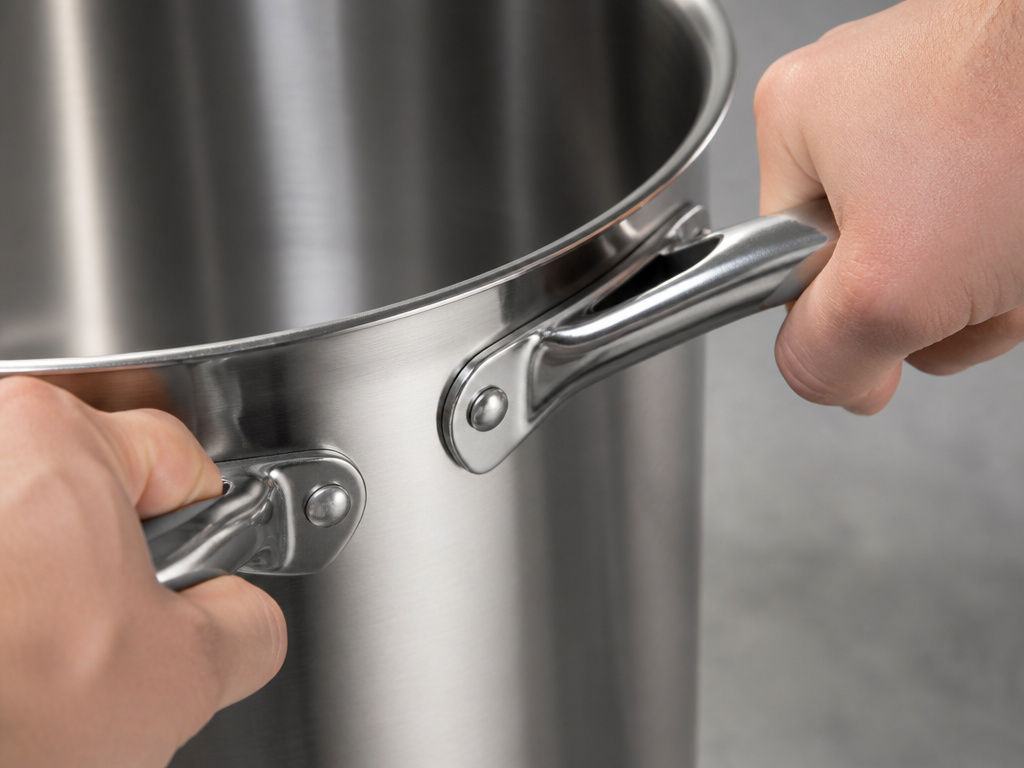
The difference between a $200 set and a $600 set isn’t just heft or brand prestige. It’s a measurable shift in which performance metrics are prioritized and which materials are used. The trade-off usually centers on handle construction, core thickness, and the inclusion of helper handles.
Let’s compare two sets with published lab data: the premium All-Clad D3 and the value-focused KitchenAid Stainless Steel.
| Feature | All-Clad D3 Try-Ply | KitchenAid Stainless Steel |
|---|---|---|
| Handle Sturdiness | Good | Fair |
| Speed of Heating | Very Good | Excellent |
| Food Release | Excellent | Very Good |
| Oven-Safe (lid) | Not Specified (likely lower) | 350°F |
| Helper Handles | On saute pan & stockpot | On stockpot only |
| Core Construction | Tri-ply (stainless/aluminum/stainless) | Clad aluminum base |
The KitchenAid set heats water faster (“Excellent” speed). The All-Clad releases food slightly better (“Excellent” vs. “Very Good”). The decisive difference is the handle. The “Fair” sturdiness score on the KitchenAid is the cost of hitting that price point. For a light simmer or sauté, it’s fine. For moving a full 6-quart stockpot of boiling water, that score gives you a timeline: the handle will likely loosen first.
Premium sets invest in thicker gauge metal, more robust rivets, and often include helper handles (a small secondary handle opposite the main one) on larger pieces. These aren’t for style. A helper handle lets you safely lift a heavy, full pan with two hands, distributing weight and reducing torque on the primary rivets. It’s a durability feature.
This Consumer Reports best budget sets guide explicitly notes that handle sturdiness is the key metric to scrutinize in lower-priced sets, as wobbly handles negate initial savings.
The short version: Budget sets get you the core cooking performance. Premium sets pay for the durability of the parts you physically hold and move.
What a “Good” Set Actually Includes (And What to Skip)
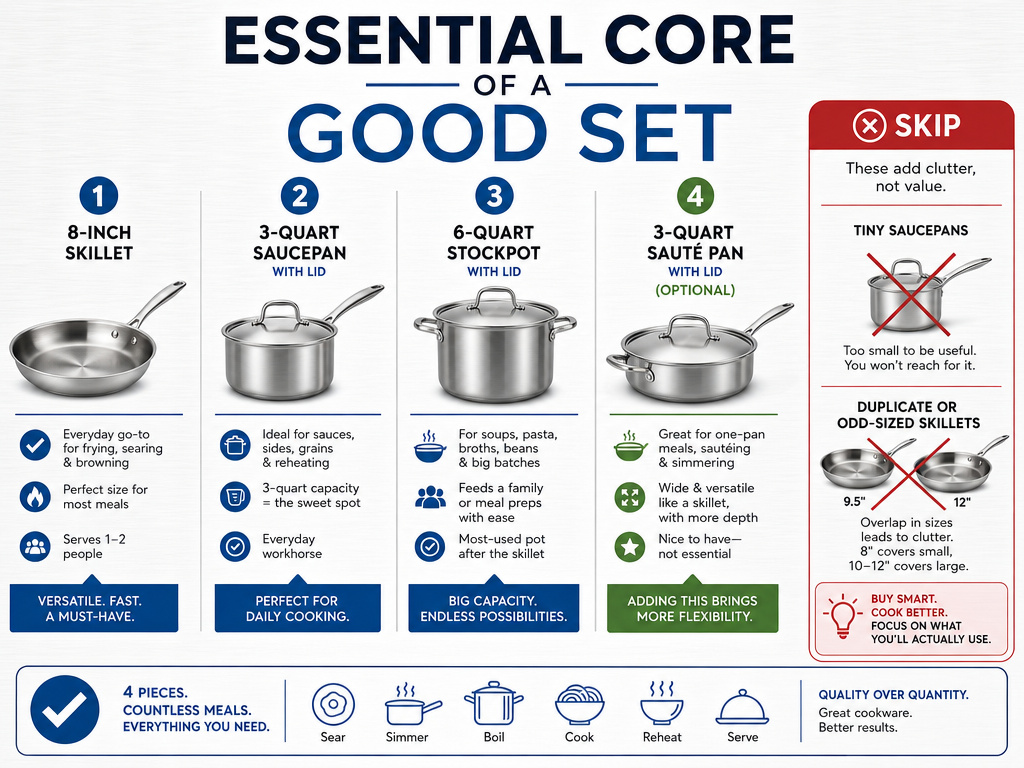
A good set covers foundational techniques without redundancy. You need a vessel for frying, a vessel for boiling, and a vessel for sautéing or braising. More pieces often mean thinner metal and smaller sizes to hit a price point.
Here is the essential core that handles most cooking tasks: 1. 8-inch or 10-inch Skillet: For eggs, grilled cheese, searing single portions. 2. 3-quart Saucepan with Lid: For rice, sauces, boiling vegetables, reheating soup. 3. 6-quart Stockpot with Lid: For pasta, soup, boiling corn, steaming lobsters. 4. 3-quart Sauté Pan with Lid (optional but highly useful): This is a skillet with straight, high sides. It’s for braising, cooking one-pan meals, or frying with less splatter.
Many large sets pad the count with tiny 1-quart saucepans (useless for much besides melting butter) or duplicate skillets in odd sizes. A 12-piece set that includes the core above plus a steamer insert and a useful Dutch oven is smarter than a 15-piece set filled with redundancies.
When evaluating best stainless steel cookware sets, look at the piece list first. Does it have this core? Or is it filled with novelty items?
How to Buy: The 5-Minute Store Checklist
You can vet a set in person in under five minutes. Ignore the sales copy and do this.
- Check the weight. Pick up the 3-quart saucepan. It should have a substantive heft, not feel like a tin can. Heft usually indicates thicker-gauge metal, which resists warping.
- Examine the rivets. Where the handle attaches inside the pan, the rivets should be flush, smooth, and without sharp edges. Rough or protruding rivets collect food and are hard to clean.
- Look at the clad edge. Hold the pan sideways and look at the rim. You should see a visible sandwich of metals, a distinct middle layer between two outer ones. This is the tri-ply construction. If the rim looks like a single, uniform line of metal, it’s not clad and won’t heat evenly.
- Test the lid fit. Place the lid on the pot. It should sit evenly without rocking. A well-machined lid is a sign of overall manufacturing quality.
- Read the fine print on the box. Find the oven-safe temperature for the lid. If it’s not listed, assume it’s lower than the pan’s rating.
This hands-on check catches the majority of quality issues that specs alone might miss. For more on evaluating construction, our article on tri-ply stainless steel cookware details what to look for.
Care & Feeding: Making Your Set Last Decades
Stainless steel is durable, but its appearance and performance depend on how you treat it. The biggest enemy isn’t metal utensils, it’s the dishwasher and thermal shock.
Common mistake: Tossing a hot pan into the sink and running cold water over it. The rapid temperature change can cause the clad layers to contract at different rates, warping the pan permanently. Let it cool on the stove.
Hand-wash only. Even if the set is labeled dishwasher-safe, the alkaline detergents and intense heat dry out and cloud the finish over time. They also accelerate corrosion around the rivets. A quick wash with hot water, a dab of dish soap, and a soft sponge preserves the finish. For stuck-on food, simmer a little water in the pan for 5 minutes to loosen it.
Use the right heat. Start on medium, not high. Stainless steel, especially with an aluminum core, conducts heat very efficiently. A medium setting is often enough to achieve a proper sear. Cranking to high from the start can cause food to bond to the surface before the Maillard reaction properly begins, leading to sticking.
Dry it immediately. To prevent water spots, dry your pans thoroughly with a towel after washing. This is especially important if you have hard water.
For those prioritizing material safety, these care practices are the first line of defense for any non-toxic stainless steel cookware sets.
Frequently Asked Questions
Is tri-ply the same as 18/10 stainless steel?
No. They describe different things. 18/10 refers to the alloy composition of the stainless steel (18% chromium, 10% nickel), which determines its corrosion resistance and finish. Tri-ply describes the construction: three layers of metal (like 18/10 stainless, aluminum, magnetic stainless) bonded together for even heating. A good set uses an 18/10 interior layer in a tri-ply build.
Can you use metal utensils on stainless steel?
Yes. This is a primary advantage over nonstick coatings. Stainless steel is hard and won’t scratch under normal use with metal spoons, spatulas, or whisks. Avoid using metal utensils to aggressively scrape at burned-on food, as this can score the surface.
Why does food stick to my new stainless steel pan?
Sticking is usually a heat management issue, not a pan defect. If the pan isn’t hot enough before adding food, proteins will bond to the metal. If it’s too hot, they’ll burn on. The reliable method is the “water droplet test”: heat the empty pan over medium until a water droplet skitters and dances across the surface. Add your oil, let it shimmer, then add your food. This creates a temporary polymerized layer that greatly reduces sticking.
Is a more expensive set always better?
Not always, but it buys longevity in specific areas. A premium set like the All-Clad D3 will likely have more robust handles, thicker gauge metal, and tighter tolerances on lid fit than a budget set. However, a well-chosen mid-range set like the Henckels Clad H3, which earned excellent scores for sturdiness and heating, delivers nearly all the cooking performance for less. The extra cost is for marginal gains in durability and finish.
How do I clean burnt-on stains from stainless steel?
Make a paste of baking soda and water or use a dedicated stainless steel cleaner like Bar Keepers Friend. Apply with a soft cloth or non-scratch sponge, following the direction of the grain (the brushed lines in the metal). Rinse thoroughly. Do not use steel wool, as it will leave deep scratches that attract more stains over time.
Before You Go
A good stainless steel cookware set isn’t a mystery. It’s a collection of pieces that pass three lab tests: even heating, clean food release, and solid handles. Your job is to match those verified specs to how you cook. Do you make big batches of soup that require lifting a heavy stockpot? Prioritize handle sturdiness. Do you sear steaks weekly? Excellent cooking evenness is your target.
Start with the core trio of skillet, saucepan, and stockpot. Understand that “dishwasher-safe” is a warranty term, not a care recommendation. And remember that the best stainless steel cookware for you is the set whose strengths align with the physical demands of your kitchen, not just the one with the most pieces or the shiniest brand name. Pick based on the data, and the pans will handle the dinner.
