
What Is Tri Ply Stainless Steel Cookware & How It Works
This post contains affiliate links. As an Amazon Associate, we earn from qualifying purchases.
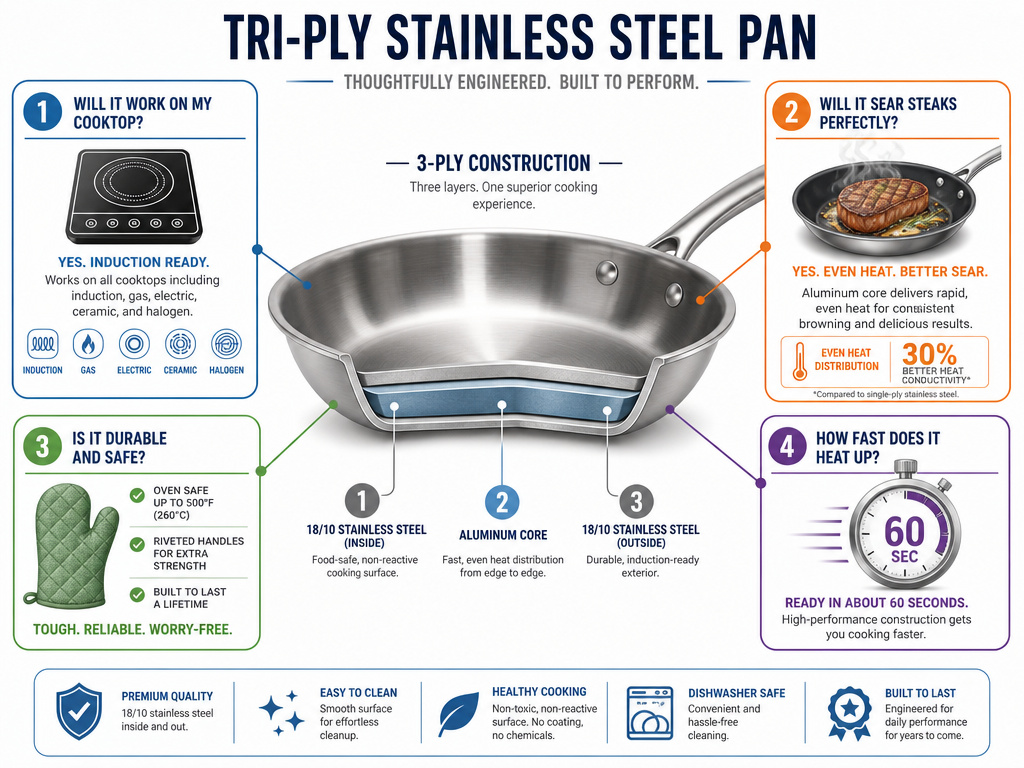
Tri ply stainless steel cookware is a pan or pot made from three permanently bonded metal layers: a food-safe stainless steel interior (usually SS304), a middle core of aluminum for heat spread, and a magnetic stainless steel exterior (often SS430) for induction compatibility. This construction eliminates hot spots better than single-ply stainless steel and provides the durability that makes it a default choice for many home and professional kitchens.
That three-layer sandwich is the whole point. The aluminum core is the functional heart, moving heat laterally across the pan’s surface so your sear is even and your sauce doesn’t scorch in one spot. The outer magnetic layer is what lets it work on modern induction ranges. It’s a design that solves specific problems single-material pans have had for decades.
What follows is a breakdown of what each layer does, the real-world mistakes that ruin these pans (straight from manufacturer service manuals), and how tri-ply stacks up against other premium options like copper core or fully clad sets. By the end, you’ll know exactly what you’re buying and how to make it last.
Key Takeaways
- The aluminum core is non-negotiable for even heating; its thickness directly impacts performance.
- Never add salt to an empty, cold pan — it causes permanent pitting on the stainless steel surface, a specific failure mode documented in OEM care guides.
- Tri-ply is fully induction-compatible because of its magnetic SS430 exterior layer.
- Overheating can discolor the stainless steel to a permanent blue or gold hue, a visual marker of heat damage per Le Creuset‘s warranty guidelines.
- For most home cooks, a tri-ply set from brands like All-Clad, Cuisinart Multiclad, or Tramontina offers the best balance of performance, durability, and value.
What “Tri-Ply” Actually Means (It’s Not Just Marketing)
Forget the word “ply” for a second. Think of it as a club sandwich where each ingredient has a job. The top slice of bread touches your food. The middle filling spreads the flavor evenly. The bottom slice interacts with your plate.
In a tri-ply pan, the 18/10 stainless steel interior (often labeled SS304) is your cooking surface. It’s non-reactive, so tomato sauce won’t pick up a metallic taste, and it’s tough enough to withstand metal utensils. The middle layer is pure aluminum. This is the heat superhighway. Stainless steel is a poor heat conductor; aluminum is excellent. The core grabs heat from your burner and distributes it sideways across the entire pan base, preventing the hot spot in the center that burns your pancakes. The exterior is magnetic stainless steel, typically SS430 or 18/0 grade. This layer gives the pan its structural rigidity and, critically, makes it work on induction cooktops.
A typical tri-ply cookware body uses three bonded metal layers: an SS304 food-contact interior, an aluminum core, and an SS430 magnetic stainless steel exterior. This structure balances durability, heat distribution, and induction-ready performance.
The bond between these layers is permanent, usually achieved through a high-pressure rolling process. You can’t delaminate a well-made tri-ply pan through normal use. This differs from cheaper “impact-bonded” or “disk-bottom” pans where an aluminum slug is only attached to the center of the base. In those, the sides stay cold and your heat distribution is limited.
How Does Tri-Ply Construction Actually Work?
The magic is in the aluminum. Heat wants to travel the path of least resistance. In a single-ply stainless steel pan, that path is straight up, creating intense heat directly over the burner element. The aluminum core provides a better lateral path, so heat energy spreads out before it rises into your food.
Think of it like pouring water on a flat tile versus a sponge. On the tile, the water pools. On the sponge, it spreads. The aluminum is the sponge. This is why recipes for tri-ply often say “medium heat is the new high.” You don’t need the burner on full blast because the pan uses the heat more efficiently.
The choice of SS304 for the interior matters. The “18/10” designation means 18% chromium (for corrosion resistance) and 10% nickel (for lustre and added durability). It’s the standard for high-quality food-contact surfaces. The outer SS430 layer contains iron, which is ferromagnetic. That’s the property an induction hob’s electromagnet grabs onto to generate heat. If the exterior wasn’t magnetic, the pan wouldn’t work on those stoves.
| Layer | Common Material | Primary Function | What Happens If It’s Missing |
|---|---|---|---|
| Interior | SS304 (18/10) | Food-safe cooking surface; durable, non-reactive. | Food may react with metal; surface scratches easily. |
| Core | Aluminum | Distributes heat evenly across base and lower sides. | Severe hot spots develop; food burns in center of pan. |
| Exterior | SS430 (18/0) | Provides structural strength and induction compatibility. | Pan won’t work on induction cooktops; may dent more easily. |
Tri-Ply vs. Other Stainless Steel Construction
Not all stainless cookware is built the same. When you’re comparing options, you’re really comparing how and where they put the conductive material.
- Tri-Ply (3-ply): Aluminum core sandwiched between two layers of steel. The aluminum typically extends partway up the sides. This is the most common premium construction.
- Fully Clad (5-ply or more): Expands on the tri-ply idea. A common 5-ply construction might be Steel-Aluminum-Steel-Aluminum-Steel. The aluminum core runs all the way up the sides, providing even better overall heat distribution. Brands like All-Clad D3 and D5 use this method.
- Copper Core: Replaces the aluminum core with a layer of copper, an even better heat conductor. This is the performance pinnacle, but it’s heavier and significantly more expensive. The copper core cookware niche is for serious enthusiasts.
- Disk Bottom: A plate of aluminum or copper is bonded only to the flat bottom of the pan. The sides are single-ply stainless steel. It’s cheaper and works fine for boiling water, but for frying or sautéing, you lose the benefit of heated sides.
For the majority of home cooks, the jump from disk-bottom to tri-ply is massive. The jump from tri-ply to fully clad or copper core is smaller and often comes down to specific cooking styles and budget.
The Right (and Wrong) Way to Use Tri-Ply Cookware
These pans are workhorses, but they have specific failure modes that manufacturer manuals spell out clearly. Ignoring them doesn’t just make cooking harder; it can permanently damage the pan.
Preheating: The Non-Negotiable First Step
You must preheat a tri-ply pan. Add a drop of water. When it dances and evaporates in 1-2 seconds, you’re at the right temperature for adding oil or fat. Then add your food. This simple step leverages the pan’s even heat to create a temporary non-stick surface through the polymerized oil layer—a technique detailed in guides on seasoning stainless steel. Skipping preheat is the number one reason people complain about food sticking to stainless steel.
Common mistake: Adding oil to a cold pan, then cranking the heat. The oil breaks down before the pan comes to temperature, food fuses to the surface, and you’re left with a stubborn, stuck-on mess.
Heat Management: Medium is Your Maximum
The aluminum core is so efficient that high heat is almost never needed. Use medium heat for 90% of tasks, including searing meat. High heat should be reserved for bringing large volumes of water to a boil. The Le Creuset care manual is explicit: damage from overheating is recognizable as the stainless steel surface changing color to a golden, brown, or blue hue. This is not reversible.
The Salt Rule
This is the most specific and often-overlooked instruction in OEM manuals. The Princess Heritage guide states: “Add salt ONLY after water has boiled or food has reached cooking temperature. Adding it beforehand may cause permanent white spots and pits on cookware surface.”
Salt granules on a cold, dry stainless steel surface can create microscopic electrochemical pits. They won’t affect performance, but they mar the mirror finish. Always dissolve salt in liquid first.
The Most Common Tri-Ply Mistakes (And What They Cost)

Manufacturer warranties are a map of what breaks. Reading them tells you exactly where the weak points are.
- Overheating an Empty Pan. This isn’t just about warping. According to Le Creuset, severe overheating can cause the stainless steel to permanently change color. That blue or gold rainbow effect on the bottom? That’s heat damage. The warranty doesn’t cover it.
- Using the Wrong Burner Size. On gas stoves, flames must be confined to the base. If they lick up the sides, you superheat the aluminum core in a spot it wasn’t designed for, potentially breaking the bond between layers over time. On induction, a pan that’s too small for the cooking zone may not be recognized at all.
- Treating it Like Non-Stick. Abrasive scrubbers like steel wool will scratch the stainless steel interior. While scratches are cosmetic, they can make cleaning more difficult over time. Stick to soft sponges or nylon brushes.
- Storing Food in the Pan. The Princess Heritage manual explicitly warns against storing food, especially salty or acidic food, in the cookware. Prolonged contact can lead to staining or accelerate pitting. Transfer leftovers to a container.
| Mistake | Immediate Consequence | Long-Term Damage |
|---|---|---|
| Adding salt to a cold, dry pan | Salt crystals sit on surface. | Permanent white pits or spots on cooking surface. |
| Cooking on high heat | Food burns instantly in center. | Permanent blue/brown discoloration (overheating damage). |
| Using harsh abrasives | Surface looks scratched. | Deep scratches harbor grease and food residue, making pan harder to clean. |
| Storing acidic food (e.g., tomato sauce) in pan | No immediate effect. | Possible surface etching or staining over several hours. |
Is Tri-Ply Cookware Right For You?
Tri-ply is the default recommendation for a reason. It’s a fantastic all-rounder. But your cooking style and stove type should drive the decision.
Ask these questions: * Do you have an induction cooktop? Then you need induction compatible cookware. Tri-ply, with its magnetic exterior, is a perfect match. * Do you sear meats, make pan sauces, and want even cooking? The aluminum core is designed for this. It outperforms disk-bottom pans dramatically. * Do you value durability and oven safety? Stainless steel is famously tough and most tri-ply is oven-safe at high temperatures, offering versatility that non-stick pans can’t match. * Are you willing to learn a simple preheat routine? If you want the “dump and go” of non-stick, tri-ply will frustrate you. If you’re okay with a 60-second preheat, you’ll get superior results.
For a first foray into high-performance cookware, a tri-ply set is the smartest place to start. It teaches good habits without the extreme cost or fuss of materials like copper.
Frequently Asked Questions
Is tri-ply the same as stainless steel cookware?
Not exactly. “Stainless steel cookware” describes the primary material. Tri-ply describes a specific construction method where stainless steel is layered with aluminum. All tri-ply cookware is stainless steel, but not all stainless steel cookware is tri-ply (it could be single-ply or disk-bottom).
What’s the difference between 3-ply and 5-ply?
The number refers to the total layers of metal. 3-ply (tri-ply) is the standard: steel-aluminum-steel. 5-ply usually means more layers of aluminum and steel (e.g., steel-aluminum-steel-aluminum-steel), often extending the conductive material further up the sides for more even heating across the entire pan interior. The performance difference is noticeable but subtle for everyday cooking.
Can you use metal utensils on tri-ply stainless steel?
Yes, that’s one of its major advantages over non-stick coatings. The SS304 interior is very hard and resistant to scratching from normal metal spatulas or spoons. However, avoid using knives to cut food in the pan, as the sharp point can still gouge the surface.
How do you clean tri-ply cookware?
Most tri-ply is dishwasher safe, but handwashing is recommended for longevity. For stuck-on food, let the pan cool, fill it with warm soapy water, and soak for 10-15 minutes as per Le Creuset’s guidance. Use a non-abrasive sponge. For stubborn stains or mineral deposits from hard water, a paste of baking soda and water or a dedicated stainless steel cleaner will restore the shine.
What are the best tri-ply brands?
Brands like All-Clad (their D3 line), Cuisinart Multiclad Pro, Tramontina Gourmet, and Made In offer excellent tri-ply clad stainless steel cookware. Le Creuset and Calphalon also have well-regarded tri-ply lines. The “best” depends on your budget and preference for handle design or weight.
The Bottom Line
Tri-ply stainless steel cookware solves the core problem of single-material pans: uneven heat. By bonding an aluminum highway between two layers of steel, it gives you the searing power of cast iron without the hot spots, and the durability of stainless without the reactivity. The learning curve is shallow—preheat, use medium heat, add salt to liquid—and the payoff is a set of pans that can handle everything from Sunday gravy to a weekday grilled cheese.
It’s not non-stick, and it shouldn’t be treated like it. It’s a precision tool. For most kitchens building a long-term arsenal, starting with a core set of tri-ply saucepans and a fry pan is a investment that outlasts trends. The performance is proven, the material science is sound, and when you treat it right, it genuinely becomes the last set of pans you’ll need to buy.
